Demonstrates the critical use of religion to challenge oppression in the U.S.
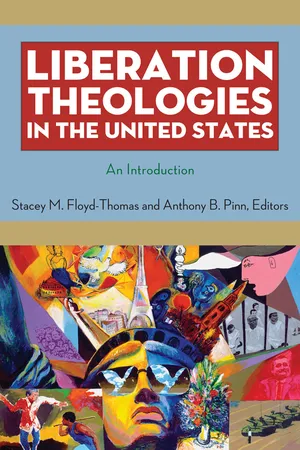
In the nascent United States, religion often functioned as a justifier of oppression. Yet while religious discourse buttressed such oppressive activities as slavery and the destruction of native populations, oppressed communities have also made use of religion to critique and challenge this abuse. As Liberation Theologies in the United States demonstrates, this critical use of religion has often taken the form of liberation theologies, which use primarily Christian principles to address questions of social justice, including racism, poverty, and other types of oppression.
Stacey M. Floyd-Thomas and Anthony B. Pinn have brought together a stellar group of liberation theology scholars to provide a synthetic introduction to the historical development, context, theory, and goals of a range of U.S.-born liberation theologies. Chapters cover Black Theology, Womanist Theology, Latino/Hispanic Theology, Latina Theology, Asian American Theology, Asian American Feminist Theology, Native American Theology, Native Feminist Theology, Gay and Lesbian Theology, and Feminist Theology.
Contributors: Grace Ji-Sun Kim, Mary McClintock Fulkerson, Nancy Pineda-Madrid, Robert Shore-Goss, Andrea Smith, Andrew Sung Park, George (Tink) Tinker, and Benjamin Valentin.
eBook - ePub
Liberation Theologies in the United States
An Introduction
- 256 pages
- English
- ePUB (mobile friendly)
- Available on iOS & Android
eBook - ePub
Liberation Theologies in the United States
An Introduction
About this book
Information
Topic
Theology & ReligionSubtopic
Christian Theology1
Black Theology
Historical Backdrop
The history of the United States involves the interplay of religion and political developments at numerous levels. From the religious rationale for the slave trade and the projection of the North American colonies as a “city on a hill,” selected by God for political dominance and economic greatness, through 20th-century appeals to religion by politicians and the political participation of religious figures, the rhetoric of the United States has involved a certain religious ethos and has given some shape to the ethical and moral sensibilities in play during the development of this nation and its self-understanding.
In the case of African Americans, this synergy between religion and political forces has not always produced healthy life options and the ability to exercise “freedom” within the various venues of life. Rather, from the first arrival of Africans as indentured servants to their enslavement for better than three centuries, religion has often served as a mechanism by which to justify and sanction discriminatory patterns and practices. Colonists in the early years of European presence in North America often argued that Africans were properly used as chattel slaves in that biblical proclamations of their inferiority were merely played out through enslavement. To justify this stance, and maintain the illusion of proper Christian conduct, they often appealed to the story of Ham (Genesis), where Canaan, the son of Ham, is cursed because Ham saw his father (Noah) naked. The story goes, Ham sees his father drunk and naked and tells his brothers, who in turn cover their father. Upon awaking, Noah learns of his exposed state and Ham’s viewing of him in that condition and punishes Ham’s son, whose descendants are to become servants. Exegetes of the Hebrew Bible (or “Old Testament” as it is commonly called), who supported the institution of slavery, argued that modern Africans were the descendents of Ham and Canaan and therefore were slaves in keeping with the scriptural mandate. Others combined this Hebrew Bible account of servitude as divinely sanctioned with “New Testament” proclamations concerning the need for slaves to be obedient to earthly masters as unto God, as well as the recommendation by the Apostle Paul that a slave, in the epistle to Philemon, return to his master. In either case, historical context and the nature of social arrangements during the biblical period were overlooked, and religious commitment and biblical proclamations were used to justify sociopolitical discrimination based on race.
Even after the formal end of slavery during the 19th century, religious commitment usually tied to interpretations of sacred texts was used to justify continued patterns of discrimination such as formal and informal mechanisms of race-based restrictions on citizenship and civic opportunities in the form of what are commonly called “Jim Crow” and “Jane Crow” regulations that restricted certain services (e.g., the best sections of public transportation; public facilities such as diners and parks). White ministers and their churches often worked hand in hand with politicians to safeguard race-based discrimination, proclaiming on Sundays the moral and ethical “rightness” of separation of the races and the superiority of white Americans. Hate-based organizations such as the Ku Klux Klan, which monitored and worked to preserve the dominance of white Americans, considered themselves to be maintaining the Christian faith through their practices of intimidation and destruction. In fact, they did not see their activities as terroristic, nor did they understand themselves as doing harm. Rather, they thought of themselves as fighting off chaos and living out the best of the Christian tradition. Groups such as the Ku Klux Klan represent an extreme. Yet, it was consistently the case that religion was used as a way of sanctioning discriminatory practices in the United States.
Nonetheless, it would be false to conclude that an appeal to religion as justification for oppressive ideas and actions went without challenge. To the contrary, many African Americans (and white Americans) countered such arguments with a different reading of scripture and a different understanding of Christianity, one that made justice and equality the benchmark of Christian faith and conduct. During the early years of Black churches, for instance, ministers such as Richard Allen (the first bishop of the oldest African American denomination—the African Methodist Episcopal Church) argued in the 1700s for an end to slavery and the proper treatment of African Americans as children of God.
Bishop Allen’s rhetoric was rather moderate in tone, but others were more forceful. In some instances, enslaved Africans used violence as a way to secure their freedom, in the process arguing that commitment to God required the securing of their liberation even if this meant killing white slaveholders. For example, Nat Turner (in 1831), Denmark Vessey (plotting before the July 14, 1822, rebellion started), and Gabriel Prosser (when the 1800 planned revolt was discovered and prevented) organized slave rebellions based on the assumption that God (vis-à-vis the Christian faith) required freedom and an end to discriminatory practices based on race. Although unsuccessful, these planned rebellions marked an alternate interpretation of the Christian faith, one by which destruction, not maintenance, of the status quo was the proper ethical and moral stance. During the period of slavery, African American women within churches also pushed for sociopolitical change. Maria Stewart, for instance, who was the first African American women to lecture publicly on political matters, in 1831 argued in Boston for increased participation of African Americans in the life of the United States, and she justified her critique of injustice through appeal to the teachings of Jesus.
After slavery’s end, ongoing discrimination spurred African American Christians to continue to rethink the faith in ways that pushed for equality. Community leader and journalist Ida B. Wells-Barnett exposed lynching in the United States to an international audience and demanded through her lectures and writings greater rights for African Americans. Henry McNeal Turner, one of the most radical clergy persons of the late 19th and early 20th centuries, exemplifies this demand for sociopolitical transformation in the name of religion. He used the scriptural mandate for justice one finds in the Hebrew Bible and the teachings of Jesus the Christ in the New Testament to fight against modern injustice. Turner critiqued white and African American Christians alike who did not actively pursue a transformed society.
One should not believe, however, that African Americans consistently used Christianity as a weapon against injustice. To the contrary, historian Gayraud Wilmore argues for a substantial period of time during which many African American churches turned inward, demonstrating more concern with an abstract spiritualized gospel of individual salvation than with an interpretation of the gospel committed to social transformation as a marker of Christian commitment. Wilmore refers to this shift away from a “this-worldly” Christianity to an “other-worldly” orientation as the deradicalization of Black religion (and the de-Christianization of radicalism). Historically situated during the Great Migration (the mass movement of African Americans from the end of slavery through the middle of the 20th century to southern and northern cities), the deradicalization of Christianity within many African American churches meant somewhat isolated attention to issues of justice as a religious concern. Such, according to Wilmore, would be the case until the emergence of the civil rights movement beginning in the 1950s.
While figures such as Wells-Barnett and Turner hold important places in the legacy of religiously based social activism in the United States, perhaps the best-known example of Christianity used to fight injustice is found within the context of the late-20th-century civil rights movement, particularly in the ministry of Martin Luther King Jr. and the religiously based social activism of Malcolm X. Both King and Malcolm X understood their work for sociopolitical transformation as an outgrowth of their religious commitments. For King, the teachings and ministry of Jesus required of his followers continued effort to make life better for those who suffered most from injustice. And Malcolm X, particularly as he moved away from the Nation of Islam in 1963, saw Islam’s ethical and moral commitments as directly transferable to activism. Yet no one who reads their writings would confuse the two. King and Malcolm X had radically different approaches to social transformation: King favored nonviolent direct action based on the transforming power of love for others consistent with God’s love for all, whereas Malcolm X’s approach was more rhetorically aggressive in that he saw nonviolent direct action and its commitment to countering violence with love and forgiveness as foolhardy. He did not rule out violence as an option, and he was more critical than King of one’s ability to appeal to the moral conscience of a society grounded in inequality.
Both men, their rhetoric and practices, received a great deal of media attention and gained significant followings from those who attempted to model their teachings. It was an effort to create synergy between the Christian commitments of King and the social critique of Malcolm X that provided the framework for the emergence of Black theology in the late 1960s: How does one remain true to the best of the Christian faith while embracing the anger generated by injustice? How does one maintain the optimism embedded in Christianity and consistently critique white supremacy in all its forms? What is the proper balancing act, the best way to both critique and embrace King’s philosophy and to critique and embrace Malcolm X’s philosophy? In short, how does one maintain the relevance of one’s faith within a context of absurdity and racial strife?
A group of ministers and academics began wrestling with these and related questions in the mid-1960s, and what eventually emerged was a new form of liberal theology—Black theology—that maintained the best of the Christian faith, as well as a critique of injustice and its religious supports. Black theology gave religious articulation to a synergy between Christian wings of the civil rights movement and the Black power movement.
Description
One of the first substantive attempts to appreciate and articulate the connections between Christianity and the demand for Black power against racial discrimination was the National Committee of Negro Churchmen’s (NCNC) full-page statement in the New York Times on July 31, 1966.1 This document addressed four groups: national leaders, white churchmen, Black citizens, and mass media. In each case, an appeal was made for rethinking the power dynamics that bred pain and suffering within African American communities. The riots and other events of the 1960s were presented as a minor threat to national security, the major threat being a failure of the nation to live in accordance with God’s demand for justice and righteousness. A move into the full expression of God’s will could not be achieved through rhetorical commitments to love (i.e., acceptance of the status quo) and appeals to U.S. individualism over community. In short, “powerlessness,” as the statement goes, “breeds a race of beggars. We are faced now with a situation where conscienceless power meets powerless conscience, threatening the very foundations of our nation.”2 The oppressed, NCNC argued, must secure power in order to fully participate in the important processes of the nation, and securing such power was consistent with the demands of the Christian faith.
This pronouncement in the New York Times was followed by other declarations, including the “Black Manifesto” authored by the national Black Economic Development Conference (Detroit, April 26, 1969) and presented at Riverside Church in New York City by James Forman. This document called for white churches and others who have benefited from the oppression of African Americans to make funds available that would be used to support the economic growth of African American communities. Fueled by events— most notably the assassination of King in 1968—and rhetorically powerful statements such as the Black Manifesto, Black clergy wrestling with the relevance of the Christian gospel were confronted in a manner that could not be ignored. So, in response, the National Committee of Black Churchmen (formerly NCNC) began articulating a theological response, one that summed up the frustration and anger over injustice, the importance of Black consciousness, and the demands of the Christian faith.
The name given this theology was “Black theology.” This new theological development, with its unapologetic focus on race and racism, did not go unnoticed in churches and organizations of professional scholars of religion. It challenged the very notion that theology (and the interpretation of the gospel) was universal: applicable to all. The name and pronouncement of this new form of liberal theology—a theology committed to addressing lived experience and human need—promoted an appreciation for the particular socioeconomic, political, and racial context in which theology is done:
Black theology is a theology of black liberation. It seeks to plumb the black condition in the light of God’s revelation in Jesus Christ, so that the black community can see that the gospel is commensurate with the achievement of black humanity. Black Theology is a theology of “blackness.” It is the affirmation of black humanity that emancipates black people from white racism, thus providing authentic freedom for both white and black people. It affirms the humanity of white people in that it says No to the encroachment of white oppression. The message of liberation is the revelation of God as revealed in the incarnation of Jesus Christ. Freedom IS the gospel.3
Furthermore,
The word “Black” in the phrase was defined by the life and teachings of Malcolm X—culturally and politically embodied in the Black Power Movement. The term “theology” was influenced by the life and teachings of Martin Luther King, Jr.,—religiously and politically embodied in the Black Church and the Civil Rights Movement. The word “liberation” was derived from the past and contemporary struggles for political freedom and the biblical story of the Exodus, as defined by the Black religious experience in the United States.4
The same year that this statement on Black theology was issued, James H. Cone published the first full-length discussion—Black Theology and Black Power (1969). This book was quickly followed by A Black Theology of Liberation (1970), the first systematic liberation theology ever published in English. In these two books, Cone, the first of the professional Black theologians of liberation, theologically links the plight of African Americans and God’s commitments as expressed in scripture. Perhaps the most challenging component of Cone’s theology is the assertion of God’s ontological blackness. In other words, God is so strongly identified with the oppressed—in this case, African Americans—that God’s very being is defined by this relationship: “The blackness of God means that God has made the oppressed condition God’s own condition.”5 God becomes defined by this Blackness— becomes one with the Black oppressed—and this is the centerpiece of Black theology. “There is no place in black theology,” Cone argues, “for a colorless God in a society where human beings suffer precisely because of their color.”6 By extension, commitment to God’s will as expressed in the Christian faith requires Christians to maintain this same strong connection to the oppressed. Hence, true Christians in the context of the United States are also ontologically Black.
This doctrine of God tied to African Americans oppressed because of race requires as strong a statement concerning the nature and meaning of the Christ-event—of Jesus—as the primary mode of God’s interaction with humans within history. For Cone, and consistent with scripture as he understands it, Jesus is the Black Messiah: a revolutionary concerned with the destruction of injustice. Hence, as one should assume, only a Black Jesus can be associated with an ontologically Black God. From Cones’s perspective, depiction of the white Jesus is so intimately connected historically with white supremacy and the oppression of people of color that it is of no use to those seeking freedom. In a word, a rather strong word, “If Jesus the Christ is white and not black, he is an oppressor, and we must kill him.”7 Put differently, conceptions of Jesus as white and all the sociopolitical baggage associated with that depiction of the divine manifest in humanity mean they are of no value to those who suffer because of their race. And, what is more, if such a white Jesus is the only option, the oppressed are better off without him. Fortunately, this is not the case: the “Black Christ” is alive and well, working with the oppressed and in him reflecting God’s commitment to liberation as a historical happening. As in the New Testament, for Black theology, Jesus is found where people suffer, and his presence speaks to a divine demand for their liberation.
Doctrine of God and Christology (the nature and meaning of Jesus the Christ) in Black theology begs the question of humanity. In the form of a question—What is the nature, purpose, and meaning of humanity?—Black theology gives primary attention to an understanding of humanity as containing the image of God (imago dei). That is, humans were created by God and are meant for freedom, not oppression. Furthermore, this is not simply a matter of individual success. Instead, humanity is meant to enjoy community—relationship with others—and it is in the context of community that freedom and liberation are most forcefully and fruitfully acknowledged and expressed. Indeed, humans must enjoy development as individuals within the context of healthy community. One must also acknowledge, Black theology is wont to inform, that humans are capable of, and in fact prone to, misdeeds, to oppression and injustice. Here the concern is not with individual misdoing such as lying but with the manner in whi...
Table of contents
- Cover Page
- Title Page
- Copyright Page
- Dedication
- Contents
- Acknowledgments
- Introduction
- 1 Black Theology
- 2 Womanist Theology
- 3 Latina Theology
- 4 Hispanic/Latino(a) Theology
- 5 Asian American Theology
- 6 Asian American Feminist Theology
- 7 Native Feminist Theology
- 8 American Indian Theology
- 9 Gay and Lesbian Theologies
- 10 Feminist Theology
- About the Contributors
- Index
Trusted by 375,005 students
Access to over 1.5 million titles for a fair monthly price.
Study more efficiently using our study tools.
Frequently asked questions
Yes, you can cancel anytime from the Subscription tab in your account settings on the Perlego website. Your subscription will stay active until the end of your current billing period. Learn how to cancel your subscription
No, books cannot be downloaded as external files, such as PDFs, for use outside of Perlego. However, you can download books within the Perlego app for offline reading on mobile or tablet. Learn how to download books offline
Perlego offers two plans: Essential and Complete
- Essential is ideal for learners and professionals who enjoy exploring a wide range of subjects. Access the Essential Library with 800,000+ trusted titles and best-sellers across business, personal growth, and the humanities. Includes unlimited reading time and Standard Read Aloud voice.
- Complete: Perfect for advanced learners and researchers needing full, unrestricted access. Unlock 1.5M+ books across hundreds of subjects, including academic and specialized titles. The Complete Plan also includes advanced features like Premium Read Aloud and Research Assistant.
We are an online textbook subscription service, where you can get access to an entire online library for less than the price of a single book per month. With over 1.5 million books across 990+ topics, we’ve got you covered! Learn about our mission
Look out for the read-aloud symbol on your next book to see if you can listen to it. The read-aloud tool reads text aloud for you, highlighting the text as it is being read. You can pause it, speed it up and slow it down. Learn more about Read Aloud
Yes! You can use the Perlego app on both iOS and Android devices to read anytime, anywhere — even offline. Perfect for commutes or when you’re on the go.
Please note we cannot support devices running on iOS 13 and Android 7 or earlier. Learn more about using the app
Please note we cannot support devices running on iOS 13 and Android 7 or earlier. Learn more about using the app
Yes, you can access Liberation Theologies in the United States by Stacey M Floyd-Thomas,Anthony B Pinn, Stacey M. Floyd-Thomas,Anthony B. Pinn in PDF and/or ePUB format, as well as other popular books in Theology & Religion & Christian Theology. We have over 1.5 million books available in our catalogue for you to explore.