Before skyscrapers forever transformed the landscape of the modern metropolis, the conveyance that made them possible had to be created. Invented in New York in the 1850s, the elevator became an urban fact of life on both sides of the Atlantic by the early twentieth century. While it may at first glance seem a modest innovation, it had wide-ranging effects, from fundamentally restructuring building design to reinforcing social class hierarchies by moving luxury apartments to upper levels, previously the domain of the lower classes. The cramped elevator cabin itself served as a reflection of life in modern growing cities, as a space of simultaneous intimacy and anonymity, constantly in motion.
In this elegant and fascinating book, Andreas Bernard explores how the appearance of this new element changed notions of verticality and urban space. Transforming such landmarks as the Waldorf-Astoria and Ritz Tower in New York, he traces how the elevator quickly took hold in large American cities while gaining much slower acceptance in European cities like Paris and Berlin. Combining technological and architectural history with the literary and cinematic, Bernard opens up new ways of looking at the elevator--as a secular confessional when stalled between floors or as a recurring space in which couples fall in love. Rising upwards through modernity, Lifted takes the reader on a compelling ride through the history of the elevator.
THE BREACH THROUGH THE BUILDING ORGANIZING THE VERTICAL
A THEORY OF THE ELEVATOR SHAFT
An early essay on multistory office buildings spoke of the “simplicity of arrangement” that should be observed when organizing their spaces in the future. “From the point where the elevators deliver in each story,” the author declared,
the door of every office on that floor should be visible; or, at least the corridors leading thereto should be plain and unmistakable. Nothing is more distressing than a labyrinth of halls and passages, with endless spurs and unexpected twists and turns, ending in culs-de-sac, mere nothing, or quite impartially in important offices or janitors’ dust bins. Plain, straight, coherent, giving an idea of the whole scope of the building at first glance—such should be the ideal to strive after in arrangement.1
This 1891 essay by the New York architect John Beverly Robinson clearly illustrated the transformation in the interior design of multistory buildings that went hand in hand with the introduction of the elevator. The stairway as means of access to the various levels had to now compete with a vertical shaft cutting a breach through the center of the building; this in turn had far-reaching consequences for the floor plans of new buildings since, as Robinson insisted, the linearity of the transport channel was to be applied to the entire organization of interior space. In office buildings equipped with elevators, the old winding corridors and labyrinthine stairwells replete with blind corners and dead-ends were replaced by a clear distribution of space comprehensible at a glance. “From the point where the elevators deliver in each story,” all confusion ends. As Louis H. Sullivan wrote in his famous manifesto of 1896, “The Tall Office Building Artistically Considered,” the multistory office building was to have “an indefinite number of stories of offices piled tier upon tier, one tier just like another tier, one office just like all the other offices—an office being similar to a cell in a honey-comb.”2
In the debates on office building design that began about 1880 in the United States and thirty years later in Germany, we see the question of the transparency of spatial organization coming to the fore again and again. The floor plan of each story was to be organized as simply as possible, a specification that, in the wake of the introduction of steel frame construction, quickly led architects to dispense entirely with permanent divisions into individual rooms. As Alfred Wiener wrote in 1912 in the longest German treatise on office buildings, “Each floor of the building is initially treated as a single large space, which can then be divided into as many individual spaces and rooms as needed and sized accordingly.”3 There is no doubt that the increase in building height at the end of the nineteenth century was inseparable from an increasingly geometric configuration of the floor plan, a hollowing-out process that led one American architectural critic to note, as early as 1899, “There is … more of conformity and homogeneousness among the twenty-story buildings than there used to be among the five-story buildings.”4 The elevator is responsible for both of these developments. Its tractive force enabled the upper reaches of a building to be colonized, while the strict linearity of its movement ensured the rearrangement of vertical space in the building’s interior. For the first time, people had access to a means of transportation that enabled them to take the most direct route from one level to another. While even the most uncomplicated stairwells represent a detour, a more or less winding and branching divergence from the vertical, the elevator channel—in the form of a closed or at least screened-in shaft—cut a plumb swath straight through the building.5 This shift had considerable implications for the image of the multistory building, since the elevator established a distribution system whose boundaries, openings, and closings were precisely determinable, in contrast to a system of stairways. From then on, the elevator lobby constituted the unmistakable nodal point of each floor, from which, according to Robinson, “the door of every office on that floor should be visible.” It was therefore logical that the interior design of the office building could restrict itself to providing continuous routes of circulation. For although “the arrangement of individual rooms does not need to be planned before the building is built,” as Alfred Wiener wrote, “a number of spaces and facilities for general use do need to be laid down from the outset. These are primarily all arrangements for traffic on and between the separate floors of the building: vestibules, entrance halls, large corridors, stairwells, elevators, paternosters. … In modern office buildings, the siting and physical form of spaces and facilities for traffic circulation receive special attention.”6 The stringency of vertical organization led to a similar stringency in the horizontal.
The elevator’s early history is also interesting for the extent to which the formerly insignificant architectural element of the “shaft” evolved in importance. Only two or three decades separate the first factory freight lifts—pieced-together, free-standing iron racks accessible from all four sides—from the continuous, partially closed shafts of New York “elevator buildings” that were soon being designed as the core of the structure. In that short time, a fundamental reorientation took place: no longer was the elevator a mobile rack adapted to fit preexisting surroundings. Now it was an integral component of the building, which in turn determined the shape of the floor plan. We must note the historical turning points at which the verticality created by the elevator became visible and the apparatus was transformed from a mere addition into a dominating swath cut through the building. In the United States, we can date this turning point to 1875 and the completion of an office building with a special claim to the designation “elevator building”: the editorial offices of the New York Tribune. Although the Equitable Life Building of 1870 was the first to be equipped with elevators, it still concealed the fact of its seven stories behind windows that extended across two stories each. And the three passenger elevators of the Western Union Company’s headquarters, completed shortly before the Tribune Building, ran between only some of its floors.7 The floor plan of the ten-story newspaper building, however, was for the first time incisively oriented around the elevators’ channel. The two public elevators, placed side by side, constituted the first “elevator bank” in history and regulated the heavy traffic in the rented office spaces on the middle floors. “There are some large buildings in this city,” boasted a piece in the Tribune’s in-house organ shortly after the building opened, “in which two elevators are placed at opposite ends of a long hall so far apart that the impatient passengers who miss one and go to the other are very apt to miss that one too.”8 The centralized elevator bank, on the other hand, was logistically much more functional. Another sign that access to the building was now concentrated in the elevators was the novel installation of an express lift on the other side of the entrance hall, a cab in an enclosed shaft that travelled nonstop directly to the editorial offices on the upper floors.
To be sure, this emphatic siting of the elevator shaft, which occurred for the first time in the Tribune Building but in the course of only a few decades became a basic principle of all multistory office and residential buildings, was above all a strategy to prevent fire and accidents. On the one hand, the disappearance of the elevator behind enclosing walls was a reaction to devastating fires in which free-standing wood-frame elevator shafts contributed to the swift spread of fires. On the other, it responded to a frequently occurring accident of the early years, when passengers would lean out of unenclosed cabs and collide fatally with stairwell pillars. This is why the engineering literature on elevator construction between 1870 and 1900 dwelled constantly on how to improve the enclosure and clearly demarcate the shaft. This development also quickly reached Germany, as is evident from relevant passages in the first set of regulations governing elevator construction in the German Reich, issued for Berlin and its suburbs in April 1893. Section 1, “Production of Elevators: Elevator Shafts or Tracks within Buildings,” stipulates that “elevators connecting separate stories within building interiors must as a rule be enclosed by solid walls with openings only for the necessary access doors and skylights.”9 Exceptions to this rule applied to elevators retrofitted in stairwells. In these cases, “a shaft with solid walls is not necessary as long as the channel is enclosed by wire mesh with maximum interstices of 0.4 inches and moreover, all parts of the elevator are adequately enclosed to prevent injury.”10 In an architectural manual that appeared shortly before the Berlin regulations went into effect, this compulsory enclosure of the shaft was already described in detail: “The platform serving to convey passengers must be enclosed in such a way that no one can be injured by extending a part of his body out of the cab. … To this end, an iron frame is mounted around the edge of the rectangular platform of the elevator. As a rule it is sheathed on all four sides with solid walls, less often with narrow-gauge wire mesh.”11
These excerpts from regulations and manuals allow us to discern a revealing historical confluence. The cultural assimilation of the elevator, the metaphoric “fitting in” of the means of transportation, was synonymous with the literal fitting of the initially ill-defined shaft into the vertical dimension of the building. As long as there was no clear demarcation between elevator and stairwell, the new apparatus represented a potential danger; hazardous overlap of the two regions led on many occasions to limbs being crushed or amputated.12 By the end of the nineteenth century, however, the elevator had achieved its final form. At the same time the disappearance of the cab behind the walls enclosing the shaft signaled the end of the defining pictorial representation of the new conveyance. The illustrations and photographs of luxurious elevator cars appearing in company prospectuses, advertising brochures, and technical manuals before the turn of the century became impossible as soon as there was nothing more to be seen of the cab except for its entrance door. A remark in a special publication in honor of the fiftieth birthday of the elevator manufacturer Flohr illustrated this iconographic disruption: at the end of an opulent twenty-page gallery of “predecessors”13—gorgeous wrought-iron Flohr elevators in open stairwells—came this succinct statement about the latest models: “The elevators themselves cannot be represented pictorially since they are located in walled-up shafts. Naturally, the decoration of such elevators is limited to the cab interiors, of which I shall present several types on the following pages.”14 One could say that the early history of the elevator lasted as long as there were still photographs of cab exteriors. The real Age of the Elevator began with the end of its representability (simultaneous with the introduction of floor indicators above the entrance doors and in the cab interior). From then on, the elevator’s location was only indirectly perceptible to its occupants and those waiting to board.
How strongly floor plan configuration was focused on the elevator’s conduit from the 1870s on was particularly apparent in the changing status of the stairwell in American buildings. In the course of only one or two decades, this traditional means of vertical access was pushed into the background, downgraded from a grandiose structural element occupying the center of a floor to a mere escape route. In the first multistory office buildings in New York, the stairwell was accorded the same location and relevance as the new means of conveyance. On all floors there was a “combined stair and elevator lobby.”15 When the establishment of steel frame construction in the early 1880s enabled buildings to rise to twelve or fourteen floors, this brief period of equal treatment came to an end, a change documented by the carefully archived floor plan modifications of the Equitable Life Building. In the course of remodeling and adding extra floors in 1887, the space-consuming main stairway rising through all stories was removed and replaced by newly configured elevator shafts with a total of ten cabs. A stairwell was installed in a side wing of the building solely to meet fire escape requirements.16 This 1887 renovation of vertical access in the Equitable Life Building is one of the oldest surviving examples of the relationship of elevator to stairway that from then on was obligatory in multistory American commercial and residential buildings. The appearance of a new space known as the “elevator lobby,” now the only visible distribution point for vertical conveyance on each floor, ushered in the disappearance of the stairwell. As early as 1893, a New York architectural critic remarked as if in hazy recollection of bygone times, “Stairs in a twelve-story office-building are an untrodden tribute to the weary past, and, like those of the cloud-piercing apartment-house, are likely to be used merely as interior fire escapes.”17 The American stairwell survived in the twentieth century as a forgotten rear view, the “dead appendage of a living building,”18 as Klaus Mann once called it in the novel Der Vulkan, the story of an affair in a New York hotel for émigrés. In order not to be found out, the lovers mostly meet among bags of trash on the “almost forbidden stairway.”19
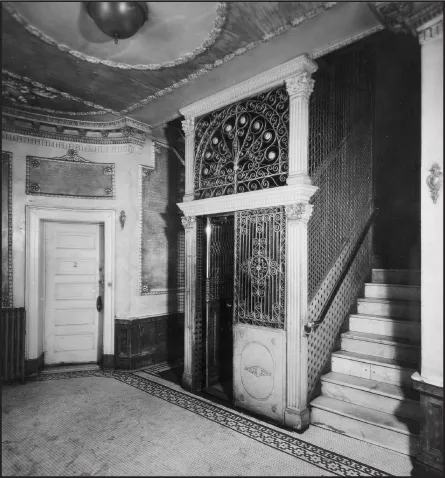
Interior lobby with elevator, 1858 – 60 Seventh Avenue (112th Street – 113th Street), New York City. Photograph by Wurts Brothers. Courtesy of the Milstein Division of United States History, Local History and Genealogy, New York Public Library, and the Astor, Lenox, and Tilden Foundations.
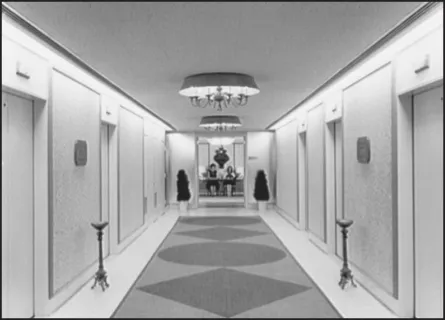
Elevator corridor to entrance, Warner Brothers Company, 90 Park Avenue, New York City. Courtesy of the Library of Congress.
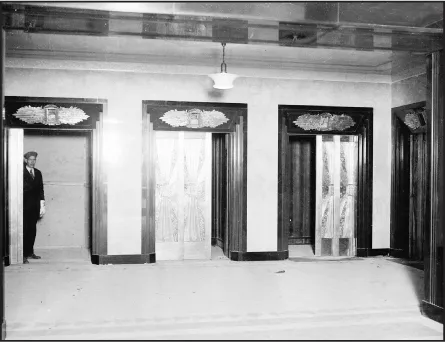
View of three sets of elevator doors in the new Chicago Daily News building, 400 West Madison Street. Photograph by Chicago Daily News, negative DN-0089017. Courtesy of the Chicago History Museum.
As is still evident today, the stairwell was not so thoroughly replaced by the elevator shaft in Germany. However, the elevator was already being discussed in the 1880s, as in Franz Reuleaux’s report on the safety standards of the Otis hydraulic elevator: “The advantage of elevator technology in general has been so accepted in the United States that in large buildings, the elevators are no longer simply welcome aids to traffic, but an essential, decisive element. … They are no longer sited like an afterthought in some obscure corner and seldom used, but are as open and accessible as possible.”20 In Germany, however, legal limitations on building height to five stories ensured that well into the 1920s, the installation of elevators, whether retroactive or part of the original plan, was always conceived of as merely an addition to the stairways. The formulations in architecture and engineering manuals around 1900 revealed that the traditional conception of the elevator as a mere extension of the actual transport system, that is, the stairs, was still unchallenged. “A passenger elevator in a building should be sited in such as way,” recommends the manual previously cited, “that persons wanting to use the elevator will not have to traverse other rooms befo...
Table of contents
Cover Page
Title Page
Copyright Page
Contents
Introduction
1. The Breach Through the Building: Organizing the Vertical
2. From Attic to Penthouse: The Vertical hierarchy of Buildings
3. Controls
4. Interiors
Notes
Bibliography
About the Author
About the Translator
Trusted by 375,005 students
Access to over 1.5 million titles for a fair monthly price.
Study more efficiently using our study tools.
Frequently asked questions
Yes, you can cancel anytime from the Subscription tab in your account settings on the Perlego website. Your subscription will stay active until the end of your current billing period. Learn how to cancel your subscription
No, books cannot be downloaded as external files, such as PDFs, for use outside of Perlego. However, you can download books within the Perlego app for offline reading on mobile or tablet. Learn how to download books offline
Perlego offers two plans: Essential and Complete
Essential is ideal for learners and professionals who enjoy exploring a wide range of subjects. Access the Essential Library with 800,000+ trusted titles and best-sellers across business, personal growth, and the humanities. Includes unlimited reading time and Standard Read Aloud voice.
Complete: Perfect for advanced learners and researchers needing full, unrestricted access. Unlock 1.5M+ books across hundreds of subjects, including academic and specialized titles. The Complete Plan also includes advanced features like Premium Read Aloud and Research Assistant.
Both plans are available with monthly, semester, or annual billing cycles.
We are an online textbook subscription service, where you can get access to an entire online library for less than the price of a single book per month. With over 1.5 million books across 990+ topics, we’ve got you covered! Learn about our mission
Look out for the read-aloud symbol on your next book to see if you can listen to it. The read-aloud tool reads text aloud for you, highlighting the text as it is being read. You can pause it, speed it up and slow it down. Learn more about Read Aloud
Yes! You can use the Perlego app on both iOS and Android devices to read anytime, anywhere — even offline. Perfect for commutes or when you’re on the go. Please note we cannot support devices running on iOS 13 and Android 7 or earlier. Learn more about using the app
Yes, you can access Lifted by Andreas Bernard in PDF and/or ePUB format, as well as other popular books in History & History of Architecture. We have over 1.5 million books available in our catalogue for you to explore.