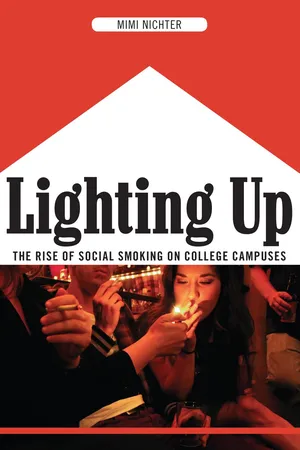
While the past 40 years have seen significant declines in adult smoking, this is not the case among young adults, who have the highest prevalence of smoking of all other age groups. At a time when just about everyone knows that smoking is bad for you, why do so many college students smoke? Is it a short lived phase or do they continue throughout the college years? And what happens after college, when they enter the “real world”? Drawing on interviews and focus groups with hundreds of young adults, Lighting Up takes the reader into their everyday lives to explore social smoking.
Mimi Nichter argues that we must understand more about the meaning of social and low level smoking to youth, the social contexts that cause them to take up (or not take up) the habit, and the way that smoking plays a large role in students’ social lives. Nichter examines how smoking facilitates social interaction, helps young people express and explore their identity, and serves as a means for communicating emotional states. Most college students who smoked socially were confident that “this was no big deal.” After all, they were “not really smokers” and they would only be smoking for a short time. But, as graduation neared, they expressed ambivalence or reluctance to quit. As many grads today step into an uncertain future, where the prospect of finding a good job in a timely manner is unlikely, their 20s may be a time of great stress and instability. For those who have come to depend on the comfort of cigarettes during college, this array of life stressors may make cutting back or quitting more difficult, despite one’s intentions and understandings of the harms of tobacco. And emerging products on the market, like e-cigarettes, offer an opportunity to move from smoking to vaping. Lighting Up considers how smoking fits into the lives of young adults and how uncertain times may lead to uncertain smoking trajectories that reach into adulthood.
- 272 pages
- English
- ePUB (mobile friendly)
- Available on iOS & Android
eBook - ePub
About this book
Information
1
“It’s No Big Deal”
It’s not like I’m going to do these things forever. I mean, I’m in college and everyone says it’s the time to let go. If I don’t do all these things now, when will I? Now’s the time to party hard with friends, stay up late, smoke and drink, and just enjoy myself. But it’s not like something I do all the time so it’s really not like a big deal. I mean, I’m sure I won’t be smoking when I’m done with college.
—Blake, eighteen-year-old male
The quote above from this college freshman echoes prevalent ideas on college campuses about smoking. Tobacco, like alcohol, is a substance that “everyone” seemed to use, especially at parties. Few students on the campuses where I worked saw themselves as “real” smokers. They were party smokers, that is, people who mostly smoked socially. That’s why so many students referred to their occasional smoking almost as an afterthought, and talked about it as “no big deal.”
Social smoking is common among young adults, particularly those who are in college. Social smokers tend to be lighter smokers who do not smoke on a daily basis. Their smoking is more related to the context in which they find themselves. In fact, it’s an umbrella term that can refer to different patterns. On the college campus, the term “social smoker” most commonly refers to a person who smokes with friends at parties when consuming alcohol. I resist assigning a number of cigarettes to define social smoking at parties, as it really depends on how much drinking is going on and who the individual is hanging out with on a particular night. Other patterns of social smoking also exist. A person on a break from work may smoke because his or her coworkers do, or a person who rarely smokes may have a cigarette with a troubled friend who is smoking as a way of bonding. Social smoking can also describe people who smoke a majority of their cigarettes in social contexts, but may also smoke alone when under stress. Indeed, some research has shown that more than half of college students who smoke fit this broad characterization of social smoker.
Recent years have seen a burgeoning epidemiological and psychological literature on social smoking, which is also referred to as light, low-level, and intermittent smoking. These terms are commonly defined in relation to the number of cigarettes smoked.1 Relatively few qualitative studies have been conducted to explore these patterns of consumption. At a time when just about everyone knows that smoking is bad for you, why are some college students starting to smoke once they arrive on campus? How, when, and where does social smoking occur? Despite an extant literature on smoking, there are lacunae in our understanding of the behavior. I argue that we must understand more about the meaning of social and low-level smoking to youth, the social contexts that facilitate uptake and those that limit use, and the social utilities of the behavior. Little is known about how smoking serves as a consumption event that facilitates social interaction, how smoking is used as a resource for negotiating identities, and how smoking serves as a signal for communicating emotive states. While much emphasis has been placed on the measurement of how much and how often young adults use cigarettes, less is known about what cigarettes say about who you are and who you are not. Thus, one of the aims of this book is to draw on interview data with social and low-level smokers in order to shed light on these increasingly common patterns of behavior.
Listening to the voices of young adults, I closely examine how smoking fits into their everyday lives and consider the extent to which college life actually fosters and sustains this behavior. In unpacking some of the complex reasons underlying smoking today, I challenge some simplistic but long-standing assessments of the behavior—for example, that most women smoke to control their weight.
Despite their smoking, most students I spoke with were confident that they were “not really smokers” and that their play time with cigarettes would be short-lived. As Blake points out in the opening quote, it was something one did in college, but certainly not after that. However, as students neared graduation, many of those who smoked expressed various degrees of ambivalence or reluctance to quit. Quit plans seemed to move farther into a distant ambiguous future, something that might be reconsidered at the next life milestone, such as getting a real job or starting a family.
While this book is largely focused on the college campus, I also consider what happens after graduation. Many grads today are stepping into an uncertain future, where the prospect of finding a good job in a timely manner is unlikely. Their twenties may be characterized by multiple moves (in and out of their parents’ and friends’ homes) and compounded by multiple stressors, not the least of which is supporting oneself in a time of high unemployment and low wages. Moving into adulthood is now an elongated process, as markers of “settling down,” like marriage, edge upward toward one’s late twenties, if that. For those who have come to depend on the comfort of cigarettes during their college years, this array of life stressors may make cutting back or quitting more difficult, despite their intentions and understandings of the harms of tobacco.
Added to this picture is the powerful tobacco industry, which has focused much of its multibillion-dollar campaigns on young adults—the youngest legal targets of its products. Slim, light, and additive-free cigarettes are marketed to young people who may think they are engaging in harm reduction through the promise of a “healthier” cigarette. Emerging products in the marketplace, like e-cigarettes, carry with them the lure of vaping (distinct from smoking), ostensibly without the harmful effects. Taking these myriad factors into account, one begins to recognize how social smoking is a behavior that may continue well beyond the college years.
My analysis draws on a social ecology of health model, which postulates that in order to understand the meaning of health behavior in context, we need to critically examine multiple levels of influence, such as the individual, the social network, the community, and global systems. Applied to the study of smoking among young adults, the social ecological perspective prompts us to look beyond psychosocial models that privilege individual behavior to consider how social, cultural, and political-economic environments affect youth behavior and how youth behavior, in turn, may influence the environment. Moving from the micro (interpersonal) to the macro (community/societal) level with a focus on reciprocal and bidirectional interaction, the social ecological model offers a productive frame for the discussion of behaviors and environments of risk that have an impact on young adults’ health.2
To date, although much research among college students has focused on singular behaviors (e.g., drinking, smoking, pharmaceutical use), qualitative studies point to the co-occurrence and interaction of these behaviors (e.g., smoking and drinking). The term “syndemic” has been used to refer to two or more epidemics (i.e., notable increases in the rate of specific diseases in a population) interacting synergistically and contributing, as a result of their interaction, to the excess burden of disease in a population. Coexisting behaviors like smoking and drinking need to be recognized as closely linked and potential independent threats to health, which need to be studied in context rather than in isolation. Recognition of the existence of syndemics suggests the need for a biosocial reconception of co-substance use and the adoption of holistic approaches that link micro-level behaviors to macro-level social and economic factors.
Shifts in Smoking in the United States
While the past forty years have seen significant declines in adult smoking (from 42 percent in 1965 to 20 percent in 2010), this is not the case among young adults, aged eighteen to twenty-five. Young adults have the highest prevalence of smoking of all other age groups, with approximately 35 percent reporting that they currently smoke.3 Analyses by race/ethnicity show that white youth have the highest prevalence overall (39 percent) followed by Hispanics (27 percent) and blacks (23 percent). Among women, white youth have the highest prevalence of smoking (37 percent) compared to other females (Hispanics 21 percent; blacks 21 percent).
I should clarify that the prevalence of smoking among young adults is highest among those who do not attend college. The focus in this book is on college-going youth, who actually represent a majority of young people in the United States today. In 2012, about two-thirds of high school graduates were enrolled in colleges or universities, and the majority of these students attended four-year institutions. Thus, it would seem that an in-depth understanding of smoking patterns on college campuses is warranted.
For many years, a widespread assumption in the public health field was that over 90 percent of those who became smokers would begin their habit before they reached age eighteen. The period of maximum vulnerability to initiation was considered to be during the middle or high school years.4 Recently the conventional wisdom about when youth start smoking has been challenged by findings that as many as 20 percent of smokers start smoking after age eighteen, a figure that represents a substantial increase from earlier years. Nationwide surveys reveal that it is increasingly common for college students to begin smoking after they arrive on campus, mostly in their freshman year. Over 30 percent of college students report that they smoked at least once in the past year, 25 percent report that they smoked at least one time in the previous month, and 12 percent smoke cigarettes daily.5
Some research has concluded that smoking behaviors acquired in older adolescence and early adulthood are more likely to persist through later life.6 There is evidence to suggest that more than half of those who smoke at low levels in their freshman year will still be smoking when they are seniors. And for those who began smoking prior to college, more than one-quarter become regular smokers during the college years.7 For some of these students, what began as social or occasional smoking will convert to daily smoking.8 Clearly, an established pattern of smoking on a daily basis will make it more difficult to quit.
By all accounts, young adulthood is a pivotal time in the development of smoking behavior. Smoking patterns among college students are much more fluid than those of adults, whose smoking behaviors tend to be already established.9 In fact, studies suggest that “the number of individuals aged 18 and 19 years in the early stages of smoking initiation may be more than double that of established smokers aged 18 years.”10 Those who once detested smoking may take it up in college, those who smoke in social contexts may increase or decrease their use, and party smokers who once swore that they were somehow immune to addiction may become dependent smokers with little interest in quitting.
Scientific understanding of how one becomes a smoker has changed over time. For many years, researchers believed that after a person initiated smoking, the progression to regular or daily use took several years, with established smoking as an endpoint that occurred in the twenties. During these early years, an individual’s smoking behavior was typically characterized as intermittent or light (i.e., the person smoked occasionally and at a low level, five cigarettes or fewer per day), a pattern that was seen as a temporary and transitional developmental stage while his or her smoking was becoming established.11 Eventually, the smokers would feel that they required steady and frequent dosing of nicotine, at which point they could be characterized as dependent on nicotine, or addicted smokers.
While this was the dominant characterization of a smoker for many years, by the late 1980s there was a growing recognition that not all smokers fit this pattern. Saul Shiffman, a professor of psychology and pharmaceutical science known for his research on addiction, identified a pattern among adult smokers whom he labeled “chippers.” These smokers inhaled and absorbed nicotine from cigarettes (typically about five or fewer per day) but did not smoke enough to maintain steady-state nicotine levels, nor did they experience many (if any) withdrawal symptoms when they did not smoke. Over time, these low-level smokers did not increase the number of cigarettes they smoked and they showed few signs of dependence.12
Increasingly, tobacco researchers have recognized that divergent patterns of smoking uptake exist, with some individuals remaining low-level smokers rather than following neatly along a trajectory of increased cigarette consumption. In fact, in the United States today over a third of adult smokers do not smoke every day, and the proportion of non-daily or occasional smokers appears to be growing.13 This is a very sharp contrast from twenty-five years ago, when the average smoker consumed thirty-two cigarettes a day, over a pack and a half.14 Smokers today smoke an average of thirteen cigarettes per day. And among many college students who smoke, the amount smoked per day is much less.
What accounts for these downward shifts in cigarette consumption? Several reasons seem plausible in the general population. First and foremost, environmental restrictions—smoke-free legislation—have limited the spaces where people can smoke. Half of the U.S. population lives in areas where smoking is banned in workplaces, bars, and restaurants. More than 70 percent of Americans, including about half of current smokers, do not allow smoking in their homes. Rather than being able to light up a cigarette wherever they wish, smokers need to find appropriate places, not only where it is legal for them to smoke but also where they will not offend others. Smoking has been increasingly stigmatized, and even when someone is smoking in a legal space—like outdoors—nonsmokers are often quick to show their annoyance. Restrictions on smoking are increasing on college campuses as well, and many colleges nationwide have enacted total smoking bans, meaning no smoking in campus buildings or outside.
A second reason for the downward shift in cigarette consumption is cost. Taxation on cigarettes, which varies across states, has resulted in increased cost, which can serve as a factor limiting the number of cigarettes one smokes as well as one’s brand choice. Numerous studies have shown that young adults are particularly sensitive to cost.15
A third factor contributing to lower levels of smoking is a growing awareness of the harm of tobacco and secondhand smoke. To mitigate harm, many people are adopting harm-reduction practices, like cutting back on the number of cigarettes they smoke each day or trying to quit completely.
How Do College Students Describe Their Smoking?
The short answer to this question is that college students view their smoking very differently than public health and psychology researchers who frequently report on their behavior. Most researchers use the term current smoker to classify those who report smoking part or all of a cigarette in the past thirty days.16 Some years back, I realized that this label was a total mismatch for how students talked a...
Table of contents
- Cover
- Half title
- Title
- Copyright
- Dedication
- Contents
- Acknowledgments
- 1. “It’s No Big Deal”
- 2. Profiles and Progressions
- 3. Smoking and Drinking: “It’s Like Milk and Cookies!”
- 4. What’s Gender Got to Do with It?
- 5. Reconsidering Smoking as a Weight-Control Strategy
- 6. The Slippery Slope
- 7. Tipping Points: Stress, Boredom, and Romance
- 8. Quit Talk
- 9. Looking Forward: Uncertain Trajectories
- Appendix: Methods
- Notes
- References
- Index
- About the Author
Trusted by 375,005 students
Access to over 1.5 million titles for a fair monthly price.
Study more efficiently using our study tools.
Frequently asked questions
Yes, you can cancel anytime from the Subscription tab in your account settings on the Perlego website. Your subscription will stay active until the end of your current billing period. Learn how to cancel your subscription
No, books cannot be downloaded as external files, such as PDFs, for use outside of Perlego. However, you can download books within the Perlego app for offline reading on mobile or tablet. Learn how to download books offline
Perlego offers two plans: Essential and Complete
- Essential is ideal for learners and professionals who enjoy exploring a wide range of subjects. Access the Essential Library with 800,000+ trusted titles and best-sellers across business, personal growth, and the humanities. Includes unlimited reading time and Standard Read Aloud voice.
- Complete: Perfect for advanced learners and researchers needing full, unrestricted access. Unlock 1.5M+ books across hundreds of subjects, including academic and specialized titles. The Complete Plan also includes advanced features like Premium Read Aloud and Research Assistant.
We are an online textbook subscription service, where you can get access to an entire online library for less than the price of a single book per month. With over 1.5 million books across 990+ topics, we’ve got you covered! Learn about our mission
Look out for the read-aloud symbol on your next book to see if you can listen to it. The read-aloud tool reads text aloud for you, highlighting the text as it is being read. You can pause it, speed it up and slow it down. Learn more about Read Aloud
Yes! You can use the Perlego app on both iOS and Android devices to read anytime, anywhere — even offline. Perfect for commutes or when you’re on the go.
Please note we cannot support devices running on iOS 13 and Android 7 or earlier. Learn more about using the app
Please note we cannot support devices running on iOS 13 and Android 7 or earlier. Learn more about using the app
Yes, you can access Lighting Up by Mimi Nichter in PDF and/or ePUB format, as well as other popular books in Social Sciences & Cultural & Social Anthropology. We have over 1.5 million books available in our catalogue for you to explore.