2007 Society for the Anthropology of North America (SANA) Book Award
Complete List of Authors:Dorothy Holland, Donald M. Nonini, Catherine Lutz, Lesley Bartlett, Marla Frederick-McGlathery, Thaddeus C. Guldbrandsen, and Enrique G. Murillo, Jr.
What is the state of democracy at the turn of the twenty-first century? To answer this question, seven scholars lived for a year in five North Carolina communities. They observed public meetings of all sorts, had informal and formal interviews with people, and listened as people conversed with each other at bus stops and barbershops, soccer games and workplaces. Their collaborative ethnography allows us to understand how diverse members of a community not just the elite think about and experience “politics” in ways that include much more than merely voting.
This book illustrates how the social and economic changes of the last three decades have made some new routes to active democratic participation possible while making others more difficult. Local Democracy Under Siege suggests how we can account for the current limitations of U.S. democracy and how remedies can be created that ensure more meaningful participation by a greater range of people.
Complete List of Authors (pictured)
From Left to Right, bottom row: Enrique Murillo, Jr., Thaddeus Guldbrandsen, Marla Frederick-McGlathery.
Top row: Dorothy Holland, Catherine Lutz, Lesley Bartlett, and Don Nonini.
eBook - ePub
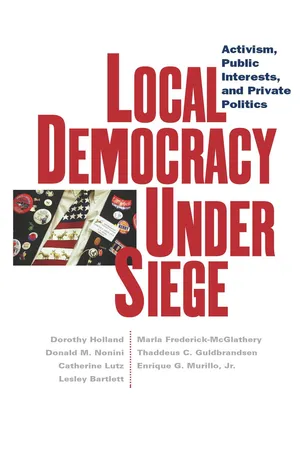
Local Democracy Under Siege
Activism, Public Interests, and Private Politics
- 368 pages
- English
- ePUB (mobile friendly)
- Available on iOS & Android
eBook - ePub
Local Democracy Under Siege
Activism, Public Interests, and Private Politics
About this book
Information
1 Experimenting with Democracy
Duany and the Water Bill: A Puzzle of Contemporary U.S. Democracy
A hot Sunbelt day in 1997 presented us with a puzzle about contemporary U.S. democracy. It was the kind of July North Carolina afternoon that makes a person break into a sweat walking from the air-conditioned car to the air-conditioned building.
Inside the City Hall complex, members and associates of Durham Inner Village, a nonprofit group of nonelected citizens, were brainstorming about how to create a better future for Durham. Seated around the conference table, in a room they had requested, were a real estate developer, two medical doctors, an IBM developer, the city planner, a leader of a nonprofit real estate development partnership, a computer engineer, and an anthropology graduate student.
They had recently invited the famed architect and New Urbanist guru, Andres Duany, to town as a consultant and they were planning his visit. In the midst of delegating key tasks—event planning, public relations, advertisement, news media involvement, and invitations for “key players”—Timothy, one of the medical doctors in the group, interrupted the discussion to ask everyone to take stock of specific goals.1
Timothy: Andres Duany and Elizabeth Plater-Zyberk are the leaders of the New Urbanist … movement in architecture and community planning. … Duany is coming to Durham to offer his assessment of the future of Durham and to offer insights into how that future might be more “livable.” What do we want out of this visit?2 Barry, the real estate developer: To affect the way the typical citizen thinks about the future of development. I want them to see New Urbanism as an alternative to [suburban] sprawl.
Calvin, a physician: I see a more concrete focus. I want to affect the key decision makers. [The ones] that generally buy into this stuff [New Urbanism or Smart Growth] but only give lip service. … I want to move up the scale of enthusiasm. We should address the key political players, like the city manager, the key bankers, and the key developers.
Stephanie, the computer engineer who neither lives nor works in Durham but was nonetheless interested in urban planning in the city: We should help people [understand how to participate] when things need to be done [for the city]. … We could have a slogan like “Reinventing Durham.”
Outside, two Durham residents gazed at the city office complex with what appeared to be apprehension. There were no parked cars around, so it was clear that the couple had walked some distance. With modest clothing, uncertain expressions, and papers in hand, the man and woman approached Thad Guldbrandsen, the anthropology graduate student and member of our research team who had just come from the meeting to the sidewalk outside City Hall.
“Can I help you find something?” Thad asked.
“Do you know where we go to deal with our water bill?”
“Sure, the cashier is right inside City Hall in the building right here.”
The couple seemed to stagger backward expressing anxiety, saying something to the effect of, “Oh no, City Hall is not for us.”
“Oh, it’s very easy,” Thad told them. “I just walked through the room where several people were standing in line waiting to pay their own bills. It’s no big deal.”
Without much more communication, the couple abruptly changed direction and walked away.
These events provide starkly contrasting images of two relationships to government. Inside the air-conditioned building eight private citizens were at home in City Hall, taking ownership of a process intended to shape the city and engaging in high-level civic engagement and participatory governance. Outside on the searing sidewalk, two people lacked the confidence to even enter the building to pay a routine bill. This couple is not alone. We know from our research that many people neither identify with their own government nor otherwise see themselves as meaningfully involved in their own governance.
So here is the puzzle: How are these contradictory images—one of empowerment, the other of estrangement—reflections of the changing shape of democracy in the United States? The reaction of the couple calls to mind widespread debates about the health of American democracy. Fall-offs in voting since the 1960s and in memberships in older, hierarchically organized federations of civic associations suggest the weakening of long-standing links between government and the people, and thus estrangement. At the same time, those bringing Andres Duany to Durham were directly engaged in participatory governance. What are the underlying conditions that make both estrangement and empowerment possible? How are they interacting? The subsequent pages of this book introduce a discussion about people with everyday problems, in everyday American towns, as they all struggle to make lives. We will show the many ways in which the American political terrain has changed during the past three decades in relation to globalization, widespread economic changes, and bold new policy initiatives. In the process, we will show how these changes matter in the lives of regular people and constitute as yet unanswered challenges to contemporary democracy.
Market Rule and the Three-Legged Stool of Democracy
In the United States, democracy is popularly associated with voting. Voting booths have clear symbolic importance. Less clearly defined, but equally important, is the expectation that U.S. society enjoys certain entitlements and guarantees, such as life, liberty, the pursuit of happiness, promotion of the common good, and justice. Likewise, related values lay out the conditions necessary for democracy to flourish. Societies that claim to be democratic are expected to promote three interrelated core values: liberty—freedom from government tyranny and from unwanted government intrusion into private spheres; equality—equality of input into decision-making about public resources regardless of birth, gender, race, religion, or wealth; and community—voluntary, communal bonds and common concerns that transcend individual self-interest.
Yet, the exact content of these values is never permanently defined once and for all. People contest the interpretation of liberty, equality, and community with different versions becoming dominant at different times.3 Today, those in power define freedom and liberty in a neoliberal fashion, as freedom of the market from government interference. Other versions of liberty continue to be intensely debated, for example, freedom from the polluting effects of industry or women’s freedom of choice over their bodies, but “freedom of the market” carries the day.
The meaning of equality is disputed as well. Does it simply mean that there shall be no laws or other barriers that directly bar the participation of anyone in governmental decision-making? Or, is it necessary to take the broader view that equality of input necessitates broad economic and social equality?
Nor do people across historical periods or even in any one historical period necessarily assign the same priority to each of the core democratic values. Since the 1980s, the rhetorical focus in political discussion has been dominated by elite and other voices calling for freedom of markets from government. “Freedom” is read as freedom for corporations from government regulation and interference, and freedom for consumers/citizens to choose among providers of public services. Now in the driver’s seat are market-based interpretations of what it means to be free.
Emergence of Neoliberalism as Received Wisdom
Neoliberalism, or market fundamentalism, currently represents the dominant governing ethos and discourse in American political life.4 Widely promulgated and accepted by elites in American politics, it has two basic premises:
1. the unfettered market, not government, is the optimal mechanism for allocating social resources;
2. governments must allow the market to function freely, without regulation, providing only the law and order that the market and its participants need to function efficiently.5
American governments from the New Deal 1930s onward mistakenly, in the eyes of the neoliberals, expanded government to provide economic support to the poor, the unemployed, and other inadequate market performers. This has led to waste, inefficiency, corruption, and parasitism, instead of the salutary discipline of market forces. To bring about the revitalization of the country, this legacy must be purged. Public policy must
• reduce, if not eliminate, Social Security and other government programs that provide assistance to the aged, the poor, and other low market performers, and stress instead individual personal responsibility;
• deregulate corporate practices, give relief from onerous environmental and labor standards set by government, and in general get government “off the backs” of business people;
• privatize government schooling, incarceration, welfare administration, and other such functions by outsourcing them to the business or philanthropic sectors whenever they cannot be eliminated outright;
• reduce taxes on income, wealth, and property, especially the estate tax, on the grounds that individuals, not government, know best how to spend their wealth.6
Given the encounter of American communities with globalization over the last thirty years, there are three additional claims within this discourse and worldview that have had uptake among local economic and political elites:
• major sources of investment, especially in capital, come from outside the unit in question (locale, region, state, country);
• thus, each person, each local community, each state, and each national government must view itself as a competitor with every other and promote its distinctive comparative advantage to outside market players to attract global capital;
• competition requires that the costs of investment to outsiders be reduced to a minimum, no matter what the broader expense to the individual, local community, or government.7
These premises of neoliberalism are widely if not universally shared among American political elites.8 We heard them, adapted to local conditions, articulated by many of the local economic and political leaders in the five communities we studied.
What about Equality and Community?
In neoliberal doctrine, equality, to the degree that it is considered at all, is supposed to come from the marketplace, where each citizen is empowered to choose among programs, much as each consumer (one with the necessary monetary means) is able to choose among consumer products. Instead of determining the public’s service needs and methods of provision through democratic means—e.g., debate about the merit of one set of needs against others—the public’s needs are set by corporations, business people, and politicians, who interpret, with an eye toward profit making, the choices of individual citizen/consumers. This is a radical redefinition of the common good and how to achieve it.
The third value of a democratic society, that of nurturing community and its well-being, is understood under market rule to mean ensuring the well-being of the business community. Most policymakers now see private corporations and businesses as crucial to the conduct of government and to the provision of government-like goods and services. Market rule sees special expertise in the businessperson and places special value on corporations and the wealth they produce. Their rights and well-being are therefore presumed to be above those of ordinary people. They have in effect become supercitizens. Market rule, in short, is a striking reformulation of the roles and responsibilities of government, business, and the public. Proponents of market rule direct their policies and rhetoric toward ensuring liberty and strengthening the family. They ignore the solidarity of the larger unit, the community, and are virtually silent about equality. Using the metaphor of democracy as a three-legged stool, we might say that the leg of liberty is enlarged and strengthened while those of equality and community suffer neglect and are allowed to splinter.
For those who consider all three legs to be structurally necessary for democracy to survive, market rule challenges democratic governance. The challenges have been articulated most clearly with respect to equality. Market rule generates fears of capitalism’s tendency, when left unchecked, to produce large and growing wealth gaps. In fact, wealth disparities among Americans have grown since the late 1970s. The wealth gap in the United States is now the largest of all advanced industrialized countries, and it continues to increase. When it comes to homes, other real estate, ownership of small businesses, savings accounts, CDs and money market funds, bonds, stocks, and such, middle-class and lower-income Americans own relatively little compared to the wealthy.9 These differences translate into stark differences between the lives of the rich and the poor and create the risk of further decline even for those who think of themselves as middle class. Reduced income through retirement, severe illness, and other not so uncommon financial downturns put the nonrich at continuing risk.
Wealth inequalities matter in a democracy, even, or perhaps especially, in a representative democracy like that of the United States. Marked wealth differences very easily translate into disparities in political influence. As spelled out in a later chapter, we concur, in fact, with scholars who hold that the United States tends strongly toward plutocracy, not democracy, wherein wealth determines who has significant input into energy, environmental, health, education, race, and other policies.
Even assuming that efforts to erase race and gender privilege have allowed the input of African Americans and women to count as much as that of whites and men (which they have not), greater wealth can be, and often is, transformed into greater political capital or influence. Elections are relatively infrequent and, especially in national elections, restricted de facto to a handful of candidates, most of whom are wealthy. Consequently, the bulk of the population must rely on representatives who tend to look out above all for the well-being of business donors, and fail to recognize the problems of the 80 percent of the population who have relatively limited resources and/or face discrimination on the basis of race or ethnicity.
Many people are now worried about the effects of inequality on politics. A person in one of our research areas summed up the point when he said, “Our water quality standards are so low because those kinds of decisions have been left up to people who … don’t have to drink the water.” Commentators make similar connections in the popular media. In an article in Esquire, Ron Reagan, son of the late president, Ronald Reagan, wrote, “Wealthy politicians and government officials, of which there are many including the current president, have little idea of what life is like for the average American who makes a little less than $32,000 per year. The two live in different worlds.”10 Senator John McCain in his 2000 campaign for president said elections today are nothing less than an “influence peddling scheme in which both parties compete to stay in office by selling the country to the highest bidder.”11 And Time magazine investigative journalists Donald Bartlett and James Steele declared that America now has “government for the few at the expense of the many.”12
Another issue associated with inequality is whether alternative views are aired in the public sphere, especially when their circulation depends on the news media.13 The conventional view is that the role of the media in a democracy is to allow its citizens to be better informed when they participate in decision making as voters and in other capacities. However, as Robert McChesney, Ben Bagdikian, and others have observed, the concentrated corporate ownership of the electronic and print media means that the media plays a major role in furthering corporate agendas and keeping many concerns of citizens from becoming public issues for democratic deliberation and decision making.14
Market rule’s version of liberty is central to the challenges faced by locales such as the ones we studied. It promotes policies that enhance global flows of goods and labor, but destabilizes local places. The “creative destruction” of textile, furniture, and, now, many white-collar jobs in the United States enabled by neoliberal free trade and, in some cases, underwritten by the government, undermines and challenges many local communities, even while providing a privileged few with new economic resources.15
Not only do relatively few enjoy the fruits of market rule’s peculiar definition of liberty, but the stool itself, democracy, threatens to topple over. Is representative democracy, skewed as it is by wealth disparities, still effective and inclusive? Many of the people we interviewed and got to know answered negatively. To them, even voting, a symbol of one of the core rights of a citizen in representative democracy, seemed a hollow act. Should the current practices of representative democracy, so swayed as they are by wealth, even be called democracy? This book argues that neoliberal doctrines and the market rule they advocate are virtually blind to structural inequalities, allowing race and other structures of privilege to operate at will. Moreover, market rule has so inflamed the wealth gap and so exacerbated the plutocratic tendencies of American democracy that the very possibility of preserving, not to mention expanding, the democra...
Table of contents
- Cover Page
- Title Page
- Copyright Page
- Dedication
- Contents
- Acknowledgments
- Preface
- 1. Experimenting with Democracy
- 2. Landscapes in Transition
- Part I: Limiting Democracy
- Part II: Governing Under Neoliberalism
- Part III: Struggling For Democracy
- Appendix: Democracy and Political Theory: Why Participatory Democracy?
- Notes
- Bibliography
- Index
- About the Authors
Trusted by 375,005 students
Access to over 1.5 million titles for a fair monthly price.
Study more efficiently using our study tools.
Frequently asked questions
Yes, you can cancel anytime from the Subscription tab in your account settings on the Perlego website. Your subscription will stay active until the end of your current billing period. Learn how to cancel your subscription
No, books cannot be downloaded as external files, such as PDFs, for use outside of Perlego. However, you can download books within the Perlego app for offline reading on mobile or tablet. Learn how to download books offline
Perlego offers two plans: Essential and Complete
- Essential is ideal for learners and professionals who enjoy exploring a wide range of subjects. Access the Essential Library with 800,000+ trusted titles and best-sellers across business, personal growth, and the humanities. Includes unlimited reading time and Standard Read Aloud voice.
- Complete: Perfect for advanced learners and researchers needing full, unrestricted access. Unlock 1.5M+ books across hundreds of subjects, including academic and specialized titles. The Complete Plan also includes advanced features like Premium Read Aloud and Research Assistant.
We are an online textbook subscription service, where you can get access to an entire online library for less than the price of a single book per month. With over 1.5 million books across 990+ topics, we’ve got you covered! Learn about our mission
Look out for the read-aloud symbol on your next book to see if you can listen to it. The read-aloud tool reads text aloud for you, highlighting the text as it is being read. You can pause it, speed it up and slow it down. Learn more about Read Aloud
Yes! You can use the Perlego app on both iOS and Android devices to read anytime, anywhere — even offline. Perfect for commutes or when you’re on the go.
Please note we cannot support devices running on iOS 13 and Android 7 or earlier. Learn more about using the app
Please note we cannot support devices running on iOS 13 and Android 7 or earlier. Learn more about using the app
Yes, you can access Local Democracy Under Siege by Dorothy C. Holland,Catherine Lutz,Lesley Bartlett,Marla Frederick-McGlathery,Thaddeus C. Guldbrandsen,Enrique G. Murillo,Donald M. Nonini,Thaddeus C. Guldbrandsen,Enrique G. Murillo in PDF and/or ePUB format, as well as other popular books in Social Sciences & Anthropology. We have over 1.5 million books available in our catalogue for you to explore.