An investigation of America's failure to atone for the wrongs of slavery
Ever since the unfulfilled promise of "forty acres and a mule" after the Civil War, America has consistently failed to compensate Black Americans for the wrongs of slavery. Exploring why America has struggled to confront the issue of racial injustice, Long Overdue provides a history of the racial reparations movement and shows why it is more relevant now than ever.
Through an examination of Americans' unwillingness to address economic injustice, Charles P. Henry crafts a skillful moral, political, economic, and historical argument for African American reparations, focusing on successful political cases. In the wake of successes in South Africa and New Zealand, new models for reparations have found traction in a number of American cities and states, from Dallas to Baltimore and Virginia to California. By looking at other dispossessed groups—Native Americans, Holocaust survivors, and Japanese internment victims in the 1940s—Henry shows how some groups have won the fight for reparations, and explores new ways forward for Black Americans.
From Hurricane Katrina to Hurricane Harvey, the events of the 21st century continue to show that the legacy of racial segregation and economic disadvantage is never far below the surface in America. As the issue of reparations is brought to the national stage by figures such as Ta-Nehisi Coates and Kamala Harris, Long Overdue provides a must-read survey of the political and legislative efforts made toward reparations over the course of American history, and offers a new path toward establishing equality for all Black Americans.
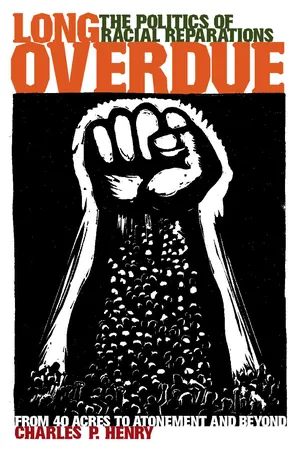
- 268 pages
- English
- ePUB (mobile friendly)
- Available on iOS & Android
eBook - ePub
About this book
Information
1
A Political and Legal History of Reparations and Race Relations
We have given this issue [an apology] considerable thought over the course of the year. We conclude that the question of an apology for slavery itself is much too narrow in light of the experience of blacks over the course of this Nation’s history.
—From President Clinton’s Initiative on Race:
The Advisory Board’s Report to the
President, September 1998
The Advisory Board’s Report to the
President, September 1998
The Politics of Reparations
Presidential Commissions
Beyond the apologies that have been made, such as they are, it is important to understand the political history of race relations and reparation in this country. The U.S. government has never convened anything resembling a truth and reconciliation commission to remember and seek remedy for the wrongs committed from the time of slavery to Jim Crow to today. There have been, however, numerous “study” commissions, and one of the most influential studies of American race relations was, in fact, not a government study. Concerned about the effects of urbanization on the increasing flow of Black migrants to urban centers following World War I, the Carnegie Foundation commissioned and financed the most extensive study of race relations in American history. The Swedish economist Gunnar Myrdal, with the help of a large staff and a number of consultants, conducted the study and published the two-volume study An American Dilemma: The Negro Problem and Modern Democracy in 1944.1 The release of this study at the end of World War II proved to be fortuitous, as it gave the report attention it might not have received before the war.
Widespread urban violence in the mid- to late 1960s prompted a host of studies on race relations. Before these disturbances, social scientists did not seem interested in applying the new science of survey research to Black populations.2 The most famous of these studies on race relations was the report by the National Advisory Commission on Civil Disorders, which was appointed by President Lyndon B. Johnson on July 29, 1967 (also known as the Kerner Commission after its chair, Illinois Governor Otto Kerner). In an address to the nation two days before he appointed the commission, President Johnson stated:
Let us condemn the violent few. But let us remember that it is law-abiding Negro families who have really suffered most at the hands of the rioters. It is responsible Negro citizens who hope most fervently—and need most urgently—to share in America’s growth and prosperity.
This is not the time to turn away from that goal.
To reach it will require more than laws, more than dollars. It will take renewed dedication and understanding in the heart of every citizen.
I know there are millions of men and women tonight who are eager to heal the wounds that we have suffered; who want to get on with the job of teaching and working and building America. . . .
And let us build something much more lasting: faith between man and man, faith between race and race. Faith in each other—and faith in the promise of beautiful America.3
Johnson’s appeal for racial reconciliation was complemented by the commission’s report calling for the following changes in the racial status quo:
• Opening up opportunities to those who are restricted by racial segregation and discrimination, and eliminating all barriers to their choice of jobs, education and housing.
• Removing the frustration of powerlessness among disadvantaged by providing the means for them to deal with the problems that affect their own lives, and by increasing the capacity of our public and private institutions to respond to these problems.
• Increasing communication across racial lines to destroy stereotypes, to halt polarization, to end distrust and hostility, and to create common ground for efforts toward common goals of public order and social justice.4
The six-hundred-page report contained dozens of recommendations, ranging from education and employment policy to news media coverage and police actions. In light of today’s views on taxation, perhaps the most remarkable recommendation is the commission’s suggestion to raise taxes: “The major need is to generate new will—the will to tax ourselves to the extent necessary to meet the vital needs of the nation.”5
In response to Johnson and the commission’s calls for action was the sobering perspective of American racial history by sociologist Kenneth Clark, testifying before the commission:
I read that report . . . of the 1919 riot in Chicago, and it is as if I were reading the report of the investigating committee on the Harlem riot of ’35, the report of the investigating committee on the Harlem riot of ’43, the report of the McCone Commission on the Watts riot.
I must again in candor say to you members of this Commission—it is a kind of Alice in Wonderland—with the same moving picture re-shown over and over again, the same analysis, the same recommendations, and the same inaction.6
In fact, the commission seems to have shared Clark’s pessimism in concluding that the “nation is rapidly moving toward two increasingly separate Americas,”7 that neither the “existing conditions nor the garrison state” nor a state maintained by military power “offer[s] acceptable alternatives for the future of this country.”8
Sounding much like Martin Luther King Jr. and the other civil rights leaders who called for a massive federal effort to end economic inequality, the commission recommended sweeping reforms in the areas of employment, education, welfare, housing, news reporting, and law enforcement: “Discrimination and segregation have long permeated much of American life; they now threaten the future of every American.”9 Lyndon Johnson was infuriated by the report, arguing that the commission ignored “the Marshall Plan we already have,”10 Moreover, having identified White racism as “the proximate cause of the riots,”11 Johnson faced a backlash from Whites, who wanted urban rioters punished rather than rewarded. Thus, bogged down in an increasingly expensive war in Vietnam, the most liberal president in U.S. history responded by creating another commission in June 1968. The National Commission on the Causes and Prevention of Violence, chaired by Milton Eisenhower, submitted its final report some eighteen months later, calling for annual increases in welfare expenditures amounting to $20 billion per year. But now that the United States was embroiled in the Vietnam War, the moment for such action had passed.12 Moreover, Richard M. Nixon, who was elected president on a platform of law and order and was against school busing, had chosen the garrison state.
More than twenty years later, in 1992, Andrew Hacker’s Two Nations contended that the Kerner Commission’s prediction of a divided America was now a reality. Indeed, much of the social science data examining the impact of Reaganomics on African Americans endorsed his view.13 Late in his second term, in 1998, President Bill Clinton responded to this racial divide by creating a presidential advisory board on race. Chaired by historian John Hope Franklin, the board was to assist the president in a year-long “great and unprecedented conversation about race.”14 But the board got a late start and its staff and the White House staff constantly disagreed. Conservatives complained that the board was not interested in their views, and some minorities argued the panel was skewed toward African American interests.15 Whereas Franklin argued that the panel must examine the past, others wanted the focus to be on the future. Franklin also believed that Black—White relations had essentially shaped a paradigm that informed relations with all other people of color in the United States. Not all board members agreed, reflecting some of the same divisions as those in the public at large.
Some civil rights leaders and elected officials praised Clinton for his initiative but urged him to narrow the focus of his effort. Although Angela Oh, a board member, and Franklin maintained that reparations should be central to the commission’s work, the president had ruled out reparations as not a “productive” issue for discussion.16 The board did, however, deal with the issue of an apology for slavery. In a remarkable transcendence of the issue, the board concluded:
We have given this issue [an apology] considerable thought over the course of the year. We conclude that the question of an apology for slavery itself is much too narrow in light of the experience of blacks over the course of this Nation’s history. . . . The apology we must all make cannot be adequately expressed in words, only in actions. We must make a collective commitment to eliminate the racial disparities in opportunity and treatment that characterize too many areas of our National life.17
Nonetheless, the actions called for fell far short of the recommendations of the previous race commissions..
The president identified four objectives for the advisory board:
1. Promote a constructive national dialogue to confront and work through challenging issues that surround race.
2. Increase the Nation’s understanding of our recent history of race relations and the course our Nation is charting on issues of race relations and racial diversity.
3. Bridge racial divides by encouraging leaders in communities throughout the Nation to develop and implement innovative approaches to calming racial tensions.
4. Identify, develop, and implement solutions to problems in areas in which race has a substantial impact, such as education, economic opportunity, housing, health care, and the administration of justice.18
In contrast to the commissions created by President Johnson, Clinton’s board limited itself largely to what citizens could do to heal the racial divide rather than what the government could do. An example is the following from the “Ten Things Every American Should Do to Promote Racial Reconciliation”:
1. Make a commitment to become informed about people from other races and cultures. Read a book, see a movie, watch a play, or attend a cultural event that will inform you and your family about the history and current lives of a group different than your own.
2. If it is not your inclination to think about race, commit at least one day each month to thinking about how issues of racial prejudice and privilege might be affecting each person you come in contact with that day. The more that people think about how issues of race affect each person, the easier it will be for Americans to talk honestly about race and eliminate racial divisions and disparities.
3. In your life, make a conscious effort to get to know people of other races. Also, if your religious community is more racially isolated than your local area, encourage it to form faith partnerships with racially different faith groups.19
Clinton’s board cited the following as the most critical parts of the initiative:
• A President’s Council for One America.
• A public education program using a multimedia approach.
• A presidential “call to action” of leaders from all sectors of our society.
• A focus on youth.20
None of these “elements” envisioned major expenditures, and there was absolutely no mention of taxation.
As Clinton himself complained, “It’s very hard to pierce through the public consciousness and to do a sustained public education campaign in the absence of some great conflict.”21 Indeed, the persons he selected for his commission seemed to be a step removed from the political influence of Johnson’s commissions.22 In short, the president was admitting that only the threat of internal violence or external threat could move the majority of Americans to address racial inequities seriously.
It is not surprising that the only presidential initiative on race in thirty years ended with a whimper, its principal recommendation being for a presidential council on racial disparities. Yet without a crisis to motivate Whites or a specific focus such as reparations to attract Blacks, such efforts are purely symbolic.
Beyond the Symbolic
The general consensus among scholars of American politics is that the demand for civil rights for African Americans pushed race to the forefront of the political agenda, thereby realigning the two major political parties. The strong opposition of the Republican presidential candidate, Barry Goldwater, to the Civil Rights Act of 1964 clearly aligned his party with the tradition of White supremacy, whereas Lyndon Johnson’s embrace of the civil rights movement firmly linked the Democratic Party with demands for Black equality. But even though Johnson beat Goldwater in a landslide in 1964, by 1968 the racial landscape had changed. The success of the former Alabama governor, George Wallace, in the presidential primaries in 1968 led Richard Nixon to adopt a “southern strategy,” in which he changed the focus of the Republican Party by trying to secure the electoral votes of the historically Democratic southern states.
Although the realignment is apparent and the Republican success in using race as a wedge issue with voters is empirical fact, what is less obvious is the change in racial discourse. Because Black demands were framed in the civil religion that combines our fundamental political beliefs with our dominant religious beliefs, the civil rights movement was able to establish a norm of equality. No longer was it possible for the Wallaces of the world to campaign on blatantly racist appeals. Accordingly, in their calls for “law and order” and their attacks on “welfare queens” and big government, Wallace and his heirs began using coded references to race. So successful was this strategy that in 1980 Ronald Reagan could appeal to “states rights” from Philadelphia, Mississippi, the infamous site of the murder of three civil rights workers in 1964, and avoid being labeled a racist.
Academics have aided in this racial sleight-of-hand by creating the new categories of “racial conservative” and “racial liberal.” Edward Carmines and James Stimson, for example, argue that “Goldwater was neither a racial bigot nor, in principle, a segregationist”; however, “his conservative ideology would not allow him to support government ordered desegregation policies.”23 They admit that his “racial conservatism” had a powerful appeal to the anti–civil rights forces that had been deserted by the national Democratic Party. What remains unclear is why Goldwater or any other person who is conservative in principle needs to have their racial views distinguished from their other policy positions. In fact, most of today’s Black neoconservatives—who claim Goldwater as an ideological father—also accept the passage of the 1960s civil rights legislation as a positive good that makes possible a color-blind society. If one believes in limiting government action only ...
Table of contents
- Cover Page
- Title Page
- Copyright Page
- Dedication
- Contents
- Preface
- Introduction: Insufficient Funds
- 1 A Political and Legal History of Reparations and Race Relations
- 2 From Forty Acres to “We Must Have Our Money”: Reparations from Antebellum to Civil Rights America
- 3 A Winning Case: Comparing the Rosewood and Greenwood Reparations Claims
- 4 The Contemporary Debate: The Legacy of Slavery and the Antireparations Movement
- 5 Reparations Go Global: Pan Africanism and the World Conference against Racism
- 6 A True Revolution of Values: Changing the Culture and Politics of Reparations
- Epilogue: We Are American: The Aftermath of Hurricane Katrina
- Notes
- Bibliography
- Index
- About the Author
Trusted by 375,005 students
Access to over 1.5 million titles for a fair monthly price.
Study more efficiently using our study tools.
Frequently asked questions
Yes, you can cancel anytime from the Subscription tab in your account settings on the Perlego website. Your subscription will stay active until the end of your current billing period. Learn how to cancel your subscription
No, books cannot be downloaded as external files, such as PDFs, for use outside of Perlego. However, you can download books within the Perlego app for offline reading on mobile or tablet. Learn how to download books offline
Perlego offers two plans: Essential and Complete
- Essential is ideal for learners and professionals who enjoy exploring a wide range of subjects. Access the Essential Library with 800,000+ trusted titles and best-sellers across business, personal growth, and the humanities. Includes unlimited reading time and Standard Read Aloud voice.
- Complete: Perfect for advanced learners and researchers needing full, unrestricted access. Unlock 1.5M+ books across hundreds of subjects, including academic and specialized titles. The Complete Plan also includes advanced features like Premium Read Aloud and Research Assistant.
We are an online textbook subscription service, where you can get access to an entire online library for less than the price of a single book per month. With over 1.5 million books across 990+ topics, we’ve got you covered! Learn about our mission
Look out for the read-aloud symbol on your next book to see if you can listen to it. The read-aloud tool reads text aloud for you, highlighting the text as it is being read. You can pause it, speed it up and slow it down. Learn more about Read Aloud
Yes! You can use the Perlego app on both iOS and Android devices to read anytime, anywhere — even offline. Perfect for commutes or when you’re on the go.
Please note we cannot support devices running on iOS 13 and Android 7 or earlier. Learn more about using the app
Please note we cannot support devices running on iOS 13 and Android 7 or earlier. Learn more about using the app
Yes, you can access Long Overdue by Charles P. Henry in PDF and/or ePUB format, as well as other popular books in Politics & International Relations & North American History. We have over 1.5 million books available in our catalogue for you to explore.