The first book to document organized crime's exploitation of organized labor and the massive federal cleanup effort
Nowhere in the world has organized crime infiltrated the labor movement as effectively as in the United States. Yet the government, the AFL-CIO, and the civil liberties community all but ignored the situation for most of the twentieth century. Since 1975, however, the FBI, Department of Justice, and the federal judiciary have relentlessly battled against labor racketeering, even in some of the nation's most powerful unions.
Mobsters, Unions, and Feds is the first book to document organized crime's exploitation of organized labor and the massive federal cleanup effort. A renowned criminologist who for twenty years has been assessing the government's attack on the Mafia, James B. Jacobs explains how Cosa Nostra families first gained a foothold in the labor movement, then consolidated their power through patronage, fraud, and violence and finally used this power to become part of the political and economic power structure of Twentieth century urban America.
Since FBI Director J. Edgar Hoover's death in 1972, federal law enforcement has aggressively investigated and prosecuted labor racketeers, as well as utilized the civil remedies provided for by the Racketeer Influenced and Corrupt Organization (RICO) statute to impose long-term court-supervised remedial trusteeships on mobbed-up unions. There have been some impressive victories, including substantial progress toward liberating the four most racketeer-ridden national unions from the grip of organized crime, but victory cannot yet be claimed.
The only book to investigate how the mob has exploited the American labor movement, Mobsters, Unions, and Feds is the most comprehensive study to date of how labor racketeering evolved and how the government has finally resolved to eradicate it.
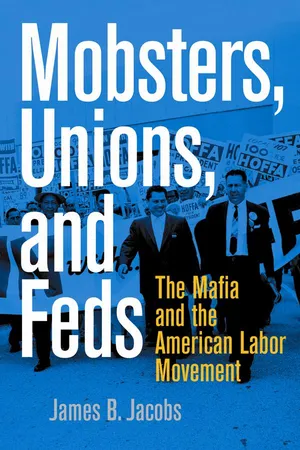
eBook - ePub
Mobsters, Unions, and Feds
The Mafia and the American Labor Movement
- 320 pages
- English
- ePUB (mobile friendly)
- Available on iOS & Android
eBook - ePub
About this book
Information
Topic
StoriaSubtopic
Storia nordamericana1
Introduction
The public must not be allowed to believe that organized labor is represented by those few unions in which union delegates have become criminals, or criminals have been made into union delegates. Unless they are purged, labor unions which have been thus taken over by criminals will, just as certainly as night follows day, wreck the cause of organized labor in this country and set back its progress many years. The officers of these unions are all too frequently the willing tools of professional criminals who direct their activities and keep them in office by means of force and fear.
—Special NYC Prosecutor Thomas E. Dewey, July 30, 1935,
radio address, quoted in Dewey’s autobiography,
Twenty against the Underworld
radio address, quoted in Dewey’s autobiography,
Twenty against the Underworld
We thought we knew a few things about trade union corruption, but we didn’t know the half of it, one-tenth of it, or the one-hundredth of it. We didn’t know, for instance, that we had unions where a criminal record was almost a prerequisite to holding office under the national union….
—AFL-CIO President George Meany reacting to the
McClellan Committee hearings, as reported by
the New York Times on November 2, 1957
McClellan Committee hearings, as reported by
the New York Times on November 2, 1957
Labor racketeering, the exploitation of unions and union power by organized crime, has been an unpleasant fact of life since the late nineteenth century. It thrived practically unopposed until the last quarter of the twentieth century and continues, albeit under relentless government attack, into the twenty-first century.
The racketeers’ basic modus operandi includes looting union treasuries and pension funds by theft, fraud, and bloated salaries; selling out union members’ rights and interests in exchange for employers’ bribes and kickbacks; exploiting union power to extort employers, and conspiring with employers to operate employer cartels that allocate contracts and set prices. Labor racketeering serves the organized crime families as a bridge to the power structure in many American cities. For much of the early and mid-twentieth century, corrupt politicians provided labor racketeers protection from the criminal justice system in exchange for campaign contributions, campaign workers, votes, manipulation of elections and corrupt opportunities for personal enrichment.1
In the late 1950s, the Senate McClellan Committee made labor racketeering a national issue. Over the next two decades, Congress created some special labor racketeering offenses and the Senate Permanent Subcommittee on Investigations held periodic hearings and issued reports criticizing the Department of Justice and the Department of Labor for failing to attack labor racketeering. Not until the mid-1970s, after the death of longtime FBI Director J. Edgar Hoover, did federal law enforcement make organized crime control a priority. When Teamsters president Jimmy Hoffa disappeared in 1975, apparently the victim of an organized crime assassination, the FBI made labor racketeering an important target in its campaign against organized crime. By contrast, the U.S. Department of Labor and the organized labor movement essentially ignored complaints by rank-and-file union “dissidents” about organized crime intimidation, fraud, mistreatment, and exploitation.
In the 1980s the FBI, the U.S. Department of Justice, and the U.S. Department of Labor launched investigations, criminal prosecutions, and civil racketeering lawsuits against racketeer-ridden union locals, regional councils, and even national/international unions. (International unions have local affiliates in Canada as well as the United States.) This campaign produced hundreds of prosecutions and at least 20 courtmonitored trusteeships imposed on organized crime–dominated labor unions. Some of those trusteeships have been brought to conclusion, having achieved varying degrees of success, but as of late 2005, most of them remain works in progress. New organized crime and labor racketeering cases (criminal, civil, and administrative) continue to percolate.
This chapter previews the rest of the book. Chapters 2–4 provide background on the nature and extent of the problem. Beyond that, they seek to establish two fundamental points: first, that labor racketeering has been a central and defining activity of the Cosa Nostra (LCN) organized crime families; second, that labor racketeers have been a significant problem for the U.S. labor movement throughout the twentieth century. More specifically, Chapters 2 documents and explains the extent of LCN exploitation of labor unions and how that exploitation turned organized crime figures into economic and political power brokers. Chapters 3 and 4 document and explain the nature and extent of labor racketeering in the labor movement circa 1980 (Chapters 3) and in New York City in the post–World War II period (Chapters 4).
Chapters 5–7 deal with the response to labor racketeering by the American Federation of Labor (AFL), the Congress of Industrial Organizers (CIO), and the combined AFL-CIO (Chapters 5), by rank-and-file union members (Chapters 6) and by local, state, and federal law enforcement agencies (Chapters 7). Chapters 5 explains that the AFL-CIO, the U.S. umbrella labor federation, took some halting steps against labor racketeering in the 1950s, during and after the U.S. Senate’s McClellan Committee hearings. However, since then, the AFL-CIO has more or less ignored the problem, apparently fearing that an attack on labor racketeering would divide and weaken the labor movement. In Chapters 6, we will see that although labor racketeers used intimidation, violence, and economic power to thoroughly repress workers and rank-and-file union members, reformers, often called “dissidents,” have courageously challenged this domination with protests, election challenges, and litigation. Sadly, these struggles almost always failed, frequently costing the reformers their economic livelihood, physical security, and sometimes even their lives. Chapters 7 argues that for most of the twentieth century, local law enforcement was either too corrupt or too weak to take on organized crime although, to be sure, there were some important exceptions. Federal law enforcement remained aloof from organized crime control. When federal law enforcement finally took action, the labor racketeers suffered major defeats and momentum passed into the hands of reformers.
Utilizing in-depth case studies, chapters 8–13 begin the monumental task of documenting and analyzing the federal government’s campaign against labor racketeering. The campaign began in 1982 with the filing of the first civil RICO (Racketeering and Corrupt Organizations Act) lawsuit against the racketeer-ridden Teamsters Local 560 and continues to the present (fall 2005). Chapters 8 explains the way the RICO law works in labor racketeering cases and provides an overview of twenty years of antilabor racketeering investigations and litigation. Chapters 9 presents a case study of the IBT Local 560 case, a remarkable success story. After twelve years of effort by the Department of Justice, the Department of Labor, a federal district court judge, a court-appointed trustee, and members of Local 560 purged the mobsters and voted a reform regime into office. The same cannot be said of the New York City District Council of Carpenters (Chapters 10), which, though subject to vigorous criminal and civil litigation and despite the best efforts of a savvy court-appointed trustee, has not been successfully liberated. In Chapters 11, we examine the RICO-spawned remediation of the four international unions that, for decades, have been most influenced by organized crime. Because of the immense size (geographically and numerically) of these unions, it is difficult to evaluate the RICO litigation, but we will identify some of the most important features of the reform efforts. Chapters 12 will draw some conclusions about the successes and failures of more than twenty years of anti–labor racketeering initiatives and suggest future strategies. The concluding chapter will attempt to place labor racketeering and its remediation in conceptual and theoretical perspective.
Having previewed the book’s organization, we now turn to introducing the “characters.”
COSA NOSTRA
The Italian-American organized crime groups that became Cosa Nostra did not invent labor racketeering. Members of Jewish and Irish organized crime groups were the earliest labor racketeers and established the basic patterns of labor racketeering.2 The Italian-American organized crime groups became extraordinarily powerful during the period of national alcohol prohibition (1920–1933). By the 1940s, these crime “families” had more or less achieved their present-day form.* There were twenty-four crime families operating in twenty cities; five families coexisted in New York City. All were organized along the following lines: the boss was assisted by an underboss and a consigliere (counselor) chosen by the “capos” as a kind of ombudsman to whom they could bring problems that arose with other capos or even with the boss. The “made members” or “soldiers” who had gone through an initiation ritual and sworn fealty to Cosa Nostra were organized into “crews,” each led by a “capo” or captain. Moreover, each crew included “associates” who worked with the capo and soldiers but who were not themselves “made members.” Scholars disagree as to whether the twenty-four families were “ruled” or “coordinated” by a “commission” of large family bosses. My view is that there is little evidence of the existence of a Mafia commission that ruled in any meaningful sense of the word. No doubt crime family bosses met from time to time, and in different configurations, to “adjudicate” or negotiate interfamily disputes and discuss matters of mutual concern. The famous 1957 mass meeting at Apalachin, New York, is an example of a convention-type get-together.3 From time to time there may have been a group (committee) of bosses who met as a kind of court, as occasions arose, to settle interfamily disputes. But there was never anything resembling national government of organized crime families that made “law” or issued and enforced policy. The crime families have always operated autonomously.
* The history of Cosa Nostra has been often told. The bloody Castellamarese war of the late 1920s pitted two organized crime factions against each other. Salvatore Maranzano emerged the victor. But when he attempted to further consolidate his power, he was assassinated by Charles (“Lucky”) Luciano, Vito Genovese, Meyer Lansky, and several other organized crime figures. Luciano assigned the major crime families territories and established a commission to mediate interfamily conflicts. See Thomas E. Repetto, American Mafia: A History of Its Rise to Power (New York: Henry Holt, 2004).
THE UNIONS
The history of the American labor movement can be traced back to the eighteenth century.4 Nascent labor unions proliferated by the late nineteenth century with the growth and industrialization of the U.S. economy. Indeed, that period was marked by some extraordinarily bloody clashes between labor organizers and businesses determined to prevent their workers from organizing. Most often the police and the courts sided with the employers. Many union organizers were prosecuted in state courts for conspiracy and other offenses.5 Many courts issued injunctions ordering union leaders and members to cease and desist from strikes and other disruptions of business.* This era of violence brought gangsters into labor/management conflicts on both sides and laid the ground for permanent organized crime infiltration of the labor movement. Intervention by the police, prosecutors, and courts on the side of business established a legacy of suspicion and distrust of government involvement in labor matters that persists to this day throughout the labor movement.
* The Norris-LaGuardia Act (1932), 29 U.S.C. § 101, prohibited federal courts from enjoining most strikes.
The 1935 Wagner Act6 recognized the right of private-sector workers to bargain collectively with their employers. The act established a National Labor Relations Board to administer a complex web of regulations governing union jurisdiction, recognition or election of the union that would serve as a given group of workers’ exclusive bargaining agent, and the duties of both management and labor in negotiating in good faith with each other. Union membership soared, increasing from 3.8 million in 1935 to 12.6 million in 1945.7
By 1947, business leaders, Republicans and some Democrats in Congress, and some elements of the citizenry had become convinced that organized labor was too powerful. Over fierce opposition from the labor movement, Congress passed the Taft-Hartley Act,8 which aimed to cut back labor’s power by prohibiting secondary boycotts, allowing the president to temporarily halt certain strikes, prohibiting political contributions by unions, and prohibiting the closed shop. The act also included a provision outlawing labor bribery; it became a crime for an employer to give anything of value to a labor official and for a labor official to accept anything of value from an employer. President Harry Truman vetoed the law, but Congress overrode the veto with a two-thirds vote.
Labor unions were organized at the local, regional, and national/international levels. National unions granted charters to individuals to organize local chapters of their union among workers in a particular bargaining unit. Local unions typically included workers employed by a number of different businesses, usually but not always in the same industry. Thus, a local’s membership could range from the low hundreds to more than ten thousand. The local’s officers bargained with each of their members’ employers to achieve collective bargaining agreements that governed the terms and conditions of employment. Beginning in the 1940s, union negotiators regularly sought to obtain employer contributions to worker pension and welfare funds. By the 1950s and 1960s some of these funds held immense deposits, thereby posing an irresistible target for organized crime.9
The constitutions of some national unions provided for regional councils comprising all the local unions in that council’s geographical area. The officers of the councils were chosen by the leaders of the union locals that made up the council. The powers of the councils differed, but in many cases the councils engaged in collective bargaining with the various locals’ members’ employers. They also provided a level of insulation for the officers who were accountable to the locals’ representatives, not to the rank and file.
LABOR RACKETEERING
The penetration of labor unions by professional criminals dates back to the late nineteenth century.10 Not all unions were equally susceptible to being taken over by organized crime elements. The most susceptible unions were those whose members worked for numerous small employers in geographically dispersed locations. Such workers were unable to organize themselves to oppose gangsterism. Working alone or in small groups, they could be easily intimidated and subdued. Therefore, it is not surprising to find that some of the first unions to be captured by organized crime were made up of restaurant workers, coach and truck drivers, and construction workers. Other unions susceptible to takeover included construction and longshoring (loading and unloading seaborne cargo), where work was seasonal or sporadic and employers relied on union hiring halls to send them workers when needed. Racketeering susceptibility was very high when union officials could punish opponents and reward supporters by denying or awarding jobs. The craft unions, those with the highest susceptibility to racketeering, were mostly affiliated with the American Federation of Labor (AFL).
The racketeering susceptibility of so-called “industrial” unions composed of factory workers was much lower. Factory workers were organized much later than “craft” workers, in part because the large employers could resist more effectively. When factory workers were organized, it was along the lines of the whole plant, that is, in industrial unions. Workers who belonged to large industrial unions were more closely tied to their employers than were craft workers who often moved from job to job, and employer to employer. Therefore it was much more difficult for labor racketeers to intimidate and dominate them. The industrial unions also tended to be more ideological than the craft unions; socialist...
Table of contents
- Cover Page
- Title Page
- Copyright Page
- Dedication
- Contents
- Preface
- Acknowledgments
- List of Acronyms
- 1 Introduction
- 2 Organized Crime and Organized Labor
- 3 President’s Commission on Organized Crime
- 4 Labor Racketeering in New York City
- 5 Organized Labor’s Response to Organized Crime
- 6 Labor Racketeering and the Rank and File
- 7 Attacking Labor Racketeering Prior to Civil RICO (1982)
- 8 Civil RICO Suits and Trusteeships
- 9 The Liberation of IBT Local 560
- 10 The New York City District Council of Carpenters
- 11 The Four International Unions
- 12 Evaluating Civil RICO
- 13 Concluding Reflections
- Notes
- Bibliography
- Index
- About the Author
Trusted by 375,005 students
Access to over 1.5 million titles for a fair monthly price.
Study more efficiently using our study tools.
Frequently asked questions
Yes, you can cancel anytime from the Subscription tab in your account settings on the Perlego website. Your subscription will stay active until the end of your current billing period. Learn how to cancel your subscription
No, books cannot be downloaded as external files, such as PDFs, for use outside of Perlego. However, you can download books within the Perlego app for offline reading on mobile or tablet. Learn how to download books offline
Perlego offers two plans: Essential and Complete
- Essential is ideal for learners and professionals who enjoy exploring a wide range of subjects. Access the Essential Library with 800,000+ trusted titles and best-sellers across business, personal growth, and the humanities. Includes unlimited reading time and Standard Read Aloud voice.
- Complete: Perfect for advanced learners and researchers needing full, unrestricted access. Unlock 1.5M+ books across hundreds of subjects, including academic and specialized titles. The Complete Plan also includes advanced features like Premium Read Aloud and Research Assistant.
We are an online textbook subscription service, where you can get access to an entire online library for less than the price of a single book per month. With over 1.5 million books across 990+ topics, we’ve got you covered! Learn about our mission
Look out for the read-aloud symbol on your next book to see if you can listen to it. The read-aloud tool reads text aloud for you, highlighting the text as it is being read. You can pause it, speed it up and slow it down. Learn more about Read Aloud
Yes! You can use the Perlego app on both iOS and Android devices to read anytime, anywhere — even offline. Perfect for commutes or when you’re on the go.
Please note we cannot support devices running on iOS 13 and Android 7 or earlier. Learn more about using the app
Please note we cannot support devices running on iOS 13 and Android 7 or earlier. Learn more about using the app
Yes, you can access Mobsters, Unions, and Feds by James B Jacobs,James B. Jacobs in PDF and/or ePUB format, as well as other popular books in Storia & Storia nordamericana. We have over 1.5 million books available in our catalogue for you to explore.