A particular dark triumph of modern nationalism has been its
ability to persuade citizens to sacrifice their lives for a political vision
forged by emotional ties to a common identity. Both men and women can respond to nationalistic calls to fight that
portray muscular warriors defending their nation against an easily recognizable
enemy. This “us versus them” mentality can be seen in sectarian violence
between Hindus and Muslims, Tamils and Sinhalas, Serbs and Kosovars, and
Protestants and Catholics. In Muscular
Nationalism, Sikata Banerjee takes a comparative look at India
and Ireland and
the relationship among gender, violence, and nationalism. Exploring key texts
and events from 1914-2004, Banerjee explores how women negotiate “muscular
nationalisms” as they seek to be recognized as legitimate nationalists and
equal stakeholders in their national struggles.
Banerjee argues that the gendered manner in which dominant
nationalism has been imagined in most states in the world has had important
implications for women’s lived experiences. Drawing on a specific intersection of gender and nationalism, she
discusses the manner in which women negotiate a political and social terrain
infused with a masculinized dream of nation-building. India and Ireland—two states shaped by the
legacy of British imperialism and forced to deal with modern political/social
conflict centering on competing nationalisms—provide two provocative case
studies that illuminate the complex interaction between gender and nation.
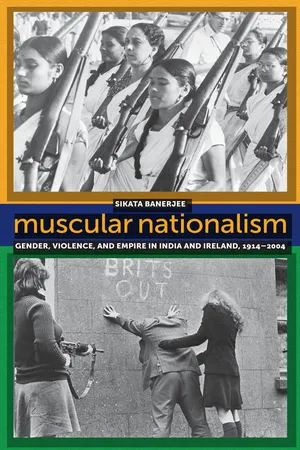
eBook - ePub
Muscular Nationalism
Gender, Violence, and Empire in India and Ireland, 1914-2004
- 217 pages
- English
- ePUB (mobile friendly)
- Available on iOS & Android
eBook - ePub
About this book
Information
1 UNDER THE BRITISH GAZE
The Weak Bengali and the Simianized Celt
Published in 1860, John Brookes’s book Manliness: Hints to Young Men drew a link between national progress and manliness, asserting that manly nations are sure to progress, whereas unmanly nations are bound to be conquered: “Nations never remain stationary—they are always either progressing or retrograding. If they are manly their march towards perfect civilization is . . . certain . . . but if they become unmanly their retrogression is rapid and awful.”1 Brookes’s conflation of manhood and national progress was an integral part of British imperial expansion in the late nineteenth and early twentieth centuries. Specifically, nations defined by martial prowess, strength, and discipline—traits of hegemonic masculinity—were sure to attain a level of civilization that “unmanly” (read: effeminate) nations hindered by weakness, as well as lack of discipline and martial prowess, could not attain. The linkage between British notions of hegemonic masculinity and imaginings of empire has been a topic of contemporary research.2 Inherent in this relationship is the pejorative judgment of the conquered. In the words of Said, such criticism can be related to a process of feminization in which the Orient (non-Western colonies in South Asia and the Middle East) was constructed as the weak, irrational, nonmartial “Other,” in contrast to a rational strong, martial European “Self.”3 Ronald Inden alludes to the European masculine hero who would conquer and create order out of the feminized chaos that was India.4 Said and Inden both imply that the feminization of the Orient encompassed a disparagement of Arab and Indian men who were conquered because they were effeminate and who were seen as effeminate because they were conquered. Their conquered status constructed them as not muscular, not aggressive, and not skilled in militarism, all values associated with femininity. Further, as is discussed in this chapter, the Irish, a colonized nation, were deemed “unmanly” and also feminized in ways similar to the processes described by Inden and Said. Thus, gender was a politically salient aspect of colonialism.
This chapter does not offer a comprehensive tracing of imperialism and normative ideas of manhood and womanhood but rather sketches out a cultural context highlighting British imperial concerns with muscularity, chivalry, martial prowess, rational governance, and self-discipline. These traits of hegemonic masculinity defined the British categorization of Indians and Irish, as well as their location within imperial space. This chapter delineates the impact of imperial masculinity as it emerged and evolved in the mid- to late nineteenth century. For the purposes of this book, the manner in which these ideals of manhood defined and constructed Irish and Bengali men was important for the unfolding of oppositional muscular nationalism in both contexts in the early twentieth century.
Green identifies four archetypes of English manliness in empire: the engineer, explorer, missionary, and soldier.5 The engineer tamed unruly nature—rivers, jungles—by utilizing science to build bridges, railroads, and highways; the explorer trekked throughout the mysterious subcontinent mapping terrain; the missionary heralded the civilizing force of Christianity; and the soldier conquered and maintained control over the “effeminate” colonized man. Although each version of manhood perhaps performed a different function within the imperial project, each figure embodied traits of hegemonic masculinity, strength, self-reliance, independence, and confidence as the colonies were controlled, categorized, and conquered.
Gender and Imperialism
I begin this exploration of the intersection of hegemonic masculinity and empire with the words of a colonial soldier who gained infamy in Indian nationalism because of his implication in the Jallianwala Bagh massacre of 1919:
I fired and continued to fire until the crowd dispersed, and I consider this is the least amount of firing which would produce the necessary moral and widespread effect it was my duty to produce if I was to justify my action. If more troops had been at hand the casualties would have been greater in proportion. It was no longer a question of merely dispersing the crowd, but one of producing a sufficient moral effect from a military point of view not only on those who were present, but more especially throughout the Punjab. There could be no question of undue severity.6
The extract is a rationale offered by General Reginald Edward Harry Dyer, defending his order to fire into a crowd of approximately ten thousand unarmed Indian men, women, and children. They had gathered in an enclosed square, Jallianwala Bagh, to protest the Rowlatt Act, which gave colonial authorities the right to detain suspects without trial. The question of “undue severity” was raised by his superiors because his troops blocked the only path into and out of the square, and many Indians and Britons characterized the deaths of his victims as a massacre.
The sociocultural processes that brought General Dyer to India and placed him in Jallianwala Bagh signify the complicated ties linking India and Ireland within the imperial grid, as well as a specific interweaving of hegemonic masculinity and empire. Ireland often functioned as the first stop for many colonial officers who went on to serve in India. For example, Sir John Anderson used the strategic expertise he gained in detaining Irish republicans to restrain and squash the physical force nationalist movement in Bengal.7 General Dyer was also a part of this colonial administrative path; he had served in Belfast in 1886 and became involved in suppressing violent anti-imperial clashes that resulted in deaths and injuries and extensive damage to property.8 Indeed, in 1920, when the British parliament debated the Hunter Commission report on the Jallianwala Bagh massacre, defenders of Dyer feared that the general’s censure would inhibit Britain’s ability to suppress rebellion not only in India but also in Ireland, which was then in the throes of the war of independence.9 There was no doubt that British imperial presence in Ireland was an implicit context for this debate about governance in India.
It should also be noted that the highly militarized Royal Irish Constabulary (RIC) provided the model of policing in the colonies. This model of policing tended to blur the line between the norms of civilian policing and military occupation.10 Although many colonial officers in India may have been influenced by their Irish experience, this experiential background in and of itself does not shape the unfolding of gendered nationalism in each context but rather remains an indicator of the interlocking reach of the British Empire, which is a part of the background against which gender, nation, and anticolonial resistance intersected.
More important for this book is the manner in which gender surfaced and played itself out in General Dyer’s approach to the rule of law and the use of justifiable force in suppressing political protest. His actions in Jallianwala Bagh need to be contextualized against the surfacing of what I have termed the role of women as border guards wherein the figure of the chaste woman functioned as the boundary between the orderly, masculine colonial Self and the chaotic, effeminate, colonized Other. Of all the violent acts committed by Indians during civil disturbances in Amritsar that culminated in the Jallianwala Bagh massacre, including the death of five European men, General Dyer viewed the violence experienced by the female missionary Marcella Sherwood, who was attacked by a group of Indian men while cycling in Amritsar, as the most serious. This led to the notorious “crawling order,” which dictated that, when Indian (men) found themselves in the lane where Miss Sherwood had been attacked, they had to get down on all fours and crawl. Many Englishwomen, including Marcella Sherwood, saw Dyer as the “savior” of the Punjab and wrote in his support when he faced a British tribunal to account for his actions at Jallianwala Bagh.11 These letters referred repeatedly to the 1857 war to reinforce the figures of virtuous English women and helpless children who required the protection of the muscular Englishman from the “bestial” native male. The chaste white woman as the victim of savage Indian sepoys (foot soldiers) was a trope that circulated in the British popular imagination and justified the violent manner in which the rebellious sepoys had been punished.12 It was clear that Dyer accepted this visual image of female virtue versus male savagery:
He [Dyer] had taken his niece to see Delhi and the Taj with Mary [his wife] just a fortnight ago, and driving through the old city of the capital they had been accosted by a mob of young men, one of whom jumped onto the rear bumper of his motor and peered grinning ape-like through the window. Luckily, Alice hadn’t turned to see that lecherous face with saliva drooling from its wretched red lips.13
Bose makes a compelling case that this fear of native male bestiality contributed to Dyer’s ferocious response in Jallianwala Bagh.
The particular gendered duality identified here, centered on the maidenly body of the English woman and the savage lust of the native man, can be situated within a specific power dynamic, the imperialism of the intimate, which emerged in the late nineteenth and early twentieth centuries, when a certain anxiety pervaded the colonial enterprise.14 This anxiety was shaped by competing strategies for maintaining control and doubts about the legitimacy of the colonial enterprise. This manifested in two main ways. First, with the abolition of slavery, colonial states had to deal with Europeans who were still running plantations and farms in Fiji, Jamaica, Trinidad, Malaysia, Indochina, Kenya, Uganda, and modern Zimbabawe and who needed cheap labor. This led to much debate over the legitimacy of colonial power at the same time that notions of universal human rights, freedom, and equality were occurring in the European centers of colonialism. Thus, much of the late nineteenth and early twentieth centuries was taken up by attention to a “noncoercive” imperialism (distinguished from violent and extractive rule) that debated attempts to create stable governments beneficial for colonized wage labor instead of slavery. In other words, an idea of facilitating the development of the colonies informed imperial control. However, this notion of development had an ambiguous relationship with Europe’s civilizing mission in its colonies.15 Put another way, political and economic development in the colonies were seen as a part of Europe’s imperial mission, but it was not clear whether self-rule was the logical culmination of this process.
A second manifestation of this societal dis-ease centered on and was expressed by the body of the white woman. The notion of “civilization” was integral to the circulation of imperial rule, and the distinction between civilized and uncivilized, although mainly defined by public actions, was also shaped by the domestic: who lived with whom, how they raised their children, what they ate. As Anne Stoler argues, colonial authority was constructed on two powerful and false premises: one, that Europeans in the colonies were an easily identifiable biological identity, and two, that boundaries separating colonizer from colonized were self-evident and recognizable.16 It is the second premise that is integral to my argument. As “border” guards, white femininities were expected to articulate this separation in an unequivocal manner. In short, their embodiment of proper motherhood and wifehood in the domestic would represent what it meant to be European. Consequently, they occupied an elevated status protected from the chaos of the colonized lives surrounding this serene private space. Race was tied to the intimate, as eloquently expressed by George Hardy, principal architect of French colonial educational policy: “A man remains a man as long as he stays under the gaze of a woman of his race.”17 Thus, sexuality and race intertwined to determine who could be intimate with whom.
This racialized imperialism of the intimate articulated itself through an interlocking and complicated dynamic linking the muscular (white) Englishman , the virtuous (white) Englishwoman, the savage colonized native male, and the vulnerable colonized woman. Since the white woman was frequently blamed for inflaming the colonized male by her very presence, her behavior, as well as the native male’s access to the space she occupied, was policed carefully. The figure of the colonized woman became implicated in this triangular relationship in several ways. Her perceived degradation and oppression were used by both white men and women and by colonized men to advance their political agendas. As the border guard of the colonized space, “native” women’s chastity was defended from the polluting gaze of the colonizing European man by her male guardians, and her body became synonymous with “authentic” anticolonial nationalism. In contrast, white men and women used her figure to either condemn the uncivilized colony or argue for the necessity of white women’s attaining political and economic equality as a precondition to helping their more unfortunate “sisters.”18 The configuration of the dynamic connecting these figures, of course, differed contextually. The first step in tracing the trajectory of this complicated dance of gender is the ideas of manhood that infused empire at this juncture.
Imperial Masculinity
The masculinity that connected empire and gender in British eyes was Christian. More specifically, it was a Protestant construct. It emerged in the mid-nineteenth century, when British imperial power was at its zenith and drew upon various traits: self-control, discipline, confidence, martial prowess, military heroism, heterosexuality, and rationality. This masculinization of Christianity emerged in a socio-economic context marked by shifting gender and racial roles enabled primarily but not exclusively by industrialization and urbanization.19 Faced by such social transformations, a certain section of the elite became apprehensive that a process of effeminization was weakening Englishmen and erasing the national masculinity on which imperial power was founded.20
Christian Manliness and Empire
In 1866, the Religious Tract Society of London published a monograph titled, “Christian Manliness: A Book of Examples and Principles for Young Men.” Its contents outlined several characteristics necessary for constructing an ideal Christian man: faith, personal will to decide, resolve, fidelity, courage, energy, perseverance, strength, gentleness, self-mastery, and prudence. The title, as well as the language of the tract, very clearly assumed a male audience.21 The Reverend John Caird, in Christian Manliness: A Sermon (1871), similarly observed, “Let inward principle take the place of instinct and outward restraint,—let the thoughtfulness, the intelligence, the earnest devotion, high and noble objects which are the characteristics of Christian manhood, raise you above the temptations of indolence and self-indulgence or the baser lives of appetites and sense.”22 These values constructed the figure of the manly English actor in opposition to an effeminate “Other” (read: native) marked by weakness, fickleness, cowardice, laziness, and a lack of self-control.
Within the discourse of imperialism, the values of Christian manliness were fused with traits of martial prowess, creating the Christian man at arms who represented empire and national glory. For example, Sir Henry Lawrence, a much revered colonial administrator and military commander, linked his imperial presence in India with his Christian duty. In his contributions to the Calcutta Review (1859), he described the ideology shaping his location as a commander in India: “On the other hand, what may not a Christian soldier do? The man who, a Chr...
Table of contents
- Cover Page
- Title Page
- Copyright Page
- Contents
- Acknowledgments
- Introduction: Politicized Femininity and Muscular Nationalism
- 1 Under the British Gaze: The Weak Bengali 21 and the Simianized Celt
- 2 “Muscular Gael” and “Warrior Monk”: Muscular Nationalism in Colonial India and Ireland
- 3 Irish and Indian Women in Muscular Nationalism (1914–1932)
- 4 Politicized Femininity and Muscular Nationalism in the Postcolonial Context: Naxal and Armagh Women
- 5 Who Is a Proper Woman in the Nation? Femininity in the Roop Kanwar Immolation and the 2004 Irish Citizenship Referendum
- Conclusion: Women and Muscular Nationalism: 163 Some Final Thoughts
- Notes
- Bibliography
- Index
- About the Author
Trusted by 375,005 students
Access to over 1.5 million titles for a fair monthly price.
Study more efficiently using our study tools.
Frequently asked questions
Yes, you can cancel anytime from the Subscription tab in your account settings on the Perlego website. Your subscription will stay active until the end of your current billing period. Learn how to cancel your subscription
No, books cannot be downloaded as external files, such as PDFs, for use outside of Perlego. However, you can download books within the Perlego app for offline reading on mobile or tablet. Learn how to download books offline
Perlego offers two plans: Essential and Complete
- Essential is ideal for learners and professionals who enjoy exploring a wide range of subjects. Access the Essential Library with 800,000+ trusted titles and best-sellers across business, personal growth, and the humanities. Includes unlimited reading time and Standard Read Aloud voice.
- Complete: Perfect for advanced learners and researchers needing full, unrestricted access. Unlock 1.5M+ books across hundreds of subjects, including academic and specialized titles. The Complete Plan also includes advanced features like Premium Read Aloud and Research Assistant.
We are an online textbook subscription service, where you can get access to an entire online library for less than the price of a single book per month. With over 1.5 million books across 990+ topics, we’ve got you covered! Learn about our mission
Look out for the read-aloud symbol on your next book to see if you can listen to it. The read-aloud tool reads text aloud for you, highlighting the text as it is being read. You can pause it, speed it up and slow it down. Learn more about Read Aloud
Yes! You can use the Perlego app on both iOS and Android devices to read anytime, anywhere — even offline. Perfect for commutes or when you’re on the go.
Please note we cannot support devices running on iOS 13 and Android 7 or earlier. Learn more about using the app
Please note we cannot support devices running on iOS 13 and Android 7 or earlier. Learn more about using the app
Yes, you can access Muscular Nationalism by Sikata Banerjee in PDF and/or ePUB format, as well as other popular books in Politics & International Relations & Politics. We have over 1.5 million books available in our catalogue for you to explore.