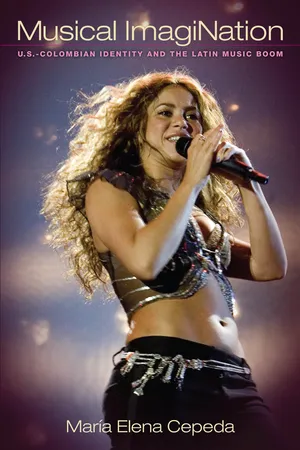
Long associated with the pejorative clichés of the drug-trafficking trade and political violence, contemporary Colombia has been unfairly stigmatized. In this pioneering study of the Miami music industry and Miami’s growing Colombian community, María Elena Cepeda boldly asserts that popular music provides an alternative common space for imagining and enacting Colombian identity. Using an interdisciplinary analysis of popular media, music, and music video, Cepeda teases out issues of gender, sexuality, race, ethnicity, and transnational identity in the Latino/a music industry and among its most renowned rock en español, pop, and vallenato stars.
Musical ImagiNation provides an overview of the ongoing Colombian political and economic crisis and the dynamics of Colombian immigration to metropolitan Miami. More notably, placed in this context, the book discusses the creative work and media personas of talented Colombian artists Shakira, Andrea Echeverri of Aterciopelados, and Carlos Vives. In her examination of the transnational figures and music that illuminate the recent shifts in the meanings attached to Colombian identity both in the United States and Latin America, Cepeda argues that music is a powerful arbitrator of memory and transnational identity.
- 272 pages
- English
- ePUB (mobile friendly)
- Available on iOS & Android
eBook - ePub
About this book
Information
1
La crisis colombiana
Contextualizing the Political Moment
Since its inception, the parameters of this project have been constantly defined and redefined by the very histories of violence and displacement that permeate contemporary Colombian history. My long-anticipated visit to Colombia’s renowned vallenato musical festival had to be canceled due to threats by guerrilla groups. A later trip to Colombia was marked by yet another armed attack against my cousin and his young grandson, the fourth such act of violence against an immediate family member that my young relative had witnessed before entering the first grade. As I completed an initial draft of this text, a large group of family members quickly left Colombia to settle near my family, victims of the nation’s failing economy and of increased guerrilla activity in the region where they lived. They have since returned to Colombia (where one of them was kidnapped and shortly thereafter released), only to be replaced by others. Virtually everyone I know in Colombia has had his or her daily activities curbed if not dictated to a marked degree by violence and by the economic and political crisis to which the violence is inextricably linked. And the characteristic Colombian desconfianza, or lack of trust, born of these circumstances follows those who relocate to the United States, in turn affecting their willingness to interact with other colombianos or to publicly recognize their own national identity at all. While it is a determining factor in the lack of social cohesion among U.S.-Colombians—the vast majority of whom do not participate in the illicit drug trade or other illegal activities—the general desconfianza that is partly attributable to the drug-trafficking stereotype has also paradoxically fortified the community’s ties to the (imagined) homeland.1 These factors and many others, familiar to so many Colombians both in South America and el exterior,2 have colored not only my eventual choice of topic but also my political views and scholarly interpretations of the music, artists, critics, fans, and government officials discussed here.
As previously established, Colombians have recently emerged as the largest community of South American origin in the United States and as one of the most dynamically transnational populations of the Western hemisphere. U.S.-Colombians have already had a noteworthy impact on the inter-Latino social, cultural, political, and economic dynamics of major U.S. urban centers like New York and Miami, where Colombian record producers, composers, and musicians played a pivotal role in the so-called Latin(o) music boom of the late 1990s and the first decade of the twenty-first century. Latino Studies scholars have long noted that in-depth analyses of lesser-known yet swiftly expanding U.S. Latino communities such as Colombians illuminate our understanding of more frequently studied Latino populations such as Chicanos, Puerto Ricans, and Cubans. To this end, the expanded interest in the study of the South American diaspora testifies to the efficacy of Latinidad as construct.3
Despite the relative proliferation of scholarly monographs on U.S. Latino popular music and culture in recent years, a dearth of book-length studies documenting the cultural production of the burgeoning populations known as “new Latinos” persists.4 Among the second- and third-largest Latino communities in major urban centers such as New York, Los Angeles, Miami, and Houston, among others, new Latino populations function as “mirrors” for larger, more established Latino communities in the same spaces and in this sense prove vital not only to the construction of individual identities but to a more nuanced understanding of Latinidad itself. However, the “new Latino” label, while serving as useful demographic shorthand, tends to mask not only the longstanding presence but also the multiple societal contributions of Central, South American, and certain Caribbean immigrant communities. The label thus inadvertently underscores the need to reformulate the ways in which we measure a given community’s historical presence in the United States.5 Nevertheless, while these communities are not as “new” as the 2000 Census data and much existing scholarly literature might lead one to believe, research on the U.S.-Colombians, Guatemalans, Salvadorans, Dominicans, and Ecuadorian communities subsumed under the “new Latinos” label is in fact new to U.S. Latin(o) music studies. This is arguably in part a result of these populations’ lack of incorporation into the U.S. higher education system and elite networks of knowledge production. For these reasons, and undoubtedly for many more, in recent years the subfield of U.S.-Colombian Studies has just begun to emerge in connection to the broader fields of U.S. Latino Studies, American Studies, Ethnic Studies, Latin American Studies, and Colombian Studies.
For all these reasons, at present U.S.-Colombian Studies is necessarily a transnational endeavor, or what Michael Peter Smith has described as a “shift from place to places, simultaneously and complexly interconnected, by intended and unintended consequences.”6 Nevertheless, after decades of relative privilege afforded to the study of external as opposed to internal colonialism within the academy, the current rush to embrace the transnational within Latin American and American Studies, is not without its flaws. In this regard, academia’s too often uncritical celebration of the transnational, both as theory and as practice, at times fails to recognize the longstanding contributions of Latino Studies (and, in particular, U.S.-Mexican border studies), to the ongoing “worlding” of American Studies.7 Ultimately, this theoretical omission symbolically reinscribes the material inequities that permit us the luxury of forgetting that transnational migrants do not function as ethnoracial monoliths. Rather, transmigrant individuals and communities are “situated within various power-knowledge venues and occupy classed, gendered, and racialized bodies in space that immensely complicate the social structure of any kind of ‘community,’ transnational or otherwise.”8 Moreover, transnational communal networks are generally much longer in the making (and far more complex) than they appear to community outsiders, who at times perceive them as “overnight” phenomena. As the Colombian case well illustrates, transnational community-building practices are perhaps best understood as the socioeconomic, cultural, and psychic survival strategies of a people that has endured many years of sustained crisis.
Although Colombia has suffered due to internal conflict for decades, since the late 1980s Colombia has been further submerged in what many consider a “dirty war” involving opposing guerrilla and paramilitary factions, the state-sponsored military, drug traffickers, and sicarios, or hired assassins. Who fights whom and which factions are allied is not always clear, even as Colombia has come under the increasing scrutiny of international and domestic human rights organizations. Perceptions of the gravity of the current political situation vary, and, although few would deny the staggering kidnapping and murder rates, the primary source of the violence is a constant point of contention.
As a result of Colombia’s internal conflict, more Colombians suffer from poverty than at any period since the worldwide economic depression of the 1930s, with an estimated 60 to 68 percent living below the poverty line. Figures from 2006 indicate a murder rate of approximately 38 homicides per 100,000 Colombians, down from the 68 murders per 100,000 inhabitants recorded just four years earlier. The numbers of journalists and union leaders murdered have also dropped significantly in recent years, according to Colombian government statistics. However, the country’s labor organizers are still the target of more homicides than in any other nation in the world, a sobering fact that has not permitted the Colombian government to escape widespread international criticism for its inaction in this regard. Despite successful Colombian military operations such as the highly visible rescue of former Colombian presidential candidate Ingrid Betancourt and four U.S. citizens in July 2008, more than 700 individuals remained kidnapped prisoners of guerrilla forces as of late 2008. Between 1997 and 2007, roughly 3.8 million Colombians (about 8 percent of the country’s population), at least one-third of whom were Afro-Colombian or indigenous, were internally displaced. More than 300,000 new cases of internally displaced individuals were recorded in 2007, with an additional 110,000 instances of displacement noted during the first three months of 2008 alone. Half a million Colombian refugees have also fled to neighboring countries as a result of the ongoing conflict among guerrilla, paramilitary, and government factions. Crimes such as assassinations, extrajudicial executions, forced disappearances, and torture frequently go unpunished.9
The inordinate amount of political violence in Colombia is further complicated by the fact that the Colombian nation is fighting a “dirty war.” A large number of armed civilians have begun to act as soldiers and policemen, allowing them to commit crimes with less fear of being detected. Conversely, actual army and police force members frequently dress as civilians in order to more easily avoid legal formalities if they are arrested. In addition, members of paramilitary groups often disguise themselves as guerrilleros to carry out their missions. These practices constitute central strategies of any “dirty war,” in which “dirty” actions “cannot be attributed to persons on behalf of the State because they have been delegated, passed along, or projected upon the confused bodies of armed civilians.”10 As a direct consequence of this violence, Colombia now claims the world’s highest homicide rate of a country not at war, as well as a dismal human rights record. According to Mario Murillo, during the 1980s the armed forces and the national police were deemed responsible for approximately 70 to 75 percent of all human rights violations in the country. Since the acceleration of counterinsurgency operations in the mid-1990s, Colombian paramilitary forces have committed an identical percentage of abuses. Guerrilla forces are blamed for 20 to 25 percent of all human rights violations.11
With roots dating back to the mid-1960s, Colombia’s two primary guerrilla factions (the FARC, or Revolutionary Armed Forces of Colombia, organized in 1964, and the ELN, or the National Liberation Army, organized in 1965) are the remaining leftist combatants in the nation’s lengthy history of armed insurrection. Although both of these groups have pledged varying degrees of allegiance to the Communist Party since their inception, many scholars argue that their existence is most accurately traced back to La Violencia (The Violence), a period of widespread political violence during the 1940s and 1950s. While frequently represented as little more than a period of entrenched familial and organizational conflict between the rival Conservative and Liberal parties, La Violencia is nonetheless inextricably linked to the violence, economic crisis, and pervasive political disenfranchisement within Colombia today.12
As of 2004, an estimated 2,000 to 3,000 Colombian men, women, and children were participants in the ELN, an organization primarily known for its repeated sabotage of the oil pipelines located in northeast Colombia. In comparison, the FARC constitutes a far larger force and has quadrupled in size since the early 1990s, with an estimated 15,000 to 20,000 members by 2004. Today, the FARC operates on more than 105 fronts and controls more than 40 percent of Colombia’s national territory. This is not to suggest, however, that the guerrilla forces are enjoying increased popularity. Rather, for rural youth in particular, joining the ranks of the FARC, the ELN, or the right-wing paramilitary squads generally known as the AUC (Autodefensas Unidas de Colombia) or “paras” is frequently the only viable employment option available. In the more than forty years since its inception, the FARC in particular has witnessed a significant decline in its support among the Colombia peasantry, at least partially as a result of the rise of AUC forces in the regions where the FARC once acted with impunity.13 This perceptible philosophical shift, however, has proven far more complex; as the historian Marco Palacios observes,
the guerrillas seem to have renounced the supreme objective of taking power for the purpose of socialist revolution. The spirit of self-sacrifice and moral Puritanism associated with the combatant of Maoist or Guevarist extraction has given way to a pragmatic and professional model. Being a guerrilla has become an organized way of life, a career, with a political track available . . . but [the guerrillas] continue to express social resentments, rebelliousness, and a political anger whose rhetoric, despite the collapse of the Soviet bloc, has some resonance in the face of a political order assumed to be unjust and rotten.14
By 1994, Amnesty International was able to verify the existence of a “third actor” in the Colombian conflict in their annual report on political violence in Colombia: the supposedly independent AUC. Since the group’s formation in the early 1980s as a means of combating Marxist guerrilla groups, wealthy anti-Communist landowners and drug traffickers have offered the paramilitaries economic aid under the guise of eliminating the guerrilla forces, though each party has its own underlying agenda.15 Thus, the paramilitaries have come to represent a “marriage of convenience” between the corrupt Colombian military and the factions that constitute its economic support base. The main targets of these groups’ aggression are trade unionists, leftist political and social organizations, and peasants. As of 1996, the AUC’s political leader, Carlos Castaño, claimed to lead a force of approximately 2,000, guaranteeing the paramilitaries national visibility by the late 1990s. By 2000, the number of AUC troops had climbed to 11,200 (a 460 percent increase in four years). As of 2003, paramilitary forces were said to number between 13,000 and 19,500.
Though historically contained within the nation’s rural zones, by the 1990s the guerrilleros had gained various urban footholds, and, soon afterwards, paramilitary forces became active in several working-class urban neighborhoods, as well. However, while the leftist guerrillas as well as the right-wing paramilitary groups maintain some ties to the Colombian drug trade, surveys have revealed that paramilitary groups have been involved in more civilian murders and displacements than the guerrillas. As individuals suspected of supporting guerrilla activities, even those involved in unrelated localized political movements are vulnerable to paramilitary retaliation. Moreover, the paramilitary leader Carlos Castaño at one point openly claimed responsibility for 80 percent of Colombia’s existing cocaine operations. As a result, in August 2001, the U.S. government officially added the AUC to its list of terrorist organizations.16
The alliance among the state military, right-wing paramilitary groups, and drug traffickers working to eliminate what the Colombian government has dubbed the “internal enemy” is responsible for the majority of recorded murders, and by the early twenty-first century paramilitary forces were connected to roughly 80 percent of all politically motivated killings. Despite the fact that roughly 1,000 current AUC members have also served in the Colombian military, including numerous officers, it is only in recent years that the Colombian government has endeavored to publicly condemn the AUC’s actions, referring to the paramilitaries as a “terrorist” organization (a classifier of potent significance in the aftermath of 9/11).17 As Murillo explains, the AUC’s relatively late classification as a terrorist organization neatly illustrates the fundamentally political nature of such definitions:
the presence of the guerrillas provides the state with the justification to declare states of emergency, suspend civil protections, expand the role of the military to include civilian police functions, endorse the use of torture, and wage a war against the popular movement, all while failing to implement the political and economic reforms demanded by the vast majority of the population. Again and again, this is done in the name of national security, restoring order, and defending democracy.18
In this context, the “internal enemy” label applied to Colombia’s armed guerrillas assumes greater significance given that the bulk of international publicity, most notably that generated within the U.S. media, posits the drug traffickers and the Colombian government as opposing forces, largely neglecting to include paramilitary, military, and guerrilla factions in the equation. This pattern persists, despite the fact that the AUC has reaped considerable economic benefits from its connections to the upper end of the international drug trade and even though both the guerrillas and the AUC use drug-trafficking profits to provide soldiers with rations, uniforms, weapons, and the like.19
Significantly, Colombia is the number one Latin American recipi...
Table of contents
- Cover Page
- Title page
- Copyright Page
- Contents
- Dedication
- Acknowledgments
- Introduction: Colombian Connections: Tracing the Boundaries of the Colombian Musical ImagiNation
- 1 La crisis colombiana: Contextualizing the Political Moment
- 2 A Miami Sound Machine: Deconstructing the Latin(o) Music Boom of the Late 1990s
- 3 Shakira as the Idealized Transnational Citizen: Media Perspectives on Colombianidad in Transition
- 4 Florecita rockera: Gender and Representation in Latin(o) American Rock and Mainstream Media
- 5 The Colombian Vallenato acá y allá: Allegory for a Musical ImagiNation
- 6 The Colombian Transcultural Aesthetic Recipe: Music Video in the “New” American Studies
- Afterword: U.S.-Colombian Popular Music and Identity: Acknowledging the Transnational in the National
- Notes
- References
- Discography
- Index
- About the Author
Trusted by 375,005 students
Access to over 1.5 million titles for a fair monthly price.
Study more efficiently using our study tools.
Frequently asked questions
Yes, you can cancel anytime from the Subscription tab in your account settings on the Perlego website. Your subscription will stay active until the end of your current billing period. Learn how to cancel your subscription
No, books cannot be downloaded as external files, such as PDFs, for use outside of Perlego. However, you can download books within the Perlego app for offline reading on mobile or tablet. Learn how to download books offline
Perlego offers two plans: Essential and Complete
- Essential is ideal for learners and professionals who enjoy exploring a wide range of subjects. Access the Essential Library with 800,000+ trusted titles and best-sellers across business, personal growth, and the humanities. Includes unlimited reading time and Standard Read Aloud voice.
- Complete: Perfect for advanced learners and researchers needing full, unrestricted access. Unlock 1.5M+ books across hundreds of subjects, including academic and specialized titles. The Complete Plan also includes advanced features like Premium Read Aloud and Research Assistant.
We are an online textbook subscription service, where you can get access to an entire online library for less than the price of a single book per month. With over 1.5 million books across 990+ topics, we’ve got you covered! Learn about our mission
Look out for the read-aloud symbol on your next book to see if you can listen to it. The read-aloud tool reads text aloud for you, highlighting the text as it is being read. You can pause it, speed it up and slow it down. Learn more about Read Aloud
Yes! You can use the Perlego app on both iOS and Android devices to read anytime, anywhere — even offline. Perfect for commutes or when you’re on the go.
Please note we cannot support devices running on iOS 13 and Android 7 or earlier. Learn more about using the app
Please note we cannot support devices running on iOS 13 and Android 7 or earlier. Learn more about using the app
Yes, you can access Musical ImagiNation by Maria Elena Cepeda in PDF and/or ePUB format, as well as other popular books in Social Sciences & Discrimination & Race Relations. We have over 1.5 million books available in our catalogue for you to explore.