eBook - ePub
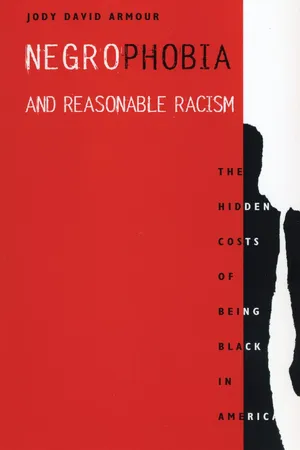
Negrophobia and Reasonable Racism
The Hidden Costs of Being Black in America
- 216 pages
- English
- ePUB (mobile friendly)
- Available on iOS & Android
eBook - ePub
About this book
Tackling the ugly secret of unconscious racism in American society, this book provides specific solutions to counter this entrenched phenomenon.
Information
Topic
Scienze socialiSubtopic
Studi afroamericaniChapter One
THE “REASONABLE RACIST”: A SLIPPERY OXYMORON
The “Reasonable Racist” asserts that, even if his belief that Blacks are “prone to violence” stems primarily from racism—that is, from a belief in the genetic predisposition of Blacks toward greater violence, from uncritical acceptance of the Black cultural stereotype, or from personal racial animus—he should be excused for considering the victim’s race before using force because most similarly situated Americans would have done so as well. In our criminal justice system, “blame is reserved for the (statistically) deviant,”1 asserts the Reasonable Racist. “Therefore,” he concludes, “an individual racist in a racist society cannot be condemned for an expression of human frailty as ubiquitous as racism.”
The Reasonable Racist’s position, though ultimately specious, can muster more factual and legal support than one might think. With regard to his claim that average Americans share his fear of Black violence, the Reasonable Racist can point to evidence such as a 1990 University of Chicago study which found that more than one out of two Americans endorses the proposition that Blacks tend to be “violence prone.”2 Moreover, numerous recent news stories chronicle the widespread exclusion of Blacks from shops and taxicabs by anxious storekeepers and cabdrivers, many of whom openly admit to making race-based assessments of the danger posed by prospective patrons.3 Thus, it is unrealistic to dispute the Reasonable Racist’s depressing contention that Americans tend to associate violence with Black people.
That most Americans share the Reasonable Racist’s discriminatory reactions to Blacks does not necessarily mean that they also share his racial prejudice. Many may claim to have completely nonracist grounds for their fear of Blacks. Specifically, many may insist that their racial fears are born of a sober analysis, or at least of rough intuition, of crime statistics that suggest Blacks commit a disproportionate number of violent street crimes. We shall consider such “rational racial fears” in the next chapter. Here we focus on irrational racial fears for two reasons. First, as we shall see in the discussion of unconscious mental reflexes in chapter 6, irrational factors figure to some extent in the racial fears of all Americans. Thus, just as he can prove that most Americans share his belief that Blacks are “prone to violence,” the Reasonable Racist can also prove that, like him, most Americans harbor irrational responses to Blacks. Thus, his most controversial contention is that most Americans’ heightened fear of Blacks is based primarily on conscious racial animus. This is equivalent to saying that most Americans are racist. I vigorously dispute this contention throughout this book.
The most apt description of the motivations that drive racial fears is “scrambled eggs.” That is, racial fears rest on mixed motives, with the yolks of the rational impulses completely and seemingly inextricably commingled with the irrational whites. To probe the legal relevance of racial fears, these motives must be temporarily unscrambled and separately evaluated. If neither the irrational nor the rational motives can justify racial discrimination standing alone, there is no reason to recognize such discrimination when its underlying motives revert to their naturally scrambled state. Therefore, let us provisionally accept the Reasonable Racist’s disquieting assumption that, like him, most Americans base their heightened fear of Black violence primarily on racism.
From the standpoint of legal doctrine, the Reasonable Racist also seems to have a case. Self-defense is generally defined as the use of a reasonable amount of force against another when the defender honestly and reasonably believes that she is about to be attacked, and that she must use such force to repel the attack.4 To be excused, then, the shooter in our tableau must convince the jury that she honestly and reasonably believed that she had to shoot just when she did to avoid being killed or seriously injured, and that nothing less drastic than deadly force would have saved her.5
Reasonableness is the linchpin of legal self-defense in two respects. First, even if the defender is mistaken in her belief that she is under attack (as was the shooter in the tableau), she has a valid defense as long as her mistaken belief was reasonable.6 Second, from a juror’s perspective, the reasonableness of a belief is a window on its honesty; that is, the more reasonable the belief seems to a jury, the more likely a jury is to be convinced that the defendant honestly held the belief herself. In the law of self-defense, therefore, “reasonableness” is the pivotal standard to which all other legal requirements are related and by which all others are measured.
The Reasonable Racist’s case hinges, therefore, on whether he can establish that typical beliefs are reasonable beliefs. The notion that typical beliefs are reasonable finds legal expression in certain familiar personifications of the reasonableness requirement, such as “the ordinary prudent man,” “the average man,” “the man in the street,”7 and “the man who takes the magazines at home, and in the evening pushes the lawn mower in his shirt sleeves.”8 The layreader must understand that “reasonableness” in legal discourse is a term of art, that is, a word whose legal usage differs markedly from that of ordinary language. A “reasonable” attitude or belief in legal discourse is not necessarily rational or right from some objective, eye-in-thesky point of view. Instead, as the “average man” formulation of the reasonableness standard suggests, courts tend to equate reasonable beliefs and attitudes with typical beliefs and attitudes. In the words of one criminal law expert, the Reasonable Man “is more appropriately described as the Ordinary Man (i.e., a person who possesses ordinary human weaknesses).”9 Moreover, in practically applying the reasonable person standard, the jurors—themselves typical people holding typical beliefs—ordinarily judge the reasonableness of the defendant’s beliefs by projecting themselves into the defendant’s situation and asking whether they would have shared his beliefs under similar circumstances. If the answer is yes, the Reasonable Racist maintains, the defendant should prevail.
How We Know What We Know: The Typical, the Reasonable, and the Accurate
Typical beliefs may be considered reasonable for two very different reasons. First, they are presumed to be accurate.10 Most of our claims to knowledge about the world rest on typical beliefs; we assume that the propositions about the world that “everyone knows” (propositions often equated with “common sense”) are true unless we have reason to doubt them. Of course, common sense may reflect and perpetuate oppressive myths and expedient misconceptions. Many women died excruciating deaths several hundred years ago because of the typical belief that witches cast spells that poisoned well water and caused crop failures. To see the disturbing implications for self-defense doctrine of the deep-seated assumption that typical beliefs are accurate, we need only make a few modifications in our earlier hypothetical situation and place it in the first half of the seventeenth century, the height of witch burnings in Europe:
The owner of a general store is counting his lucre at day’s end when out of the corner of his eye he suddenly notices a figure approaching his store. Focusing his full attention on the approaching figure, he notes that the person is an old woman (at least 65); that she is wearing a black dress and a cone-shaped black hat; and that she has a wart on her nose. As the old woman crosses the threshold, she reaches toward a pouch on a string around her neck (where she keeps her money, to buy something from the storekeeper) but which the storekeeper thinks is a pouch for potions. Panic-stricken and conscious of the bad graces he is in with the old women of the town (he has never passed up an opportunity to bilk or insult one he came across), he pulls a crossbow from under his counter and levels it at the entering figure. Seeing the crossbow trained on her, the woman thrusts her right hand in front of her while shouting at the man not to release the arrow. Perceiving spell-inducing gesticulations and unintelligible incantations, the storekeeper shoots and kills the old woman, who dies clutching a gold ducat.
However disturbing it may seem, in a seventeenth-century court that indulged the still prevalent presumption of accuracy for typical beliefs, there is no reason to think the storekeeper’s self-defense claim would not pass muster. Yet, despite the long and deplorable litany of injustices that historically have sprung from blind faith in conventional wisdom, conservatives continue to tout the sovereignty of “common sense” (Oliver North calls his syndicated talk show “common sense radio—for all America,” and Philip Howard’s book, Death of Common Sense, has been celebrated by conservatives for its catchy title, even though its substance does not necessarily bolster the conservative agenda).
American courts have shown undue deference to typical beliefs even in the case of scientific knowledge, an area where one would hope for a more searching truth-seeking methodology than mere nose counting. Until very recently, the test courts adopted for determining whether an expert could give an opinion on a scientific matter was whether the expert’s methodology and conclusions were consistent with the consensus of the scientific community. In other words, courts would not permit experts to talk about theories and findings that were not typical for the scientific community. The courtroom doors were closed to cutting-edge iconoclasts—contemporary counterparts of Copernicus and Galileo were denied a voice in the high halls of justice. Opinions that did not conform to prevailing scientific paradigms and practices were essentially treated as “junk science.” Such judicial genuflection to scientific orthodoxy has abated somewhat following the Supreme Court’s 1993 Daubert decision, in which the Court rejected the “general acceptance” test for scientific evidence in federal courts.11 Nevertheless, the pitfalls of relying too heavily on conventional wisdom, “common sense,” and hoary tradition in the search for truth can hardly be overstated.
Whether the reference group for determining what is typical is society at large (as in the case of the witch burnings) or some privileged subgroup within society (as in the case of the scientific community for purposes of expert testimony), our legal system tends to reward conformity and penalize nonconformity with the majority. Certainly the reasonableness standard, in its classic legal formulations (e.g., the “average man”), privileges the perspective of the majority. This approach to reasonableness might be equated to the problem of the Procrustean bed. In Greek mythology, Procrustes was a highwayman who waylaid unsuspecting travelers and dragged them to his lair, where he bound them to his bed. Although the abducted travelers came in many different sizes, Procrustes’ bed came in only one. If a hapless traveler proved too short for his host’s bed, Procrustes racked and stretched him into conformity; too long, Procrustes lopped of the offending extremities. In the end, the diversity of dimensions that the different travelers embodied was reduced to bland uniformity—a consummation devoutly sought by current proponents of Procrustean legislation that is fashioned to force the body politic to speak only one language, form only one kind of sexual union, worship only one god, and embrace only one worldview.
Procrustean beds abound in the law, but perhaps nowhere more than in the legal definition of reasonableness, which figures centrally in such areas as torts, contracts, criminal law, and criminal procedure. The legal definition of reasonableness is uniquely insidious in that it takes the merely typical and contingent and presents it as truth and morality, objectively construed. For example, according to legal usage, the “objective” standard of reasonableness encompasses those beliefs and attitudes that are shared by most people. In those limited instances in which a court instructs a jury to look at a situation from the standpoint of an actor’s atypical beliefs and attitudes, it is said to apply a “subjective” standard of reasonableness. Thus, a battered woman may believe that calling the police or attempting to separate from her batterer will only put her in greater danger. Accordingly, she may shoot him in his sleep. In judging the reasonableness of her belief, typical jurors may believe that calling the police or walking out would have prevented further harm. Some courts would characterize the jurors’ beliefs in this case as the “objectively” reasonable ones, while they would admit evidence of the battered woman’s atypical beliefs (especially expert testimony about those beliefs) only under the “subjective” test of reasonableness.
The problem with this approach is that the battered woman’s beliefs may be decidedly more rational and accurate than the jurors’. The beliefs of ordinary jurors about battering relationships are often based on inexperience and naiveté, or on ideological suppositions that women who remain in battering relationships masochistically enjoy being beaten, deserve to be beaten, or at least assume the risk of beatings. Saying that the wrongheaded beliefs of typical jurors meet the “objective” standard of reasonableness, while the atypical but accurate and rational beliefs of the battered woman are only relevant under a “subjective” standard of reasonableness, disparages the woman’s beliefs and wrenches all recognizable meaning from the term “objective.”
In the end, typical beliefs—in courts and in everyday life—still carry with them a presumption of accuracy. Accordingly, typical beliefs about the propensity of Blacks toward violence are deemed reasonable (i.e., accurate) insofar as we have no reason to doubt them. Often, however, a racially sensitive defender will not be claiming that his fearful reaction to Blacks is rational, but merely excusable. I therefore turn to the legal relation between the typical and the excusable.
Why We Blame Whom We Blame: The Typical, the Reasonable, and the Damnable
Alternatively, typical beliefs may be considered reasonable on the supposition that they are not blameworthy, however inaccurate or even irrational they may be.12 This is the claim of reasonableness invoked by both the Reasonable Racist and, as we will discuss later, the Involuntary Negrophobe. According to this position, even admittedly wrong judgments about a fact or situation should be excused so long as most people would have reached the same wrong conclusions under similar circumstances. A roll of keys that looks just like a gun in the eerily flickering lights of a bank lobby provides a simple illustration of this excuse. The argument rests on the premise that “blame is reserved for the (statistically deviant); we are blamed only for those actions and errors in judgment that others would have avoided.”13 Under a noninstrumental theory of criminal liability (that is, a theory that determines legal liability solely on the basis of an actor’s just deserts, and that gives no weight to social policy in fixing liability), it is unjust to punish someone like the Reasonable Racist since his typical beliefs are by definition not morally blameworthy.14
Speaking to a jury of other seventeenth-century men, the storekeeper who shot the supposed witch would argue that his belief was typical and accurate; speaking to a modern jury, however, he might concede that his beliefs were inaccurate, but still argue that they were typical for someone from his cultural background, and that therefore he was not blameworthy for holding such admittedly inaccurate beliefs. When the reference group for determining whether an attitude or belief is typical is not the majority, this kind of claim is referred to as the “cultural defense.” Thus, a Hmong tribesman from Laos kidnapped his intended bride in California and raped her in order to officiate their marriage, as is the tradition in his native country.15 Also in California, a Chinese mother killed her son in an attempt to commit parent-child suicide after discovering her husband’s adultery.16 Through a “cultural defense,” these defendants could attempt to negate or mitigate their criminal liability by arguing that they believed they were reasonably committing such acts because their cultural background and beliefs permit, and even encourage, such behavior.
Of course, insofar as our courts reject the claims of these cultural minorities, they raise Procrustean bed concerns. But insofar as they recognize such claims, they raise the problems on which the discussion now centers, namely, the problem of showing undue deference—and giving undue normative legitimacy—to the merely typical. Our investigations will uncover more such conundrums as we proceed.
A variant of the cultural defense is often asserted in defense of some of this country’s revered “forefathers.” For example, not long ago I heard a Black alumnus of the University of Virginia singing the illimitable praises of his alma mater’s founder and benefactor, Thomas Jefferson. “You know, Jefferson maintained that Blacks were a naturally inferior race and remained a slave owner until the day he died,” I observed.17 “Oh, but it is unfair to judge him by today’s standards,” my interlocutor shot back. “Lots of people owned slaves back then, and most Americans of that era thought it was all right. Besides, Jefferson was a gentleman slaver.” I was about to respond that a “gentleman slaver” is like a “nice Nazi,” but it occurred to me that such a point would not assail the logic of his position—if anti-Semitism was a typical attitude among Germans in the 1930s and 1940s, how could we by his logic blame individual Germans of that era for holding such typical attitudes?
The problem with the claim that typical attitudes are not blameworthy...
Table of contents
- Cover Page
- Title Page
- Copyright Page
- Dedication
- Contents
- Acknowledgments
- Introduction “Rational” Discrimination and the Black Tax
- Chapter One The “Reasonable Racist”: A Slippery Oxymoron
- Chapter Two The “Intelligent Bayesian”: Reckoning with Rational Discrimination
- Chapter Three The “Involuntary Negrophobe”
- Chapter Four Of Mice and Men: Equal Protection and Unconscious Bias
- Chapter Five Blame and Punishment: Narrative, Perspective, Scapegoats, and Demons
- Chapter Six Repealing the Black Tax: Breaking the Discrimination Habit
- Conclusion
- Notes
- Index
Trusted by 375,005 students
Access to over 1.5 million titles for a fair monthly price.
Study more efficiently using our study tools.
Frequently asked questions
Yes, you can cancel anytime from the Subscription tab in your account settings on the Perlego website. Your subscription will stay active until the end of your current billing period. Learn how to cancel your subscription
No, books cannot be downloaded as external files, such as PDFs, for use outside of Perlego. However, you can download books within the Perlego app for offline reading on mobile or tablet. Learn how to download books offline
Perlego offers two plans: Essential and Complete
- Essential is ideal for learners and professionals who enjoy exploring a wide range of subjects. Access the Essential Library with 800,000+ trusted titles and best-sellers across business, personal growth, and the humanities. Includes unlimited reading time and Standard Read Aloud voice.
- Complete: Perfect for advanced learners and researchers needing full, unrestricted access. Unlock 1.5M+ books across hundreds of subjects, including academic and specialized titles. The Complete Plan also includes advanced features like Premium Read Aloud and Research Assistant.
We are an online textbook subscription service, where you can get access to an entire online library for less than the price of a single book per month. With over 1.5 million books across 990+ topics, we’ve got you covered! Learn about our mission
Look out for the read-aloud symbol on your next book to see if you can listen to it. The read-aloud tool reads text aloud for you, highlighting the text as it is being read. You can pause it, speed it up and slow it down. Learn more about Read Aloud
Yes! You can use the Perlego app on both iOS and Android devices to read anytime, anywhere — even offline. Perfect for commutes or when you’re on the go.
Please note we cannot support devices running on iOS 13 and Android 7 or earlier. Learn more about using the app
Please note we cannot support devices running on iOS 13 and Android 7 or earlier. Learn more about using the app
Yes, you can access Negrophobia and Reasonable Racism by Jody David Armour in PDF and/or ePUB format, as well as other popular books in Scienze sociali & Studi afroamericani. We have over 1.5 million books available in our catalogue for you to explore.