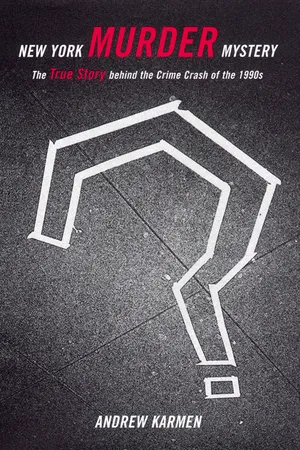
Andrew Karmen tracks a quarter century of murder in the city Americans have most commonly associated with rampant street crime. Providing both a local and a national context for New York's plunging crime rate, Karmen tests and debunks the many self-serving explanations for the decline. While crediting a more effective police force for its efforts, Karmen also emphasizes the decline of the crack epidemic, skyrocketing incarceration rates, favorable demographic trends, a healthy economy, an influx of hard working and law abiding immigrants, a rise in college enrollment, and an unexpected outbreak of improved behavior by young men growing up in poverty stricken neighborhoods. New York Murder Mystery is the most authoritative study to date of why crime rates rise and fall.
- 336 pages
- English
- ePUB (mobile friendly)
- Available on iOS & Android
eBook - ePub
About this book
Information
ONE
The 1990s Crime Crash in New York
A Mysterious Outbreak of Better Behavior Sweeps over the City
I have never seen anything as extraordinary as this, and I have been in government for 40 years.
—Queens district attorney Richard Brown (quoted in Krauss, 1995a:1)
At the dawn of the 1990s, New Yorkers were slaughtering one another at a record clip. A staggering body count of 2,245 violent deaths made 1990 the bloodiest year in the City’s history. The surging crime wave foretold of a nightmarish future, and many longtime residents proclaimed their intention of escaping from an unlivable and unworkable metropolis that had deteriorated into an urban battleground. But then, unexpectedly, an astonishing turnaround took place. By the close of the decade, the death toll had been halved and then nearly halved again, tumbling to its lowest levels since the mid-1960s. For some mysterious reasons, interpersonal conflict subsided dramatically and the inhabitants of the five boroughs found themselves coexisting much more peacefully. Manhattan, in particular, once again became the place to live and work. Such progress toward resolving a serious social problem over a short time span is rarely achieved. If cancer mortality, poverty rates, pollution levels, or even traffic congestion could be cut so substantially in just a few years, the degree of improvement would be termed “a miracle.”
Pundits discussing New York City’s incredibly shrinking crime rate discovered that there was no appropriate expression in the terminology of criminology or even in everyday language to describe the opposite of a rapidly spreading epidemic of lawlessness. Mild metaphors such as an “ebbing,” “subsiding,” or “receding” of an earlier crime wave that had engulfed the City just didn’t capture the drama and novelty of the momentous reversal. Never before had double-digit declines, year after year, taken place in a major metropolitan area, so there had been no previous need to coin such an upbeat expression. Perhaps the alliterative term “crime crash” is the most appropriate way to describe an unanticipated plunge of this magnitude and importance. However, unlike an unforeseen but ruinous stock market crash that suddenly wipes out financial investments, the crime crash was greeted with sighs of relief as an oppressive burden quickly melted away.
Surprisingly, no “blue ribbon” commission of criminal justice experts was set up by the mayor, the governor, or the president to attempt to figure out why the crash took place. Even though New York City’s future viability was at stake, no politician or office seeker called for a thorough investigation of the events leading up to the sudden reversal of fortune. In fact, no steps were even taken to improve public access to government records and agency files for those who wanted to seriously study this dramatic turnaround.
The outbreak of better behavior that swept across the City presented an unparalleled opportunity for researchers. The challenge was to get to the bottom of this “miracle” and discover its underlying nonsupernatural causes, so that even more lives could be saved before it dissipated or, worse yet, reversed course. A capsule history of some of the key developments as well as the mood swings that preceded the crash will shed light on the reasons for this unprecedented but most welcomed change.
Written Off as Terminally Ill: A Near-Death Experience?
Reports of New York City’s impending demise have always been premature.
Even before the Civil War, a traveler (Strong, quoted in Barbanel, 1991:B1), watching the planting of trees in a muddy excavation that would become Central Park, mused that the City might succumb to the intertwined problems of poverty and crime long before the saplings grew to maturity: “Perhaps the city itself will perish before then by growing too big to live under faulty institutions, corruptly administered.”
But that dire forecast was completely off-base. About one hundred years later, in 1964, the five boroughs, far from being deserted, were home to an overflow population that briefly broke the eight million mark. Yet, just as the number of residents hit an all-time high, perceptions spread that Gotham was rapidly going downhill. The frank admission that the inner city was burdened by deep-seated problems was triggered by the 1964 Harlem “riot,” the first of a wave of big-city ghetto uprisings that swept across the nation. The headlines introducing a series of articles in the New York Herald Tribune in 1965 about the state of the City reflected a loss of confidence: “New York City in crisis,” and “New York, greatest city in the world—and everything is wrong with it” (Ehrenhalt, 1992). To dispel the sense of impending disaster, Mayor John Lindsay in the late 1960s cheerfully characterized the five boroughs as “Fun City.”
But pessimism about the future marred the start of the 1970s. In his first try at becoming mayor in 1973 (which failed), Congressman Edward Koch warned that unless a “tough stance” was adopted, the rising crime rate would drive away the middle class, setting into motion a chain reaction that would undercut the City’s tax base and consequently lead to a deterioration in municipal services (see Newfield and Barrett, 1988:122). To restore investor confidence, an economist adopted an up-beat title for his book, New York Is Very Much Alive (Ginzberg, 1974). But any optimism was short-lived. In 1975, Mayor Abraham Beame discovered that New York’s government had accumulated so much short-term debt that it could not repay its loans. The threat of bankruptcy and the ensuing fiscal crisis compelled the Beame administration to eliminate 65,000 jobs from the municipal payroll, impose a wage freeze on the remaining work force, severely cut back services that the poor depended on much more than the affluent, raise the fare on subways and buses, and end the century-long tradition of free tuition for students at the eighteen campuses of the sprawling City University (see Newfield and Barrett, 1988). Perhaps the most painful blow was delivered by the administration in Washington, when it refused to put the City on a life-support system. The bad news about the denial of a federal bailout was captured by the tabloid headline, “Ford to City: Drop Dead” (Daily News, 1975). Even after the calamity of near-insolvency receded as belt-tightening saved the day, the damage was done in terms of lowered expectations about the quality of urban life in the foreseeable future. New Yorkers abandoned their old neighborhoods in droves and headed for the greener pastures of suburbia; census figures revealed that the population of the five boroughs emptied out by more than 800,000 (over 10 percent) during the 1970s.
Predictions about doom and gloom persisted as the 1980s began with a severe nationwide recession. Murderers claimed a record number of New Yorkers’ lives (1,826 in 1981). But fears about a further downward slide melted away when the City’s finance, real estate, and high-tech industries recovered, showering prosperity on the City’s more privileged residents. Murders declined for four years and then bottomed out in 1985 at their lowest level in fifteen years. Mayor Edward Koch’s speech inaugurating his third term in 1986 was laced with upbeat promises that local government could and should and would do more for the disadvantaged. The mayor (quoted in Newfield and Barrett, 1988:20) trumpeted a can-do chauvinism that defied the doomsayers:
This is not a place of carefree quietude. Our city is not a refuge from reality. New York is what it always has been: it’s the world’s number one arena for genius, it’s the battleground for new ideas. New York is the city where the future comes to rehearse, where the best come to get better. We are the leading city because we are the city of leaders. If you are trying for the top, you can’t top New York.
After a brief respite of restored self-confidence, pessimism and cynicism returned with a vengeance in the latter half of the 1980s, and for good reasons. City government was rocked by a far-ranging corruption scandal, the crack-smoking epidemic swept through poor neighborhoods, AIDS seemed an unstoppable plague that was about to go mainstream, and homelessness loomed as an intractable feature of the urban landscape. A crash on the New York Stock Exchange in 1987 (with the Dow losing 22 percent of its value in a single day) triggered an economic downturn that within a few years enveloped the entire nation in another recession. Before long, a depiction of the “Rotting of the Big Apple” graced the cover of Time magazine. Inside, a slew of particularly brutal slayings provoked an article entitled “The Decline of New York.” It read like an obituary for a once-proud and vibrant metropolis that now was “consumed with crime,” where “unchecked violence” had “dulled the luster.” The citizenry was “plunging into chaos” as the situation “spun out of control.” The hustle and “bustle of a hyperkinetic city” had degenerated into a mad frenzy. In nursery schools, students were drilled “to hit the floor at the sound of gunfire.” Epidemics of AIDS and venereal diseases had pushed the city’s health care system “to the breaking point.” Busy streets deteriorated into “public restrooms for people and animals.” Trash collection had to be cut because the city’s budget was in a “financial straightjacket.” Even the banker who headed up the city’s financial control board eschewed his usual optimism and confessed that he could not see any light at the end of the tunnel (see Attinger, 1989:41).
Suspicions that Gotham’s lingering illness had finally turned terminal reached a feverish pitch among journalists and commentators during 1990, just as David Dinkins, New York’s first African American mayor, assumed his new responsibilities. Calling New York “a city under siege” during his campaign, Mayor Dinkins vowed in his inaugural address to be the “toughest mayor on crime this city has ever seen” (quoted in “Mobilizing to fight crime,” 1990:B2). Elected on a platform of racial healing and a better deal for the downtrodden, Mayor Dinkins was quickly forced by revenue shortfalls to make hard choices. At first, he planned to delay the hiring of new police recruits, declaring, “It is a mistake … to make sure that we have plenty of cops and cut out all of the services.” But as the local economy worsened, the misery and abject poverty visible for all to see caused the editors of the New York Times (1990:28) to lament: “New York City is staggering. The streets already resemble a New Calcutta, bristling with beggars and sad schizophrenics tuned in to inner voices. Crime, the fear of it as much as the fact, add overtones of a New Beirut. … And now the tide of wealth and taxes that helped the city make these streets bearable has ebbed.”
The soft-spoken mayor’s reformist agenda immediately became sidetracked by demands that he allocate the City’s limited resources to the fight against a rag-tag army of predators that was inflicting a slow death from thousands of cuts. One journalist warned that “A new tidal wave of crime has swept over New York, adding terrifying numbers and stories to a city already plagued by violence” (Greenberg, 1990:20). In the poorer parts of town, the sounds of gunfire punctuated the night. After stray bullets claimed the lives of four children within a nine-day span, a reporter (Attinger, 1990) for a leading news magazine condemned this slaughter of the innocents:
The slain children are called mushrooms in street lingo—as vulnerable as plants underfoot. Their deaths have pushed New Yorkers, already reeling from a daunting inventory of urban ills, to a new depth of despair. … More than the epidemic of homelessness, more than inadequate schools, filthy streets, high taxes and the outrageous cost of living, violent crime is gnawing at the soul of the city that thinks of itself as the embodiment of American energy and creativity.
New York State’s chief justice, Sol Wachtler, warned that crack-related offenses were overwhelming the court system. “And certainly no illicit drug epidemic in our history will produce consequences as profound and lasting,” he feared, because “hundreds of thousands of children are growing up knowing only violence, abuse, neglect, addiction and hopelessness” because their mothers as well as their fathers were swept up into self-destructive behaviors (quoted in Egan, 1990:B3). He predicted that “what we are living with in New York today is not a cyclical rise and fall in the rate of crime.” As 1990 went down in the record books as the bloodiest year in New York’s history, marred by 2,245 murders, a tabloid headline screamed, “Dave, Do Something!”1 The mayor was forced to devise a massive tax package to beef up the police and the criminal justice system, calling it “our battle plan against fear, a plan that will give us the tools to restore our confidence in the future” (Dinkins, 1990:B2). The mayor also was compelled to accept what pundits dubbed a “doomsday budget” because it severely cut back the municipal services that poor people counted upon (see Barbanel, 1991; Klein, 1991).
The City’s image slipped another notch because of a highly publicized murder of a tourist: a son was stabbed to death while trying to protect his parents from a pack of young robbers in a midtown subway station (T. Morgenthau, 1990). Concerns about the City’s moral health heightened when a young father became so infuriated with his six-day-old son that he chopped up the baby boy and fed the pieces to the family’s German shepherd. A veteran journalist decried the sorry state of affairs:
In the barbarized city of New York, there is no horror these days. We no longer seem capable of that basic human emotion, which is why so many of us have begun to lose all hope for a more decent future. … Millions of New Yorkers have been as emotionally immobilized as anyone who lives too long in the presence of violence and death: emergency-room doctors, soldiers, Mafia hit men.
Meanwhile, as this dreadful century comes to an end, poor New York will slide deeper into decay, becoming a violent American Calcutta. The middle class will flee in greater numbers, the tax base will shrink, the criminals will rule our days and nights. Drugs, crime, despair, illiteracy, disease: All will increase into the next century. If there are twenty-five bums in the corner park now, make way for another 100. If there are two thousand murders this year, get ready for four thousand. New York is dying. (Hamill, 1990)
Back from the Dead: Was This a Great Time, or What?
As we move toward the new millennium, we as New Yorkers can take pride in the fact that our great city has regained its true stature as the Capital of the World. Our crime rate is at levels not witnessed since the 1960s, tourism in the City is at historic levels and our streets and parks are the cleanest in recent memory.
Four years ago, few would have dreamed, much less believed that these strides were possible. In fact, New York City, like other American cities, was essentially written off as a symbol of urban decay. Yet we have proven the cynics wrong and shown what is possible.
—Mayor Rudolph Giuliani (1997c:1)
Fast-forward a few years and a dramatic mood swing has swept across the social landscape. Unbridled boosterism and unabashed triumphalism has supplanted despair about the present and pessimism about the future. To many commentators, it was as if a prolonged, blinding blizzard had ended, the storm clouds were breaking up, the sun was shining once again, and people were emerging from their homes to survey the damage and make repairs. The rush was on to declare New York City back on its feet, alive and kicking, revitalized and reinvigorated. The local economy that had sputtered to a halt was picking up steam. The former U.S. attorney for the metropolitan area’s Southern District in the Reagan administration, Rudolph Giuliani, had won the mayoralty on the Republican ticket even though the overwhelming majority of voters were registered Democrats. The Giuliani administration abandoned the social welfare policies and tolerance of deviant behavior that had become so closely identified with New York–style liberalism, and instead pursued a prosecutorial approach of tightening up, cracking down, and getting tough. As crime rates fell and profit margins rose, Mayor Giuliani’s conservative policies were given the credit and reaped a windfall of highly favorable, accentuate-the-positive publicity, even in the reputedly liberal organs of the mass media.
From the summer of 1995 onward, story after story recounted the same theme: that the recovery was made possible by the drop in crime, which in turn was due to strict enforcement of the law. One of the more politically explicit attacks on the alleged failure of liberal policies summed up the situation this way:
Flash back a few years. New York City had become seemingly ungovernable, a seedy place of garbage, graffiti, and crime, mired in economic decline and home to the nation’s largest underclass. Who’d want to live there? No longer the hub of urbanity, Gotham was by the late eighties the very symbol of urban decay—30 years of cultural revolution had done its grievous work undermining city life. Today, astoundingly, New York is once again the place where striving men and women want to live. (Anderson, 1998:24)
The same news magazines that solemnly announced the city’s impending demise in 1990 gleefully proclaimed its rebirth in the second half of the 1990s. One ran a cover story entitled, “The Big Apple comes roaring back—and other cities wonder how it was done.” It focused on the signs of optimism that “were everywhere” in “Comeback City”: “After three decades of economic and social malaise, Gotham has reversed its fortunes to become a national model for how cities resurrect themselves” (Marks, 1997).
A caption under some photos in a rival news magazine underscored this same spiritual renewal theme: “After decades of graffiti, muggings, and subway shootings, all this good news has even the most blasé New Yorkers taking notice. Whether it’s falling crime rates or a healthy Dow, residents have new reasons to be proud of their city” (Adler, 1997).
In the media frenzy of accounts purporting to explain how the City escaped the grim reaper’s clutches, the upbeat titles of the articles got the main messages across: “The end of crime as we know it” (...
Table of contents
- Cover Page
- Title Page
- Copyright Page
- Contents
- Preface
- Acknowledgments
- Abbreviations
- 1 The 1990s Crime Crash in New York
- 2 Deconstructing Murders
- 3 NYPD or Not NYPD: That Is the Question
- 4 Behind Bars?
- 5 The Drug-Crime Connection
- 6 It’s the Economy, Stupid! Or Is It? Did the Boom Cause the Crash?
- 7 Where Have All the Criminals Gone? Did Favorable Demographic Trends Facilitate the Crash?
- 8 Lessons from the New York Experience
- Appendix
- References
- Name Index
- Subject Index
- About the Author
Trusted by 375,005 students
Access to over 1.5 million titles for a fair monthly price.
Study more efficiently using our study tools.
Frequently asked questions
Yes, you can cancel anytime from the Subscription tab in your account settings on the Perlego website. Your subscription will stay active until the end of your current billing period. Learn how to cancel your subscription
No, books cannot be downloaded as external files, such as PDFs, for use outside of Perlego. However, you can download books within the Perlego app for offline reading on mobile or tablet. Learn how to download books offline
Perlego offers two plans: Essential and Complete
- Essential is ideal for learners and professionals who enjoy exploring a wide range of subjects. Access the Essential Library with 800,000+ trusted titles and best-sellers across business, personal growth, and the humanities. Includes unlimited reading time and Standard Read Aloud voice.
- Complete: Perfect for advanced learners and researchers needing full, unrestricted access. Unlock 1.5M+ books across hundreds of subjects, including academic and specialized titles. The Complete Plan also includes advanced features like Premium Read Aloud and Research Assistant.
We are an online textbook subscription service, where you can get access to an entire online library for less than the price of a single book per month. With over 1.5 million books across 990+ topics, we’ve got you covered! Learn about our mission
Look out for the read-aloud symbol on your next book to see if you can listen to it. The read-aloud tool reads text aloud for you, highlighting the text as it is being read. You can pause it, speed it up and slow it down. Learn more about Read Aloud
Yes! You can use the Perlego app on both iOS and Android devices to read anytime, anywhere — even offline. Perfect for commutes or when you’re on the go.
Please note we cannot support devices running on iOS 13 and Android 7 or earlier. Learn more about using the app
Please note we cannot support devices running on iOS 13 and Android 7 or earlier. Learn more about using the app
Yes, you can access New York Murder Mystery by Andrew Karmen in PDF and/or ePUB format, as well as other popular books in Social Sciences & Criminal Law. We have over 1.5 million books available in our catalogue for you to explore.