Not Working chronicles the devastating effects of the 1996 welfare reform legislation that ended welfare as we know it. For those who now receive public assistance, “work” means pleading with supervisors for full-time hours, juggling ever-changing work schedules, and shuffling between dead-end jobs that leave one physically and psychically exhausted.
Through vivid story-telling and pointed analysis, Not Working profiles the day-to-day struggles of Mexican immigrant women in the Los Angeles area, showing the increased vulnerability they face in the welfare office and labor market. The new “work first” policies now enacted impose time limits and mandate work requirements for those receiving public assistance, yet fail to offer real job training or needed childcare options, ultimately causing many families to fall deeper below the poverty line.
Not Working shows that the new “welfare-to-work” regime has produced tremendous instability and insecurity for these women and their children. Moreover, the authors argue that the new politics of welfare enable greater infringements of rights and liberty for many of America's most vulnerable and constitute a crucial component of the broader assault on American citizenship. In short, the new welfare is not working.
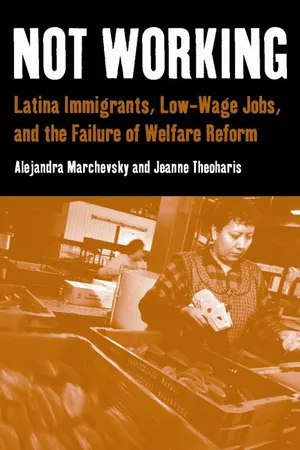
eBook - ePub
Not Working
Latina Immigrants, Low-Wage Jobs, and the Failure of Welfare Reform
- 308 pages
- English
- ePUB (mobile friendly)
- Available on iOS & Android
eBook - ePub
Not Working
Latina Immigrants, Low-Wage Jobs, and the Failure of Welfare Reform
About this book
Information
Neither a Hand Up nor a Handout
1
Ending Welfare
New Nativism and the Triumph of Post–Civil Rights Politics
The passage of PRWORA in August 1996 heralded the success of a “post–civil rights consensus” in American politics. Americans had come to embrace the idea that race no longer determines individual success or failure, and that the government should only help those who help themselves. The emerging consensus among liberal politicians, scholars, and journalists around the cultural nature of welfare reflected a confidence that the nation had moved past its own history of denigrating the “cultures” of nonwhite people. With his set of black friends and New South background, President Bill Clinton was well situated to usher in a post-welfare world that played on racial imagery and ensured a racially bifurcated workforce while disavowing that race had anything to do with it. Indeed, the PRWORA sent a stark message about race and citizenship in late twentieth-century America. By marking who would have and who would be denied access to state protection and public benefits, welfare reform was a form of civic disfranchisement that had long roots in the racialized politics of American entitlements.
Equally historic was the PRWORA’s intervention in the arena of U.S. immigration policy. Welfare reform served as a “back door” to immigration reform as it widened the gap between citizens and legal immigrants, created immigrant categories entirely new to U.S. law, and opened up new channels of surveillance and information-sharing between social service agencies and the Immigration and Naturalization Service (INS). Riding on the political momentum of California’s Proposition 187, the 1994 ballot initiative that sought to bar undocumented immigrants from most social services, welfare reform signaled the emergence of an anti-immigrant agenda markedly different from other periods of nativism in U.S. history.1 This “new nativism” represents immigrants from Latin America and Asia not so much as threats to American workers, as in previous decades, but increasingly as threats to the civic and fiscal community.2 Accompanying this shift in focus is a gendered language for immigration that vilifies immigrant women as welfare cheats and overly fertile breeders, who are responsible for the “browning of America.” Yet, although the new nativism deploys a racial-nationalist discourse, policies like Proposition 187 and PRWORA ultimately further a neoliberal agenda, in which the state serves the interests of global capital by ensuring the availability of a foreign-born and female low-wage workforce in the United States.3
Despite evidence of a shortage of jobs with living wages for welfare recipients to get out of poverty, the PRWORA accepted the labor market as is: recipients were the ones needing fixing, not the economy.4 The legislation’s “work-first” approach required welfare recipients to accept any job, regardless of pay, work conditions, and childcare considerations. Those recipients who cannot secure paid employment were placed in “workfare” assignments, performing work in the public sector in order to receive their monthly welfare stipends. However, workfare assignments did not have to be new jobs, workfare workers were not accorded the labor protections other workers have under national law, and there were no requirements for job training or higher education. Passed amidst a resurgence of labor activism in the United States, and particularly at a time when service sector unions like the Service Employees International Union (SEIU) had made significant gains in organizing female and immigrant workers, welfare reform unleashed a frontal assault on organized labor. Not only did this policy force millions of low-skilled workers into a deregulated labor market, but it also did not require states to keep records on what happens to recipients once they leave the welfare rolls. Thus, there were few safeguards to protect individuals as states seek to reduce their rolls by any means available, and as employers capitalize on the vulnerability of this new workforce.
The dismantling of the American social welfare system provides a revealing window into the role of the nation-state under late twentieth-century capitalism. On the one hand, welfare reform represents an attempt to tighten the reigns of state authority and to reassert U.S. sovereignty in the face of global economic integration. The second most significant piece of legislation of the 1990s, following the 1994 North American Free Trade Agreement (NAFTA)—passed at a time when Ford cars and Sears clothing are manufactured in Third World “free trade zones” and when the gospel of free trade is used to undermine the power of workers around the world—the PRWORA offered American voters insulation against the tide of globalization. Vilified as an affront to American values of family, individualism, and self-reliance, black and Latina welfare mothers confirmed the voting public’s sense of Americanness precisely by serving as its antithesis.5
Yet, although framed by a moralistic discussion of the psychosocial benefits of work and “self-reliance,” the actual rewards of welfare reform were to be found in the economic benefits of an enlarged low-wage work-force within the United States. Through its work-first approach, the PRWORA ensured a plentiful workforce vulnerable to the demands of global capital. By imposing time limits on welfare, welfare reform eradicated social subsidies as an alternative or supplement to low-wage work, shifting more power to employers to set wage levels and working conditions. Welfare reform followed from NAFTA’s paradigms—removing the national fetters on work and trade while erecting higher boundaries to entitlement and state protection.6 Supporters sold both NAFTA and PRWORA through the neoliberal logic of free trade, arguing that lifting trade restrictions and social subsides would elevate all workers. Yet, the economic effects of both policies have hardly been elevating for those at the bottom of the economic ladder. Indeed, the PRWORA provides a telling window on the centrality of race within the ideologies fueling globalization: by playing on faulty assumptions about the cultures and values of people of color, such ideologies legitimate economic policies that maintain, if not exacerbate, racial hierarchies.
The War on Welfare: From Deserving Mothers to Welfare Queens
AFDC had its roots in the mother’s pensions programs instituted by most states in the 1910s and 1920s that sought to reinforce women’s domestic role and keep mothers out of the workplace by giving “deserving mothers”—white women with children—a small subsidy.7 In 1935, in the midst of a savage depression and mounting political unrest, Congress passed the Social Security Act, creating five new programs to provide a safety net for Americans if they were to come on hard times: unemployment compensation, old-age insurance, Aid to the Blind, Old Age Assistance, and Aid to Dependent Children (ADC, changed to AFDC in 1962). ADC benefits were “designed to release from the wage earning role the person whose natural function is to give her children the physical and affectionate guardianship necessary.”8 Yet, because states had control over most New Deal programs, and because, particularly in the South, white politicians feared losing black women’s agricultural and domestic labor, black women were largely deemed ineligible for ADC benefits, barred during the cotton harvesting season, or intimidated from even applying.9 “Suitable home” provisions found in the statute were often enforced on a racial basis; caseworkers disqualifying black children if their mothers did apply.10 In the Southwest, local relief agencies shut their doors to immigrant and U.S.-born Mexican applicants, using federal welfare dollars instead to assist police and immigration authorities in “repatriating” over one million ethnic Mexicans during the 1930s. Thus, welfare was largely not accessible to African-American and Mexican-American families.
Turned away from their entitlements as mothers, women of color were also denied their rights as workers. Both the Social Security Act and the Wagner Act enacted special exemptions for agricultural workers and domestic servants, leaving the majority of Mexican and black workers ineligible for the minimum wage and unprotected under Old Age and Unemployment Assistance and union legislation. Forged by a powerful coalition between southern politicians and white organized labor, the New Deal created what historian Jill Quadagno calls a “racial welfare state regime,” one that denied people of color “the full perquisites of citizenship,” while ensuring their availability as a flexible, low-wage workforce for U.S. employers.11 At the close of the twentieth century, this racial regime would be revived under the PRWORA’s welfare-to-work mandate.
Indeed, although AFDC had never been a very popular program, the backlash against welfare began when women of color began demanding access to the entitlements that had long been the prerogative of whites. In the late 1960s, growing activism in communities of color, particularly the formation of the National Welfare Rights Organization (NWRO) in 1967, led to change in the welfare system, and as historian Michael Katz notes, “for the first time, social welfare policy became one strategy for attacking the consequences of racism in America.”12 Civil rights activists pushed to open AFDC to all those who met means-tested standards and lobbied to increase benefits to ensure that they met poor families’ basic needs. Framing welfare as a right and a matter of equality, the NWRO took its message to the streets, into welfare offices, in front of state legislatures, and before the courts on behalf of the rights of poor women. By 1969, its membership reached 25,000 with thousands more participating in NWRO-sponsored events. As Johnnie Tillmon, the first chairwoman of the NWRO and a black welfare recipient herself, argued:
There are a lot of other lies that male society tells about welfare mothers: that AFDC mothers are immoral, that AFDC mothers are lazy, misuse their welfare checks, spend it all on booze and are stupid and incompetent. If people are willing to believe these lies, it’s partly because they’re just special versions of the lies that society tells about all women.13
Civil rights lawyers and NWRO activists challenged these stereotypes as they successfully fought to overturn “man in the house” rules, establish a right to a fair hearing to maintain or obtain welfare benefits, and ensure enforcement of little-known provisions in welfare regulations, outlining minimum standards for people on welfare.14
Chicana activists both in the NWRO and in separate Mexican-American organizations also challenged their exclusions from welfare and fought to oppose Nixon’s support for work-based welfare. On November 7, 1967, over 75 Mexican-American welfare recipients gathered in East L.A. to protest cuts to medical, fight for access to full benefits, and form a new organization: the East Los Angeles Welfare Rights Organization.15 In 1973, Chicanas spearheaded opposition to the Talmadge Amendment to the Social Security Act, which required mothers on public assistance with children over six to register with the state employment office and report every two weeks until they found work. As Sandra Ugarte wrote in La Raza,
The taxpayers are not the only ones who want the poor to work—the poor also want to work. But at decent jobs with decent wages and without the stigma of welfare. … [Nixon’s proposal] will force a cheap source of labor on the labor market at a time when job competition is already at a critical level.… Employers are already laying off their own employees and replacing them with welfare recipients at far reduced wage rates.16
Francisca Flores, founding director of the Chicana Service Action Center in Los Angeles, and Alicia Escalante, founder of the East Los Angeles Welfare Rights Organization that later became the Chicano National Welfare Rights Organization, led this opposition to Nixon’s plan.17
These grassroots organizing efforts, along with President Lyndon Johnson’s War on Poverty, opened welfare to those eligible, including women of color; by 1971, over 90 percent of eligible families were receiving AFDC, up from less than 33 percent in 1960. At the same time, increasing numbers of families faced extreme poverty in the late 1960s, particularly as a result of the mechanization of southern agriculture and deindustrialization in the North. By 1974, 10.8 million people were receiving AFDC, up from 3.1 million in 1961, and there was ample evidence that the expansion of AFDC and food stamp benefits was succeeding in reducing hunger and malnutrition in America.18
Although the AFDC rolls remained predominantly white in the 1960s, public discourse during this period almost exclusively associated welfare with unmarried and sexually irresponsible women of color. The large number of black women in the NWRO and the organization’s ties to the civil rights movement inadvertently lent a black face to welfare. Moreover, an emergent liberal consensus flagged AFDC as a prime example of the “cultural deprivation” that plagued poor blacks and Latinos. Released in 1965, the influential Moynihan Report blamed the “Negro crisis” on black women who took jobs and status away from men, had babies without marrying, and formed matriarchal families dependent on government handouts. Published the following year, anthropologist Oscar Lewis’s La Vida: A Puerto Rican Family in the Culture of Poverty, San Juan and New York legitimated the prevailing view of Latinos as culturally inferior with its thesis that poverty produces its own unique and self-defeating cultural patterns. Although intended to paint a sympathetic portrait of poor people by providing a rationale for their behavior, liberal tracts on the “culture of poverty” instead fueled public resentment toward irresponsible women of color and the liberal government programs that rewarded their bad choices.19
Equally pivotal in the war on welfare were the federal government’s primary beneficiaries: middle-class whites. At the peak of the social revolts of the 1960s, white suburbanites launched a counterrevolution that propelled right-wing conservatism from the margins to the center of U.S. politics. Angered by the “lawlessness” of civil rights and student protests, and by what they perceived as the federal government’s intrusion in their “private” affairs, white suburbanites mobilized to take back the nation from the Washington “establishment” of liberal intellectuals and radical minorities. Deploying the symbols of the McCarthy era, New Right conservatives forged a powerful social movement against state centralization, the spread of dangerous liberal ideas (like sex education and multiculturalism) in public school curricula, and the conspiracy to extend “special rights” to, as worded by one conservative newsletter, “the black and brown peoples of the world.”20
High on the New Right’s list of grievances were anti-poverty programs that redistributed middle-class tax dollars to “undeserving” minority groups. Introducing arguments that two decades later would dominate the welfare debate, conservatives in the 1960s and 1970s asserted that AFDC undermined free-market capitalism and American civil liberties. By providing individuals with a modicum of economic security, welfare produced “overly secure workers who are less likely to acquiesce to onerous working conditions,” and violated the “freedom” of poor people by making them dependent on a centralized government. This argument was advanced in The Socialist Plan for Conquest, a political pamphlet published in 1966 by the California Free Enterprise Association (CFEA):21
The difference between a free nation and a slave nation can be very simply stated. In a free nation, the people accept the responsibility for their own welfare; while in a slave nation the responsibility is turned over to the government. […] They will want their government to guarantee minimum wages … full employment … good prices for their produce … good housing … medical care … such people are … choosing slavery rather than freedom … for this is the security of the penitentiary.22
The CFEA’s association of welfare recipients with black slaves typified the New Right’s effective strategy of disguising racist arguments in anti-communist and anti-federalist language. Avoiding the forthright (and politically unpopular) white supremacy typical of the Deep South, new conservatives couched their racist assault on welfare in a racially coded lexicon of “personal responsibility,” “government intrusion,” and “basic Americanism.” For all its anti-government rhetoric, the New Right squarely located governmental power, public resources, and “basic rights” in the material and social interests of white citizens.
New Right ideology and organizations flourished in Sunbelt suburban locales like Orange County, California, and Scottsdale, Arizona, the bedrocks of “modern Americanism” that had been manufactured entirely by postwar federal policy and spending.23 Historian Lisa McGirr’s study of the New Right in Orange County, Suburban Warriors, illustrates this sharp contradiction in neoconservative politics. The wealthy white entrepreneurs and professionals, who formed the rank...
Table of contents
- Cover Page
- Title Page
- Copyright Page
- Contents
- Acknowledgments
- Introduction: Latinas on the Fault Lines of Citizenship
- PART I Neither a Hand Up nor a Handout
- PART II Any Job at Any Wage
- Conclusion: The Emperor’s New Welfare: Reassessing the “Success” of Welfare Reform
- Notes
- Index
- About the Authors
Trusted by 375,005 students
Access to over 1.5 million titles for a fair monthly price.
Study more efficiently using our study tools.
Frequently asked questions
Yes, you can cancel anytime from the Subscription tab in your account settings on the Perlego website. Your subscription will stay active until the end of your current billing period. Learn how to cancel your subscription
No, books cannot be downloaded as external files, such as PDFs, for use outside of Perlego. However, you can download books within the Perlego app for offline reading on mobile or tablet. Learn how to download books offline
Perlego offers two plans: Essential and Complete
- Essential is ideal for learners and professionals who enjoy exploring a wide range of subjects. Access the Essential Library with 800,000+ trusted titles and best-sellers across business, personal growth, and the humanities. Includes unlimited reading time and Standard Read Aloud voice.
- Complete: Perfect for advanced learners and researchers needing full, unrestricted access. Unlock 1.5M+ books across hundreds of subjects, including academic and specialized titles. The Complete Plan also includes advanced features like Premium Read Aloud and Research Assistant.
We are an online textbook subscription service, where you can get access to an entire online library for less than the price of a single book per month. With over 1.5 million books across 990+ topics, we’ve got you covered! Learn about our mission
Look out for the read-aloud symbol on your next book to see if you can listen to it. The read-aloud tool reads text aloud for you, highlighting the text as it is being read. You can pause it, speed it up and slow it down. Learn more about Read Aloud
Yes! You can use the Perlego app on both iOS and Android devices to read anytime, anywhere — even offline. Perfect for commutes or when you’re on the go.
Please note we cannot support devices running on iOS 13 and Android 7 or earlier. Learn more about using the app
Please note we cannot support devices running on iOS 13 and Android 7 or earlier. Learn more about using the app
Yes, you can access Not Working by Alejandra Marchevsky,Jeanne Theoharis in PDF and/or ePUB format, as well as other popular books in Social Sciences & Discrimination & Race Relations. We have over 1.5 million books available in our catalogue for you to explore.