Lubet's Nothing But The Truth presents a novel and engaging analysis of the role of storytelling in trial advocacy. The best lawyers are storytellers, he explains, who take the raw and disjointed observations of witnesses and transform them into coherent and persuasive narratives.
Critics of the adversary system, of course, have little patience for storytelling, regarding trial lawyers as flimflam artists who use sly means and cunning rhetoric to befuddle witnesses and bamboozle juries. Why not simply allow the witnesses to speak their minds, without the distorting influence of lawyers' stratagems and feints?
But Lubet demonstrates that the craft of lawyer storytelling is a legitimate technique for determining the truth andnot at all coincidentallyfor providing the best defense for the attorney's client. Storytelling accomplishes three important purposes at trial. It helps to establish a "theory of the case," which is a plausible and reasonable explanation of the underlying events, presented in the light most favorable to the attorney's client. Storytelling also develops the "trial theme," which is the lawyer's way of adding moral force to the desired outcome. Most importantly, storytelling provides a coherent "story frame," which organizes all of the events, transactions, and other surrounding facts into an easily understandable narrative context.
As with all powerful tools, storytelling may be misused to ill purposes. Therefore, as Lubet explains, lawyers do not have carte blanche to tell whatever stories they choose. It is a creative process to be sure, but every story must ultimately be based on "nothing but the truth." There is no room for lying.
On the other hand, it is obvious that trial lawyers never tell "the whole truth," since life and experience are boundless and therefore not fully describable. No lawyer or court of law can ever get at the whole truth, but the attorney who effectively employs the techniques of storytelling will do the best job of sorting out competing claims and facts, thereby helping the court arrive at a decision that serves the goals of accuracy and justice.
To illustrate the various challenges, benefits, and complexities of storytelling, Lubet elaborates the stories of six different trials. Some of the cases are real, including John Brown and Wyatt Earp, while some are fictional, including Atticus Finch and Liberty Valance. In each chapter, the emphasis is on the narrative itself, emphasizing the trial's rich context of facts and personalities. The overall conclusion, as Lubet puts it, is that "purposive storytelling provides a necessary dimension to our adversary system of justice."
eBook - ePub
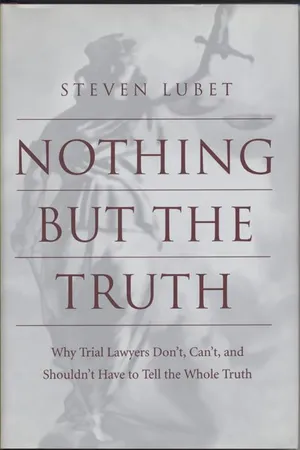
Nothing but the Truth
Why Trial Lawyers Don't, Can't, and Shouldn't Have to Tell the Whole Truth
- 219 pages
- English
- ePUB (mobile friendly)
- Available on iOS & Android
eBook - ePub
Nothing but the Truth
Why Trial Lawyers Don't, Can't, and Shouldn't Have to Tell the Whole Truth
About this book
Information
Table of contents
- Cover Page
- Title Page
- Copyright Page
- Dedication
- Contents
- Acknowledgments
- Introduction Storytelling Lawyers
- Chapter One Biff and Me: Stories That Are Truer Than True
- Chapter Two Edgardo Mortara: Forbidden Truths
- Chapter Three John Brown: Political Truth and Consequences
- Chapter Four Wyatt Earp: Truth and Context
- Chapter Five Liberty Valance: Truth or Justice
- Chapter Six Atticus Finch: Race, Class, Gender, and Truth
- Chapter Seven Sheila McGough: The Impossibility of the Whole Truth
- Index
- About the Author
- Footnote
Trusted by 375,005 students
Access to over 1.5 million titles for a fair monthly price.
Study more efficiently using our study tools.
Frequently asked questions
Yes, you can cancel anytime from the Subscription tab in your account settings on the Perlego website. Your subscription will stay active until the end of your current billing period. Learn how to cancel your subscription
No, books cannot be downloaded as external files, such as PDFs, for use outside of Perlego. However, you can download books within the Perlego app for offline reading on mobile or tablet. Learn how to download books offline
Perlego offers two plans: Essential and Complete
- Essential is ideal for learners and professionals who enjoy exploring a wide range of subjects. Access the Essential Library with 800,000+ trusted titles and best-sellers across business, personal growth, and the humanities. Includes unlimited reading time and Standard Read Aloud voice.
- Complete: Perfect for advanced learners and researchers needing full, unrestricted access. Unlock 1.5M+ books across hundreds of subjects, including academic and specialized titles. The Complete Plan also includes advanced features like Premium Read Aloud and Research Assistant.
We are an online textbook subscription service, where you can get access to an entire online library for less than the price of a single book per month. With over 1.5 million books across 990+ topics, we’ve got you covered! Learn about our mission
Look out for the read-aloud symbol on your next book to see if you can listen to it. The read-aloud tool reads text aloud for you, highlighting the text as it is being read. You can pause it, speed it up and slow it down. Learn more about Read Aloud
Yes! You can use the Perlego app on both iOS and Android devices to read anytime, anywhere — even offline. Perfect for commutes or when you’re on the go.
Please note we cannot support devices running on iOS 13 and Android 7 or earlier. Learn more about using the app
Please note we cannot support devices running on iOS 13 and Android 7 or earlier. Learn more about using the app
Yes, you can access Nothing but the Truth by Steven Lubet in PDF and/or ePUB format, as well as other popular books in Law & Law Theory & Practice. We have over 1.5 million books available in our catalogue for you to explore.