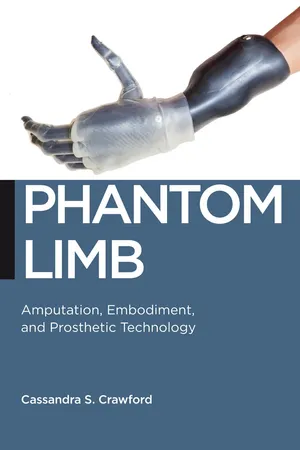
Phantom limb pain is one of the most intractable and merciless pains ever known—a pain that haunts appendages that do not physically exist, often persisting with uncanny realness long after fleshy limbs have been traumatically, surgically, or congenitally lost. The very existence and “naturalness” of this pain has been instrumental in modern science’s ability to create prosthetic technologies that many feel have transformative, self-actualizing, and even transcendent power. In Phantom Limb, Cassandra S. Crawford critically examines phantom limb pain and its relationship to prosthetic innovation, tracing the major shifts in knowledge of the causes and characteristics of the phenomenon.
Crawford exposes how the meanings of phantom limb pain have been influenced by developments in prosthetic science and ideas about the extraordinary power of these technologies to liberate and fundamentally alter the human body, mind, and spirit. Through intensive observation at a prosthetic clinic, interviews with key researchers and clinicians, and an analysis of historical and contemporary psychological and medical literature, she examines the modernization of amputation and exposes how medical understanding about phantom limbs has changed from the late-19th to the early-21st century. Crawford interrogates the impact of advances in technology, medicine, psychology and neuroscience, as well as changes in the meaning of limb loss, popular representations of amputees, and corporeal ideology. Phantom Limb questions our most deeply held ideas of what is normal, natural, and even moral about the physical human body.
- 314 pages
- English
- ePUB (mobile friendly)
- Available on iOS & Android
eBook - ePub
About this book
Information
1
Introduction
In many ways, the conference was like all others. Hundreds of us had taken over the lobby, the hallways, the dining spaces, and many of the meeting rooms in the Fairmont Dallas on an oppressively sultry August weekend. We were all signing in, orienting, mingling—all of those registration day musts. I was given a “first-timer” sticker. But, unlike most of the other first-timers, I was one of a very few at the conference who was not an amputee. The Amputee Coalition of America’s (ACA) Annual Education Conference and Exposition was officially devoted to changing direction, and to the technology, prevention, information, and support needed to make that happen. However, another theme was more conspicuous. I found it in the sessions, the workshops, the informal gatherings, and most prominently in the exhibit hall where attendees spent the majority of their time watching presentations, having their gaits analyzed by prosthetists other than their own, and collecting generous amounts of swag. Prosthetization, it seemed, was tantamount to rebirth.
The schedule included two days of technology sessions with presentations on issues such as phantom pain reduction, cutting-edge advances that will change the way amputees live and work, or choosing a microprocessor knee; workshops on issues such as fitness and state advocacy; networking rooms; panels addressing psychological health and finding community resources; a gait analysis clinic; and a very large exhibit hall that included hundreds of exhibited products as well as exhibitor product-theater presentations such as Freedom Innovation’s “Join the Revolution.” Manufacturers of prostheses and prosthetic paraphernalia were all vying for our attention. Össur, whose slogan was “life without limitations,” had world-class amputee athlete Sarah Reinertsen center stage. She and her biking-leg were a seamless extension of the stationary show-bike that she dutifully rode for hours on end. Sarah was a principle member of Team Össur whose mission was public awareness; their message was that “with the help of modern technology, amputees can lead the kind of lives they want, achieving things that were almost unimaginable in previous generations” (Össur 2005, 2). Össur’s prosthetic line included the Mauch, a hydraulic knee that presumably transformed its user into a force to be reckoned with. Like anything or anyone capable of mach speeds, Össur’s (2010, 1) knee promised to move amputees with the kind of “advanced performance functions” that mocked—perhaps with a hint of contempt—those knees that only permitted basic performance, those made of soft tissue and bone.
Freedom Innovations showcased the Revolution Series, including the Renegade, which apparently enabled its wearer to “reject tradition … [and] break away from the pack” (FI 2005, 2) to join another, more worthy cause, one that repudiated prerevolutionary embodiment, espoused radical change, and avowed technologically mediated corporeal transcendence. Freedom Innovations also offered attendees the chance to meet Chad Crittenden, the first amputee to appear on the television show Survivor. They made photo opportunities available with Chad, but more importantly, they offered freedom—the kind of freedom that allowed Chad to survive in Vanuatu—freedom from disability, freedom from the limitations of dismemberment.
“Technology for the human race” (CPI 2004, 2), assertedly for all of humanity as well as for the intraspecies evolutionary “race to the top,” was College Park Industries’ slogan. They presented, among others, their Venture, which as the moniker implied implored its user to embrace an undertaking that was neither trivial nor certain. But, College Park Industries assured transition with ease. The often debilitating phantom pain, the performativity, the abandonment and adoption of embodied technique, the many problems associated with and the work involved in techno-corporeal seaming or coupling were each and all hidden behind shiny prostheses, slogans, and salespeople.
These manufacturers and some forty others inundated attendees with messages about the possibilities of rebirth through prosthetization. In fact, the state of the science was touted as extraordinary, cutting-edge, awe-inspiring, and decidedly futuristic, and we were without exception identified as potential beneficiaries; we were all enthusiastically invited to join the revolution and to embrace technologically achieved corporeal enhancement, self-actualization, aesthetic individuation, moral transcendence, and much more. It was this discourse on the transformative nature and power of prostheses that inspired my work. It was conspicuously apparent at the ACA conference where I observed1 and conducted both formal and informal interviews, as well as in the 805 prosthetic science, psychiatric/psychological, and (bio)medical articles and texts from circa 1870 to 2011 that I analyzed utilizing a grounded-theory-inspired2 interpretive content analysis;3 among the clinicians and researchers whom I interviewed4 from across the United States and Canada working on various aspects of phantom limb syndrome; and in the often techno-philic or at least techno-friendly arguments of academics and other pundits that I referenced.
Prosthetized Rebirth
Rooted in a form of hegemonic ableism, the discourse on prosthetized rebirth assumes an impoverished body amenable to liberatory enhancement and existential transcendence because it is “in need of” technologic quickening while also assuming its antithesis: the natural, “normal,” biologic/biomedical body. As Shildrick (2008, 32; original emphasis) cautioned, “We must constantly remind ourselves that what is called normal is always normative, and at the very least devolves on some form of unstated value judgment that may well require intervention and manipulation to achieve.” Like the impoverished body, the normal body is a moral, conceptual, technologic, and practical accomplishment, and its often unremarkable and unexamined naturalness is held in place by way of such practices as “achieved” prosthetization and “acquired” physical deficiency or defect. Although outwardly liberatory, the discourse on prosthetized rebirth asserts and reaffirms the distinction between the normal and the hybridized, it secures a form of exclusive biomedical authority as researchers and practitioners assume the role of the legitimate arbitrators of normality, and it reinforces a particular biopolitical order that places some bodies and not others at the center of emerging forms of life and living. When imbricated with a vision of the impending “progressive” cyborgian revolution, this discourse confirms that body modification by way of techno-corporeal conjoin-ment is incontrovertibly desirable and eminently advantageous—augmenting body, mind, and spirit—and by extension, that biomedicine and technoscience are the only or at least the most obvious means of achieving physical, functional, aesthetic, and moral preeminence.
As a core feature of the twenty-first century biopolitical order, the discourse on prosthetized rebirth or transcendent hybridization has enormous implications for the bodies that zealously pursue, migrate towards, or are unwittingly thrust into the center of biomedical and technoscientific projects inspired by the belief in revolutionary and emancipatory techno-corporeality. Casper and Moore (2009, 1) argue that in the age of “proliferating human bodies,” it has become imperative that we document precisely which bodies have gone missing or have been made invisible in an effort to confront the processes of erasure-as-social-control. However, it is also crucial in this context to ask, Which bodies do we regularly catch sight of? Which bodies capture our attention? Which bodies do we peek, leer, stare, and gaze at? Which bodies are seen and which bodies are shown? Which bodies are made clearly visible or, in Casper and Moore’s (2009, 179) terms, “hypervisible”? In this way, we can also confront the processes of exposure-as-social-control. Taken together, these types of inquiries help to define the emerging biopolitical order or the means through which power is exercised on, over, and though the body in order to regulate ever more aspects of the biophysical (what is fundamentally “organic” or indicative and derivative of the organism and assertedly distinct from the cultural, the artificial, and the inorganic), the corporeal (what constitutes the physical or tangible attributes of the body when overdetermined), the embodied (what makes up, classifies, and is produced by living through the body), the visceral (what makes up and originates in the interior but manifests outside of bodies becoming collective), and the flesh (what composes the body’s exterior or surface that is both amenable and resistant to attempts at “inscription”).
As an exemplar of what Foucault (1978, 141) referred to as “anatomo-politics” or the purposive surveillance, categorization, regimentation, and manipulation of the human body with the intention of optimizing its capacities, extorting its forces, and rendering it docile, the discourse on prosthetized rebirth establishes the historicity of technologic quickening—a narrative of authenticity about techno-corporeality and its properties; it reinforces internalized self-order and control—by way of identification with species cyborg and the mandates that citizenship entails; and it individuates the responsibility for “successful” actualization—after all, biomedicine can show you the way, but you have to want it first.
I engage the discourse on prosthetic transcendence or rebirth critically, interested in deconstructing the naturalized, purportedly “unmediated” relationship between prosthetization and corporeal transformation. This kind of critical approach allows for the conditions under which the discourse surfaced, matured, and elaborated to be made apparent. It also exposes the past, present, and potential future effects of its dissemination, while opening up the possibilities for and the implications of its disruption. In Rose’s (2007, 4, 5) terms, discourses are dissected and denatured in order to “destabilize a present that has forgotten its contingency … [and] destabilize the future by recognizing its openness.” It also destabilizes a reified past by denaturing an origin story and a developmental or evolutionary history that has been a source of definitiveness rather than contingency and completion rather than openness.
Thus, I ask precisely how and in what ways has prosthetization transformed the bodies, selves, and identities of the men, women, and children who have survived amputation? How does historicizing and contextualizing these transformations give us insight into the ways in which bodies and corporeal technologies relate as well as into the ways in which past bodies and future bodies are inflected within present technologies of the body? What part has the evolution of prostheses played in the modernization of amputation? Furthermore, what are the implications of such transformations for all of us, for how we collectively envision what prosthetization does to bodies? How do the promises and realizations of revolutionary forms of techno-corporeality alter what we expect from these technologies and from bodies, especially the “disfigured” or “functionally impaired”?
Ghost in the Machine
I have taken pains not to celebrate or fetishize prosthetic technologies, not to be eagerly or even cautiously seduced by the arguably imminent or actualized revolution, not to be mesmerized by the transformative power of prostheses because prosthetization is not simply or straightforwardly done to bodies. Instead, it is always a relational process of technologization-in-the-making. Transcendent prosthetization, for example, has only been realized for amputees, prosthetists, clinicians, and others as a consequence of the relationship forged between artificial limbs and phantom limbs or those ghostly appendages that can persist sometimes with uncanny realness long after fleshy limbs have been traumatically, surgically, congenitally, or electively amputated. For instance, Simmel (1966b, 346) described how convincingly haunted limbs could present themselves to amputees; she wrote,
The first meeting between a phantom limb and its owner is, typically, a rather dramatic affair. As the patient wakes up from surgery he feels his leg present, he seems to be able to wiggle his toes quite normally—and then someone steps up to him and tells him that the operation went very well and he will be able to walk on an artificial limb in no time at all. No matter how well and how long before the operation he was prepared for the loss of the leg, the patient typically cannot believe that it is really gone … [because] he continues to feel the absent limb as if it were still present.
Phantom limbs have often been conceptualized as thoroughly mimetic, all but faultless copies of the genuine thing, or even as possessing more awareness than the preamputated limbs they emulated and consequently, as exceptionally pleasant or pleasurable. One of Simmel’s (1956, 641) patients reported, “The leg felt good … real good.” For other amputees, phantoms have been sensed as paralyzed and functionally dead to the world, as if submerged in mercury, weighed down by plaster, or imbedded in a block of ice. And quite disturbingly, these bodily apparitions have also subjected some amputees to a lifetime of one of the most intractable and merciless pains ever known.
Phantom limbs are curious to be sure because they often move in the world like fleshy limbs—waving goodbye or gesticulating during conversation—because they possess lovely or disturbing histories—wearing precious engagement rings, favorite lace-lined socks, or blood-filled boots; because they can exist tenaciously and sometimes audaciously—penetrating solids, objects, and even the very viscera of others; and because they “physically” detach from the body—leaving gaping holes as the hovering bit follows the body with reverence and in perfect harmony. Embodied ghosts are curious for these and many other reasons, and it is their curiousness—their many eccentricities—that make phantom limbs a uniquely productive ingress into epistemological and ontological questions about the body,5 techno-corporeality, and embodiment, questions that have surfaced over the last few decades as the dismembered body has become an increasingly fruitful object and site of biomedical intervention, and as phantoms have become ever more productive technologies-of-the-body. To be sure, shadowy limbs are “technologies”; they are the practical application of biomedical and scientific knowledge intended to accomplish a task, the creation and use of technical means to serve a purpose, even if that purpose goes unrealized, is converted, is intentionally subverted, or is deliberately (or naively) appropriated.
Deeply Embodied Technologies
Without question, prostheses are invested in and become vital via human labor and inventiveness —by designers—but they are also vitalized by those who embody them—by users (Oudshoorn and Pinch 2005). Technologies are imagined and constructed with “user representatives” in mind (Akrich 1995; Woolgar 1991), but they are also always negotiated in-use both deliberately and as a consequence of the recalcitrant nature of the body. Deeply embodied technologies leave transitory and lasting traces on physical bodies, just as “body-based traces” (Hocky and Draper 2005, 47) of various kinds are left on those same technologies. Prostheses bruise, rub, lacerate, and fatigue, while also being “worn in” and lived-as-flesh. And, it is because of the profound intimacy had with phantom limbs—the tendency for prostheses to rouse and civilize unruly phantoms and for phantoms to animate lifeless prostheses—that prostheses have become invested with therapeutic, transcendent, evocative, and other qualities.
In other words, the corporeality (in addition to the subjectivity) of users will always have an effect on technologies just as those same technologies function to shape the bodies of users precisely because they are of-the-body, because they are embodied. I use the term “embodiment” to signal the engaged process of both having and being a body, of possessing a body while also being possessed by it, of simultaneously being both object and subject to oneself (Mead and Morris 1934). The body-as-object is shaped by normative understandings of private and public behavior, techniques, acts, practices, and the like, all of which are governed by those individuals, collectives, institutions, and knowledges that colonize bodies, define the body-collective, and regulate, delimit, and normalize populations. The body-as-subject is purposefully individuated, reflexively managed, and intentionally inhabited (Adler and Adler 2011). It is used, shaped, ornamented, performed, and done. Undeniably, “The body is alive, which means that it is as capable of influencing and transforming social languages as they are capable of influencing and transforming it” (Siebers 2008, 68). Thus, we intentionally and unintentionally take on both material and ideational features of the social world such that we come to embody (to express, personify, or exemplify), provide a body for (to make incarnate by living), and comprise (to make up while embracing, rejecting, or modifying) that very world. As opposed to pure object—the body objectified and treated as “thing”—as opposed to the pure subject—the “deciding force” and foundational impulse—we are of-our-bodies, and it is through them that the world itself comes into being.
Foregrounding the concept of embodiment circumvents the trappings of technological determinism that threatens projects like these. It also exposes not only the ways in which amputation surgery and prosthetic science have related as disciplines or the ways in which amputees and their prosthetists have related interpersonally, but also the ways in which amputated bodies and prostheses themselves have related. In other words, focusing the analytic lens on amputated bodies (rather than selves, identities, psyches, etc.) with their undeniably uncanny phantomed limbs and their deeply embodied artificial limbs takes seriously the role that haunted limbs have played in the representation of technologic appendages as transformative while simultaneously acknowledging the role that prostheses have played in phantom limbs becoming productive technologies-of-the-body, becoming socially and materially substantive. Inquiry into how phantom limbs and prosthetic limbs relate, into phantom-prosthetic relations, tells us as much about what is “known” and knowable about these curious and illusive ghosts as it does about how prostheses transform or precisely what prosthetized rebirth entails, for whom, and why. Indeed, whether intended for functional restoration or for radical enhancement, whether relatively crude or comparatively sophisticated, whether mimetic or revolutionary, modern prostheses have transformed; they have transformed the bodies, the minds, and the brains of amputees while also transforming the prosthetic imaginary.
Transforming Bodies
In the early history of American prosthetic science, the aim of designers and manufacturers was to return the male body to a functional state, enabling the amputee to regain his role as productive citizen and to fend off accusations of dependency, emasculation, and radical impairment. At times this entailed prioritizing the functionality of the artificial limb at the expense of its “look.” For the mid-twentieth-century skilled laborer, for example, upper limb prostheses were sometimes adapted through work-specific attachments to interface with industrial machinery, making the amputee a living extension of industry (Meier 2004). These prostheses, intended for functional restoration, were far from mimetic of fleshy limbs. That is not to say that the aesthetic of artificial limbs was inconsequential. In fact, from the postbellum con...
Table of contents
- Cover Page
- Title Page
- Copyright Page
- Contents
- Acknowledgments
- 1. Introduction: Ghost in the Machine
- 2. Characterizing Phantoms: Features of Phantom Limb Syndrome
- 3. From Pleasure to Pain: Accounting for the Rise and Fall in Phantom Pain
- 4. Phantoms in the Mind: The Psychogenic Origins of Ethereal Appendages
- 5. Phantoms in the Brain: The Holy Grail of Neuroscience
- 6. Phantom-Prosthetic Relations: The Modernization of Amputation
- 7. Conclusion: Authenticity and Extinction
- Notes
- References
- Index
- About the Auhor
Trusted by 375,005 students
Access to over 1.5 million titles for a fair monthly price.
Study more efficiently using our study tools.
Frequently asked questions
Yes, you can cancel anytime from the Subscription tab in your account settings on the Perlego website. Your subscription will stay active until the end of your current billing period. Learn how to cancel your subscription
No, books cannot be downloaded as external files, such as PDFs, for use outside of Perlego. However, you can download books within the Perlego app for offline reading on mobile or tablet. Learn how to download books offline
Perlego offers two plans: Essential and Complete
- Essential is ideal for learners and professionals who enjoy exploring a wide range of subjects. Access the Essential Library with 800,000+ trusted titles and best-sellers across business, personal growth, and the humanities. Includes unlimited reading time and Standard Read Aloud voice.
- Complete: Perfect for advanced learners and researchers needing full, unrestricted access. Unlock 1.5M+ books across hundreds of subjects, including academic and specialized titles. The Complete Plan also includes advanced features like Premium Read Aloud and Research Assistant.
We are an online textbook subscription service, where you can get access to an entire online library for less than the price of a single book per month. With over 1.5 million books across 990+ topics, we’ve got you covered! Learn about our mission
Look out for the read-aloud symbol on your next book to see if you can listen to it. The read-aloud tool reads text aloud for you, highlighting the text as it is being read. You can pause it, speed it up and slow it down. Learn more about Read Aloud
Yes! You can use the Perlego app on both iOS and Android devices to read anytime, anywhere — even offline. Perfect for commutes or when you’re on the go.
Please note we cannot support devices running on iOS 13 and Android 7 or earlier. Learn more about using the app
Please note we cannot support devices running on iOS 13 and Android 7 or earlier. Learn more about using the app
Yes, you can access Phantom Limb by Cassandra S. Crawford in PDF and/or ePUB format, as well as other popular books in Social Sciences & Medical Theory, Practice & Reference. We have over 1.5 million books available in our catalogue for you to explore.