Reveals the global effects of the bubonic plague, and what we can learn from this earlier pandemic
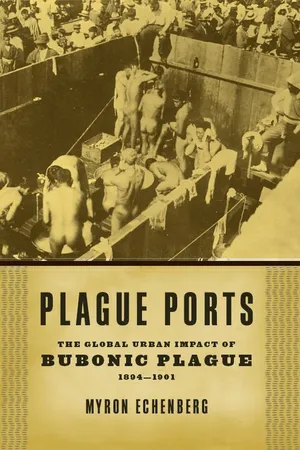
A century ago, the third bubonic plague swept the globe, taking more than 15 million lives. Plague Ports tells the story of ten cities on five continents that were ravaged by the epidemic in its initial years: Hong Kong and Bombay, the Asian emporiums of the British Empire where the epidemic first surfaced; Sydney, Honolulu and San Francisco, three "pearls" of the Pacific; Buenos Aires and Rio de Janeiro in South America; Alexandria and Cape Town in Africa; and Oporto in Europe.
Myron Echenberg examines plague's impact in each of these cities, on the politicians, the medical and public health authorities, and especially on the citizenry, many of whom were recent migrants crammed into grim living spaces. He looks at how different cultures sought to cope with the challenge of deadly epidemic disease, and explains the political, racial, and medical ineptitudes and ignorance that allowed the plague to flourish. The forces of globalization and industrialization, Echenberg argues, had so increased the transmission of microorganisms that infectious disease pandemics were likely, if not inevitable.
This fascinating, expansive history, enlivened by harrowing photographs and maps of each city, sheds light on urbanism and modernity at the turn of the century, as well as on glaring public health inequalities. With the recent outbreak of COVID-19, and ongoing fears of bioterrorism, Plague Ports offers a necessary and timely historical lesson.
- 366 pages
- English
- ePUB (mobile friendly)
- Available on iOS & Android
eBook - ePub
About this book
Information
PART 1
Belle Époque and Bubonic Plague1
Belle Époque
The God of Light, the Spirit of Knowledge, the Divine Intellect, is gradually spreading over the planet and upward to the skies. . . . Disease will be extirpated; the causes of decay will be removed; immortality will be invented.
Winwood Reade, 18722
To mark the dawn of a new century and to serve as an epilogue to the old, the nations of the world gathered in the summer of 1900 at the grandiose Paris Exposition. Covering 336 acres from the slopes of Trocadero to both sides of the Seine and offering 80,000 exhibits, Expo 1900 attracted the astonishing number of 51 million people, a figure never matched before or since by world’s fairs. Royal visitors included the monarchs of Sweden, Belgium, Greece, and Persia. French President Loubet entertained no fewer than 21,000 French mayors, many dressed in regional costumes, at a banquet in the Tuileries Gardens. Gathering in two gigantic tents, the mayors feasted on salmon, pheasant, and other delicacies while the principal chef and his staff supervised the meal using such new-fangled devices as the automobile and telephone.
World’s fairs were expressions of positivist, Saint-Simonian faith in the ability of material and scientific progress to overcome backwardness, and Expo 1900 was no exception. While propaganda heralded the exposition as a symbol of universal concord as seen through art, science, and industry, in reality the Great Powers used Paris as an opportunity to display their economic and military might with such products as Schneider-Creusot’s long-range cannon and Vickers-Maxim’s collection of death-dealing, rapid-firing machine guns.
Only the Germans and the French heralded their medical accomplishments. Germany featured Roentgen’s revolutionary X-ray, first developed in 1895 and which, along with the laboratory, was to revolutionize the practice of medicine. Also attracting attention was a French physician who utilized the new technology of film to show a movie of himself performing an operation. In addition, Paris was the venue that summer for a large medical congress with more than 6,000 participants, although the public was more impressed with Pierre de Coubertin’s second Olympiad, the first having taken place four years earlier in Athens.
Rich and Poor
Let the reader walk through the wretched streets . . . of the Eastern or Southern districts of London. . . . [S]hould he be of average height, he will find himself a head taller than those around him; he will see on all sides pale faces, stunted figures, debilitated forms, narrow chests, and all the outward signs of a low vital power. Surely this ought not to be. . . . Cities must exist, and will continue to increase. We should therefore turn our attention seriously to the question of how to bring health within the reach of our poorer city populations.
Reginald Meath, Lord Brabazon, London, 18863
Imperial wars were one manifestation of global tensions in 1900. Another source was the latent conflict between rich and poor, often thrown together in burgeoning cities fed by huge waves of continental and oceanic migration. Nowhere was the stark contrast between the wealthy and the impoverished more glaring than among the 6 million inhabitants of turn-of-the-century London, then the largest city in the world and the fulcrum of the richest country on earth. The Whitehall District in central London immediately south and west of Trafalgar Square contained the political power of the nation and empire, from the Home Office and the Local Government Board to the Colonial and India Offices. Economic power was concentrated in another district, the City of London, where the warehouses, offices, and banks were located. Meanwhile, one-third of Londoners crowded into insalubrious East End tenements, where native “cockneys” competed for light and space with Jews from eastern Europe, Irish laborers, and Lascars, a term reserved for seamen from the Indian subcontinent who made London their home port. The 1901 census revealed that up to one-half of London’s poor lived in flats of only one or two rooms. Not until after the First World War, when public housing projects inspired by Fabian Socialism emerged, did the housing situation improve.
London’s situation was not exceptional. Its dichotomies between rich and poor, the native born and the foreign newcomer, the healthy and the sick, could be matched in cities around the globe. Hastily constructed and overcrowded tenements went by a variety of names and could be found in any of the ports in this study: the conventillos of Buenos Aires, the ilhas of Porto, the cortiços or “beehives” of Rio de Janeiro, the chawls of Bombay, and the okelles of Alexandria. Nevertheless, industrialization and trade expansion had clearly produced more global wealth, even if its distribution remained dramatically uneven between regions of the world and within single polities. Although improvements in science, technology, and medicine were arguably beneficial on the whole; again, they were not equally shared.
Perceptions about public health in 1900 varied widely. Optimists could cite innovations and improvements such as safe drinking water; modern sewage disposal; better nutrition; medical innovation, especially in immunology; better inspection of food; and, last but not least, an overriding paradigmatic shift in the explanation of disease causation based on the germ theory of infection.
Therefore, pessimists could barely control their panic over the prospect that bubonic plague, Europe’s greatest remembered scourge, was once more poised to attack. Despite breakthroughs by sanitary engineers and bacteriologists, waterborne infections like cholera and typhoid continued to threaten overcrowded or ill-prepared cities. Turn-of-the-century epidemiological data revealed that 10 of every 100 children never lived to celebrate their first birthday; 33 did not live to adulthood; and the overall average life expectancy was less than 50 years. Infectious disease accounted for three-quarters of all deaths, with tuberculosis the greatest killer. Despite the new revolution in biomedicine, physicians were still largely limited to making their patients comfortable as they strove to “do no harm.” Only with the benefit of hindsight may we now observe that the twentieth century, whatever other horrors may have characterized it, experienced a steady and often dramatic improvement in public health in the Northern Hemisphere. Yet in 1900, living in the early stages of this demographic transformation, many people had reason to be fearful rather than triumphal.
If income and health disparities were enormous in the northern lands, the same can equally be said for the Southern Hemisphere. The scramble for territory in Africa and Asia and the American takeover of much of what remained of Spain’s old empire in the Caribbean and the Pacific had placed a heavy burden on newly subject peoples. Nor was the accompanying expansion of Western biomedicine and sanitary practices an unmitigated triumph of enlightened science over superstition and ignorance, as many Europeans chose to frame their accomplishments. Rather, infectious disease was not only a weapon permitting Europeans both to conquer and to live in the tropics, it also demoralized those who might have resisted European domination more strenuously. Diseases such as cholera, malaria, yellow fever, trypanosomiasis, and bubonic plague all gained ground as a result of the political, military, and economic transformations unleashed by late-nineteenth-century European imperialism.
Psychological and moral issues were involved as well. Western medical advocates saw their offerings as a measure of their alleged superiority, a rationalization for the right to conquer and rule and an implicit means of demonstrating to indigenous peoples that the inadequacy of their own healing practices and principles was itself proof of their inferiority. In short, Europeans made locals out to be peoples without knowledge.
Three Plague Pandemics
No greater misfortune, from a public health point of view, could befall a community than an outbreak of bubonic plague in a large and crowded city.
Emanuel Klein, London, 19064
The very term plague evokes horror in the collective memories of Europe and the Islamic world. The word itself has become generic in several languages for calamity and disaster. Over the centuries, Western writers from Giovanni Boccaccio through Daniel Defoe to Albert Camus have treated plague epidemics as both human catastrophes and powerful metaphors for political and social breakdown. The great North African scholar Ibn Khaldun lived through the horrors of the Black Death and was motivated to write his monumental study of the collapse of the fourteenth-century world order because “the East and the West was [sic] visited by a destructive plague which devastated nations and caused populations to vanish.”5 It is more difficult to find Chinese parallels before the twentieth century, as medicine there did not accept bubonic plague as a distinct medical category. Nevertheless, devastating plaguelike epidemics caused terror in China from at least the Ming-Qing transition in the mid-seventeenth century.
Medical historians have distinguished three recorded pandemics of bubonic plague, although recently a debate has developed over whether the same pathogen was involved in all three cases.6 The first calamity, not counting others like the biblical “Plague of the Philistines” that probably preceded it, occurred in 542 C.E. in the eastern Mediterranean and the Middle East. Known as Justinian’s Plague, this visitation killed untold millions and helped destroy the Roman Empire in the East.
The Black Death, the second bubonic plague pandemic and the one that has received the most attention from historians, reached Europe from Central Asia in 1347 and was even more devastating. The ecologies of the medieval European cities were ideal for plague. Housing was very crowded, hygiene was terrible, and food was stored in and near dwellings, within easy access for rats. As people fled the plague, with rats and fleas traveling with their goods, new rat populations and new towns became infected. Within the first four years, no fewer than 20 million Europeans died, and estimates of deaths from plague during the rest of the fourteenth century range from a low of one-quarter to a high of one-half the total population of both Europe and the Middle East. The demographic crisis triggered by this die-off did not end until 1500, and historians generally agree that it was the single most important factor in bringing the Middle Ages to a close.
The focus of this book is the third and most recent plague pandemic, which lasted from 1894 to roughly 1950. Emerging from its wild rodent reservoir in the Himalayan borderlands between China and India soon after 1855 and traveling this time not west but east, bubonic plague infected the densely populated provinces of south China before attacking Canton and then the British colonial port of Hong Kong in 1894. There it rekindled international fears, especially when it reached Macao and Fuzhou a year later, and struck Singapore and Bombay in 1896. Transported rapidly by British steamships throughout the empire and beyond, bubonic plague took only a few years to reach every continent. A partial list of plague ports and riverine towns would include not only the ten cases in this study but also Vera Cruz, Lima, Glasgow, Manila, and Kobe. What is more, locales as disparate as Dakar, Jakarta, and Algiers, spared this unwelcome visitor in the first years of the twentieth century, took their turn to host bubonic plague soon after.
This time around, the plague pandemic produced a highly variable death toll.7 Most of the roughly 15 million lives it ended prematurely were inhabitants of India, China, and Indonesia. For India alone, recent estimates exceed 12 million, which is about 25 percent higher than earlier figures. In a minority of jurisdictions, such as the British colonies of Burma, Hong Kong, and Mauritius; the French colonies of Senegal and Madagascar; and the Portuguese Madeira islands, recurring plague epidemics were both numerous and severe in the first half of the twentieth century. Elsewhere, the pandemic proved relatively benign. Europe’s death toll was 7,000 people between 1899 and 1950. Central and South America lost roughly 30,000 people to plague over this long time span. In the United States, approximately 500 deaths were attributed to plague during mild outbreaks in San Francisco, Los Angeles, and New Orleans and in isolated rural settings in Arizona and New Mexico during this same period.
Such a lopsided impact for a world pandemic was a new phenomenon. The first two plague visitations had been devastating wherever they had struck, and the same was true for the first four cholera pandemics between 1817 and 1874, and for the great influenza pandemic of 1918. Because the third plague pandemic coincided with the dramatic growth of the new science of bacteriology, many observers drew a connection between the two. Sounding a palpably congratulatory note, these writers assumed that because the third pandemic’s impact was benign in the West and lasted only half a century everywhere, modern science must be the cause of these happy developments. Fabian Hirst, who devoted his entire research life to the study of plague in South Asia, called his then-definitive study of the disease The Conquest of Plague.8 Similarly, William McNeill holds that plague’s containment “by international teams of doctors constitutes one of the most dramatic triumphs of modern medicine.”9 Not only do such arguments minimize the severe impact of plague on many non-Western peoples, but they also err in attributing the eventual retreat of plague as a victory for human agency. As we will see, for plague and other complex diseases, some arguments stumble into a logical trap known as post hoc ergo propter hoc (one thing follows another, therefore it was caused by the other).
Rats and Their Fleas
Dead rats found in houses and in the streets [of Hong Kong] always harbor large quantities of the microbe in their organs. Many have real buboes. I have placed healthy mice and inoculated mice in the same cage. The inoculated ones died first, but within a few days all of the others die from the invasive plague bacillus. Plague is therefore a contagious and transmissible disease. It is probable that rats are the major vector in its propagation.
Alexandre Yersin in his classic first article on plague, 189410
Bubonic plague is a zoonosis, a disease of wild rodents. As a result of the third pandemic, plague now exists in a series of permanent reservoirs: among the field rats of India and Indonesia; the marmots of Manchuria; prairie dogs and squirrels in the Rocky Mountain foothills of the southwestern United States; the gerbils of South Africa; and cavies (wild guinea pigs) in Argentina. Only rarely does it cross over to humans. The pathogen is Yersinia pestis (formerly called Pasteurella pestis), and the most efficient flea vector is the biting rat flea, Xenopsylla cheopis. Although nothing is simple about this disease, its main form of transmission can be succinctly summarized. A flea seeking a blood meal bites a rodent infected with Y. pestis bacilli and, while feeding on its blood, becomes infected with the bacteria that goes on to multiply in its gut. The flea then transmits the plague bacteria to more rodents and other mammals, including humans who inadvertently find themselves within the flea’s range. Before the arrival of antibiotics after 1945, a human’s chances of surviving this lethal disease were fifty–fifty at best; case fatality rates of 80 or 90 percent were common.
Practitioners of the new science of bacteriology wasted little time applying their methodology to bubonic plague when it surfaced in Hong Kong in the late spring of 1894. Within weeks of the outbreak, Alexandre Yersin, a young Franco-Swiss Pastorian, observed the rodlike bacilli under the microscope and successfully demonstrated that the bacteria were the cause of bubonic plague. But recognition and acceptance of the rat flea as plague’s vector took at least another decade, and the development of effective therapy, much longer still. Not until the emergence of antibiotics in 1945 could physicians effectively cure this terrible disease.
Despite the critical role of insects in its transmission, extensive research by entomologists on precisely how this transmission occurred took several decades to determine. What we now know but what even the most avantgarde scientists and public health workers in 1900 did not, is that only a few species of fleas can trigger a plague epizootic among rats or a major epidemic among humans.
Only these later understandings of the critical role of the flea vector would explain so many of the conundrums presented by plague epidemics. Even though many species of fleas can become infected, only a few are truly efficient vectors. Thus the human flea, Pulex irritans, can be a carrier of Y. pestis, but the single most important vector is the biting flea, Xenopsylla cheopis. When this flea feeds on infected blood, its proventriculus becomes blocked by a gelatinous mass of bacilli. The obstruction prevents blood from traveling to the mid-gut, so the flea begins to starve. In a frantic effort to feed, the flea leaps from host to host, sucking blood until its esophagus, containing virulent bacilli, becomes grossly distended. Each time it bites in this condition, it regurgitates sufficient numbers of organisms to transfer plague to the next mammal. The dominant flea in San Francisco and in other cities where plague epidemics proved to be mild was the European rat flea, Ceratophyllus fasciatus, an ineffective plague vector.
While the maximum life span of an infected flea with a blocked proventriculus is only twenty to thirty days, infected but unblocked fleas may live for up to six months, depending on the microclimate of their hosts’ burrows. Optimal conditions for fleas’ longevity are moderately high temperatures and a moist but not wet atmosphere. Under such favorable climatic conditions, infected fleas can also travel long distances with all kinds of cargo. For example, the dangerous X. cheopis flea breeds easily in cereal husks. This species has simple nutritional requirements in the larvae stage and can survive transport in grain without the presence of rats.
In order for a human outbreak of bubonic plague to occur, three conditions must be met. First is the presence of a reservoir in which particular species of infected fleas cohabit with a nonsusceptible wild rodent population. Hundreds of varieties of rodents and lagomorphs (rabbits and related species) around the world have been known to harbor the pathogen. Second, a vulnerable, highly susceptible population of commensal rodents must become infected through accidental contact with t...
Table of contents
- Cover Page
- Title Page
- Copyright Page
- Dedication
- Contents
- Acknowledgments
- Preface
- Illustrations
- PART 1: Belle Époque and Bubonic Plague
- PART 2: Asian Beginnings
- PART 3: Plague at the Doors of Europe
- PART 4: South American Settings
- PART 5: Plague under the Stars and Stripes
- PART 6: Plague under the Union Jack
- PART 7: Plague’s Lessons
- Appendix
- Notes
- Index
- About the Author
Trusted by 375,005 students
Access to over 1.5 million titles for a fair monthly price.
Study more efficiently using our study tools.
Frequently asked questions
Yes, you can cancel anytime from the Subscription tab in your account settings on the Perlego website. Your subscription will stay active until the end of your current billing period. Learn how to cancel your subscription
No, books cannot be downloaded as external files, such as PDFs, for use outside of Perlego. However, you can download books within the Perlego app for offline reading on mobile or tablet. Learn how to download books offline
Perlego offers two plans: Essential and Complete
- Essential is ideal for learners and professionals who enjoy exploring a wide range of subjects. Access the Essential Library with 800,000+ trusted titles and best-sellers across business, personal growth, and the humanities. Includes unlimited reading time and Standard Read Aloud voice.
- Complete: Perfect for advanced learners and researchers needing full, unrestricted access. Unlock 1.5M+ books across hundreds of subjects, including academic and specialized titles. The Complete Plan also includes advanced features like Premium Read Aloud and Research Assistant.
We are an online textbook subscription service, where you can get access to an entire online library for less than the price of a single book per month. With over 1.5 million books across 990+ topics, we’ve got you covered! Learn about our mission
Look out for the read-aloud symbol on your next book to see if you can listen to it. The read-aloud tool reads text aloud for you, highlighting the text as it is being read. You can pause it, speed it up and slow it down. Learn more about Read Aloud
Yes! You can use the Perlego app on both iOS and Android devices to read anytime, anywhere — even offline. Perfect for commutes or when you’re on the go.
Please note we cannot support devices running on iOS 13 and Android 7 or earlier. Learn more about using the app
Please note we cannot support devices running on iOS 13 and Android 7 or earlier. Learn more about using the app
Yes, you can access Plague Ports by Myron Echenberg in PDF and/or ePUB format, as well as other popular books in History & 19th Century History. We have over 1.5 million books available in our catalogue for you to explore.