Explains the failure—on both sides of the aisle—of the War on Poverty
The much-heralded War on Poverty has failed. The number of children living in poverty is steadily on the rise and an increasingly destructive underclass brutalizes urban neighborhoods. America's patience with the poor seems to have run out: even cities that have traditionally been havens for the homeless are arresting, harassing, and expelling their street people.
In this timely work, William Kelso analyzes how the persistence of poverty has resulted in a reversal of liberal and conservative positions during the last thirty years. While liberals in the 1960s hoped to eliminate the causes of poverty, today they increasingly seem resigned to merely treating its effects. The original liberal objective of giving the poor a helping hand by promoting equal opportunity has given way to a new agenda of entitlements and equal results. In contrast, conservatives who once suggested that trying to eliminate poverty was futile, now seek ways to eradicate the actual causes of poverty.
Poverty and the Underclass suggests that the arguments of both the left and right are misguided and offers new explanations for the persistence of poverty. Looking beyond the codewords that have come to obscure the debate—underclass, family values, the culture of poverty,—Kelso emphasizes that poverty is not a monolithic condition, but a vast and multidimensional problem.
During his Presidential campaign, Bill Clinton called for an overhaul of the welfare system and spoke of a new covenant to unite both the left and right in developing a common agenda for fighting poverty. In this urgent, landmark work, William Kelso merges conservative, radical, and liberal ideals to suggest how the intractable problem of poverty may be solved at long last by implementing the principles of this new covenant.
eBook - ePub
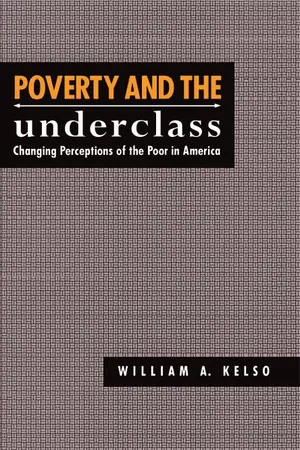
Poverty and the Underclass
Changing Perceptions of the Poor in America
- 352 pages
- English
- ePUB (mobile friendly)
- Available on iOS & Android
eBook - ePub
Poverty and the Underclass
Changing Perceptions of the Poor in America
About this book
Information
Topic
EconomíaSubtopic
Economía políticaThe Poverty Debate
ONE
Doesn’t Anything Work? Is a War against Poverty Really Feasible?
As Lyndon Johnson began his first full term as president of the United States in 1964, many liberal Democrats were optimistic and excited about his social agenda. Political pundits as well as the news media speculated that the country was finally going to take action to relieve the poverty and misery that seemed to afflict so many people in this land of plenty. After all, Johnson promised to initiate a “war on poverty” that would create a more just and humane society that all Americans could be proud of. In the heady days of the 1960s, the American political left sincerely believed that the plight of the poor would finally be eliminated by the government’s attack on the causes of poverty.
But after three decades of experience with welfare programs, the sense of optimism that previously animated liberalism seems spent. By the late 1970s it was apparent that President Johnson’s war on poverty had been a failure. Despite the billions of dollars spent on programs like compensatory education and CETA (Comprehensive Employment Training Act), government efforts to deal with the origins of poverty have met with minimal success at best. In light of these failures, an increasing number of liberals began to reassess their social agenda and started talking about treating the consequences rather than eliminating the causes of poverty: if the government could not help people become financially independent, its next best policy was to shield them from the hardships of limited income. But surprisingly enough, as the expectations of many liberals faded, conservatives started to argue that the government might be able to alleviate the origins of poverty after all. Over the last thirty years there has been a paradoxical shift in the attitudes of liberal Democrats, conservatives, and Marxists about the nagging problem of poverty. To appreciate this current state of affairs, it is important to understand how attitudes toward the poor have changed dramatically since the idea of the Great Society was first articulated thirty years ago.
In establishing his war on poverty, Johnson’s goal had been to eliminate the causes rather than the consequences of poverty; or, as the president forcefully put it, his objective was to give people a hand rather than a handout. The Johnson administration rejected the policy of subsidizing he poor because it hoped to attack the origins of poverty by providing individuals with the training and skills necessary to earn their way out of a life of destitution.
To achieve that objective, the administration launched a multifaceted attack on the causes of low income. Some in the administration, such as Walter Heller, stressed the need to stimulate economic growth, while others emphasized the importance of eliminating racial barriers to upward mobility. But Johnson’s main thrust was geared to upgrading the skills of the poor.1 The Johnson presidency believed that even if indigents wanted to work, they lacked the appropriate training and skills necessary to compete in the labor market successfully. To correct these problems, the government launched a series of initiatives such as the Job Corps, the Manpower Development and Training Act, Head Start, Upward Bound, and the Elementary and Secondary Education Act.
However, governmental efforts to improve the education of the poor quickly proved to be ineffective in enabling people to climb out of poverty. The problem certainly was not from a lack of trying. From 1963 to 1985, the government spent over $282 billion (in 1986 dollars) on targeted education and training programs.2 Yet during that same time, the percentage of people climbing out of poverty by securing decent jobs remained static, and the distribution of income in the United States became even more unequal. Even more disturbing was the growth of a large and often self-destructive underclass in our inner cities that seemed impervious to change. The government had offered a helping hand, but the vast majority of the poor seemed unable to grasp it.
As their hope for eradicating the causes of poverty turned sour, many liberals began to redefine the objectives of the welfare state. Instead of admitting that the government’s war on poverty had failed, they insisted that the growth of government transfer programs had enabled millions of people to deal with the consequences of poverty. The metaphor of a war, with the implication that victory was possible, ceased to appear in discussions of the poverty problem. Instead of asking how to make people self-sufficient, government agencies began to focus on giving the less fortunate a handout in order to shield them from the financial insecurities of the marketplace. The failure of Johnson’s efforts to prepare people adequately for effective competition in the workplace convinced many liberals that they needed to focus their efforts on protecting people from the transformations occurring in the U.S. economy. By the end of the 1980s, the early rhetoric of enhancing the skills of the poor and promoting equal opportunity gave way to a new agenda that stressed entitlements, quotas, and equal results. If the government’s efforts to help people help themselves had met with only mixed success, elected officials could at least make sure that those with low incomes received adequate subsidies to deal with the consequences of poverty. While many liberals became increasingly pessimistic about the efficacy of government programs and reluctantly became resigned to treating the effects as opposed to the causes of poverty, an increasing number of conservatives shook off their sense of despair and began to express exactly the opposite view.
In the early 1960s, academics on the right like Edward Banfield had insisted that the poor were afflicted by a “culture of poverty,” which made it impossible for them to ever compete successfully in the workplace.3 As conservatives watched the Great Society mushroom in size, they insisted that it would only prove to be a costly failure. What is even more important, they maintained that such programs would unjustifiably raise the expectations of the poor that things would get better, when in reality the plight of the poor would probably change very little. Because they believed the poor had little ability to improve their lot, conservatives thought it was futile for the government to try to solve the causes of poverty.
However, by the mid-1970s the view of many conservatives about poverty had changed dramatically. Beginning with Thomas Sowell, critics on the right began to write about the successes several ethnic groups had enjoyed in climbing out of poverty.4 Instead of dwelling on the pathological culture of the poor, they identified ethnic groups such as West Indian blacks, Japanese, Chinese, and Jews who had come to this country poor but had achieved prosperity within a relatively short time. Many of these same ethnic groups had to deal with systematic racial discrimination and limited government assistance but had still managed to prosper. The critics thus suggested that maybe a war against poverty could be won after all: the success stories among ethnic Americans belied the claim that all the poor were permanently locked in a self-perpetuating poverty trap.
Similarly, other conservatives, such as Charles Murray, began to express hope that the poor could eventually become self-sufficient. In studying upward mobility in this country, Murray wanted to know if poverty rates had historically been constant or if they had declined over time.5 To his amazement, he found that in the 1950s, when the government did little to assist the poor, the poverty rate dropped about 2 percent a year. Apparently, when people were left to their own devices, they seemed to be able to climb out of poverty on their own. But the picture began to change in the late 1960s, to the detriment of the poor. As the Great Society’s efforts to combat poverty swung into action, the number of people escaping poverty on their own, that is, escaping what is now called “pretransfer poverty,” leveled out and even began to decrease. Murray argued that well-meaning government transfer programs were in large part responsible for the poor “losing ground” in their fight against poverty.
Because Murray questioned the very raison d’être of the Great Society and suggested drastic cuts in the size of entitlement programs, he was harshly criticized by his liberal detractors. While its supporters recognized that the growth of the welfare state had proved ineffectual in eliminating the causes of poverty, they were determined to disprove the notion that their transfer programs created disincentives for low-income people to escape poverty. To concede that some public programs were ineffective was very different from accepting the proposition that government transfer programs were actually harmful to the poor.
In attacking Murray’s pessimistic assessment, critics tended to overlook his rather optimistic assessment that the causes of poverty could be successfully overcome. Both Murray and Sowell suggested that, given the proper conditions, the poor could work their way out of poverty. Whether it was due to the entrepreneurial activities of ethnic groups or the trickle-down effects of economic growth, the number of people stuck in poverty had significantly declined in the 1950s and 1960s. If that progress had been halted in the 1970s, it could be restarted by a different set of policies. While conservatives in the 1960s had insisted that the pathological nature of lower-class culture rendered efforts to eliminate poverty an exercise in futility, they downplayed such sentiments in the 1980s and 1990s and optimistically suggested that the causes of poverty could be treated.
Simultaneously, many American Marxists also began to reevaluate their assessment of the welfare state. In the 1960s radicals like Francis Fox Piven and Robert Cloward had lambasted the war on poverty as a cynical effort to coopt and pacify the poor, but by the 1980s and 1990s they embraced the programs they had earlier criticized.6 Marxists were initially critical of Johnson’s poverty programs because they saw poverty as playing a functional role in a capitalist economy. In their eyes, the captains of industry needed a large pool of dispossessed indigents to maintain downward pressure on wages. If the working class ever became active and powerful enough to secure sizable increases in their wages, they would seriously eat away the profit margins of the country’s corporations. Conversely, if there were millions of poor people waiting to fill any available openings at minimal wages, the leverage of trade unions would be broken and the threat to corporate profits would disappear. By playing the poor off against the working class, business interests could always neutralize the bargaining power of the working class. Given their perspective of the marketplace, Piven and Cloward saw poverty as essential to the workings of our capitalist system. People were poor not because they had a pathological culture or inadequate work skills. Poverty, in fact, had nothing to do with the characteristics of individuals at all. People were kept in poverty because it served the long-term functional needs of capitalism in general and the short-term profit needs of corporations in particular.
However, the poor often refused to play this docile role by periodically rioting and disrupting the peace and quiet of American cities. In order to stop this threat to political harmony, the political system tried to buy off the poor by temporarily expanding the scope of the welfare state. At the behest of the capitalist interests that allegedly dominated our government, public officials cynically placated the poor so that more meaningful reforms would not be required. Piven and Cloward contended that once the poor were pacified and the rioting in our cities had died down, politicians would begin to dismantle the enlargement of the welfare state. The expansion of the welfare state under Lyndon Johnson was thus part of a long-term cycle going back to the Great Depression. As the economy worsened, the government made cosmetic changes to pacify the poor and thus negate the need for dramatic and meaningful change.
Despite their wholesale condemnation of the war on poverty, Piven and Cloward were animated by a revolutionary belief that the riots sweeping American cities held out the potential for solving the poverty problem. If the government could be prevented from buying off the poor, there was hope for systematic change in our capitalist economy. In the early 1960s, American Marxists thus entertained a curious combination of both hope and despair that the causes of poverty could eventually be attacked. If only the poor could be made aware that the welfare state was part of the class struggle, they might resist its seductive nature and bring about meaningful economic change.
By the 1980s, the same Marxists who had condemned the war on poverty for coopting the poor vigorously defended those same programs against the budget cutters in the Reagan administration who wanted to contract the scope of the welfare state. They insisted that public relief had to be preserved intact in order to protect the financial well-being of those stuck at the bottom of the economic ladder. Instead of modifying capitalism and thus getting at the root causes of poverty, they seemed more intent on guaranteeing that transfer programs adequately insulated people from the vagaries of the market economy. Paradoxically, like liberals, Marxists had increasingly become preoccupied with treating the consequences rather than the causes of poverty.
WHY THE SHIFT IN ATTITUDES?
In less than a quarter of a century, attitudes toward poverty had been dramatically turned upside down. Why is it that many liberals, who had once hoped to win the war against poverty, now seemed resigned to treating its effects? Why did Marxists, who once condemned the welfare state as being harmful to the long-term interests of the poor, now embrace the programs they earlier saw as manipulative? Why did numerous conservatives, who once argued that the poor would always be burdened with low incomes, now argue that a sizable number of poor could permanently work their way out of poverty?
The answers to these issues are based on both changing perceptions of the causes of poverty as well as the political realities of American politics. Some Marxists insist that their opinions of the welfare state reflect the dialectical and contradictory nature of social change in general: while poverty programs may be functional to the needs of capitalist development, they may also simultaneously advance the class interests of the poor in their struggle to survive in a capitalist economy. However, in more practical terms, Piven and Cloward have probably altered their view of the welfare state out of a reluctance to lend any kind of support to conservatives who wish to curtail the growth of transfer programs. When Ronald Reagan raised serious questions about the welfare state in the 1980s, many radicals undoubtedly felt the need to respond to his attack. Even if ideologically they felt that the welfare state was manipulative, their hostility to the agenda of the right led them to embrace programs they had earlier dismissed. While their reversal of positions may have been of some tactical and strategic advantage, their credibility in offering a meaningful interpretation of the welfare state was called into question.
The dispute between conservatives and liberals, in contrast, was based more on empirical than strategic considerations. The changing perceptions of many on the left and the right as to whether or not the government could eliminate the causes of poverty reflected in turn their changing perceptions as to why people had become poor in the first place. As the government’s efforts to effectively reduce poverty came to an end around the late 1960s, it was apparent to everyone that the government’s original diagnosis of why poverty had occurred in this country was wrong. Since the proponents of Johnson’s war on poverty maintained that poverty stemmed from a deficiency in educational and vocational skills, they could optimistically believe that a war on poverty could be won. But as liberals abandoned supply side theories of poverty and focused on structural conditions in the economy, their optimistic belief that they could eliminate the causes of poverty began to disappear. When the Japanese started to penetrate the U.S. marketplace in the 1970s, critics like William Julius Wilson raised fears that the industrial heartland of America would become a rust belt. As new jobs declined, the opportunities to escape poverty would also dry up, limiting the ability of government to treat the causes of poverty.7 A very real danger thus existed that the economy would fragment into a series of high-paying and low-paying sectors. Rather than working in the industrial sector where prospects of upward mobility still existed, the poor now faced the bleak prospect of flipping hamburgers for minimum wages. In the same way that the war in Vietnam had not succeeded, the war on poverty also had been a misguided failure. In both cases the country had misdiagnosed the nature of the enemy. It made little sense to upgrade the skills of the poor when the manufacturing base of the U.S. economy had lost the capability to actually employ the poor. If these economic changes were permanent, it was obvious that protecting the poor from the changing world economy was the best substitute for victory the political system could achieve.
While liberals focused on structural changes in the economy, conservatives began to zero in on either government programs or the breakdown of traditional values to explain the persistence of poverty. They abandoned their belief of the 1960s that the poor were mired in poverty because of a pathological “culture of poverty.” On the contrary, some analysts like Charles Murray insisted that the disincentives embedded in many government welfare programs as well as the philosophical underpinnings of many transfer programs had eroded the initiative and self-reliance of the poor. However, others, such as Myron Magnet, the author or the provocative book The Dream and the Nightmare, insisted that the problems of the poor reflected a breakdown in traditional values—such as a belief in self-restraint, hard work, and marital stability—in the larger society.8 Once political and civic elites ceased upholding traditional beliefs in a clear and unambiguous fashion, many of the poor let go of traditional beliefs faster than the rest of society. As this phenomenon, which the famous French sociologist Emile Durkheim labeled “anomie, “ trickled down to the poor, a large and often destructive underclass began to appear in our inner cities. Despite their internal differences, analysts on the right increasingly believed that it was possible to eliminate the actual causes of poverty. While conservatives often espoused policies such as cutting back the size of the welfare state or the establishment of workfare, which generated considerable controversy, they remained optimistic that a war on poverty could eventually be won.
By the 1980s the political right and left had thus significantly revised their diagnosis of poverty as well as their solutions for dealing with the large poverty population in the country. As numerous liberals insisted that poverty was rooted in the changing nature of the economy, they increasingly became resigned to treating the effects of poverty while many conservatives, who blamed either governmental disincentives or the erosion of traditional values for the persistence of poverty, became hopeful that public officials could still eliminate the origins of poverty.
WHERE DOES THE DEBATE GO FROM HERE?
In light of the shi...
Table of contents
- Cover Page
- Title Page
- Copyright Page
- Contents
- Preface
- Part I The Poverty Debate
- Part II Explaining Poverty: Individual Explanations
- Part III Explaining Poverty: Motivational Explanations Accounting for the Growth of the Underclass
- Part IV Explaining Poverty: Structural Explanations
- Part V The Changing Views of Poverty in America
- Appendix: The Controversy over the Government’s Definition of Poverty
- Notes
- Index
- Footnotes
Trusted by 375,005 students
Access to over 1.5 million titles for a fair monthly price.
Study more efficiently using our study tools.
Frequently asked questions
Yes, you can cancel anytime from the Subscription tab in your account settings on the Perlego website. Your subscription will stay active until the end of your current billing period. Learn how to cancel your subscription
No, books cannot be downloaded as external files, such as PDFs, for use outside of Perlego. However, you can download books within the Perlego app for offline reading on mobile or tablet. Learn how to download books offline
Perlego offers two plans: Essential and Complete
- Essential is ideal for learners and professionals who enjoy exploring a wide range of subjects. Access the Essential Library with 800,000+ trusted titles and best-sellers across business, personal growth, and the humanities. Includes unlimited reading time and Standard Read Aloud voice.
- Complete: Perfect for advanced learners and researchers needing full, unrestricted access. Unlock 1.5M+ books across hundreds of subjects, including academic and specialized titles. The Complete Plan also includes advanced features like Premium Read Aloud and Research Assistant.
We are an online textbook subscription service, where you can get access to an entire online library for less than the price of a single book per month. With over 1.5 million books across 990+ topics, we’ve got you covered! Learn about our mission
Look out for the read-aloud symbol on your next book to see if you can listen to it. The read-aloud tool reads text aloud for you, highlighting the text as it is being read. You can pause it, speed it up and slow it down. Learn more about Read Aloud
Yes! You can use the Perlego app on both iOS and Android devices to read anytime, anywhere — even offline. Perfect for commutes or when you’re on the go.
Please note we cannot support devices running on iOS 13 and Android 7 or earlier. Learn more about using the app
Please note we cannot support devices running on iOS 13 and Android 7 or earlier. Learn more about using the app
Yes, you can access Poverty and the Underclass by William A Kelso, William A. Kelso in PDF and/or ePUB format, as well as other popular books in Economía & Economía política. We have over 1.5 million books available in our catalogue for you to explore.