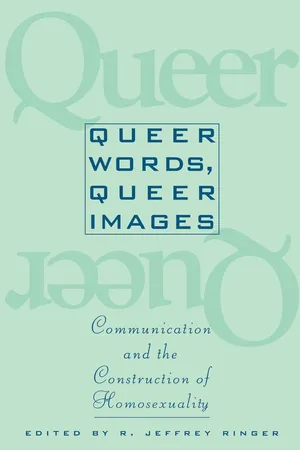
In many arenas the debate is raging over the nature of sexual orientation. Queer Words, Queer Images addresses this debate, but with a difference, arguing that homosexuality has become an issue precisely because of the way in which we discuss, debate, and communicate about the concept and experience of homosexuality. The debate over homosexuality is fundamentally an issue of communication—as we can see by the recent controversy over gays in the military. This controversy, termed by one gay man as the annoying habit of heterosexual men to overestimate their own attractiveness, has been debated in communication-sensitive terms, such as morale and discipline.
The twenty chapters address such subjects as gay political language, homosexuality and AIDS on prime-time television, the politics of male homosexuality in young adult fiction, the identification of female athleticism with lesbianism, the politics of identity in the works of Edmund White, and coming out strategies. This is must reading for students of communication practices and theory, and for everyone interested in human sexuality.
Contributing to the book are: James Chesebro (Indiana State), James Darsey (Ohio State), Joseph A. Devito (Hunter College, CUNY), Timothy Edgar (Purdue), Mary Anne Fitzpatrick (Wisconsin, Madison), Karen A. Foss (Humboldt State), Kirk Fuoss (St. Lawrence), Larry Gross (Pennsylvania), Darlene Hantzis (Indiana State), Fred E. Jandt (California State, San Bernardino), Mercilee Jenkins (San Francisco State), Valerie Lehr (St. Lawrence), Lynn C. Miller (Texas, Austin), Marguerite Moritz (Colorado, Boulder), Fred L. Myrick (Spring Hill), Emile Netzhammer (Buffalo State), Elenie Opffer, Dorothy S. Painter (Ohio State), Karen Peper (Michigan), Nicholas F. Radel (Furman), R. Jeffrey Ringer (St. Cloud State), Scott Shamp (Georgia), Paul Siegel (Gallaudet), Jacqueline Taylor (Depaul), Julia T. Wood (North Carolina, Chapel Hill).
eBook - ePub
Queer Words, Queer Images
Communication and the Construction of Homosexuality
- 360 pages
- English
- ePUB (mobile friendly)
- Available on iOS & Android
eBook - ePub
About this book
Information
Topic
Ciencias socialesSubtopic
Estudios LGBTGay and Lesbian Rhetoric
1. The Logic of Folly in the Political Campaigns of Harvey Milk
Harvey Milk did not enter politics until he was forty-three; he lost three of the four political offices he sought; and when finally elected, he served only eleven months in office. The political record of San Francisco’s first openly gay supervisor, however, does not tell the whole story. In the course of four political campaigns, Milk moved from being an unknown outsider in virtually every way possible to a member of the Board of Supervisors, a position of considerable political power in San Francisco.
Milk’s background offered little evidence that he would become successful in San Francisco politics or that he would become a symbol for gay rights.1 He grew up in a suburb of New York City and kept his gay identity a secret through college and during a stint in the Navy. Dissatisfied with his chosen career as a high school teacher, Milk moved from job to job before becoming a financial analyst on Wall Street. At the same time, he began working on a friend’s Broadway productions, which introduced him to the counterculture of the 1960s. When his partner took a job as stage manager for the San Francisco production of Hair, Milk moved with him to San Francisco, again taking a job as a financial analyst. He was fired for burning his BankAmericard during a protest against the Vietnam War, after which he returned to New York to again work in theater. Milk settled permanently in San Francisco in 1973, where he and his new partner, Scott Smith (who would become his campaign manager), opened a store called Castro Camera.
The failure of government to meet people’s needs was the impetus for Milk’s decision to enter San Francisco politics. Three separate incidents in the summer of 1973 infuriated him: the lack of honesty in government revealed by the Watergate scandal, a special tax charged him as a small-business owner, and a request by a teacher to borrow a projector from the camera store because her district could not afford one.2 Milk decided he could make a difference in politics and announced his candidacy for the 1973 supervisorial race. He did surprisingly well for a newcomer to San Francisco politics, coming in tenth out of thirty candidates.3
Milk ran again for the Board of Supervisors in 1975; this time, he came in seventh after the six incumbents on the Board, all of whom were reelected.4 George Moscone, the new mayor of San Francisco, appointed Milk to a seat on the Board of Permit Appeals.5
Milk announced his decision to run again for public office only two months after taking his seat on the Board of Permit appeals.6 This time, his goal was the California Assembly; he sought the Democratic nomination for a seat in the Sixteenth District. Again, however, Milk was unsuccessful, losing to Art Agnos by a narrow margin.7
Milk was successful when he ran for supervisor for a third time, in 1977. Out of the seventeen candidates in the race, he won 30.5 percent of the votes cast.8 Milk, however, served only eleven months of his term. On November 27, 1978, Milk and Mayor George Moscone were assassinated by Supervisor Dan White.9 On the day of the killings, Moscone was to have announced his decision not to reappoint White to the Board of Supervisors, from which White recently had resigned.
On the surface, the campaign strategies that are evident in Milk’s political campaigns appear to be the usual moves of a candidate who becomes increasingly astute about the political process; they suggest typical adaptations in terms of language, dress, and decorum to the political arena. Milk’s name recognition alone, after conducting three campaigns in four years, undoubtedly contributed to his ultimate political victory. That Milk was gay, however, and ran for office at a time when the gay and lesbian community, even in San Francisco, was not a political force, created a rhetorical situation that was far from ordinary.
In this essay, I suggest that the logic of folly provides a means of explaining how Milk’s political campaigns effectively addressed the particular circumstances he confronted as a gay man seeking political office. Milk used the dimensions of folly as an underlying logic to preserve and foster his relationship with the gay community while simultaneously appealing to traditional political audiences. This study of Milk’s campaign rhetoric, then, offers a model useful for other gay and lesbian office seekers and may apply to other contexts in which gays and lesbians—and other outsider groups—seek positions of influence without abandoning or compromising their own identities.
In using the term folly in reference to Milk, I am not suggesting the casual meanings of the term—lacking good sense or refusing to accept reality—that are more likely than not to imbue contemporary definitions of folly. Instead, I refer to the notion of folly as defined and experienced in traditional societies. While fools of one sort or another have been part of virtually every culture, traditional folly was a distinct historical phenomenon in prerational societies: “when human societies were not yet ruled by bureaucracy, technology, and the sciences, when human minds were leavened with metaphysical notions and associative patterns of thought, when reality was experienced as a vast field of contingencies, structured mainly by fictitious and magical connections between cause and effect.”10
In such a worldview, any kind of change or period of transition was experienced with a certain amount of trepidation and awe. Even the expected transitions of everyday life—the movement from one season to another, from the old to the new year, from life to death—were vulnerable times in which reality lost its usual structures and meanings. To cope with these times, traditional people invented rituals and ceremonies that functioned as rites of passage.11 The fool was held in esteem because s/he could deal with the mysterious and especially difficult phase of transition. Neither male nor female, good nor evil, fools embodied and spoke for worlds that existed beyond reality. They reminded society of the power, energy, and magic of the cosmos, of “what could become of them if they would chance to abandon tradition and forsake the established norms and values of their society.”12
While modernity has altered profoundly the nature of folly,13 the essential dimensions of it can still function profitably as a critical framework for illuminating periods of transition. Among the central features of folly is its parasitic status—it is simultaneously outside of and in society. Folly flourishes in those moments that are outside the usual social order and thus is a phenomenon marked by marginality; yet folly is dependent on the very reality it calls into question. The effectiveness of the fool depends on the ability to hold a mirror up to the traditional social order, exaggerating its features and showing that reality as it is experienced could very well be different. The function of folly is to show the members of a society the borders of their worldview, and by bringing to consciousness taken-for-granted assumptions about what reality is, folly reinforces existing values, norms, and meanings of society.
The two techniques that are the special province of the fool are reversal and laughter. Reversal is the epitome of how folly functions since the fool’s essential act is to invert the social order and thus suggest that the world may not be as it appears:
Folly would focus on the opposites of human existence, … [and] play an irreverent game with them: male fools would dress up and behave like women, female fools would act like men and assume male roles and responsibilities; they would change into animals or undifferentiated, crassly materialistic and rudely erotic monsters. Left would be changed into right, right into left, sacred into secular, secular into sacred.14
The technique of reversal permits a society to envision new alternatives and ways of doing and being. Ernesto Grassi’s study of folly in the writings of the Italian humanists further underscores the importance of folly as a critical perspective. Grassi sees folly as embodying the fundamental human process, embedded in language, of making connections and seeing similarities; folly is “reality in the unveiling of its essence.”15 Donald Verene, in the preface to Grassi’s work on folly, elaborates: “To see human affairs as folly is to have an ontological insight into what is possible in any situation; that is, to see all as folly is to realize that things are never what they seem.”16 Folly, then, is not a loss of contact with reality—a form of psychotic insanity—but the distinctive human capacity to imagine self in new situations and to deal with those situations effectively: “It is folly which allows the projection of … one’s own desires, hopes, worries, expectations, fears … on the stage of life.”17
Laughter is also the particular province of the fool, a feature that, like reversal, accomplishes important functions for a society beyond mere entertainment. When watching a fool “fool around” in terms of worldviews, meanings, values, and norms, laughter often seems to be “the only sensible response” to the performance: “the fool renders his audience speechless.”18 Under the guise of laughter, ideas that would be unsettling in other circumstances can be raised without anyone having to take them too seriously. Thus, folly provides a way by which to verbalize what has heretofore been unspeakable, and the fool can encourage dialogue about issues that previously were not available for discussion.19
Traditional folly, then, was serious business and bore little resemblance to the forms of comedy, humor, and wit that accompany modernity. In contrast to the contemporary tendency to use the word “fool” as only a derogatory label, the traditional fool held a position of considerable importance because of the capacity to respond ritually to a world that was seen as unpredictable, hazardous, and enchanted.
The description of traditional folly has many parallels to the situation in which Milk and the gay community generally found themselves in the early 1970s. San Francisco had become a haven for gays and lesbians, and the long-time residents of the city generally displayed a benign tolerance of the openness of the gay/lesbian community. At the same time, gays had not yet secured representatives in any of the leadership positions in the city; the record on gays and lesbians in politics in San Francisco looked no different from most cities in its reluctance to grant a formal voice to this community.20 Furthermore, gays had been so continually harassed that they did not see themselves as a group with political power and were reluctant to publicly declare their collective support for any political candidate.21
In response to the existing political atmosphere, indirectness characterized gays’ approach to politics. The leaders of the gay community urged gays to work to elect liberals who would be sympathetic to their demands once in office, and various gay political clubs were formed to work toward these ends. For all of these liberal friends, however, gays had not been appointed to any city commissions or achieved a comprehensive civil rights law that banned discrimination against gays.
The political world Milk sought to enter, then, was in direct opposition to the marginalized gay world. Political success was granted to those prepared to stay within a narrow range of expectations and behaviors. Typical politicians were straight family men who dressed appropriately in suits and ties; in their campaign rhetoric, their aim was to avoid offending as many segments of their audience as possible. In contrast, Milk was a hippie, which violated traditional values of the political realm about lifestyle and dress; in fact, hippies have been considered examples of contemporary fools in the premium they played on nonrational thoughts and feelings, rejection of rational structures, and a search for “emotionally gratifying enchantments.”22
That Milk was gay heightened the similarities with images of fools because gays and lesbians, like traditional fools, play havoc with traditional gender roles. What the dominant society has considered “normal” in terms of intimate relationships, reproduction, and family directly is contradicted by the preferences and experiences of gays and lesbians. In fact, many have not considered gays to be human, and inhumanity is a feature frequently ascribed to the fool. In addition, the gay community is known for literally reversing traditional gender roles. Dressing “in drag,” for example, flaunts a reversal of gender characteristics and makes problematic the intrinsic connection between sex and gender to which the dominant culture typically subscribes. The similarities between the posi...
Table of contents
- Cover
- Dedication
- Title Page
- Copyright
- Contents
- Acknowledgments
- Introduction by R. Jeffrey Ringer
- Part One: Gay and Lesbian Rhetoric
- Part Two: Portrayals of Gay Men and Lesbians in the Media
- Part Three: Portrayals of Gay Men and Lesbians in Language and Text
- Part Four: Interpersonal Communication in Gay and Lesbian Relationships
- Part Five: Coming Out in the Classroom
- Contributors
- Name Index
- Subject Index
Trusted by 375,005 students
Access to over 1.5 million titles for a fair monthly price.
Study more efficiently using our study tools.
Frequently asked questions
Yes, you can cancel anytime from the Subscription tab in your account settings on the Perlego website. Your subscription will stay active until the end of your current billing period. Learn how to cancel your subscription
No, books cannot be downloaded as external files, such as PDFs, for use outside of Perlego. However, you can download books within the Perlego app for offline reading on mobile or tablet. Learn how to download books offline
Perlego offers two plans: Essential and Complete
- Essential is ideal for learners and professionals who enjoy exploring a wide range of subjects. Access the Essential Library with 800,000+ trusted titles and best-sellers across business, personal growth, and the humanities. Includes unlimited reading time and Standard Read Aloud voice.
- Complete: Perfect for advanced learners and researchers needing full, unrestricted access. Unlock 1.5M+ books across hundreds of subjects, including academic and specialized titles. The Complete Plan also includes advanced features like Premium Read Aloud and Research Assistant.
We are an online textbook subscription service, where you can get access to an entire online library for less than the price of a single book per month. With over 1.5 million books across 990+ topics, we’ve got you covered! Learn about our mission
Look out for the read-aloud symbol on your next book to see if you can listen to it. The read-aloud tool reads text aloud for you, highlighting the text as it is being read. You can pause it, speed it up and slow it down. Learn more about Read Aloud
Yes! You can use the Perlego app on both iOS and Android devices to read anytime, anywhere — even offline. Perfect for commutes or when you’re on the go.
Please note we cannot support devices running on iOS 13 and Android 7 or earlier. Learn more about using the app
Please note we cannot support devices running on iOS 13 and Android 7 or earlier. Learn more about using the app
Yes, you can access Queer Words, Queer Images by Ronald Jeffrey Ringer in PDF and/or ePUB format, as well as other popular books in Ciencias sociales & Estudios LGBT. We have over 1.5 million books available in our catalogue for you to explore.