Radio is the most widespread electronic medium in the world today. As a form of technology that is both durable and relatively cheap, radio remains central to the everyday lives of billions of people around the globe. It is used as a call for prayer in Argentina and Appalachia, to organize political protest in Mexico and Libya, and for wartime communication in Iraq and Afghanistan. In urban centers it is played constantly in shopping malls, waiting rooms, and classrooms. Yet despite its omnipresence, it remains the media form least studied by anthropologists.
Radio Fields employs ethnographic methods to reveal the diverse domains in which radio is imagined, deployed, and understood. Drawing on research from six continents, the volume demonstrates how the particular capacities and practices of radio provide singular insight into diverse social worlds, ranging from aboriginal Australia to urban Zambia. Together, the contributors address how radio creates distinct possibilities for rethinking such fundamental concepts as culture, communication, community, and collective agency.
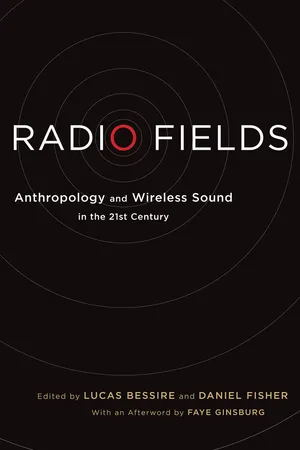
eBook - ePub
Radio Fields
Anthropology and Wireless Sound in the 21st Century
- 298 pages
- English
- ePUB (mobile friendly)
- Available on iOS & Android
eBook - ePub
Radio Fields
Anthropology and Wireless Sound in the 21st Century
About this book
Information
1
Introduction
Radio is the most widespread electronic medium in the world today. More than a historical precedent for television, film, or the Internet, radio remains central to the everyday lives of billions of people around the globe. Its rugged and inexpensive technology has become invested with new import in places on the other side of the “digital divide,” where topography, poverty, or politics limit access to television, computers, or electricity. In metropolitan centers, radio also remains a constant presence, sounding and resounding in public space. It is broadcast from satellites into cars and jets, streamed through laptops and loudspeakers in shopping malls, classrooms, and waiting rooms, and it fills the air at parades, weddings, military bases, and squatter settlements. It is beamed into war zones and native villages, broadcast from cellular phones and homemade transistors powered by the sun. Urban taxi companies, Pacific Islanders, and indigenous people in Amazonia alike use it as a channel for two-way dialogues. Radio quite literally seems to be everywhere, but it is the technological form that has been least studied by anthropologists.
This collection arises from the recognition that radio is ubiquitous around the globe, and the following chapters are testimony to the geographic breadth and diversity of radio media’s social presence. Yet this volume offers more than additional evidence for radio’s far-flung travels. Here, we take the diversity of radio itself as a provocation for anthropology and its comparative endeavor and draw on this diversity to frame our central problematic. What, we ask, is widespread about radio? Is radio the same phenomenon or thing in Aboriginal Australia as it is in cosmopolitan Zambia? And if, as we propose here, radio is best imagined not as a thing at all, how might anthropology better conceive of radio as a domain of ethnographic research? How might ethnography illuminate the power of this media and the different social worlds it calls forth?
The authors in this book have all begun to answer such questions. They demonstrate how media anthropologists are increasingly turning to radio to illuminate broader disciplinary concerns with emergent forms of kinship, political agency, religious life, subjectivity, and other social domains. The following chapters explore the social reach and nature of radio technology to ask what is at stake in its practical entanglement with people’s lives. These essays describe how one particular technological form animates the political, linguistic, strategic, or emotional registers of lived experience in concrete ways that are amenable to ethnographic analysis and comparison. This volume collects pioneering efforts by anthropologists to take radio seriously, efforts that often are relegated to the margins or footnotes of other anthropological projects. In doing so, the volume aims to identify and energize an emerging anthropology of radio and its orienting concerns.
Each contributor reveals the ways in which ethnography, as a loose set of methods and claims, is uniquely suited to grapple with radio’s dispersed social life. At the same time, the contributors suggest how ethnographic attention to radio may enrich the concerns of anthropology. This book, then, is intended as an argument for what ethnographic methodologies may contribute to the study of radio, as well as for the ways that radio offers a rich terrain for exploring the concepts, methods, and praxis of contemporary anthropology. It demonstrates how radio fields are being newly imagined as ethnographic sites by a broad range of anthropologists and compares how radio’s particular capacities inflect and transform social life in concrete ways. Anthropology and its signature methodology of long-term participant observation makes a fundamental contribution to how we might understand radio and ask questions of its social life. Although each of the contributors draws inspiration from a wider body of scholarship on radio, they also suggest several ways in which their work is fundamentally distinct from important intellectual projects currently under way in the fields of communications, media studies and history, sound theory, and cultural studies. Each contributor shows how an anthropology of radio may simultaneously further and redirect these broader trends in radio scholarship and media analysis.
One of the principal questions that emerge from our contributors is that of the social definition of radio itself. From investments in two-way radio by recently contacted Ayoreo-speaking people to Nepali engagements with liberal conceptions of the self, radio is never a single technology. Rather, it gains force and traction according to wider formations of meaning, politics, and subjectivity that often remain inaudible to short-term, focus-group or questionnaire-based research. For instance, radio means something different to two different female Muslim radio preachers in Mali or to a development worker in the same place, let alone to a DJ in Mexico City or Nepal. And beyond such hermeneutic questions, radio acquires its form within specific practices, politics, and “assemblages” that give it shape, including its digital transformation and extension through the Internet (Collier and Ong 2005; see also Born 2005). In such ways, it might be approached as an “actor-network” (Latour 1991, 2005) or “apparatus” (Foucault 1980, 1988; cf. Agamben 2009), social theoretical terms which call attention to emergent constellations of power, social relations, and things, as well as the historical moments in which they acquire durability and specificity. Radio’s boundaries thus cannot easily be assumed a priori; its objectness is always potentially unsettled by shifting social practices, institutions, and technological innovations and by the broader domains within which it finds shape, meaning, and power.
At the same time, radio matters for such domains in ways that can productively be compared across time and space. Diversity of form and content, or effect and distribution, may be most noticeable to ethnographers in the field, but unexpected similarities between radio’s varied apparatuses or assemblages are also strikingly apparent and impossible to ignore. It is no coincidence that Ayoreo-speaking people in the Gran Chaco and Appalachian radio preachers both imagine radio as a suitable prosthesis for the metaphysics of prayer, or that radio stations were occupied by women marchers in Oaxaca in 2006 and Libyan protestors in Benghazi in 2011 and were targeted by FARC guerrilla fighters in Colombia in 2010, or that radio’s historic role as a wartime media technology is being reprised in present-day Iraq and Afghanistan (Ahrens 1998). The challenge for an anthropology of radio is to put such tensions of difference and commonality to work. It means developing a set of analytics capable of drawing together substantive, experience-near research on radio’s plasticity with wider questions about the recurrent dynamics associated with radio’s broader assemblages. The authors collected in this book suggest several ways that such a project could be imagined.
As editors, we use the concept of “radio fields” to signal this complex intersection of radio technology and social relations (cf. Williams 1974). Here, we imagine radio fields as unruly ethnographic sites, as well as zones where social life and knowledge of it are organized in specific and comparable ways. The authors of this collection show how the diversity of such entanglements defies any single notion of radio’s social labor, even as they emphasize how radio matters across time and space. They describe how radio’s voice gives force and texture to news, music, and events. From two-way conversations about the weather in South America to Appalachian Pentecostal faith healing and narratives of national crisis in Israel, radio’s electronic sound marks the urgent as well as the ordinary, the mundane alongside the metaphysical. It crosses borders of all kinds: national frontiers for Turkish immigrants in Germany, ethnic and caste markers in South Asia, and even prison walls for incarcerated Aboriginal peoples in Australia. Radio may be put in the service of governance and empire, and it is central to state and imperial projects around the world. Yet it also lends material and means to a wide range of minority claims and social movements, from Oaxacan marches for women’s rights or indigenous mobilization against the state to Somali pirates or Zulu musicians in South Africa.
Radio routinely intensifies and elicits novel forms of imagination, meaning, and desire that exceed its informational content. This, along with the profoundly embodied nature of listening and sounding, makes radio deeply entangled with the inner lives and political agency of its users. What does it mean, for instance, for young Indian boys to come of age listening to BBC broadcasts of cricket matches or for people living on the dispersed islands of Vanuatu to valorize kastom on the radio in the context of a newly independent, postcolonial nation (Appadurai 1996; Bolton 1999)? And radio also creates expertise around its material constants of microphones, wires, and antennae, or iPods, audio streaming software, and wireless networks. Historically such expertise has been inseparable from the forms of imagination and desire that have underwritten nationalist and postcolonial social movements, even as any media technology always exists as only one element in a larger and complex “media world” (Ginsburg, Abu-Lughod, and Larkin 2002b). Today, radio is being transformed and extended by digital technologies and new web-based networks of distribution, a process that demonstrates how the technological specificities of audio mediation alter the reach of radio sound and its availability to different social projects at different times (Bull 2004; Tacchi, chap. 12 in this volume). Radio fields, as Frantz Fanon noted, are thus impossible to assess in their “quiet objectivity” alone (1959, 73).
This collection thereby offers several arguments for the ways culture matters for the study of radio—as the context in which it is deployed and gains meaning but also as the object of its transformative potential. The contributors show how cultural forms and radio’s technologies are mutually constitutive across time and space. As several chapters make apparent, odd things happen to both “culture” and “radio” at their intersection. It is a central premise of this book that the anthropology of radio must begin by taking both radio and culture as ideal forms and ethnographic questions rather than a priori contexts. This inductive framing also entails rethinking many of the other concepts commonly used to describe radio. The chapters thus take ideas of “community,” “autonomy,” “voice,” “public” or “counterpublic sphere,” and even “mediation” as terms for critical analysis and ethnographic specification rather than preexisting, stable analytic categories.
In sum, this volume does not aim to encompass the entire field of radio studies or history. It is instead composed of diverse examples of what anthropologists offer to the study of radio’s culturally varied worlds and of what radio fields offer to anthropology. In this introduction, we first locate an emerging anthropology of radio within history and wider bodies of radio scholarship. Then we use the insights of the work collected here to suggest several conceptual axes that may be useful for future anthropological engagements with radio’s sociality.
Anthropology and Radio
People have been intensely interested in radio since its inception. Thought to travel through an invisible “ether,” the disembodiment of radio voices and its ability to separate spirit from flesh was initially understood through reference to spirituality or magic (see Houdini 1922). The 1920s have been described as a time of widespread “radio fever” (Sterling and Kittross 2002), and by 1926, radio broadcasts had “become one of the most essential elements of public life” in Europe and the United States (Weill 1984 [1926]). Radio technology soon figured in a variety of national, colonial, and imperial projects, even as artists and writers such as Gastón Bachelard (1971), Bertolt Brecht (Strauss and Mandl 1993; cf. Kahn 1994), and Felix Guattari (1978) hoped that radio and “radiophonic space” (Weill 1984 [1926]) could provide a “veritable feedback system with listeners” and, thus, “turn psyche and society into a single giant echo chamber” (McLuhan 1964, 299). Intellectuals including Brecht, Rudolf Arnheim, Theodor Adorno, and Walter Benjamin began experimenting with radio technologies even as they sought to understand their implications. Benjamin alone wrote more than seventy radio “models” for Radio Frankfurt between 1929 and 1933, including twenty intended for children (Mehlman 1993; see Benjamin 1999a–f). These echo features of Brecht’s “epic theater” by questioning radio’s mass distribution of culture as “stimuli” and encouraging “the training of critical judgment” (Benjamin 1999f, 585; see also Mehlman 1993).
The parallel histories of radio and the consolidation of anthropology as a discipline have created a unique relationship between anthropologists and radio as well. Franz Boas, for example, was an advocate for using radio to spread anthropological insights (E. Boas 1945), while Margaret Mead, Alfred Kroeber, Robert Redfield, and many others regularly appeared on radio programs. Moreover, many anthropologists in the 1930s and 1940s were involved in large-scale projects involving radio, such as the Rockefeller Foundation’s “Radio Project,” which began in 1937, and, beginning in the late 1940s, UNESCO’s Division of Radio in its Department of Mass Communication, which produced radio programs and distributed radio sets—efforts that established community-based radio stations around the world (see Lind 1950). Other anthropologists were involved as administrators and consultants for colonial projects in Africa, India, and Asia, to which radio was central. By the 1930s, for instance, the British Colonial Office required its administrators to use radio as a tool for “imprinting British culture and ideas into the minds of native listeners” through daily broadcasts, often on the battery-powered “saucepan special” receivers manufactured throughout the 1940s specifically for African audiences (Head 1979; Posner 2001). In Nazi Germany, the Reich Broadcasting Company aired extensive nationalist propaganda over a series of affordable radio sets subsidized by the state, called the Volksempfanger, or “the people’s receivers.” Between 1933 and 1939, more than seven million of these sets were produced, each stamped with a swastika and an eagle (Aylett 2011).
During World War II, Axis and Allied anthropologists alike were involved in radio propaganda, including Gregory Bateson and Ruth Benedict’s “black propaganda” radio programs, which successfully undermined Japanese morale in the South Pacific (Cummings 2001; Jelavich 2006; Price 1998; Soley 1989). After the war, public anthropologists also were regular contributors to radio programs in the United States, Canada, and the United Kingdom, such as BBC’s Third Programme. Aspiring to bring social anthropology to a broad public audience, the program featured lectures by E. E. Evans-Pritchard, Mary Douglas, Max Gluckman, Raymond Firth, and Audrey Richards throughout the 1950s and 1960s. By the late 1940s, anthropologist Edmund Carpenter was also hosting his own radio show, Explorations, for the Canadian Broadcasting Corporation (Prins and Bishop 2007). Such widespread radio use by anthropologists produced a substantial corpus of skill-based tacit knowledge that prefigures an explicit research paradigm for the anthropology of radio (see also Eiselein 1976). Carpenter (1972), for instance, later theorized the implications of his experiences with visual and aural media in Canada and Papua New Guinea.
Meanwhile, radio was broadly reshaping the diverse sites in which anthropology was practiced as an academic enterprise. This global spread of radio included its use as a “portable missionary” for proselytizing Native groups, beginning when HCJB went on air in Ecuador in 1931. This was followed by the Far East Broadcasting Company in Manila in 1948 and Trans-World Radio in Tangier and Liberia in 1954. By 1964, there were forty international Christian stations operating around the world. The reach of such missionary radios has been so effective that missionaries estimated that only ninety-three major language groups were not reached by Christian radio a decade ago (Gray and Murphy 2000; see also BBC 2005). Radio sound was an instrumental tool for much early “contact” work by missionaries in lowland South America (see Capa 1956).
Latin America was also the site of the earliest experiments in community-based radio stations (see Dagrón and Cajías 1989). In 1947, Aymara and Quechua silver miners started a group of radio stations focused on collective advocacy for better wages and ...
Table of contents
- Cover Page
- Title Page
- Copyright Page
- Acknowledgments
- 1 Introduction: Radio Fields
- 2 Aurality under Democracy: Cultural History of FM Radio and Ideologies of Voice in Nepal
- 3 From the Studio to the Street: Producing the Voice in Indigenous Australia
- 4 Editing the Nation: How Radio Engineers Encode Israeli National Imaginaries
- 5 Reconsidering Muslim Authority: Female “Preachers” and the Ambiguities of Radio-Mediated Sermonizing in Mali
- 6 Community and Indigenous Radio in Oaxaca: Testimony and Participatory Democracy
- 7 The Cultural Politics of Radio: Two Views from the Warlpiri Public Sphere
- 8 Frequencies of Transgression: Notes on the Politics of Excess and Constraint among Mexican Free Radios
- 9 “Foreign Voices”: Multicultural Broadcasting and Immigrant Representation at Germany’s Radio MultiKulti
- 10 “We Go Above”: Media Metaphysics and Making Moral Life on Ayoreo Two-Way Radio
- 11 Appalachian Radio Prayers: The Prosthesis of the Holy Ghost and the Drive to Tactility
- 12 Radio in the (i)Home: Changing Experiences of Domestic Audio Technologies in Britain
- 13 “A House of Wires upon Wires”: Sensuous and Linguistic Entanglements of Evidence and Epistemologies in the Study of Radio Culture
- Radio Fields: An Afterword
- About the Contributors
- Index
Trusted by 375,005 students
Access to over 1.5 million titles for a fair monthly price.
Study more efficiently using our study tools.
Frequently asked questions
Yes, you can cancel anytime from the Subscription tab in your account settings on the Perlego website. Your subscription will stay active until the end of your current billing period. Learn how to cancel your subscription
No, books cannot be downloaded as external files, such as PDFs, for use outside of Perlego. However, you can download books within the Perlego app for offline reading on mobile or tablet. Learn how to download books offline
Perlego offers two plans: Essential and Complete
- Essential is ideal for learners and professionals who enjoy exploring a wide range of subjects. Access the Essential Library with 800,000+ trusted titles and best-sellers across business, personal growth, and the humanities. Includes unlimited reading time and Standard Read Aloud voice.
- Complete: Perfect for advanced learners and researchers needing full, unrestricted access. Unlock 1.5M+ books across hundreds of subjects, including academic and specialized titles. The Complete Plan also includes advanced features like Premium Read Aloud and Research Assistant.
We are an online textbook subscription service, where you can get access to an entire online library for less than the price of a single book per month. With over 1.5 million books across 990+ topics, we’ve got you covered! Learn about our mission
Look out for the read-aloud symbol on your next book to see if you can listen to it. The read-aloud tool reads text aloud for you, highlighting the text as it is being read. You can pause it, speed it up and slow it down. Learn more about Read Aloud
Yes! You can use the Perlego app on both iOS and Android devices to read anytime, anywhere — even offline. Perfect for commutes or when you’re on the go.
Please note we cannot support devices running on iOS 13 and Android 7 or earlier. Learn more about using the app
Please note we cannot support devices running on iOS 13 and Android 7 or earlier. Learn more about using the app
Yes, you can access Radio Fields by Lucas Bessire, Lucas Bessire,Daniel Fisher in PDF and/or ePUB format, as well as other popular books in Social Sciences & Anthropology. We have over 1.5 million books available in our catalogue for you to explore.