The modern law of search and seizure permits warrantless searches that ruin the citizenry's trust in law enforcement, harms minorities, and embraces an individualistic notion of the rights that it protects, ignoring essential roles that properly-conceived protections of privacy, mobility, and property play in uniting Americans. Many believe the Fourth Amendment is a poor bulwark against state tyrannies, particularly during the War on Terror.
Historical amnesia has obscured the Fourth Amendment's positive aspects, and Andrew E. Taslitz rescues its forgotten history in Reconstructing the Fourth Amendment, which includes two novel arguments. First, that the original Fourth Amendment of 1791—born in political struggle between the English and the colonists—served important political functions, particularly in regulating expressive political violence. Second, that the Amendment’s meaning changed when the Fourteenth Amendment was created to give teeth to outlawing slavery, and its focus shifted from primary emphasis on individualistic privacy notions as central to a white democratic polis to enhanced protections for group privacy, individual mobility, and property in a multi-racial republic.
With an understanding of the historical roots of the Fourth Amendment, suggests Taslitz, we can upend negative assumptions of modern search and seizure law, and create new institutional approaches that give political voice to citizens and safeguard against unnecessary humiliation and dehumanization at the hands of the police.
eBook - ePub
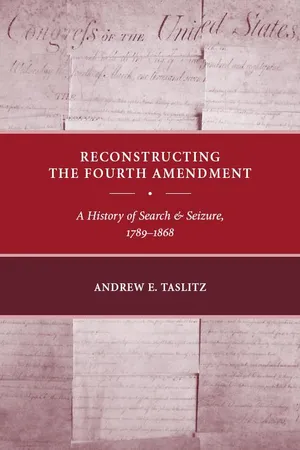
Reconstructing the Fourth Amendment
A History of Search and Seizure, 1789-1868
- 363 pages
- English
- ePUB (mobile friendly)
- Available on iOS & Android
eBook - ePub
About this book
Information
Topic
DroitSubtopic
Droit public1 Plugging into the Fourth Amendment′s Matrix
Entering the Matrix: State Violence as Politics
In the now-classic movie The Matrix the humans of the future are almost entirely enslaved by intelligent machines, which have created a “matrix,” a massive, shared, interactive computer program that simultaneously runs through each human′s mind. To the humans, the program in their heads is reality. They therefore remain complacent, divided, and blind to their condition.1
A small band of free humans living in the real world venture forth to do battle with the machines. Much of that battle takes place when they plug in to the matrix, searching for enslaved humans whom they can convince of the need to break their literal and mental chains. “Agents”—programs that look like the movie-stereotype of FBI law enforcement—prowl the matrix, using brutal violence on behalf of the machine “state” to locate and crush the fully sighted dissenters. The agents mean not merely to kill but to humiliate, to send the message of their invincibility and absolute rule. But the agents are afraid too, for they know that the rules that govern their world, the laws that define their society, are at stake.2
The agents ultimately arrest a human known as “Neo” on the pretense of suspecting him of computer crimes, but really to seek his aid in locating the renegade humans, whom they identify to Neo as “criminals.” When he refuses, insisting on his rights to silence and to an attorney, the agents make Neo′s lips grow together into a silencing mask. They next plant an electronic bug on him, inserting it into his abdomen, so that they can track his movements. Ultimately, however, Neo makes common cause with the renegades and discovers that he is likely “the One,” the savior who will free all humanity, uniting them in the consciousness that they are all indeed one. He returns to the matrix, battling the machines until he learns that he can bend their laws to his will, thus stopping bullets, defying gravity, and even defying his death. In the two sequels that follow, Neo brings this all-pervasive violence into the real world, crushing the machines’ tyranny, replacing it with the laws of a unified mankind and human love.3
Perhaps only a law professor would see in The Matrix a metaphor for the origins and social function of the Fourth Amendment. Nevertheless, the metaphor is an apt one. The agents of the state in the matrix use violence in the form of arrests, searches, and electronic surveillance for political purposes, to silence dissent, to reinforce governing social norms, and to maintain the current distribution of power. Of course, the state′s ability to use force—to govern —is necessary to any state′s existence and to the safety of its people. The Matrix sequels notably reveal violence at work in the governance of the somewhat militaristic human city of Zion—the sole haven for the few free humans. But the humans use violence to liberate, unify, and protect. Ultimately it is the clash of these two forms of political violence, one degrading and the other uplifting, that are at the core of The Matrix films and of the everyday violence of policing. Likewise, the Fourth Amendment is best understood as serving to tame everyday political violence, an insight ignored by other commentators and having important implications for constitutional doctrine and police practice.4
Absent a citizen′s voluntary consent, all police activity involves violence or its threat. A “search” is by definition an unwanted, thus forced, invasion of a reasonable expectation of privacy. A “seizure” similarly is an unwanted interference with a person′s freedom of movement or his possessory interest in property. Any film or novel about the police makes the violence of their work stark. If that violence is usually less stark in everyday policing, it is no less real. A tremor of fear, however fleeting and mild, runs through any driver stopped for a traffic violation, who worries that he or she may be subject to arrest or that saying or doing the wrong thing may anger the officer. The uniform, the holstered weapons, the command voice are all designed to make the threat of violence clear.5
When that threat becomes real, it can be degrading, as both the majority and the dissenters on the U.S. Supreme Court recently recognized in Atwater v. City of Lago Vista, in which a mother unsuccessfully challenged the reasonableness of her being arrested for driving without a seatbelt, an offense punishable by a fine only. There the majority declared that “the physical incidents of [Atwater′s] arrest were merely gratuitous humiliations.” The Court continued: “Atwater′s claim to live free of pointless indignity and confinement clearly outweighs anything the city can raise against it specific to her case.”6
Such violence may often be legitimate, necessary to enforcing the law, to encouraging respect for it, and to catching the bad guys. But whether legitimate or not, police violence is always “political” in three related ways: first, it is committed by the state, the police′s employer; second, it often affects the distribution of power resources among social groups; and third, it is essential to the coherence and survival of political society.7
Lockean Liberals and Virtuous Republicans
This last point is implicit in both the Lockean social contract and republican virtue theories that animated the Framers of the U.S. Constitution and form the backdrop for understanding the real meaning of the Fourth Amendment. In Lockean liberalism, a community or a People forms from the consent of individuals who, to protect themselves, transfer the personal right to execute the law of nature—to use force—to the community. The community serves as an impartial judge and as the single authoritative interpreter of nature′s law. The community in turn creates a government, a set of institutions entrusted by the community to bring about the social peace and the preservation of natural rights for which the community was created. A legitimate state will pass, interpret, and execute laws for the noble purpose of preserving citizens’ “property,” meaning their lives, liberties, and possessions. Such a state thereby rightly acquires “political power.”8Locke explains:
Political power, then, I take to be a right of making laws with penalties of death, and consequently all lesser penalties, for the regulating and preserving of property, and of employing the force of the community in the execution of such laws, and in the defense of the commonwealth from injury, and all this only for the public good.9
The “public” or “common good” is the good of all the People, not of any subset or elite, preserving both the People′s safety and their existence as “a People.” The kind of state force involved in stops, arrests, searches, and seizures is therefore necessary to the very existence of a People and of a state. Yet Lockean liberals are simultaneously distrustful of the state, fearful that it will use its awesome force to serve factions rather than the People as a whole, imposing tyrannical rule in ways both large and small. The state′s use of force must therefore be monitored and tamed by the People or by institutions legitimately acting on their behalf. The Fourth Amendment′s declaration that the state use force to effect “searches and seizures” only when “reasonable” is sensibly understood as constitutionalizing the mandate that the People tame state power.10
Republican (as opposed to liberal) theory likewise recognized that the state must serve the common good rather than that of a faction. But the common good can be discerned only by virtuous citizens shaping a virtuous state and vice versa. Virtuous citizens’ qualities include a willingness to invoke their rights in a way that makes them part of a deliberative dialogue over what kind of state and People we should be. Yet those Framers most heavily influenced by republican thinking still accepted that this political conversation could successfully be undertaken only in the context of a neo-Lockean social contract. For republicans, however, that contract was political, in the sense that it required institutions to encourage the sense of shared values necessary to an effectively functioning People. Only such a united People could tame otherwise unbridled state violence. For republicans too, therefore, the Fourth Amendment channels state force to productive purposes.11
For both liberals and republicans, the use of state violence to enforce the laws—modernly, the function of the police—is thus a necessary precondition to Peoplehood and to social stability. Yet neither sort of thinker trusted the state. Rules and institutions were understood to be necessary to monitor the state and to prevent its abusing its authority to use force to crush the People or to undermine the equality principles embraced by the social contract, serving the needs of a faction or elite. The Fourth Amendment is best understood, or so this book will argue, as just such an attempt to tame political violence, ensuring its service to the “security” of a free People by prohibiting unreasonable exercises of the state′s use of force. Among the political dangers that constitute the state′s abuse of violence are conduct sending degrading messages about human worth, insulting individuals or groups, undermining rather than reinforcing desirable republican norms, and suppressing dissenting voices. Abuse also arises when the police de-individualize justice, treating persons on the basis of stereotype or surmise rather than as “unique, a ‘universe of one,’” as judged by ample and trustworthy evidence.12
The Original Fourth Amendment
This book′s approach is historical, in part 1recasting the history of the original Fourth Amendment of 1791 as one about the taming of expressive political violence. The origins of the amendment indeed lay in part in efforts to suppress dissent in infamous seditious-libel prosecutions. But the amendment′s origins also lay in a violent dispute over what it means for the state to “represent” the People. Mob actions during the Revolutionary period were prompted to protest not simply “taxation without representation” but rather the enforcement of the tax laws by general searches, ones without adequate individualized evidence of wrongdoing. But the very authority for those searches was ostensibly granted by Parliament—the British legislature—so that mob complaints extended also to Americans’ lack of voice in the decision about when and how searches may happen. The dispute over search and seizure policy was thus at the very heart of the passions and political theory motivating the Revolution.13
Part of the Revolutionaries’ concern with oppressive general searches lay also in the insult of being subjected to actual or threatened state force. Part of that insult was class based: subordinate, uneducated, and “low-born” officers searched the homes of higher-ranked free householders. But the colonists were insulted too not simply by who did the searches but by how the suspects were chosen: arbitrarily, without adequate supporting evidence of individual wrongdoing and without guidelines limiting officer discretion. This arbitrary violation of principles of individualized justice was so dear to the Revolutionaries’ hearts that they described it as the equivalent of slavery, the ultimate political evil. By “slavery” the colonists did not mean “chattel slavery,” which they ultimately protected via specific provisions in the original Constitution of 1789. Rather, for the colonists slavery was the absence of corporate political liberty and economic independence for individuals. General searches symbolized this ultimate political degradation, marking the colonists (in their view) as outside the community of recognized political equals, silencing their voices and making them dependent on the whims of a tyrannical empire.14
The sense of insult stemmed not only from voiceless deindividualization but also from the related idea that the state must not use force against any citizen without strong, reliable evidence of individual wrongdoing. The American passion for this evidentiary principle—later encapsulated in the idea of “probable cause”—had its roots in fears of Continental-style inquisitions, but developed into a fairly complex and robust set of common-law concepts. The colonists were alert to the need for significant assurances of evidentiary reliability. Mere surmise or weakly supported allegations of individual wrongs would not suffice. The “probable cause” concept served to restrain state force, protecting both individuals from violence and the People from subjugation to a power other than their own. Making this point clear requires an explanation of the meaning of the “common law” and its significance in interpreting the Fourth Amendment and an explanation of the respective roles of the People, the Congress, the judiciary, and the executive in making Fourth Amendment freedoms real. Although the judiciary was assigned a special role in this process (the warrant-issuing prerogative), commentators too often de-emphasize the multibranch responsibilities created by the amendment.15
Finally, part 1of this book ends by analyzing the modern implications of understanding the original Fourth Amendment as regulating the everyday political violence of the state. These implications focus on the amendment′s role in building a “monitorial,” politically attentive, unified “People” from social diversity and on the expressive nature of police conduct and its consequences. More specifically, the final section of part 1suggests a number of lessons to be drawn from the amendment′s early history that require changes in current doctrine. Such changes should include the creation of incentives for other branches to create more People-inclusive search and seizure institutions, a serious commitment to individualized justice in deed and not just in words, a more careful quest for reliable evidence of wrongdoing, a heartfelt embrace of the close link between First and Fourth Amendment values, and a deeper appreciation for the way poorly conceived search and seizure policies can insult individuals and groups and undermine both governmental legitimacy and public safety.
The Fourth Amendment Is Not a Mere Technicality
Part 2 of this book was originally prompted by the question, Why do many minority communities experience rage at certain police search and seizure practices involving their communities’ members? My apparently obvious answer: because the police act in ways that make minority communities feel disrespected. In reaching that answer, I came to recognize, however, that members of the majority also often bear the brunt of disrespectful search and seizure practices. Minorities and the majority may differ in when they believe that “respect” has been shown. History, philosophy, and social science converge in establishing that “respect” should nevertheless be at the center of all Fourth Amendment reasoning. What “respect” is, how it is conceived of by minority versus majority communities, and what psychological and social processes lead to its loss are, however, not so obvious. Nor has it yet become clear to the U.S. Supreme Court what role respect-based concerns should play in Fourth Amendment analysis. Those concerns have significant implications for every current search and seizure doctrine. Understanding the Court′s current approach and its failures, and defending a respect-enhancing alternative, first requires an analysis of the dominant “mere technicality” vision of the Fourth Amendment. That vision seems at odds with the amendment′s sweeping language:16
The right of the people to be secure in their persons, houses, papers, and effects against unreasonable searches and seizures, shall not be violated, and no warrants shall issue, but upon probable cause, supported by oath or affirmation, and particularly describing the place to be searched and the persons or things to be seized.17
The right was of central importance to our nation′s founders. It was included in the Bill of Rights, which the people demanded be added to the 1789 Constitution as the price for its ratification. Images of King George′s troops violating “a man′s castle” in search of contraband come readily to mind. The brave colonists’ resistance to monarchy seems embodied in this amendment′s lofty words.18 Whatever noble ideals the amendment′s ringing language might seemingly inspire, however, the amendment is in practice modernly seen by many as a pointless annoyance. Consider this scenario:
Two police officers, Cagney and Lacey, pay off a local stool pigeon for information about a planned cocaine sale. The stoolie′s information is vague, and he refuses to reveal his sources. Nevertheless, based on this tip, Cagney and Lacey guess that a cocaine sale will happen that night at a Water Str...
Table of contents
- Cover Page
- Title Page
- Copyright Page
- Contents
- Preface
- Acknowledgments
- 1 Plugging into the Fourth Amendment’s Matrix
- Part I: Political Violence and the Original Fourth Amendment
- Part II: The Reconstructed Fourth Amendment
- Notes
- Index
- About the Author
Trusted by 375,005 students
Access to over 1.5 million titles for a fair monthly price.
Study more efficiently using our study tools.
Frequently asked questions
Yes, you can cancel anytime from the Subscription tab in your account settings on the Perlego website. Your subscription will stay active until the end of your current billing period. Learn how to cancel your subscription
No, books cannot be downloaded as external files, such as PDFs, for use outside of Perlego. However, you can download books within the Perlego app for offline reading on mobile or tablet. Learn how to download books offline
Perlego offers two plans: Essential and Complete
- Essential is ideal for learners and professionals who enjoy exploring a wide range of subjects. Access the Essential Library with 800,000+ trusted titles and best-sellers across business, personal growth, and the humanities. Includes unlimited reading time and Standard Read Aloud voice.
- Complete: Perfect for advanced learners and researchers needing full, unrestricted access. Unlock 1.5M+ books across hundreds of subjects, including academic and specialized titles. The Complete Plan also includes advanced features like Premium Read Aloud and Research Assistant.
We are an online textbook subscription service, where you can get access to an entire online library for less than the price of a single book per month. With over 1.5 million books across 990+ topics, we’ve got you covered! Learn about our mission
Look out for the read-aloud symbol on your next book to see if you can listen to it. The read-aloud tool reads text aloud for you, highlighting the text as it is being read. You can pause it, speed it up and slow it down. Learn more about Read Aloud
Yes! You can use the Perlego app on both iOS and Android devices to read anytime, anywhere — even offline. Perfect for commutes or when you’re on the go.
Please note we cannot support devices running on iOS 13 and Android 7 or earlier. Learn more about using the app
Please note we cannot support devices running on iOS 13 and Android 7 or earlier. Learn more about using the app
Yes, you can access Reconstructing the Fourth Amendment by Andrew E. Taslitz in PDF and/or ePUB format, as well as other popular books in Droit & Droit public. We have over 1.5 million books available in our catalogue for you to explore.