Millions of people enter or seriously consider entering alcohol or drug treatment each year. In their understandable state of urgency, most first-time treatment seekers and their loved ones may rush to the first treatment option they encounter. They are unlikely to be aware of why one form of intervention would be a good choice for their particular problem or why some approaches may, under some conditions, actually be harmful. Lacking reliable information, they are unable to make informed choices.
Recovery from Addiction offers a concise, reader-friendly guide for substance dependent persons, their families, and friends to help make sense of the full range of available treatment options.
Cloud and Granfield introduce readers to their options, from inpatient and outpatient programs and today's major pharmacological approaches to alternative therapies including strategies for using the Internet to access support meetings and approaches which do not call for life-long abstinence from the substances now causing the problem. They outline the underlying principles of each program, its pros and cons, and what a participant can expect when entering that type of treatment, guiding readers in choosing the approach likely to be best for them or their loved one. They also provide specific strategies for addicted individuals who wish to consider recovery on their own, without groups or treatment.
A vital resource for addicts wishing to recover and their loved ones, Recovery from Addiction is also a valuable tool for health care professionals, from social workers to school counselors, responsible for referring clients to drug and alcohol recovery programs.
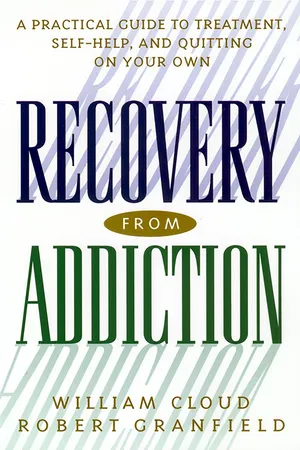
eBook - ePub
Recovery from Addiction
A Practical Guide to Treatment, Self-Help, and Quitting on Your Own
- 248 pages
- English
- ePUB (mobile friendly)
- Available on iOS & Android
eBook - ePub
Recovery from Addiction
A Practical Guide to Treatment, Self-Help, and Quitting on Your Own
About this book
CHAPTER 1
Introduction
Each year several million people choose, or are encouraged by loved ones, to enter treatment or join self-help groups for their alcohol and/or drug-related problems. Not unlike first-time consumers of other services, consumers of treatment and those who care about them are generally uninformed about these services and unfamiliar with the range of possible treatment options and types of self-help groups currently available. They are also likely to be unaware of why a particular approach would be a good choice for one kind of problem but a poor choice or even harmful for another. In the understandable state of urgency that many people who experience drug problems confront, they and their loved ones may rush to the first treatment option they encounter. Yet some approaches to resolving addiction are inappropriate for certain types of situations or simply do not work. More importantly, how you attempt to resolve your substance abuse problems can have profound and lifelong consequences. This guide is meant to introduce you to the range of recovery options available so that you can choose the approach that is best for you.
Consumers of treatment services tend to be unaware of many of the emerging controversies surrounding alcohol and drug treatment. Experts disagree about fundamental questions concerning what actually causes addiction to alcohol and other drugs and how best to treat it. Consumers are also unlikely to be aware of the range of criticisms currently leveled at traditional treatment approaches by an increasing number of researchers.
Over the last few decades, addiction has commonly come to be perceived as a lifelong disease that will continue to get worse unless interrupted by treatment. However, much recent research challenges this narrow biological explanation of addiction as a “disease” and the necessity to treat all cases of substance dependency.
The mistaken belief that treatment is always necessary in overcoming addiction comes from putting too much stock in biological explanations of substance dependency and underestimating the role of other critical psychological, social, and environmental factors. By viewing drug-dependent persons as sufferers of a disease, this approach has inadvertently resulted in a number of addiction remedies that ignore the social circumstances that can play a pivotal role when it comes to the use and abuse of substances.
There is no medical cure for addiction, no magic pill, and no surgical procedure to remove addiction from the body. This is because addiction has less to do with physical reality and much more to do with social and psychological experiences. People overcome addictions when they come to view their excessive use of intoxicants as deleterious and when they experience improvements in their lives in relation to work, family, community, and the many enriching relationships that develop as a result.
People often ask us how to identify and select the most appropriate treatment for their problem and what are the advantages and disadvantages of treatment and self-help groups. They also ask how they should go about attempting to resolve their addiction without treatment. Here we attempt to address these questions.
This book is a consumer’s guide to treatment, self-help, and natural recovery for users, family members, students, and practitioners. We provide you with detailed information about the various approaches to recovery in order to illuminate the options available to people with alcohol and drug addictions as they contemplate their own recovery paths. In order to make this book accessible to a large audience, we have purposely resisted the temptation to provide citations from our own research and the research of other experts. For those who wish to examine the available data and research, particularly as it relates to self-resolution from addiction, readers are advised to review our earlier book, Coming Clean: Overcoming Addiction without Treatment, which will provide you with over six hundred academic citations we use to support our research.
As a potential consumer of these services, you are provided with information about these programs so that you will be able to make the choice that is best for you. Our presentation is broad in scope. We do not offer details on all the possible treatment and self-help options available to you; rather, our purpose is to present general descriptions and insights that will provide you with a framework for making informed decisions about these options. Let us point out, however, that in providing information about treatment and self-help groups, we are in no way advocating any particular therapeutic or self-help option. If we advocate anything, it is this: most people overcome addictions to alcohol and drugs without treatment, and, therefore, as people contemplate their own recoveries, they might first consider attempting a natural recovery. We detail how to go about the natural recovery process in Part Two of this book. However, we recognize that for a variety of reasons, a person confronting a drug addiction may feel more comfortable seeking out formal treatment or may be in the unfortunate position of having treatment imposed upon him or her by others. So, while we advocate that individuals who are struggling to overcome their addictions consider natural recovery options, we provide information on treatment and self-help for those who are, for one or assorted reasons, unable or uninterested in adopting this pathway to overcome addiction.
Our purpose in writing this book stems from a genuine interest in helping people overcome the problems they are experiencing through their use of alcohol and drugs. As you will see, we do not believe that recovery is contingent upon treatment, we do not believe that recovery is contingent upon abstinence, and, perhaps most importantly, we do not believe that addiction is a disease. We offer information and ideas that will hopefully allow you to reflect on your use and assist you in finding your own road away from addiction.
We would like to add one final caveat about the language that we adopt throughout this book. We are keenly aware of the power of language to create meaning, to distort, and to perpetuate unfounded images of reality. The language that is used to discuss and describe the world of alcohol and drug problems is particularly problematic and often overly moralistic. However, in order to communicate with one another, we are sometimes forced into using language that might not be sufficient to describe more subtle understandings of the world. Such is the case in this book. In our use of terms such as “addiction” and “recovery,” we do not affix any essential or biological characteristic to the described behavior. For instance, when we use the term “addiction,” we in no way mean to suggest that this behavior is a disease or that individuals who are addicted will be so permanently. Similarly, when we discuss recovery, we do not mean to convey the idea of recovery in a medical sense of having an illness, but rather we use it to refer to the behavioral cessation of the habitual and often damaging use of intoxicating substances. While many people in treatment or in self-help groups see themselves as “in recovery,” those who have recovered without treatment most often see themselves as having “recovered.” Some of these self-remitters even purposely choose not to employ the language of “recovery” and, in doing so, reject the premise that they have, or once had, a disease.
Drawing on our combined fifty years of practice, research, and teaching in the field of addiction, Part One of this book will help the addicted person, significant others, and professionals who are likely to refer clients to alcohol and drug treatment sort through their options. It will aid you in choosing an approach that is both least intrusive and most likely to achieve a positive outcome.
We begin Part One by introducing you in chapter 2 to the range of traditional treatment services available and to the underlying principles upon which most of these treatment approaches are based. We then give an overview of the basic structure and configuration of activities within these various options. We also summarize today’s major pharmacological approaches to substance dependency and discuss the role of 12-step groups in treatment and as aftercare strategies.
In chapters 3 and 4 we cover some of the major pros and cons of entering traditional treatment or participating in 12-step groups. Most persons are likely to have some familiarity with the advantages of enrolling in addiction treatment when it is thought to be necessary. They are less likely to be acquainted with the advantages of attending 12-step meetings. However, unbeknownst to most, there are also major disadvantages to participating in both of these forms of intervention. In these two chapters we will discuss what we believe to be the main advantages and disadvantages of entering formal treatment or participating in 12-step groups.
In chapter 5 we identify a range of emerging alternatives to traditional addiction treatment and self-help. We introduce these alternatives in a way that will help inform you about nontraditional treatment possibilities and the increasing range of self-help options available. In this chapter we identify and discuss a number of new approaches, including Brief Interventions, Rational Recovery, Self-Management and Recovery Training, Women for Sobriety, Secular Organization for Sobriety, Moderation Management, and Drink Wise. We also show how access to these groups and other substance-dependency-related assistance can be found on the Internet at no cost.
In chapter 6 we discuss the various contexts within which addiction and resolution of drug problems occur. Substance dependency does not emerge in a vacuum isolated from the personal characteristics and environmental contexts of the user. Age, gender, values, available resources, severity of use, types of substances used, physical and mental health, as well as a range of other conditions are all factors that can influence how drugs affect people. In this chapter we discuss the relevance of such factors in planning an effective cessation strategy.
Chapter 7 is the last chapter in Part One. Here we identify strategies for selecting the least intrusive approach that will most likely render positive results with the least amount of adverse risks. In this chapter we encourage you to visit programs, treatment professionals, self-help meetings, and websites as part of your decision-making process. We explain methods for evaluating your fit with a particular program, including questions to ask the treatment staff. We also note the lack of alternative self-help groups in many communities and show how some of this limitation can be addressed by using the Internet.
Part Two of this book is directed to those who want to quit their destructive use of alcohol and other drugs but also want to avoid treatment and self-help groups altogether. Drawing on our research on natural recovery, we identify the major advantages of recovery without formal treatment or participation in self-help groups and introduce you to the types of people in our studies who were successful at it. In the bulk of Part Two we identify and discuss the principle strategies that were employed by these self-remitters at various stages of their efforts.
In chapter 8 we identify what we have found to be the major advantages of untreated recovery and introduce you to the characteristics of self-remitters, both those who have been identified by our own research as well as by the research of others who have studied natural recovery. We identify personal characteristics and social conditions that appear to foster a successful natural recovery.
In chapter 9 we discuss how you can begin a natural recovery effort. Here you will find the key issues that you should address as you contemplate this course of resolution. We identify the strategies that we have discovered, from our research and the research of others, to be essential in the early phase of this self-change process.
In chapter 10 we identify strategies that have been found to be particularly helpful in the latter phase of a successful natural recovery effort. For example, in this chapter we introduce you to the concept of conversion experience, the importance of engaging in meaningful work, methods for experiencing an improved sense of well-being without substance use, and other proven strategies.
Chapter 11 provides suggestions for successfully reintegrating yourself back into conventional society with a healthy perspective on your past life that had included alcohol and drugs. Here, both those who wish to adopt an abstinent lifestyle and those who opt for moderation will find helpful suggestions and information. In this chapter we also discuss the relevance of personal growth that goes far beyond merely arresting addiction, and we identify resources that we have found to be invaluable aids in assisting people in their efforts.
CONSUMERS’ GUIDE TO ADDICTION TREATMENT
CHAPTER 2
Overview of Traditional Addiction Treatment
Addiction treatment in the United States has had a relatively short but interesting history. In the name of treating people for their drinking and drug habits, various approaches such as incarceration, whippings, and blood letting have been used. While such techniques may sound absurd today, these approaches were considered state-of-the-art in their time and can serve to remind us of the limitations associated with any accepted form of addiction treatment, even those used today.
While addiction treatment in the United States can be traced to the founding of this country, several twentieth-century events have had major influences on contemporary treatment, including the creation of two hospitals in 1935, one in Lexington, Kentucky, the other in Fort Worth, Texas, to treat prison inmates for narcotic addiction; the founding of Alcoholics Anonymous (AA) that same year; the influence of Marty Mann, an early member of AA, and E. M. Jellinek in the 1950s to regard alcohol dependency as a disease that belongs in the sphere of medicine; the creation of the National Institute of Alcoholism and Alcohol Abuse (NIAAA) in 1970, which provides funds for alcohol dependency treatment; and the creation of the National Institute on Drug Abuse (NIDA) in 1975, which provides funding for drug abuse treatment. In fact, before the creation of NIAAA in 1970, treatment for substance dependency was primarily relegated to large, state-run mental health hospitals. The vestiges of these past events and procedures undergird most treatment programs across the country today. Due to developments in the past sixty years, treatment has primarily been seen as the province of medicine, with the view that addiction is a disease exerting a major influence over the way we treat addicted persons. The leading disease-based approach to addiction, Alcoholics Anonymous (AA), is currently a main staple of most treatment and aftercare programs.
In this chapter we identify traditional treatment services—approaches that are most widely available in the United States and that tend to approach addiction from similar ideological and theoretical frameworks. We also introduce you to the basic tenets of Alcoholics Anonymous and other 12-step groups and identify their influence on traditional addiction treatment.
Treatment
For the most part, treatment for alcohol and other drug dependencies has historically been in the form of inpatient care, where the client enters a program for a specified amount of time and undergoes various therapeutic experiences that are intended to address his or her substance dependency. When addiction treatment was primarily the responsibility of large state mental health hospitals, patient stay was approximately sixty days. More recently, as treatment became recognized as an insurable expense, the extent of coverage for treatment stay has been declining, primarily in an effort by insurance companies to contain costs. At one point, twenty-eight days of inpatient care was the norm as a reimbursable expense for substance abuse treatment services. Today, while there are some insurance plans that still pay for twenty-eight days of inpatient care, most coverage has been significantly reduced to cover fewer days, often a detoxification period of three to seven days coupled only with outpatient care. In terms of private inpatient care, most addiction services are now provided by managed care organizations (MCOs). While public programs can still offer more protracted inpatient treatment, many of these programs are guided by collaborative arrangements between the states, insurance companies, and MCOs. When this is not the case, limited funding and other financial restraints are forcing public programs to reduce the amount of care that they can offer substance-dependent clients.
More recently, however, cost containment measures by MCOs have led to a dramatic increase in outpatient services as well as a move toward such services in publicly funded programs. These outpatient services operate both from the traditional perspective and in more innovative, less traditional ways. We will briefly give an overview of traditional outpatient care in this chapter, but we will also discuss nontraditional outpatient services in chapter 5. Here we also survey detoxification, inpatient residential, therapeutic communities, and pharmacological approaches to treating substance dependency.
Detoxification
Detoxification (detox) is the beginning of treatment for some, though it may not be required in all cases. Detoxification is the process of gradually weaning a person off alcohol or other drugs. The procedure generally requires medical supervision and close monitoring of the patient since withdrawal from chronic use of certain substances can...
Table of contents
- Cover Page
- Title Page
- Copyright Page
- Dedication
- Contents
- Acknowledgments
- 1. Introduction
- PART ONE: Consumers’ Guide to Addiction Treatment
- PART TWO: Quitting on Your Own
- About the Authors
Trusted by 375,005 students
Access to over 1.5 million titles for a fair monthly price.
Study more efficiently using our study tools.