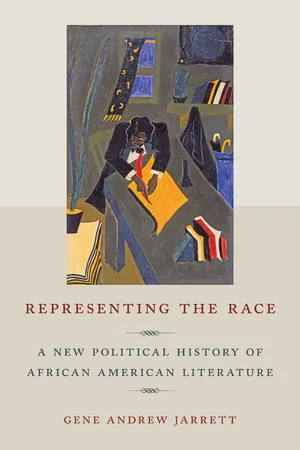
The political value of African American literature has long been a topic of great debate among American writers, both black and white, from Thomas Jefferson to Barack Obama. In his compelling new book, Representing the Race, Gene Andrew Jarrett traces the genealogy of this topic in order to develop an innovative political history of African American literature. Jarrett examines texts of every sort—pamphlets, autobiographies, cultural criticism, poems, short stories, and novels—to parse the myths of authenticity, popular culture, nationalism, and militancy that have come to define African American political activism in recent decades. He argues that unless we show the diverse and complex ways that African American literature has transformed society, political myths will continue to limit our understanding of this intellectual tradition.
Cultural forums ranging from the printing press, schools, and conventions, to parlors, railroad cars, and courtrooms provide the backdrop to this African American literary history, while the foreground is replete with compelling stories, from the debate over racial genius in early American history and the intellectual culture of racial politics after slavery, to the tension between copyright law and free speech in contemporary African American culture, to the political audacity of Barack Obama's creative writing. Erudite yet accessible, Representing the Race is a bold explanation of what's at stake in continuing to politicize African American literature in the new millennium.
eBook - ePub
Representing the Race
A New Political History of African American Literature
- 256 pages
- English
- ePUB (mobile friendly)
- Available on iOS & Android
eBook - ePub
About this book
Information
1
The Politics of Early African American Literature
In fall 1780, Thomas Jefferson, as governor of Virginia and as a recently elected member of the American Philosophical Society, began drafting the twenty-three “queries” or chapters of Notes on the State of Virginia. Jefferson wrote the book in response to a questionnaire sent to him and the rest of the republic’s twelve governors by François Marbois, the secretary of the French Legation in the United States, who was requesting cultural, historical, scientific, economic, geographic, and political information about the states. From the first to the final published editions of the manuscript, a process that began in Paris in 1785 and ended with an authoritative version in 1787, Notes turned out to be a thoroughgoing naturalist ethnography of Virginia. Amid this analysis, in “Query XIV,” Jefferson claims that the poems of “Phyllis Whately [sic]” are “below the dignity of criticism.” Equally relevant, the literature of Ignatius Sancho, a fellow black writer of Wheatley’s generation, also lacks “reason and taste” and, “in the course of its vagaries, leaves a tract of thought as incoherent and eccentric as is the course of a meteor through the sky.”1
Regarding this infamous criticism, scholars have long held that the racism of Jefferson mirrored the racism of the broader Western Enlightenment, a philosophical movement spanning both the American and European sides of the Atlantic, the former featuring the so-called Founding Fathers; the latter, Immanuel Kant and David Hume, among others. In Notes, Jefferson states his belief that the “race of Negroes brought from Africa” are naturally, or inherently, inferior and that the limited production and quality of their literature serves as evidence (77). Presumably, the subsequent nature of black-authored literature developed in response to Jefferson and his Enlightenment brethren. Henry Louis Gates Jr., one of the leading scholars on race and Jefferson, has recently said that “Jefferson’s comments about the role of their literature in any meaningful assessment of the African American’s civil rights became the strongest motivation for blacks to create a body of literature that would implicitly prove Jefferson wrong. This is [Phillis] Wheatley’s, and Jefferson’s, curious legacy in American literature.” The response of blacks to Jefferson and the Enlightenment, Gates concludes, helped to determine the “political motive” of the African American literary tradition.2
Declaring the political origin of African American literature is tricky. The premise of Gates’s conclusion arises intact from the first book he wrote on the subject and published in 1989, Figures in Black: Words, Signs, and the “Racial” Self, which, according to one of its book reviewers, Kenneth W. Warren, suffers from a paradox. In Gates’s endeavor to derive a racially authentic literary theory, he condemns the social-science approaches, cultivated in the Black Studies era of the 1970s and early 1980s, neglecting the literariness of African American creative writing. Yet, as Gates treasures the political authenticity of African American authors from the eighteenth century until the present, he arguably treats their literature in similarly nonliterary ways. The notion of Wheatley’s political motives, then, can be just as untenable as the methodological critique used to derive it.3
A second flaw shows that the political myth of literary origins is neither an isolated nor an old case. Even cutting-edge scholarship has floated this myth, which reduces the complexity of African American literary history to a scenario of cause and effect: to the idea that the “political motive” of Wheatley and early African American authors—“early,” in the sense of those writing in the late eighteenth and early nineteenth centuries—reacted almost directly to the racism of Jefferson and his fellow Founding Fathers. The paradigm of causation—or the idea that racism spurred the formation of racial politics—has framed certain recent literary and political historiographies of race and slavery in early America. David Kazanjian, a literary scholar of this period, said, in a recent debate held on this topic in the journal Early American Literature, “the terms of this debate were poorly posed, caught as they were in a mechanical understanding of historical causality. It seems to me that slavery and race are usefully understood as coextensive formations feeding off of one another and requiring genealogical investigations of effects, rather than discrete entities functioning either as cause or [as] effect and requiring presumptively positivist searches for a singular origin.”4 Frances Smith Foster, another such scholar, has expressed more general reservations over the kinds of African American literary studies that have aimed to “offer a definitive or comprehensive survey of origins or of development.” Often, these studies write or rewrite histories that “require facts or observations and conclusions that are then selected, organized, and emphasized.”5 The complementary points made by Kazanjian and Foster are clear. Whereas Kazanjian urges us to avoid the political historiography of race and slavery according to causation, Foster suggests further that this historiography has already conspired in a teleology that uses a political effect of race, such as the instituting of antebellum antislavery societies, to explain early American phenomena, such as African American print culture.
In this chapter, I examine a crucial but, for now, simple-sounding question implied by the diagnoses of Kazanjian and Foster: How do we assess the political value of literature written by Africans and their descendants in the New World? Before we can surmise that such literature was political insofar as it aimed to confront racism, before we can reach conclusions on the literature’s political effects and success—before we can do any of these things, we should take a closer look at how the notions of literature and politics themselves resonated in debates held at the time. The debates, it turns out, featured white and black intellectuals alike—not simply authentically black political agents of social change—whose politicizations of early African American literature did not necessarily correspond to the scales of racism and radicalism, respectively. Rather, the politicizations meditated on the implications of literacy and intelligence for the ability of the African diaspora to govern itself and to represent itself as an official constituency with collective interests.
Early African American literature emerged at a time when culture and politics were almost one and the same in the written and social constitutions of government. Two close readings, one on Jefferson’s Notes and the other on its 1829 critique, David Walker’s Appeal to the Coloured Citizens of the World, but in Particular, and Very Expressly, to Those of the United States of America, support this claim. In Notes, Jefferson’s dismissal of the ability of blacks to reason and imagine, and then to produce exceptional literature, was so reprehensible that, of course, subsequent generations of black writers sought to refute it. But Jefferson’s hypothesis on black literary or intellectual inferiority was not what he wanted to prove ultimately. Still held today, the inference that blacks sought to refute the hypothesis through literature happens to misstate Jefferson’s logic, which turned out to be just one among several corollaries in Notes, just one among several incidental steps toward proving that reason and imagination were prerequisite to the induction of any society into the early American polity. Jefferson’s disparagement of Phillis Wheatley certainly interlocks with a broader critical tendency—evident in reviews of her 1773 book, Poems on Various Subjects, Religious and Moral—to view hers as merely “imitative” of the poetry written by whites. In a sense, the way that Wheatley’s poetry was “slavish,” or subservient to traditional literary forms, reaffirmed her legal subjectivity as a slave (because she was not manumitted until five years later). Subtended by the romantic notions of literary genius and originality, allegations of black imitativeness demonstrated, in the words of literary historian Eric Slauter, “the new language of cultural racism.”6 I spend less time on Jefferson’s own literary racism—after all, he says very little about Wheatley and Sancho—than on its implied intercorrelations of genius, race, and political representation.
Walker recognized the trajectory of Jefferson’s logic when other historians and writers of his time did not. My analysis of Walker’s Appeal enables us to qualify a political genealogy of early African American literature. Better than any other black writer of his generation, Walker rebuts the cultural and political implications, as opposed to the premise, of Jefferson’s condemnation of Wheatley. Representative examples of black intelligence accredit, rather than discredit, the case for black political enfranchisement. Moving beyond the prominent black commentary on Jefferson’s fear of divine retribution for the nation’s enslavement of blacks, Walker also incorporates the jeremiad into Appeal in order to achieve several rhetorical goals: to insulate his critique from theistic reprobation; to rebut authoritatively the religious ideologies that had underwritten slavery; and while citing Notes line by line, to identify the self-contradiction that Jefferson shares with those who advocate religious egalitarianism even as they withhold it from black slaves.
Walker attempts to debunk Jefferson’s prescription of reason and imagination for political citizenship by taking advantage of his membership in an educated black elite whose broad grasp of Western history and whose access to the resources of print culture enhanced its authority in the public sphere. In fact, while critical of the racism of Enlightenment rationality, Walker nonetheless belonged to a broader American movement at the turn into the nineteenth century in which blacks (and whites, including Jefferson) were going as far back as the ancient, classical traditions of Greece and Rome to define a usable intellectual past and tailor it to fit current political agendas.7 Written “in behalf of freedom,” as put by African American abolitionist Henry Highland Garnet’s preface to an 1848 edition, Appeal embodies intellection and assumes the format of four “articles” (or chapters) imitating what Kazanjian has rightly called “the very legal and governmental speech acts—such as the Declaration of Independence and the Constitution.”8 Walker rightly predicted that the impending political controversy surrounding Appeal would lead to a host of commercial challenges. The historical record of regional authorities trying to suppress Appeal’s circulation—which spanned Virginia, South Carolina, and Georgia—confirms Walker’s prescience.9 The supposed blasphemy lay in how Walker borrowed the very historical analogies of Notes, suggesting that blacks, if unshackled, could demonstrate the political potential whose existence Jefferson was so eager to deny. Appeal is singular as much for its precise refutation of Jefferson on this issue as for expressing Walker’s own concession, ironically, that “ignorance” and “wretchedness” have stunted the political growth of blacks (32). Education can help blacks overcome these flaws.
The payoff of my comparative reading of Jefferson and Walker is twofold. First, we are poised to affirm a political genealogy of African American literature in which the doctrine of racial uplift, or the idea of elevating the African diaspora in intellectual and cultural ways, began prior to the 1865 emancipation of slaves. Racial uplift was not exclusively a phenomenon of the postemancipation nineteenth century, though its ideological entrenchment during this period set the terms of racial representation in African American literature for generations to come. Rather, this doctrine began in the preemancipation era and, for that matter, even before the antebellum era, in direct engagement with Founding conceptions of intellectual and political agency.10 Second, we are poised to marry in a special way formal with informal realms of political action, such as action in law and government with action in intellectual culture. The longstanding oppositionality of racial politics versus racism in early American literary criticism mischaracterizes the contact between formal and informal politics as the solitary argument for proving that writing literature alone was enough for blacks to disprove white allegations of their intellectual inferiority. I recommend that we refrain from this simplified political view of early African American literature. When extracted from the teleological presumptions retrofitted from our contemporary time, the antonymic relationship between literary excellence and intellectual inferiority turns out to have emerged from a more complex genealogy of race and racism peculiar to early American political culture. Indeed, when David Ramsey, a white historian, wrote to Jefferson and lamented that Notes “depressed the negroes too low,” we should couple these words with those of David Walker, who attempted, in 1829, to critique Jefferson’s “depressing” disqualification of blacks from American emancipation and citizenship, not just from the canon of American literature.11
Toward a Political Genealogy of Race and Racism
Describing the political genealogy of early African American literature potentially opens the proverbial can of worms, if a 2006 roundtable published in Early American Literature, mentioned earlier, is any indication. Entitled “Historicizing Race in Early American Studies” and featuring the eminent scholars Joanna Brooks, Philip Gould, and David Kazanjian, the roundtable reveals the fault lines of disagreement on how to historicize the construction of race and how to historicize the politics of race.12 The journal’s current editor, Sandra M. Gustafson, invites the roundtable scholars “to think about the theoretical implications of their work for an understanding of ‘race’ in the early period.”13 In response, the scholars outline their methodologies of race and literary history by reciting and elaborating the arguments of their books, all published in 2003: Brooks’s American Lazarus: Religion and the Rise of African American and Native American Literatures, Gould’s Barbaric Traffic: Commerce and Antislavery in the Eighteenth-Century Atlantic World, and Kazanjian’s The Colonizing Trick: National Culture and Imperial Citizenship in Early America.
To begin with, Brooks argues that the philosophical and practical impact of race on oppressed groups was quite evident. The very racial “concepts of ‘Blackness’ and ‘Indianness’ were essentially Euro-American inventions imposed upon people of color of various African and indigenous American ethnic affiliations to advance the economic and political dominance of whites.” Gould does not necessarily underplay this racial impact, but he does suggest that the meaning of race itself demonstrates a “far greater elasticity” than what Brooks permits. Interpreting “race in context of the historical formations of sentimentalism and capitalism,” Gould considers the mutual influence of transnational and transgeneric literatures alongside “ideologies of race that are themselves unstable.”14 Above all, the studies of Brooks and Gould proceed from different assumptions about the ideological construction and material tractability of race in early America. (Implicit in Kazanjian’s words on the debate, which I quoted earlier, he stands somewhere between these two positions.)
Measuring the tractability of race leads to a submerged, though no less important, disagreement between Brooks and Gould on the criteria by which we should assemble a literary archive of early America. Should we examine the lives and literatures of the alleged perpetrators of racial discrimination, or those of the alleged victims, in order to historicize the meaning of race? What is at stake in studying white imaginations of race as opposed to black experiences of racism? Gould rightly points out that cataloging the archive merely in these terms neglects the ideological current of racism through the minds and actions of both whites and blacks. Yet Brooks also correctly asserts that reducing racism to merely an ideology threatens to ignore its actual devastation of minority groups.
Despite Brooks’s and Gould’s different approaches to historicizing race, they agree that the racial paradigm of human difference stood at the center of how the authors and subjects of primary texts negotiated, accumulated, and allocated political power in the early republic. Gould senses this agreement when he asks, “What does it mean, for example, to say that [Phillis] Wheatley is ‘free’? Or that she emancipates herself as a writer? The field is still in the process of engaging such questions. I would argue, as I think Brooks does, that addressing such questions necessitates thinking through the different registers on which the very terms ‘liberty’ and ‘slavery’ signified.”15 We must also study how early American literature served as the site of such thought, in which race, nature, slavery, politics, emancipation, liberty, and citizenship are defined in their contemporary terms, not retrofitted from our own.16 If we accept this precaution, how do we establish the political genealogy of early African American literature?
First, we should examine the way in which the political genealogy of race and racism underwrote in early America the fundamental relationship between intellectual culture and political representation. By “fundamental,” I do not simply mean in the basic sense that examples of intellectual culture, such as literature, motivated the political action of its readers or that such action necessarily inspired writers to engrave certain forms and themes in the literature. Rather, I mean that intellectual culture and political representation were so inextricably interwoven in early America that defining one without the other was nearly impossible. In a recent study of the cultural origins of the U.S. Constitution, to which I have already referred a couple times, Eric Sla...
Table of contents
- Cover Page
- Title Page
- Copyright Page
- Contents
- Preface and Acknowledgments
- Introduction: Toward a New Political History of African American Literature
- 1 The Politics of Early African American Literature
- 2 The Intellectual Culture of Racial Politics after Slavery
- 3 New Negro Politics from Reconstruction to the Harlem Renaissance
- 4 The Geopolitics of African American Autobiography between the World Wars
- 5 Copyright Law, Free Speech, and the Transformative Value of African American Literature
- 6 The Political Audacity of Barack Obama’s Literature
- Epilogue: The Politics of African American Literature after Obama
- Notes
- Index
- About the Author
Trusted by 375,005 students
Access to over 1.5 million titles for a fair monthly price.
Study more efficiently using our study tools.
Frequently asked questions
Yes, you can cancel anytime from the Subscription tab in your account settings on the Perlego website. Your subscription will stay active until the end of your current billing period. Learn how to cancel your subscription
No, books cannot be downloaded as external files, such as PDFs, for use outside of Perlego. However, you can download books within the Perlego app for offline reading on mobile or tablet. Learn how to download books offline
Perlego offers two plans: Essential and Complete
- Essential is ideal for learners and professionals who enjoy exploring a wide range of subjects. Access the Essential Library with 800,000+ trusted titles and best-sellers across business, personal growth, and the humanities. Includes unlimited reading time and Standard Read Aloud voice.
- Complete: Perfect for advanced learners and researchers needing full, unrestricted access. Unlock 1.5M+ books across hundreds of subjects, including academic and specialized titles. The Complete Plan also includes advanced features like Premium Read Aloud and Research Assistant.
We are an online textbook subscription service, where you can get access to an entire online library for less than the price of a single book per month. With over 1.5 million books across 990+ topics, we’ve got you covered! Learn about our mission
Look out for the read-aloud symbol on your next book to see if you can listen to it. The read-aloud tool reads text aloud for you, highlighting the text as it is being read. You can pause it, speed it up and slow it down. Learn more about Read Aloud
Yes! You can use the Perlego app on both iOS and Android devices to read anytime, anywhere — even offline. Perfect for commutes or when you’re on the go.
Please note we cannot support devices running on iOS 13 and Android 7 or earlier. Learn more about using the app
Please note we cannot support devices running on iOS 13 and Android 7 or earlier. Learn more about using the app
Yes, you can access Representing the Race by Gene Andrew Jarrett in PDF and/or ePUB format, as well as other popular books in Literature & North American Literary Criticism. We have over 1.5 million books available in our catalogue for you to explore.