Reveals America’s long history of making both naturalized immigrants and native-born citizens un-American after stripping away their citizenship
Expatriation, or the stripping away citizenship and all the rights that come with it, is usually associated with despotic and totalitarian regimes. The imagery of mass expulsion of once integral members of the community is associated with civil wars, ethnic cleansing, the Holocaust, or other oppressive historical events. Yet these practices are not just a product of undemocratic events or extreme situations, but are standard clauses within the legal systems of most democratic states, including the United States. Witness, for example, Yaser Esam Hamdi, captured in Afghanistan in November 2001, sent to Guantánamo, transferred to a naval brig in South Carolina when it was revealed that he was a U.S. citizen, and held there without trial until 2004, when the Justice Department released Hamdi to Saudi Arabia without charge on the condition that he renounce his U.S. citizenship.
Hamdi’s story may be the best known expatriation story in recent memory, but in Revoking Citizenship, Ben Herzog reveals America’s long history of making both naturalized immigrants and native-born citizens un-American after their citizenship was stripped away. Tracing this history from the early republic through the Cold War, Herzog locates the sociological, political, legal, and historic meanings of revoking citizenship. Why, when, and with what justification do states take away citizenship from their subjects? Should loyalty be judged according to birthplace or actions? Using the history and policies of revoking citizenship as a lens, Revoking Citizenship examines, describes, and analyzes the complex relationships between citizenship, immigration, and national identity.
eBook - ePub
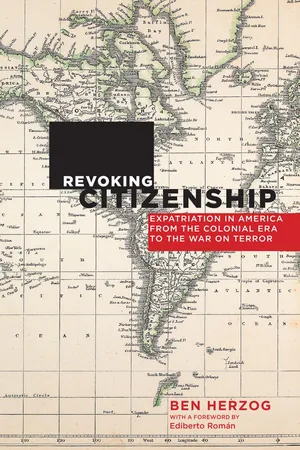
Revoking Citizenship
Expatriation in America from the Colonial Era to the War on Terror
- 216 pages
- English
- ePUB (mobile friendly)
- Available on iOS & Android
eBook - ePub
Revoking Citizenship
Expatriation in America from the Colonial Era to the War on Terror
About this book
Information
Topic
DerechoSubtopic
Derecho migratorio1
Revoking Citizenship
Man, it turns out, can lose all so-called Rights of Man without losing his essential quality as a man, his human dignity. Only the loss of a polity itself expels him from humanity.
—Hannah Arendt, The Origins of Totalitarianism
Why is citizenship fundamental for possessing rights? What happens when citizenship is taken away? What are the differences and similarities between the different conceptions of modern citizenship? In this chapter I will try to answer these questions by explaining the theoretical basis of the study of citizenship and its revocation. I define the concept of citizenship through exploration of the coherence debate within the study of citizenship. Then, I explain the notion of the national world system, which I argue is the reason (and justification) for the revocation of citizenship. The state measure of taking away citizenship has both practical and symbolic significance. I conclude this chapter by explaining my research design and presenting the policy of taking away American citizenship and the legal terminology that is utilized to express it. In this research, I place the revocation of citizenship into a sociological framework as well as a comparative-historical context. The scope of my study includes not only the actual implemented policy of expatriation, but also the social and symbolic meanings of such policy. This sociological framework is illuminated through the analysis of the texts of proposed and legislated laws; the views of the politicians who introduced those bills; the reactions of the United States Supreme Court; the interpretations of the State Department; and the positions of international treaties on this issue.
Defining Citizenship
Citizenship is usually defined (with some variations) as “both a set of practices and a bundle of rights that define an individual’s membership in a polity.”1 Yet, defining citizenship as an analytical concept is a presumptuous task for two reasons. First, its definition is highly contested and has competing, if not contradictory, meanings and applications, ranging from the purely legal/bureaucratic to an indicator of status, a form of identity, and a set of practices. Second, this institution is constantly changing and will probably continue to change in the future. Citizenship in its various forms is contingent upon historical struggles and conflicts, and both access to it and the types of privileges and obligations it entails have been contested by various political organizations.
Given the constantly transforming nature of citizenship, I describe it by highlighting one of the important debates regarding the characteristics of citizenship. This debate involves two contradictory views. On one side of the theoretical spectrum are scholars who argue that citizenship is a constant and coherent value that describes both rights and obligations associated with belonging to a particular political entity (usually, a nation-state). The major opposing theory argues that citizenship is neither coherent nor consistent and that the rights and obligations associated with it can have opposing (and sometimes conflicting) rationales, motives, or justifications, even when proposed by the same people. Although scholars have described national citizenship in a variety of additional ways, I claim that all writings on citizenship can be categorized into one of the above-mentioned analytical classifications.
In some instances researchers are aware of this distinction between understanding citizenship as a stable concept and the perception of this status as the outcome of ongoing and everlasting political struggle, and even try to advocate for one perspective over another. For many other scholars of citizenship, this debate is only implied in their writings. Moreover, some of the scholars I mention might even reject my analytical categorization of their own theories. I hope to persuade the reader of the usefulness of this particular classification of theories, at least for the purposes of this book.
According to Brubaker, the difference between Germany and France is in their conception of citizenship. While France’s model is one of territorial inclusion and assimilative citizenship (jus soli), Germany applies a model of nationhood based on ethnic inclusion (jus sanguinis). The former gives priority to the protection of individual rights within the territory of the state, while the latter emphasizes ethnic origin as the criterion for equal citizenship or naturalization. Brubaker invokes a cultural explanation of citizenship, which attributes a volk-centered nationhood to Germany and a civic-centered citizenship to France, and argues that these differences arise from particular historical circumstances of state-building. The French nation-state and its national consciousness were gradually developed, and the notion of citizenship was crystallized within the framework of the state during the French Revolution. Conversely, the German national consciousness was for centuries divorced from any cohesive or unified organization (a German state). “The French understand their nation as the creation of their state, the Germans their nation as the basis of their state.”2 While Brubaker’s conception of citizenship and nationhood is theoretically contingent on historical circumstances, in reality it is deeply rooted in national self-perception (which is reinforced by its institutionalization in immigration policies) and thus is unlikely to change. Joppke and Roshenhek criticized the shortcomings of the implicit primordialist account in Brubaker’s position from 1992 (which he later retracted), especially “the assumption of a ‘straight line’ between reified and fixed identities and policies, which leaves out the fundamental role of conflict and contingency, that is, politics and history, as intervening variables.”3
This standpoint, which perceives nationality as a reified and fixed identity, is shared by many people in the academic community and in the general public. The broad generalization of citizenship practices and national culture can be very useful in locating overarching characteristics of large societies. The simplification of the notion of citizenship as consisting of a single and coherent value system is usually a necessity for both comprehending and explaining national trends. Accordingly, many scholars identify a nation-state with a particular coherent citizenship in both descriptive and normative terms.4 Many others argue that if a single coherent citizenship is not established, a conception of citizenship should be constructed for each specific state.5
Brubaker’s unitary approach is challenged by Rogers Smith, who claims that the various citizenship principles are neither coherent nor consistent. In other words, at any given time, citizenship is a mix of multiple civic ideas. Smith explores the United States’ conception of citizenship by examining all federal statutes and all federal, circuit, and Supreme Court decisions from the nation’s origins (1798) to the progressive era (1912), and he argues that three conceptions of citizenship can (and usually do) exist together in the same polity. These three correspond with liberalism, “ascriptive inegalitarianism” (which supports the superiority of the origins of current rulers), and republicanism,6 which can be expressed simultaneously “in logically inconsistent but politically effective combinations.”7 In his analysis of the American Revolution, de Tocqueville described this nation as an essentially liberal democratic society, especially since it appeared remarkably egalitarian in comparison to the class hierarchies in Europe. Even if some inconsistencies could be pointed out, as in attitudes towards slavery, de Tocqueville depicted them as temporary exceptions likely to dissipate in time, particularly through universal liberal citizenship laws. However, careful analysis of court rulings on important citizenship issues covering three centuries of American history shows that for over 80 percent of this history U.S. laws declared that most of the world’s population was ineligible for full American citizenship solely because of race, origins, or gender. In the same manner, for at least two-thirds of its history, the majority of the domestic population in the United States was also ineligible for this political status. The Tocquevillian and post-Tocquevillian theses falter because they center their examinations on the dominant minority in American history—European white men. That is, the relative egalitarianism among white men was surrounded by abundant structured ethno-national hierarchies that accorded all other non-male, non-white, non-Christian, non-heterosexual people an inferior political status. Smith suggests replacing the Tocquevillian perspective with a view of America as having overlapping and multiple traditions so as to be able to pay appropriate attention to oppression and inequality within the United States.
Smith’s is not the only criticism of Brubaker’s path-breaking 1992 study. Theories of citizenship have been constantly revised to better correspond to real-life situations. The unitary point of view has been criticized in several ways. One is that citizenship is not consistent for each nation-state but highly dependent on internal and external historical developments. According to another, citizenship is not an independent “cultural idiom” but a value contingent on internal and external events.8 And a third is that citizenship might be coherently defined, but only as the outcome of the political struggle between permanent interest groups (each possessing different conceptions of citizenship).9 Nevertheless, for all their differences, these still accept the underlying principle that citizenship involves a coherent and stable worldview (at least for particular groups within the state).
Following Brubaker’s initial work on citizenship, many scholars chose to explore naturalization as a focal point where the “nature” of citizenship and nationhood is brought into sharp focus. “Admission and exclusion are at the core of communal independence. They suggest the deepest meaning of self-determination.”10 Determining who becomes a member is the state’s way of shaping and defining the national community. Thus, granting citizenship is a powerful tool in maintaining the state’s sovereignty, especially in times when it confronts substantial external pressures (such as transnational migration), which can undermine its independence and self-determination. However, concentrating only on the inclusion mechanism can be misleading. On the one hand, politicians choose agreed-upon standpoints and “avoid ‘compromising’ stances, which would mean being of the same mind as the occupants of opposite positions in the space of the political field.”11 The centrality of immigration policies and the vast public attention it draws force politicians to distinguish themselves by using definite and opposing political philosophies. Hence, focusing on incorporation regimes may mislead one to conclude that all policies are coherent and stable. On the other hand, looking only at inclusion does not take into account Walzer’s assertion that both admission and exclusion are at the core of communal independence. In this book, I concentrate on the revocation of citizenship in order both to understand why states take away citizenship and to better explain what citizenship is.
Before explaining the reasons for and mechanisms of taking away citizenship, I wish to consider the hegemonic national logic in which modern citizenship is embedded and which constitutes the backdrop for the need to take away citizenship.
The National Logic
As empires disintegrated, the modern states that grew out of them attempted to establish sovereignty over heterogeneous communities and promote an ideology of national homogeneity, persecuting social groups that failed to comply with the unifying ethos. The nation-state typically pursues a tight fit between the perceived ethnic, religious, cultural, or political borders of nationality and its territorial borders. Nationality is constructed around ethnic, religious, cultural, or political identities and by excluding groups that clash with such cohesive factors.
The ideas of nationalism and nations coincide with the arrival of modernity as a powerful order-building system. “Throughout the era of modernity, the nation-state has claimed the right to preside over the distinction between order and chaos, law and lawlessness, citizen and homo sacer, belonging and exclusion, useful (=legitimate) product and waste.”12 The nation-state came into being in the eighteenth century in America and Europe, flourished in Europe in the late nineteenth century, and from then on spread to other regions of the world. The modern state signifies the making of a universal legal and constitutional order.13 A notion was gradually developed arguing that there must be full congruence between institutional-organizational aspects (the state) and cultural aspects (the nation) and among the state framework, society, and the economy.
The national logic divides the whole world into states separated by boundaries. The Western geopolitical imagination endows territorial demarcation with normative significance: the border marks out the sovereignty of each nation-state because the state, the nation, and the border supposedly coincide naturally. The border is also socially significant, creating a dichotomy between the social groups in every nation and thus between “us” and “them.”14 However, the centrality of the nation-state creates a paradox. Although no state exists in which the four elements—society, culture, territory, and government—overlap, most people perceive the world as divided into nation-states. Hence, as a subjective cultural frame, nationalism still provides a political formula for organizing the world.15 At the same time, the lack of fit is an inbuilt source of instability, and the national order has to be continually reasserted in when the inevitable boundary issues arise.
According to the national logic, loyalty should be exclusive to a single nation-state, and multiple allegiances (or citizenships) should not be allowed. In the case of immigration or border changes, the citizen should choose to which of the two countries to profess his or her complete loyalty. Thus, according to the national logic, a conscious renunciation of citizenship or any act that might imply such a voluntary decision should be grounds for removal of a person’s citizenship.
It is important to acknowledge that the current nation-state system is based on the premises of this ideological position. Whether nationalism is addressed as a mode of thought by which people perceive themselves16 or as a political manipulation generated by interested parties,17 one can see that the nation-state has become a significant part of human experience, in terms of ideology and everyday life. Most states in the world do not achieve total congruence of the four components of the national idea—society, culture, territory, and government—either because of failures when forming the political unit or because of flaws due to territorial changes, migration and so on, which emerged after sovereignty was achieved. Nevertheless, nationalism today is still perceived as a central cultural frame that is taken for granted. Nation-states have created in their citizens such a profound sense of belonging and identification that their citizens are willing to sacrifice their lives in the name of the state and for its sake.
Citizenship—The Right to Have Rights
The dominance of the national world order in the twentieth century established the possession and acquisition of citizenship as the main path to obtaining rights (practically and theoretically). Although this world order had begun to crystallize in the eighteenth century, it reached its peak only two centuries later, with the nation-state becoming essential to providing a large range of privileges for its citizens. The lack of citizenship signified extreme political exclusion, not only from a specific nation-state, but from the national world order at large.
Arendt argued that, since the nineteenth century, human rights have been exclusively associated with political rights and citizenships. Humans are not equal because of their humanness, but rather become equal citizens under the guarantee of the modern state. “Man, it turns out, can lose all so-called Rights of Man without losing his essential quality as a man, his human dignity. Only the loss of a polity itself expels him from humanity.”18 Hence, stateless people lose all protection from the national order, and are excluded from the sanctuary of the law.
The abhorrent administrations of the authoritarian regimes of the twentieth century seized ...
Table of contents
- Cover
- Title Page
- Copyright Page
- Dedication
- Contents
- List of Tables and Figures
- Foreword
- Acknowledgments
- Introduction
- 1 Revoking Citizenship
- 2 National Beginnings—American versus British Citizenship
- 3 Legislative Initiatives
- 4 International Relations
- 5 Consular Dilemmas
- 6 Supreme Court Rulings
- 7 The Board of Appellate Review
- 8 The War on Terror
- 9 Dual Citizenship and the Revocation of Citizenship
- Conclusion
- Notes
- Bibliography
- Index
- About the Author
Trusted by 375,005 students
Access to over 1.5 million titles for a fair monthly price.
Study more efficiently using our study tools.
Frequently asked questions
Yes, you can cancel anytime from the Subscription tab in your account settings on the Perlego website. Your subscription will stay active until the end of your current billing period. Learn how to cancel your subscription
No, books cannot be downloaded as external files, such as PDFs, for use outside of Perlego. However, you can download books within the Perlego app for offline reading on mobile or tablet. Learn how to download books offline
Perlego offers two plans: Essential and Complete
- Essential is ideal for learners and professionals who enjoy exploring a wide range of subjects. Access the Essential Library with 800,000+ trusted titles and best-sellers across business, personal growth, and the humanities. Includes unlimited reading time and Standard Read Aloud voice.
- Complete: Perfect for advanced learners and researchers needing full, unrestricted access. Unlock 1.5M+ books across hundreds of subjects, including academic and specialized titles. The Complete Plan also includes advanced features like Premium Read Aloud and Research Assistant.
We are an online textbook subscription service, where you can get access to an entire online library for less than the price of a single book per month. With over 1.5 million books across 990+ topics, we’ve got you covered! Learn about our mission
Look out for the read-aloud symbol on your next book to see if you can listen to it. The read-aloud tool reads text aloud for you, highlighting the text as it is being read. You can pause it, speed it up and slow it down. Learn more about Read Aloud
Yes! You can use the Perlego app on both iOS and Android devices to read anytime, anywhere — even offline. Perfect for commutes or when you’re on the go.
Please note we cannot support devices running on iOS 13 and Android 7 or earlier. Learn more about using the app
Please note we cannot support devices running on iOS 13 and Android 7 or earlier. Learn more about using the app
Yes, you can access Revoking Citizenship by Ben Herzog,Ediberto Román in PDF and/or ePUB format, as well as other popular books in Derecho & Derecho migratorio. We have over 1.5 million books available in our catalogue for you to explore.