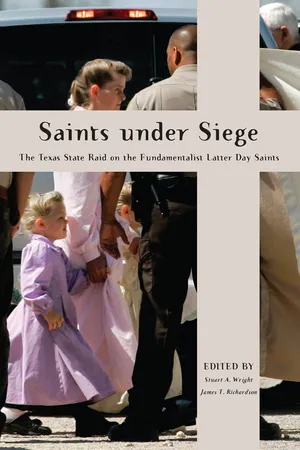
In April 2008, state police and child protection authorities raided Yearning for Zion Ranch near Eldorado, Texas, a community of 800 members of the Fundamentalist Church of Jesus Christ Latter Day Saints (FLDS), a polygamist branch of the Mormons. State officials claimed that the raid, which was triggered by anonymous phone calls from an underage girl to a domestic violence hotline, was based on evidence of widespread child sexual abuse. In a high-risk paramilitary operation, 439 children were removed from the custody of their parents and held until the Third Court of Appeals found that the state had overreached. Not only did the state fail to corroborate the authenticity of the hoax calls, but evidence reveals that Texas officials had targeted the FLDS from the outset, planning and preparing for a confrontation.
Saints under Siege provides a thorough, theoretically grounded critical examination of the Texas state raid on the FLDS while situating this event in a broader sociological context. The volume considers the raid as an exemplar case of a larger pattern of state actions against minority religions, offering comparative analyses to other government raids both historically and across cultures. In its look beyond the Texas raid, it provides compelling evidence of social intolerance and state repression of unpopular minority faiths in general, and the FLDS in particular.
eBook - ePub
Saints Under Siege
The Texas State Raid on the Fundamentalist Latter Day Saints
- 281 pages
- English
- ePUB (mobile friendly)
- Available on iOS & Android
eBook - ePub
Saints Under Siege
The Texas State Raid on the Fundamentalist Latter Day Saints
About this book
Information
Topic
Theology & ReligionSubtopic
Christian DenominationsHistorical Context
1
The Past as Prologue
A Comparison of the Short Creek and Eldorado Polygamy Raids
MARTHA BRADLEY EVANS
When the story of the raid on the community of the Fundamentalist Church of Jesus Christ of Latter Day Saints (FLDS) at the Eldorado, Texas, Yearning for Zion (YFZ) Ranch rolled out, the past was prologue. The similarities between the Short Creek raid of 1953 and the Eldorado raid of 2008 are striking, resonating in scope, design, and impact. As historians, we teach our students that we are doomed to repeat the mistakes of the past if we do not learn the lessons history has to teach us. This most recent episode reminds us of the profound importance of this idea. In this chapter we compare the 1953 raid on Short Creek to the 2008 raid on the YFZ Ranch in Eldorado, Texas, focusing on corresponding patterns and dynamics. We also analyze the ways in which FLDS members sought to interpret the meaning of the raids through their religious beliefs and experiences. Next, we explore how we might understand the most recent endeavors of the FLDS to build a sacred landscape in Texas and determine the influence of its prophet, Warren Jeffs. Finally, we ask what lessons have been learned from these raids.
Short Creek and Eldorado: A Special Symbiosis
Determined to end the practice of plural marriage once and for all, the mastermind of the raid at mid-century was Governor Howard Pyle of Arizona. His accomplices were the State of Arizona’s Attorney General’s Office, the Mohave County Supreme Court, and the Juvenile Court, along with more than one hundred officers of the court and other governmental personnel. This massive response to what Pyle conceived as an “insurrection” within state boundaries was partly inspired by the desire to protect the interests of underage girls who were the victims of the “foulest conspiracy” to ensnare them in marriages before the legal age of consent.
A career in radio prepared Pyle for his statewide broadcast the morning of July 26, 1953, at 4:00 am, announcing the raid on the Short Creek polygamists.
Before dawn today the State of Arizona began and now has substantially concluded a momentous police action against insurrection within its own borders. Arizona has mobilized and used its total police power to protect the lives and futures of 263 children.…More than 1,500 peace officers moved into Short Creek.…They arrested almost the entire population of a community dedicated to the production of white slaves who are without hope of escaping this degrading slavery from the moment of their birth. (Pyle 1953b)
As would be true for the 2008 Eldorado raid more than half a century later, Arizona state officials acted as parens patrea to protect the interests of those unable to protect themselves—the underage, perceived victims of polygamy.
Here is a community—many of the women, sadly right along with the men—unalterably dedicated to the wicked theory that every maturing girl child should be forced into the bondage of multiple wifehood with men of all ages for the sole purpose of producing more children to be reared to become mere chattel of this totally lawless enterprise. (Pyle 1953a)
Pyle anticipated the raid for two years as the state carefully developed a plan, a rationale and support for an unprecedented invasion of a religious community within the confines of the United States. Working in conjunction with the state Attorney General’s Office, Pyle developed ingenious strategies for investigating the behavior and persons involved in the polygamous lifestyle. In April 1951 Pyle hired the Burns Detective Agency in Los Angeles with $10,000 appropriated by the state legislature. “Pretending to be a movie company looking for locations and extras, they packed movie equipment into the town and photographed every adult and child in the community. The polygamists, uneasy but courteous, posed for their pictures, meanwhile cautioning their children to stay nearby.” Pyle was mostly disgusted at what Burns found. “When they brought the facts back, photographic and otherwise, we realized that the judge was right, we had a problem,” Pyle said in 1984. The agency found significant violations of law—tax fraud, misuse of state electrical power, and living conditions that were, in his mind, “unfit for animals let alone human beings.” Homes were generally filthy; some families were living in old cars, in unfinished buildings, and in what he considered to be “subhuman conditions” (Pyle 1984).
Fast forward fifty-five years; a phone call from an alleged sixteen-year-old polygamous girl, pregnant and the alleged victim of both physical and sexual abuse, initiated the Eldorado, Texas, raid by the Department of Family and Protective Services (DFPS) and the Texas Rangers. The complexity of the raid suggests that it was carefully planned before the phone call was ever made; the government was poised and ready for a trigger that would justify the intervention (see Richardson and Schreinert, this volume). Before they began, DFPS and state police informed the governor that they were planning to raid Eldorado on April 3, 2008, because of a call they had received from a sixteen-year-old pregnant polygamous girl. The unidentified young woman reported both physical and sexual abuse on the part of her “spiritual husband” (Hoppe 2008). Three days after the raid began several hundred girls and women were taken into custody and removed from the ranch. Supplies were called in from the Red Cross, Goodfellow Air Force Base, and local shelters. DFPS workers’ state-issued credit cards were quickly maxed out. According to one news report, “The Governor’s Division of Emergency Management had set up a command post, state agencies had pitched in—including even the Forest Service—and hundreds of state workers had been deployed” (Hoppe 2008). The plan was to transport the women and children to a Salvation Army facility in Midlothian, Texas, where they would separate the mothers from their children. Midlothian was a more secure facility, but at the last minute the Salvation Army chose not to allow the transfer to occur on their site.
For Texas, the specter of the government siege on the Branch Davidian community at Mt. Carmel loomed large, recalling the horrors of that tragedy (Wright 1995). Instead of learning the lesson of the 1953 raid on Short Creek or of the 1993 raid at Waco, the government reacted imprudently by launching a paramilitary raid and inviting the possibility of a violent confrontation. The past became prologue to yet another chapter in the history of the clash between religious and civic values. The women and children of Eldorado became symbolic victims in a moral drama, not unlike what occurred at Waco (Ellison and Bartkowski 1995), for which various external institutions (child protection workers, the courts, the media) claimed to be acting in their best interests.
Fundamentalist Origins and Separation of Plurality from the Mormon Church
Who are the FLDS and what is their relationship to the Church of Jesus Christ of Latter-day Saints (LDS)? Although several splinter groups left Mormonism beginning in the 1830s in the Midwest, Mormon Fundamentalism was always located in the Great Basin Church. The groups still practicing polygamy today have their roots in the nineteenth-century church and in the doctrines taught by the church’s early generation of general authorities, and they have lives and a history that run parallel to that of the mainstream LDS Church beginning with the abandonment of plural marriage that began with the Manifesto of 1890, ending official church sanctioned plurality. The term “fundamentalist” applies to those who continue to practice plural marriage and who believe that they follow the more pure doctrines of the Church, before it caved in to the pressure of the federal government to conform to national mores and religious standards.
Most were long-term members of the Church and children of polygamous parents. They chose to remain loyal to this basic long-standing tenet of their Mormon heritage; many were unwavering in their adherence to “the Principle” as the Church position gradually hardened into active prosecution. But as was true in the nineteenth century, opposition separated out the faint-hearted, strengthened the strong, and found willing martyrs. The assumption that God required great sacrifices from the faithful provided meaning to their hardships and rendered even the most menial work sacred.
The FLDS call plural marriage “the Principle,” believing that it is central to the efforts of faithful men and women to enter the Celestial Kingdom in the life hereafter. Also called “Celestial Marriage,” the “New and Everlasting Covenant,” and “Priesthood Work,” plural marriage centers around a single patriarch and his multiple wives and many children. It is at the heart of a patriarchal ordering of relationships between men and women and their families. Fundamentalist leader Leroy S. Johnson described the range of “fundamentals” that were at the heart of the movement (Johnson 1983–1984, 4:1635). Members believe that their religious practice is mandated by God and that priestly authority was restored to Joseph Smith in the nineteenth century and transferred to John Taylor, who authorized a few men to continue the practice of plural marriage through the priesthood council organized in 1886.
The fundamentalists based their claim to continual priesthood authority on a purported vision that President John Taylor received in September 1886 at the home of John W. Woolley in Centerville, Utah, where he was hiding. Taylor’s son, Apostle John W. Taylor, told friends that his father had left among his papers a revelation concerning the future of plural marriage.1 The fundamentalists never intended to form a new church separate from Mormonism and they continued to identify themselves as members of the Church of Jesus Christ of Latter-day Saints.
Even today, Colorado City/Hildale is the largest single gathering place for Mormon fundamentalism or what would become known as the FLDS. First settled in the late 1920s by Leroy S. Johnson and other polygamist families, Short Creek, as it was then known, was the frequent subject of intense repression and persecution, including ex-communications during the mid-1930s, arrests for conspiracy, Mann Act violations for transporting women over state borders for immoral purposes, Lindberg kidnapping violations for transporting underage women by polygamist men in the Boyden raids of 1944, and, finally, the large-scale raid of the entire community orchestrated by Arizona Governor Howard Pyle on the armistice day of the Korean War in 1953.
In the fifty-five years between 1953 and 2008, Mormon fundamentalism evolved to become a distinctive religious culture that persisted despite considerable efforts by both the federal and state governments to eliminate it. Its members have been penalized and ostracized. In the same years, a significant dissenter community formed outside fundamentalism to fight for those most vulnerable in the FLDS culture and those who chose to leave.
The Short Creek Raid
In the days leading up to July 26, 1953, word had leaked out of the governor’s office and Salt Lake City about the plan for a raid on Short Creek. Knowing that it would be soon, two of John Y. Barlow’s sons—Joseph and Dan Barlow—climbed to a vantage point overlooking the town on the red butte where they could detect the stream of government vehicles as it moved slowly out of the Kaibab Forest, with car lights announcing their arrival. When certain that the caravan would within hours arrive at Short Creek, the young men threw sticks of dynamite into the air to warn the people of the town.
Short Creek’s men and women met at the schoolhouse, prayed together, and sang “We Thank Thee, O God, for a Prophet.” Leroy Johnson spoke to them, encouraging them to consider whether they would be willing to die for their faith. When the parade of government officials—policemen and women, social service matrons, attorneys and reporters pulled into town at 4:00 am, they flashed every spotlight, blasted every horn or alarm, creating chaos and fear in the hearts of all who stood in the schoolyard waiting to find out what would happen to them and their families. Many remembered the lunar eclipse that happened minutes after their arrival, the way the moon sucked the light out of the sky and left it pitch black (Barlow n.d.). They brought with them warrants for thirty-six men and eighty-six women, 122 warrants in all. Rather than polygamy itself, a felony, the charges included rape, statutory rape, carnal knowledge, polygamous living, cohabitation, bigamy, adultery, and misappropriation of school funds. Tied to the initial motivation of child abuse, the government accused group members of having “encouraged, advised, counseled and induced their minor, female children under eighteen years of age to actively participate in said unlawful conduct” (Superior Court of Arizona 1953). No violence resulted. Neither the polygamists nor their government invaders fired guns or resorted to violence.
The National Guard set up a tent at the center of town where they prepared meals for the town members throughout the weeklong siege. They arrested the men and jailed them in the schoolhouse lunchroom. In addition, the government set up a place where all the men and women were fingerprinted. The first evening they took the men to Kingman, Arizona, where they were jailed while awaiting their hearings.
On the fourth day, in the morning, police matrons told the women to pack for a three-day trip. The children and their mothers walked from their homes to the schoolyard, where they waited all afternoon for the five greyhound buses that came at 5:00 pm to take them to their foster homes. Finally, the buses arrived and the women and children were loaded on board. Twenty-two teenage boys stayed behind at Short Creek.
When the buses arrived in Phoenix, they pulled up in front of a National Guard Armory at about 7:00 am. The women and children were assigned to foster homes throughout the area. “We didn’t know if we would ever see each other again or not! So as each mother and her children were let out of the bus, we said good-bye with tears streaming down our cheeks” (E. Jessop n.d.).
After the women and children were settled in their new homes they began walking the streets looking for other women from their community. Eventually they found one another and met Saturday mornings at the park to talk. At one point the government sponsored a party for the women and children at Phoenix Park. Eventually they gathered for Sunday School at one of their homes.
During the two years following the Short Creek raid, the women and children endured a protracted series of hearings at the Juvenile Court. In the first months the men received sentences but served their time on probation in their homes at Short Creek. When the ordeal was finally over, all but one of the women who had been underage at the time of her marriage returned with their children to Short Creek. The raid failed to end the practice of a plurality of wives, but it created a central defining myth, linking the FLDS with religious martyrs of every generation.
The Eldorado Raid
Within two months after the Eldorado raid, the state of Texas began returning more than 400 children to their families on the ranch. The Third Circuit Court of Appeals ruled that the state did not produce sufficient proof that the children were in imminent danger. In the appeal, thirty-eight women whose children had been seized argued that the District Court lacked proof and was required to return the children to their parents and had abused its discretion by failing to do so (Kinkade 2008). The appeals court agreed and, according to one news report, “The result will likely be the slow and steady crumbling of efforts to prosecute crimes that are a part of the dogma of the Fundamentali...
Table of contents
- Cover Page
- Title Page
- Copyright Page
- Contents
- List of Abbreviations
- Preface and Acknowledgments
- Introduction
- Part One: Historical Context
- Part Two: Social and Cultural Dimensions
- Part Three: Legal and Political Perspectives
- About the Contributors
- Index
Trusted by 375,005 students
Access to over 1.5 million titles for a fair monthly price.
Study more efficiently using our study tools.
Frequently asked questions
Yes, you can cancel anytime from the Subscription tab in your account settings on the Perlego website. Your subscription will stay active until the end of your current billing period. Learn how to cancel your subscription
No, books cannot be downloaded as external files, such as PDFs, for use outside of Perlego. However, you can download books within the Perlego app for offline reading on mobile or tablet. Learn how to download books offline
Perlego offers two plans: Essential and Complete
- Essential is ideal for learners and professionals who enjoy exploring a wide range of subjects. Access the Essential Library with 800,000+ trusted titles and best-sellers across business, personal growth, and the humanities. Includes unlimited reading time and Standard Read Aloud voice.
- Complete: Perfect for advanced learners and researchers needing full, unrestricted access. Unlock 1.5M+ books across hundreds of subjects, including academic and specialized titles. The Complete Plan also includes advanced features like Premium Read Aloud and Research Assistant.
We are an online textbook subscription service, where you can get access to an entire online library for less than the price of a single book per month. With over 1.5 million books across 990+ topics, we’ve got you covered! Learn about our mission
Look out for the read-aloud symbol on your next book to see if you can listen to it. The read-aloud tool reads text aloud for you, highlighting the text as it is being read. You can pause it, speed it up and slow it down. Learn more about Read Aloud
Yes! You can use the Perlego app on both iOS and Android devices to read anytime, anywhere — even offline. Perfect for commutes or when you’re on the go.
Please note we cannot support devices running on iOS 13 and Android 7 or earlier. Learn more about using the app
Please note we cannot support devices running on iOS 13 and Android 7 or earlier. Learn more about using the app
Yes, you can access Saints Under Siege by Stuart A. Wright,James T. Richardson, Stuart A. Wright, James T. Richardson in PDF and/or ePUB format, as well as other popular books in Theology & Religion & Christian Denominations. We have over 1.5 million books available in our catalogue for you to explore.