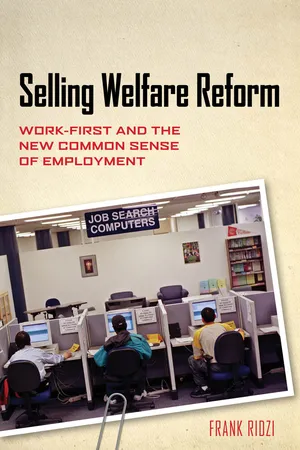
The 1996 Welfare Reform Act promised to end welfare as we knew it. In Selling Welfare Reform, Frank Ridzi uses rich ethnographic detail to examine how new welfare-to-work policies, time limits, and citizenship documentation radically changed welfare, revealing what really goes on at the front lines of the reformed welfare system. Selling Welfare Reform chronicles how entrepreneurial efforts ranging from front-line caseworkers to high-level administrators set the pace for restructuring a resistant bureaucracy. At the heart of this remarkable institutional transformation is a market-centered approach to human services that re-framed the definition of success to include diversion from the present system, de-emphasis of legal protections and behavioral conditioning of poor parents to accommodate employers. Ridzi draws a compelling portrait of how welfare staff and their clients negotiate the complexities of the low wage labor market in an age of global competition, exposing the realities of how the new "common sense" of poverty is affecting the lives of poor and vulnerable Americans.
- 336 pages
- English
- ePUB (mobile friendly)
- Available on iOS & Android
eBook - ePub
About this book
Information
1
“Selling Work-First”
Introduction
Common sense is not something rigid and stationary, but is in continuous transformation, becoming enriched with scientific notions and philosophical opinions that have entered into common circulation. —Antonio Gramsci, 1985, 421
PERHAPS the sentiments contained in the following pages, are not yet sufficiently fashionable to procure them general favor; a long habit of not thinking a thing wrong, gives it a superficial appearance of being right, and raises at first a formidable outcry in defence of custom. But tumult soon subsides. Time makes more converts than reason. —Thomas Paine, Common Sense, 1791
The philosophy of one century is the common sense of the next.
—Henry Ward Beecher
—Henry Ward Beecher
Have you heard about the Republican and the Democrat who were locked in the White House for 20 years? They agreed to reform welfare. During the 1976 presidential campaign, Republican Ronald Reagan’s stump speech introduced a story about a Cadillac-driving welfare queen from Chicago: “She has 80 names, 30 addresses, 12 Social Security cards. … She’s got Medicaid, getting food stamps, and she is collecting welfare under each of her names. Her tax-free cash income alone is over $150,000.”1 Reagan’s comments brought welfare criticism into the national spotlight. Over a decade later, Democratic candidate William Jefferson Clinton made a campaign pledge to “end welfare as we know it.” Though efforts were made along the way, the convergence of Republican and Democratic platforms culminated in the 1996 welfare reform that was passed by a Republican Congress and Democratic president. Indeed, over those 20 years it seems that nearly everyone came to agree that welfare produced an unacceptable state of affairs. In an age where political partisanship and social polarization are the norm, we can learn a great deal from occasions when opposing agendas coalesce around shared ideas. In this case there are lessons to be gleaned about one of the most powerful tools in the arsenal of an institution— common sense.
People have both local and extra-local reasons for doing what they do. By local I mean the everyday decisions that we make about our work and leisure lives. They may be based on interests such as personal preference, needs, or values. Local actions, however, are not completely isolated from the actions of others. To the extent that individual actions are coordinated with each other, we can glimpse the extra-local reasons for our actions— such as national identity, economic principles, social values, or, of course, common sense. These extra-local reasons account for the trends in societal behavior that sociologists notice—people’s participation in holidays or civil rights movements, for instance. When individuals do not see any clear self-interest in a situation, it is quite likely common sense that will lead to the course of action chosen.2 Nevertheless, the social power of common sense to marshal support and action, and the role of institutions in forging it, is routinely overlooked.
We assume that common sense originates on its own and is somehow natural. As with “street smarts,” it seems to us an innate dimension of intelligence rather than the adroit perception of and acclimation to distinctively contemporary rules of the street. In other words, we overlook that common sense on the streets of Brooklyn several hundred years ago would be anachronistic in the same location today. Yet, even this realization does not acknowledge the degree to which common sense is socially constructed in concrete and observable ways, often via social institutions.
Selling Welfare Reform is about the U.S. welfare institution’s efforts since the 1996 reform to convince poor families to buy into a new common sense about what welfare should be. The common sense of work-first, the dominant version of welfare since the reform, has not been an easy sell; it has required a massive overhaul of the way administrators, staff, and clients are treated. Still, there are some in each of these groups who do not fully buy in: some caseworkers insist, “I’m not in this for the welfare reform, I’m in this to feed my children”; some clients claim that work-first is “creating a workforce of slave laborers.” These individuals notwithstanding, work-first, as a national institution, has been phenomenally successful in forging a new common sense among the general public. Research portrays unprecedented support for work-first among both caseworkers and clients.3 Political leaders and the news media herald the 1996 legislation as a monumental achievement that has succeeded in reducing welfare caseloads by over 50 percent.4
This book, however, is more concerned with understanding what was intended than in judging the extent to which the reform achieved what was intended. It will show where the current “common sense” of work-first originated, why it has come to dominate, and how it is conveyed to the poor families whose lives it affects. It certainly was not the prevailing way of thinking under the pre-1996 system. I will argue that the common sense of the work-first approach is best understood as neoliberal; it is a new (or neo) take on how to structure society, and welfare, according to principles of economic liberalism. Liberalism’s perhaps best-known variant is the laissez-faire approach to fostering “free markets” by limiting governmental involvement. This “neoliberal” approach is at odds with the preceding Keynesian philosophy that dominated U.S. welfare since the New Deal. Keynesianism, championed by British economist John Maynard Keynes, advocated governmental protectionism for working people and markets.
Understood in this context, the selling of work-first common sense to those who would presumably buy into it is a creative enterprise. It enlists the innovative energies of social entrepreneurs to re-envision welfare. At the same time, however, work-first has a destructive element as it dismantles the prior work of Keynesian social engineers. In this changing of the guard, the inevitability of power is apparent. Macrostructural ideologies about how best to structure society are at odds; and in this case there is a clear victor. Though the ongoing battle between opposing liberal and protectionist meta-philosophies is a necessary backdrop for understanding common sense at the welfare office, it is not at this level that this book largely focuses. It is an instructive case study of institutional change and an opportunity to examine the structural power dynamics that institutions uphold. Most of all, however, this is a study of the way local and extra-local interests merge in the production of the nation’s foremost welfare program for poor families. To the extent that I am successful, I will provide a window into the everyday lives of administrators, caseworkers, and clients in the nationally exemplary work-first program that developed in East County, New York.5 As I hope to illustrate, understanding their work and experiences requires attention to both local and extra-local ingredients of the common sense that is forged at the welfare office.
A Rising Star: Welfare Reform in East County
Welfare reform in East County was conceived in the back of a Toyota as local movers and shakers returned from a conference on curbing the spread of illegitimate births and welfare dependency. Less than two decades after Reagan’s campaign stump speech about Cadillac-driving welfare queens gave voice to a groundswell of anti-welfare sentiment, public administrators in East County set out to devise a way to reform the unpopular system. According to Roger, one of the top administrators in East County, “we could see the writing on the wall. … You keep your ear to the ground. You’ve got a new governor, a new president, Clinton, who made a big deal about how welfare reform was going to happen. You know something is going to happen and you know it’s going to emphasize work. You just don’t know how it’s going to sort of settle in.” There was a sense of urgency and a need to hit the ground running so as to be well-prepared by the time the federal government passed binding reform legislation. It was the calm before the storm that would become the Personal Responsibility and Work Opportunity Reconciliation Act (PRWORA) of 1996. This would replace Aid to Families with Dependent Children (AFDC) with Temporary Assistance for Needy Families (TANF) and set a new course for the nation’s primary cash assistance (welfare) program for poor families.
Roger, who eventually became director of East County’s program, recalls the years just prior to 1996 as a time of excitement and innovation in which synergy among local social entrepreneurs was aglow.
Starting our program was a highlight. I will always remember that as such a creative time, because we had a lot of energy, a lot of enthusiasm. We worked great together to create something from nothing. What’s not to like about that? We weren’t necessarily building on something; we weren’t having to fix something. We had a new building, we had new employees, we had a new direction! It was fun.
The idea behind East County’s program, and behind the national legislation that would follow within a few years, was that of work-first, or moving a large percentage of TANF recipients into work and work-related activities as quickly as possible. As a result, welfare services should not focus on long-term training, human resource development, or income maintenance. Rather, workforce preparation should involve activities that are “authentic and replicate to the greatest extent possible actual labor force conditions.”
Work-first was a change from previous approaches that had emphasized an entitlement of poor families to a safety net below which they would not be allowed to fall and long-term developmental programs, some of which had even paid for community college. As might be anticipated, East County’s program at first faced daily challenges from those who saw value in the previous approach. Roger recounts:
Sometimes it was a real challenge. If you were being asked by a quote unquote “liberal” group, what they were saying was basically to the effect of “isn’t this awful that you are making all these people work?” … People on the other side of the political aisle felt that welfare reform was terrible, that we were hurting people who already had tough lives, and making people work in unpaid work experience [workfare] was a terrible thing. And there were a lot of articles about all right what you are going to have is an increase in the prison population, an increase in food bank problems, all that kind of stuff—none of which ever happened. But the idea was that this was just such a terrible punitive system.
As Roger recalls, he had to diffuse this carefully. After all, this was not an extremist position; “I understood the thinking” and “I really had a lot of respect for people who wanted to help other people, and that’s what you were getting there—people who were trying to step up and help people, and sometimes they were right and we were doing things wrong.” He admitted, “I understood because I used to feel that same way… I grew up in the ‘60s.” “Looking at the [professional] things I had done before, I was certainly of that bent and I would never call myself a conservative now, I don’t know what I would call myself.”
Though Roger had not switched political parties, the common sense from which he viewed welfare had changed. In the midst of national and state discussions and excitement, he recalled: “You really start seeing it in a different way. You really start seeing yourself more as someone who should be encouraging work as opposed to just making sure people get their benefits and get out of the way. That probably doesn’t sound like a big thing but it was a big thing.” As he explains, this forced him to rethink his position on requiring labor market participation.
Work had been sort of the bad thing before. It was like you don’t want to make anyone work in a minimum-wage job. And I totally changed my mind about that. When you really think about it, I worked at minimum-wage jobs. That’s how I learned all the basic work skills that everybody is still complaining that people don’t have, not just people on welfare, kids out of school. All of the basic stuff about being a professional at work, getting to work on time, knowing how to interact with your supervisor, being consistent, even going to work, you know those kinds of things. That’s how you learn that and a lot of these folks had never experienced that. So I kind of changed my mind about the value of work, even if it was minimum wage, or even if it was what was then called “unpaid work experience” [workfare].
Though work-first seemed like a pro-business answer to dissatisfaction with the existing welfare system, gaining the support of the business community was not without its own challenges.
They didn’t think that welfare reform was a big economic development issue. And I will never forget the look on their face when I explained to them that [taxes will go up if people stay on the rolls after the federal five-year limit], and I remember one of them looked up and said, “We need to make sure people know about this!” We were trying to get employers to see that this is to their benefit too, to give people a chance. … Some were really good, but the hard thing is—and this is still the balance—you want to get an employer who will be willing to take a chance on somebody, but you really have to send them some great people to begin with or they will never come back to you. And that is so hard; they need the soft skills, showing up on time etc. … So that was always a very delicate balance to keep.
Faced with a public relations challenge in relating to both potential employers and advocates for the poor, East County’s work-first program set out on a marketing campaign. “We knew what we wanted to do, the concept was there, and we knew why we wanted to do it. The challenge was then to sell it to the county.” Strategizing with the marketing department at a local community college and relying on the work of a marketing person on staff, East County’s program “held receptions for everything.”
We had a lot of local publicity when we opened. We did that intentionally because we wanted to raise awareness; … we would emphasize both the educational and welfare reform portion. … We had a lot of innovative programming and one of our staff members had a background in marketing and I would be ready to just do it, but she would say, “No, you have to get some information out about this.” That’s why we had receptions for everything. I will never look at punch and cookies again. So I guess that’s how [we were discovered]. Because it brought awareness. And it was also the topic of the time. People were talking about welfare reform. We would get the press coming to us and say, “I need a story about such and such, what do you have?” So it really worked both ways. And we really did feel like we had some interesting things we were doing.
In addition to public attention, the program was performing as planned. The director recalls, “We had great numbers, we really did, our numbers were great.”
Stemming from the publicity and outcomes, others took note. A neighboring county executive unexpectedly flattered East County in her state of the county speech, by declaring, “Why can’t we be more like East County?” As the director recalls, “Then we started getting all these phone calls.” A national organization invited East County to present on the specifics of what they were doing, “and that kind of got us out there and we got a lot more calls of people interested in what we were doing. There were people from all over the country.” This led to a much broader than expected level of national outreach. Roger beams:
We did a lot of presentations at the national level. We had some ideas of what other places were doing from attending national conferences, but mostly people came to us. … We had a lot of people come and visit us. We did presentations, wrote an article in a journal, so we were aware of what other people were doing, but it was more because when they came to us we would ask them, “Well, how do you do this?” And if we heard a good idea, we would steal it.
All of this attention led to v...
Table of contents
- Cover Page
- Title Page
- Copyright Page
- Contents
- Acknowledgments
- 1 “Selling Work-First”
- 2 “You’re All Doing the Wrong Thing”
- 3 “A New Way of Doing Business”
- 4 New Technology and New Customers
- 5 “We Are a Thorn in the Side of Those Who Won’t Change”
- 6 “Not Everybody Fits into Their Box”
- 7 “Don’t Blame Me, It Wasn’t Up to Me!”
- 8 Conclusion
- Appendix: Collection of Data
- Notes
- Bibliography
- Index
- About the Author
Trusted by 375,005 students
Access to over 1.5 million titles for a fair monthly price.
Study more efficiently using our study tools.
Frequently asked questions
Yes, you can cancel anytime from the Subscription tab in your account settings on the Perlego website. Your subscription will stay active until the end of your current billing period. Learn how to cancel your subscription
No, books cannot be downloaded as external files, such as PDFs, for use outside of Perlego. However, you can download books within the Perlego app for offline reading on mobile or tablet. Learn how to download books offline
Perlego offers two plans: Essential and Complete
- Essential is ideal for learners and professionals who enjoy exploring a wide range of subjects. Access the Essential Library with 800,000+ trusted titles and best-sellers across business, personal growth, and the humanities. Includes unlimited reading time and Standard Read Aloud voice.
- Complete: Perfect for advanced learners and researchers needing full, unrestricted access. Unlock 1.5M+ books across hundreds of subjects, including academic and specialized titles. The Complete Plan also includes advanced features like Premium Read Aloud and Research Assistant.
We are an online textbook subscription service, where you can get access to an entire online library for less than the price of a single book per month. With over 1.5 million books across 990+ topics, we’ve got you covered! Learn about our mission
Look out for the read-aloud symbol on your next book to see if you can listen to it. The read-aloud tool reads text aloud for you, highlighting the text as it is being read. You can pause it, speed it up and slow it down. Learn more about Read Aloud
Yes! You can use the Perlego app on both iOS and Android devices to read anytime, anywhere — even offline. Perfect for commutes or when you’re on the go.
Please note we cannot support devices running on iOS 13 and Android 7 or earlier. Learn more about using the app
Please note we cannot support devices running on iOS 13 and Android 7 or earlier. Learn more about using the app
Yes, you can access Selling Welfare Reform by Frank Ridzi in PDF and/or ePUB format, as well as other popular books in Politics & International Relations & Social Policy. We have over 1.5 million books available in our catalogue for you to explore.