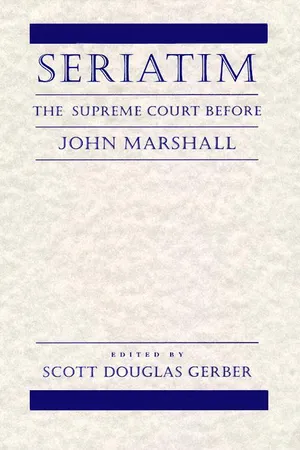
Seldom has American law seen a more towering figure than Chief Justice John Marshall. Indeed, Marshall is almost universally regarded as the "father of the Supreme Court" and "the jurist who started it all."
Yet even while acknowledging the indelible stamp Marshall put on the Supreme Court, it is possible--in fact necessary--to examine the pre-Marshall Court, and its justices, to gain a true understanding of the origins of American constitutionalism. The ten essays in this tightly edited volume were especially commissioned for the book, each by the leading authority on his or her particular subject. They examine such influential justices as John Jay, John Rutledge, William Cushing, James Wilson, John Blair, James Iredell, William Paterson, Samuel Chase, Oliver Ellsworth, and Bushrod Washington. The result is a fascinating window onto the origins of the most powerful court in the world, and on American constitutionalism itself.
- 376 pages
- English
- ePUB (mobile friendly)
- Available on iOS & Android
eBook - ePub
About this book
Information
Chapter 1
Introduction
The Supreme Court before John Marshall
The Pre-Marshall Court in the American Mind
Students of judicial institutions in recent years have come to appreciate more than ever that to understand any court we must understand its origins.1 Nowhere is this more correct than in the case of the Supreme Court because the origins of that institution are so closely identified with one justice—John Marshall. This holds true no matter what one thinks of Marshall. For those who hold Marshall in high esteem—and most scholars today do exactly that—the study of the Court prior to 1801 makes more plain the stamp Marshall placed on the institution. For those who view Marshall less heroically—as do several contributors in this volume—studying the pre-Marshall Court reveals what the institution might have been like had Marshall not accepted the nomination to be chief justice.
Jumping ahead two centuries to the present—and some three hundred fifty pages to the end of this book—an examination of the Supreme Court before John Marshall reveals much of interest to students of the institution. Marshallphiles will note, for example, the absence of the institutional voice Marshall’s leadership was able to provide—an institutional voice that has been absent for much of the twentieth century as well.2 Those who view Marshall less heroically will find in these pages, by contrast, that, among other things, judicial review—the Court’s most important power in the American system of constitutional government—was understood by the early justices, was argued for by them, and was practiced by them.
I thank Mark Hall for his contributions to this essay; Todd Ellinwood for his research assistance; and George Billias, Bill Casto, Chuck Hobson, Wythe Holt, Steve Presser, Jim Stoner, and Sandra VanBurkleo for their suggestions for making it better. An earlier version was presented at the 1996 meeting of the Northeastern Political Science Association. I thank the participants on the “Elements of Judicial Culture” panel—John Brigham, Nancy Kas-sop, Jeffrey Morris, Suzanne Samuels, and Grier Stephenson—for their enthusiasm about this project.
The conventional wisdom is, of course, that the Supreme Court became an important institution only after Marshall’s arrival and the opinion rendered in Marbury v. Madison (1803). It is not exactly accurate to say that the pre-Marshall Court has been completely ignored by students of the judicial process, but most scholars on the subject stress the Court’s lack of significance. Bernard Schwartz, for instance, concludes in A History of the Supreme Court (1993) that “the outstanding aspect of the Court’s work during its first decade was its relative unimportance.3 Similarly, George Lee Haskins and Herbert A. Johnson comment in their 1981 volume in the Holmes Devise History of the Supreme Court that the Court was a “relatively feeble institution during the 1790s, too unimportant to interest the talents of two men who declined President Adams’ offer of the position of Chief Justice, it... acquired in ... a few years’ time, and largely under the guiding hand of John Marshall, more power than even the framers of the Constitution may have anticipated.4 There is also the following observation by Robert G. McCloskey in The American Supreme Court (1960), arguably the most important book ever written about the Court:
It is hard for a student of judicial review to avoid feeling that American constitutional history from 1789 to 1801 was marking time. The great shadow of John Marshall, who became Chief Justice in the latter year, falls across our understanding of that first decade; and it has therefore the quality of a play’s opening moments with minor characters exchanging trivialities while they and the audience await the appearance of the star.5
There are countless other examples of the pre-Marshall Court being trivialized by law professors, historians, and political scientists.6Invariably, scholars point out that Robert H. Harrison never served as an associate justice after he was confirmed, and that William Cushing declined elevation from associate to chief justice. Similarly, Charles C. Pinckney, Edward Rutledge, Alexander Hamilton, and Patrick Henry—significant statesmen in the 1790s—refused to be appointed to the Court, and several men who were appointed resigned to accept other positions. Most notable among the latter group, John Rutledge left the Court after two years to become chief justice of the South Carolina Court of Common Pleas, and John Jay, who spent part of his Supreme Court tenure serving as minister to Great Britain, resigned from the Court to become governor of New York, and later refused reappointment to the Court.
After noting the difficulty of staffing the early Supreme Court, scholars usually mention in passing a few cases, such as Hay burn’s Case (1792), Chisholm v. Georgia (1793), Ware v. Hylton (1796), Hylton v. United States (1796), and Calder v. Bull (1798), and then hurry on to discuss related Marshall Court opinions. While some may hesitate for a moment to address Chisholm v. Georgia, those who do typically emphasize that this decision was overturned in 1798 by the Eleventh Amendment. Finally, many scholars cite the absence of a separate Supreme Court building as evidence that the early Court lacked prestige.7
There have been scholars, of course, who recognized that the early Court has been neglected. Edward S. Corwin, for one, in his 1919 book about John Marshall, wrote:
The pioneer work of the [pre-Marshall] Supreme Court in constitutional interpretation has, for all but special students, fallen into something like obscurity owing to the luster of Marshall’s achievements and to his habit of deciding cases without much reference to precedent. But these early labors are by no means insignificant, especially since they pointed the way to some of Marshall’s most striking decisions.8
Unfortunately, Corwin failed in his long and distinguished career to fill this gap in the literature.
A few scholars have begun to challenge the idea that the Supreme Court became important only when John Marshall arrived. The multivolume ongoing project documenting the activity of the early Court edited by Maeva Marcus and others, and Marcus’s edited collection of essays on the Judiciary Act of 1789, have been of great assistance in this regard.9 Also worth noting is William R. Casto’s The Supreme Court in the Early Republic: The Chief Justiceships of John Jay and Oliver Ellsworth (1995). Casto, who contributes an essay about Oliver Ellsworth in this volume, makes an important contribution with his book by presenting a compelling theory as to why the pre-Marshall Court is often viewed negatively. As he puts it:
Society in the late twentieth century—particularly political society—is usually viewed primarily in terms of conflicts of values and interests. . . . The abiding theme of the early Supreme Court, however, was precisely to the contrary. The Court sought to support the political branches of the new federal government, not to oppose them.10
According to Casto, “Though the justices occasionally resorted to constitutional interpretation, their primary objective was to bolster and consolidate the new federal government.” The label of “mediocrity” attached to the pre-Marshall Court, he concludes, “is probably due to the direct conflict between the modern judicial paradigm of conflict and the early Court’s paradigm of support.”11
Insights from Biography
Although a few scholars have begun to pay attention to the pre-Marshall Court,12 much work remains to be done. One fruitful approach is to examine the contributions pre-Marshall Court justices made as individuals to American law and politics. After all, one does not need to subscribe to the psychological and sociological tenets of legal realism to recognize that any court, including the Supreme Court, is first and foremost composed of individuals.13 The biographical approach to the pre-Marshall Court is particularly appropriate, given that most of that Court’s business took place while the justices were riding circuit. Seriatim: The Supreme Court before John Marshall was designed with a multiple biographical methodology in mind.
The ten pre-Marshall Court justices (this number excludes the largely unknown Thomas Johnson and Alfred Moore) are worthy of study because of their impressive credentials and active involvement in America’s founding. Of the ten, three signed the Declaration of Independence, six were members of the Federal Convention of 1787, and six were prominent members of their state ratifying conventions. Besides these credentials, seven served in the Continental Congress, eight had held prior judicial posts, and all served in state governments in some capacity. Two, Oliver Ellsworth and William Paterson, cowrote the Judiciary Act of 1789, which helped to shape the institution of the Court.
As the first president, George Washington had the unique opportunity to nominate an entire Supreme Court. He took this responsibility seriously and regarded “the due administration of Justice as the strongest cement of good government.” Consequently, he sought “the fittest characters to expound the laws and dispense justice.14
In his classic study of the political history of the appointment process, Henry J. Abraham identifies seven criteria employed by Washington to choose Supreme Court justices:
(1) support and advocacy of the Constitution; (2) distinguished service in the Revolution; (3) active participation in the political life of state or nation; (4) prior judicial experience on lower tribunals; (5) either a “favorable reputation with his fellows” or personal ties with Washington himself; (6) geographic suitability; (7) love of country.15
The result was a number of impressive appointees. The nation’s first Court was composed of John Jay of New York, John Rutledge of South Carolina, William Cushing of Massachusetts, James Wilson of Pennsylvania, John Blair of Virginia, and Robert H. Harrison of Maryland. The original six justices never met together as the Court, however. On his way to the inaugural session, Harrison fell ill, so ill in fact that he resigned his post without ever having sat on the Court. While Harrison’s resignation is sometimes used as evidence to indicate that the early Court lacked prestige, it should be noted that his death two months later indicates the severity of his sickness. Harrison was replaced by James Iredell of North Carolina.
In 1791 the Supreme Court lost a second member, John Rutledge, who resigned to become chief justice of the South Carolina Court of Common Pleas. After South Carolinians Charles C. Pinckney and Edward Rutledge had both declined, Washington offered the position to Thomas Johnson of Maryland. Although Johnson accepted, he resigned within two years. William Paterson of New Jersey was then named to succeed Johnson.
Chief Justice John Jay was next to leave the Court, resigning in 1795 after being elected governor of New York. Washington’s decision to replace Jay with John Rutledge—who had expressed a desire to return to the Supreme Court as chief justice—led to an embarrassing series of events. Rutledge’s was a recess appointment, and during the recess he attacked the Jay Treaty with such vitriol that his confirmation by the Senate was unlikely at best. Indeed, the Federalist-controlled Senate considered Rutledge’s assault on the treaty tantamount to treason and rejected his appointment by a vote of 10 to 14. Washington turned to Patrick Henry to fill the center chair, but Henry declined the nomination. William Cushing was then nominated and confirmed as the nation’s third chief justice. About a week later, Cushing, citing advanced age and ill health, resigned his promotion and returned to his position as the Court’s senior associate justice. Finally, in 1796 Oliver Ellsworth of Connecticut became chief justice, a post he held for a full four years.
The year 1796 was also when John Blair’s resignation from the Court became effective. Washington offered Blair’s seat to Samuel Chase of Maryland, the converted Antifederalist, who accepted. Two years later James Wilson died in office, becoming the first justice to do so. After John Marshall had declined an invitation to serve as an associate justice, Wilson’s seat was filled by his former law student, Bushrod Washington of Virginia.
James Iredell died the following year and was replaced by Alfred Moore, a fellow North Carolinian. Moore served four years on the Court but with little distinction. Finally, in 1800, in a letter sent from France where he was serving as a special envoy, Chief Justice Oliver Ellsworth resigned from the Court. John Adams quickly nominated John Jay, who was confirmed by the Senate. Jay refused to serve, however. The chief justiceship then fell to Adams’s secretary of state, John Marshall of Virginia, who has since acquired the reputation as the “greatest” Supreme Court justice in American history.16
The difficulty Washington, and to a lesser extent Adams, had in staffing the Supreme Court is stressed by those who dismiss the significance of the pre-Marshall Court. At a minimum, this perspective ignores the hardships faced by the early justices, such as illness and circuit riding.17 More substantially, it overlooks the important contributions to American law and politics made by the early justices, both on circuit, where most of their judicial business was conducted, and before they arrived at the highest court in the land, where their respective efforts in the founding of the American regime were tremendous.
Scholars have long appreciated the value of studying individual Founders when trying to discern the character of the early American republic. The scores of volumes and papers projects on John Adams, Alexander Hamilton, Thomas Jefferson, James Madison, John Marshall, and George Washington, among others, all testify to this fact. In a real sense, Seriatim picks up where Stephen B. Presser left off. Presser, who contributes an essay about Samuel Chase to the present collection, demonstrated in his provocative book, The Original Misunderstanding: The English, the Americans and the Dialectic of Federalist Jurisprudence (1991), the value of examining the individual pre-Marshall Court justices—in Presser’s case, Chase—for dispelling the myth of Marshall’s apotheosis.18 This said, the point of Seriatim is not that Marshall was not a force in American law and politics. There is, after all, a difference between revisionism and fiction. Rather, Seriatim is designed to put an end to the claim to unequivocal domination by Marshall on early American jurispruden...
Table of contents
- Cover Page
- Title Page
- Copyright Page
- Dedication
- Contents
- Preface
- 1 Introduction: The Supreme Court before John Marshall
- 2 “Honour, Justice, and Interest“: John Jay’s Republican Politics and Statesmanship on the Federal Bench
- 3 John Rutledge: Distinction and Declension
- 4 Deconstructing William Cushing
- 5 James Wilson: Democratic Theorist and Supreme Court Justice
- 6 John Blair: “A Safe and Conscientious Judge”
- 7 James Iredell: Revolutionist, Constitutionalist, Jurist
- 8 William Paterson: Small States’ Nationalist
- 9 The Verdict on Samuel Chase and His “Apologist”
- 10 Oliver Ellsworth: “I have sought the felicity and glory of your Administration”
- 11 Heir Apparent: Bushrod Washington and Federal Justice in the Early Republic
- Editor’s Note
- Contributors
- Index
- About the Editor
- Footnotes
Trusted by 375,005 students
Access to over 1.5 million titles for a fair monthly price.
Study more efficiently using our study tools.
Frequently asked questions
Yes, you can cancel anytime from the Subscription tab in your account settings on the Perlego website. Your subscription will stay active until the end of your current billing period. Learn how to cancel your subscription
No, books cannot be downloaded as external files, such as PDFs, for use outside of Perlego. However, you can download books within the Perlego app for offline reading on mobile or tablet. Learn how to download books offline
Perlego offers two plans: Essential and Complete
- Essential is ideal for learners and professionals who enjoy exploring a wide range of subjects. Access the Essential Library with 800,000+ trusted titles and best-sellers across business, personal growth, and the humanities. Includes unlimited reading time and Standard Read Aloud voice.
- Complete: Perfect for advanced learners and researchers needing full, unrestricted access. Unlock 1.5M+ books across hundreds of subjects, including academic and specialized titles. The Complete Plan also includes advanced features like Premium Read Aloud and Research Assistant.
We are an online textbook subscription service, where you can get access to an entire online library for less than the price of a single book per month. With over 1.5 million books across 990+ topics, we’ve got you covered! Learn about our mission
Look out for the read-aloud symbol on your next book to see if you can listen to it. The read-aloud tool reads text aloud for you, highlighting the text as it is being read. You can pause it, speed it up and slow it down. Learn more about Read Aloud
Yes! You can use the Perlego app on both iOS and Android devices to read anytime, anywhere — even offline. Perfect for commutes or when you’re on the go.
Please note we cannot support devices running on iOS 13 and Android 7 or earlier. Learn more about using the app
Please note we cannot support devices running on iOS 13 and Android 7 or earlier. Learn more about using the app
Yes, you can access Seriatim by Scott Douglas Gerber in PDF and/or ePUB format, as well as other popular books in Law & Law Theory & Practice. We have over 1.5 million books available in our catalogue for you to explore.