Explores the sexual world of the one of the most fabled and romanticized characters in history—the pirate
From Blackbeard to Captain Hook, pirates have been the subject of countless movies, books, children's tales, and even a world-famous amusement park ride. In Sodomy and the Pirate Tradition, B.R. Burg looks beyond the myth to analyze the social and sexual world of sea rovers. Through his innovative analysis of archival materials, he uncovers the queer history of piracy.
Burg makes the groundbreaking argument that buccaneer sexuality differed widely from that of other all-male institutions such as prisons. Instead of existing within a regimented structure of rule, regulations, and oppressive supervision, buccaneers operated in a society in which widespread tolerance of homosexuality was the norm and conditions encouraged its practice.
Sodomy and the Pirate Tradition has helped to reshape the figure of the pirate for a new century. In Burg's introduction, he discusses the controversy that surrounded the book when it was published in 1983 and how our perspectives on all-male societies have since changed. Creating an indelible impact on our culture, the book was even read by Johnny Depp in preparation for his role of Captain Jack Sparrow. In a time when we are rethinking conventional historical narratives, Sodomy and the Pirate Tradition offers an essential, alternative perspective on the centuries-old figure of the pirate.
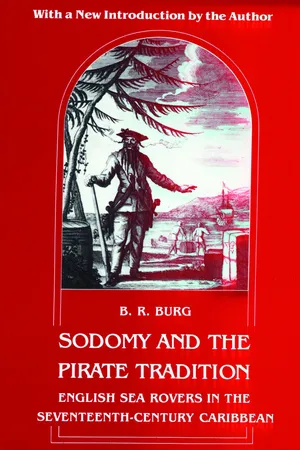
eBook - ePub
Sodomy and the Pirate Tradition
English Sea Rovers in the Seventeenth-Century Caribbean, Second Edition
- 264 pages
- English
- ePUB (mobile friendly)
- Available on iOS & Android
eBook - ePub
Sodomy and the Pirate Tradition
English Sea Rovers in the Seventeenth-Century Caribbean, Second Edition
About this book
Information
NOTES
PREFACE
1. Calendar of State Papers. Colonial Series. America and the West Indies, 5:636, 7:236; Interesting Tracts Relating to the Island of Jamaica Consisting of Curious State Papers, Councils of War, Letters, Petitions, Narratives, etc…. from Its Conquest, Down to the Year 1702 (St. Jago de la Vega [Spanish Town], Jamaica, 1800), p. 116.
INTRODUCTION
1. For a comprehensive account of the trials and condemnation, see Arthur N. Gilbert, “The Africaine Courts-Martial: A Study of Buggery and the Royal Navy,” Journal of Homosexuality 1 (1974): 111–122.
2. More complete discussions of societal reaction theory are found in Kenneth Plummer, Sexual Stigma: An Interactionist Perspective (London: Routledge and Kegan Paul, 1975), pp. 1–92; Edwin M. Schur, Labeling Deviant Behavior: Its Sociological Implications (New York: Harper and Row, 1971). For a short discussion of societal reaction theory and its uses in dealing with homosexuality, see John I. Kitsuse, “Societal Reaction to Deviant Behavior: Problems of Theory and Method,” Social Problems 9 (Winter, 1962): 247–256. For analysis of societal reaction theory and its relation to historical research see Kenneth Kenniston, “Psychological Developments and Historical Change,” in Explorations in Psychohistory, ed. Robert Jay Lifton (New York: Simon and Schuster, 1974), pp. 149–164; despite the title, Robert F. Berkhofer, Jr.’s A Behavioral Approach to Historical Analysis (New York: Free Press, 1969) also contains a fine discussion of societal reaction theory in Chapter II. An example of societal reaction as a base for historical analysis can be found in Kai T. Erikson’s Wayward Puritans: A Study in the Sociology of Deviance (New York: Wiley, 1966).
1. SODOMY AND PUBLIC PERCEPTION: SEVENTEENTH-CENTURY ENGLAND
1. Peter Laslett, The World We Have Lost (New York: Scribners, 1965).
2. Frederick Pollock and Frederic W. Maitland, The History of English Law Before the Time of Edward I (Cambridge: Cambridge University Press, 1895), 2:554–555; A.L. Rowse, Homosexuals in History: A Study of Ambivalence in Society, Literature and the Arts (New York: Macmillan, 1977), pp. 24–25; J.S. Cockburn, A History of the English Assizes, I558-I7J4 (Cambridge: Cambridge University Press, 1972), pp. 127–133; J.H. Baker, “Criminal Courts and Procedure at Common Law, 1550–1800,” Crime in England, 1550–1800 (Princeton: Princeton University Press, 1977), pp. 43–44; M.J. Ingram, “Communities and Courts: Law and Disorder in Early Seventeenth-Century Wiltshire,” ibid., p. 110. For an excellent survey of assorted sexual practices during the seventeenth and eighteenth centuries, see Vern L. Bullough’s compendious Sexual Variance in Society and History (New York: Wiley, 1976), Chapter XVI. H. Montgomery Hyde’s The Other Love, An Historical and Contemporary Survey of Homosexuality in Britain (London: Heinemann, 1970) is also exceedingly useful; Hyder Rollins and Herschel Baker, “Richard Barnfield,” in The Renaissance in England (Boston: D.C. Heath, 1954), pp. 396–397.
3. Anthony Fitzherbert, Loffice et Auctority de Iustices de Peace (London, 1606), folio 50; William Lambarde, Eirenarcha, or Of The Office of the Justices of Peace in Foure Bookes (London, 1610), pp. 224–225; Retha M. Wamicke, William Lambarde, Elizabethan Antiquary (London: Phillimore, 1973), pp. 61, 70–72; Lambarde’s same absence of concern was evident in Michael Dalton’s Countrey Justice published over half a century later in 1655. Dalton barely touched on the crime, although he did extend it to include sex acts involving only women and several unspecified heterosexual practices (pp. 340–341); Sir Edward Coke, The Third Part of the Institutes of the Laws of England (London, 1644), pp. 58–59; Coke, The Twelfth Part of the Reports of Sir Edward Coke (London, 1658), pp. 36–37.
4. A.L. Rowse, Homosexuals in History, pp. 48–66.
5. Ibid., p. 67; Lawrence Stone, The Family, Sex and Marriage in England 1500–1800 (New York: Harper, 1977), pp. 492–493.
6. Chester Quarter Sessions 21/3, p. 174a.
7. [Anon.], The Tryal and Condemnation of Mervin, Lord Audley Earl of Castle-Haven (London, 1699).
8. Ibid., p. 9.
9. Ibid., p. 4.
10. Ibid., pp. 10–12. On sodomy indictments see also the anonymously written Faithful Narrative of the Proceedings in a Late Affair … to which is Prefixed A Particular Account of the Proceedings Against Robert Thistlethwayte for a Sodomical Attempt upon Mr. W. French (London, 1739), p. 30.
11. [Anon.], Tryal and Condemnation of… Lord Audley, pp. 22–31.
12. There is no evidence in accounts of the trial to indicate the execution of Castlehaven’s two servants is proof, as one authority contends, of the revulsion toward sodomy held by members of the court. See Caroline Bingham, “Seventeenth-Century Attitudes Toward Deviant Sex,” Journal of Interdisciplinary History 1 (Spring 1971): 463–465. Even though Bingham suggests homosexuality was considered an abomination early in the century, she concedes, significantly, that this was not the case seventy years later (ibid., pp. 464–468).
13 Nicholas Bernard, The Penitent Death of John Atherton (Dublin, 1641), p. 15.
14. Ibid., pp. 15, 26, et passim; Atherton’s accuser was hanged some days or weeks before Atherton (ibid., p. 26); DNB, I, pp. 689–690.
15. John White, The First Century of Scandalous, Malignant Priests (London, 1643), preface, pp. A2 (recto, verso), A3, 1–2, 11, 23–24, 28; [Lionel Gatford], Public Good Without Private Interest (London, 1657), p. 16.
16. William Wycherly, The Country Wife, in The Complete Plays of William Wycherly, ed. Gerald Weales (New York: New York University Press, 1966), Act III, scene 1.
17. Thomas Killigrew, The Parson’s Wedding in Comedies and Tragedies by Thomas Killigrew (London, 1664), Act I, scene 2.
18. Ibid., Act I, scene 1.
19. Ibid., Act III, scene 5.
20. Ibid., Act II, scene 7; Act I, scene 3.
21. Ibid., Act II, scene 2.
22. Montague Summers, Introduction to Restoration Comedies (London: Jonathan Cape, 1921) p. xxxi.
23. Charles Johnson, The Successful Pyrate (London, 1713).
24. John Wilmot, Second Earl of Rochester, “A Satyr on King Charles II,” in Collected Works of John Wilmot, Earl of Rochester, ed. John Hayward (London: Nonesuch Press, 1926), p. 104.
25. London Gazette, November 22–25, 1680.
26. Wilmot, Sodom or the Quintessence of Debauchery (Paris: Olympia Press, 1957), Act V, scene 2.
27. Samuel Pepys, The Diary of Samuel Pepys, eds. Robert Latham and William Matthews (Berkeley: University of California Press, (1970– ), 9: 2, 247, 293. This was apparently true even into the next century (J. Jean Hecht, The Domestic Servant Class in Eighteenth-Century England [London: Routledge and Kegan Paul, 1956), pp. 201–204).
28. William Prynne, Histrio-Mastix: The Players Scourge (London, 1633), pp. 75–76.
29. Ibid., p. 211.
30. Ibid., pp. 208–214.
31. Ibid., p. 135.
32. Arthur Bedford, The Evil and Danger of Stage Plays Showing Their Natural Tendency to Destroy Religion and Induce a General Corruption of Manners (London, 1706), p. 139; “Copies of Several Presentments of the Grand Juries, Against the Play House Lately Erected in the City of Bristol” (1704–1706), in Bedford, Evil and Danger of Stage Plays, pp. 222–227; Middlesex County Records, Calendar of Session Books, 1689–1709, ed. W.J. Hardy (London: Richard Nicholson, 1905), p. 347; John Dennis, The Critical Works of John Dennis, ed. Edward N. Hooker (Baltimore: Johns Hopkins University Press, 1943), I, 153, 156, 473, II, 311, 314, 315, 396, 510–511; Dudley W.R. Bahlman, The Moral Revolution of 1688 (New Haven, Conn.: Yale University Press, 1957), pp. 4–5.
33. Pepys, Diary, 3: 159–160. Neither did Mrs. Pepys accept the notions of sexual promiscuity common to the court. Exceedingly jealous, she raged at her husband’s infidelities, real and imagined, almost destroying their marriage (ibid., 9: 337–338 ff.).
34. Ibid., 8: 596.
35. Ibid., 4: 209.
36. Ibid.
37. Ibid., 4: 210.
38. Ibid., 3: 66, 206–207, 4: 382.
39. John Evelyn, The Diary of John Evelyn, ...
Table of contents
- Cover Page
- Title Page
- Copyright Page
- Dedication
- Contents
- Preface
- Introduction to the New Edition
- Introduction
- One Sodomy and Public Perception Seventeenth-Century England
- Two To Train Up a Buccaneer
- Three The Caribbee Isles
- Four Buccaneer Sexuality
- Five The Buccaneer Community
- Notes
- Bibliographical Essay
- Index
Trusted by 375,005 students
Access to over 1.5 million titles for a fair monthly price.
Study more efficiently using our study tools.
Frequently asked questions
Yes, you can cancel anytime from the Subscription tab in your account settings on the Perlego website. Your subscription will stay active until the end of your current billing period. Learn how to cancel your subscription
No, books cannot be downloaded as external files, such as PDFs, for use outside of Perlego. However, you can download books within the Perlego app for offline reading on mobile or tablet. Learn how to download books offline
Perlego offers two plans: Essential and Complete
- Essential is ideal for learners and professionals who enjoy exploring a wide range of subjects. Access the Essential Library with 800,000+ trusted titles and best-sellers across business, personal growth, and the humanities. Includes unlimited reading time and Standard Read Aloud voice.
- Complete: Perfect for advanced learners and researchers needing full, unrestricted access. Unlock 1.5M+ books across hundreds of subjects, including academic and specialized titles. The Complete Plan also includes advanced features like Premium Read Aloud and Research Assistant.
We are an online textbook subscription service, where you can get access to an entire online library for less than the price of a single book per month. With over 1.5 million books across 990+ topics, we’ve got you covered! Learn about our mission
Look out for the read-aloud symbol on your next book to see if you can listen to it. The read-aloud tool reads text aloud for you, highlighting the text as it is being read. You can pause it, speed it up and slow it down. Learn more about Read Aloud
Yes! You can use the Perlego app on both iOS and Android devices to read anytime, anywhere — even offline. Perfect for commutes or when you’re on the go.
Please note we cannot support devices running on iOS 13 and Android 7 or earlier. Learn more about using the app
Please note we cannot support devices running on iOS 13 and Android 7 or earlier. Learn more about using the app
Yes, you can access Sodomy and the Pirate Tradition by B. R. Burg in PDF and/or ePUB format, as well as other popular books in Social Sciences & Gender Studies. We have over 1.5 million books available in our catalogue for you to explore.