The weather in Moscow is good, there's no cholera, there's also no lesbian love...Brrr! Remembering those persons of whom you write me makes me nauseous as if I'd eaten a rotten sardine. Moscow doesn't have them--and that's marvellous."
—Anton Chekhov, writing to his publisher in 1895
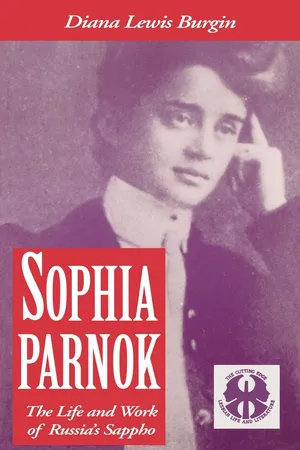
Chekhov's barbed comment suggests the climate in which Sophia Parnok was writing, and is an added testament to to the strength and confidence with which she pursued both her personal and artistic life. Author of five volumes of poetry, and lover of Marina Tsvetaeva, Sophia Parnok was the only openly lesbian voice in Russian poetry during the Silver Age of Russian letters. Despite her unique contribution to modern Russian lyricism however, Parnok's life and work have essentially been forgotten.
Parnok was not a political activist, and she had no engagement with the feminism vogueish in young Russian intellectual circles. From a young age, however, she deplored all forms of male posturing and condescension and felt alienated from what she called patriarchal virtues. Parnok's approach to her sexuality was equally forthright. Accepting lesbianism as her natural disposition, Parnok acknowledged her relationships with women, both sexual and non-sexual, to be the centre of her creative existence.
Diana Burgin's extensively researched life of Parnok is deliberately woven around the poet's own account, visible in her writings. The book is divided into seven chapters, which reflect seven natural divisions in Parnok's life. This lends Burgin's work a particular poetic resonance, owing to its structural affinity with one of Parnok's last and greatest poetic achievements, the cycle of love lyrics Ursa Major. Dedicated to her last lover, Parnok refers to this cycle as a seven-star of verses, after the seven stars that make up the constellation. Parnok's poems, translated here for the first time in English, added to a wealth of biographical material, make this book a fascinating and lyrical account of an important Russian poet. Burgin's work is essential reading for students of Russian literature, lesbian history and women's studies.
- 382 pages
- English
- ePUB (mobile friendly)
- Available on iOS & Android
eBook - ePub
About this book
Trusted by 375,005 students
Access to over 1.5 million titles for a fair monthly price.
Study more efficiently using our study tools.
Information
1.
“That Marvelous Female Tenderness…”
At the turn of the twentieth century, the sleepy, whitewashed southern town of Taganrog on the inland sea of Azov had a population of about 61,000 inhabitants, the majority of whom were involved in trade and commerce. A century earlier, Taganrog had been a major Russian port, but its economic importance had steadily declined until it ranked only tenth in exports and eighth in imports among the port cities of imperial Russia.1
The city’s multinational population included many Greek and Turkish subjects whose cultures contributed to Taganrog’s exotic, un-Russian atmosphere. In the port area, with its ever-present Turkish feluccas and Greek ships, the air smelled of ship tars and salt. The sea changed color with the seasons—greyish-blue in spring, bright green in the peculiar amber yellow of Taganrog’s summer sunsets.
Most of the houses in the city had terraces and balconies; “the gardens and public parks were full of tea roses, lilacs, and heliotrope. Planted with white acacias and pyramidal poplars, the shapely streets seemed like a park in themselves.” In summer, the wealthier sections of Taganrog exuded a sweet fragrance. From the “Greek monastery, its Doric columns showing white against the sky, came the mournful sound of evening bells.” After the oppressive heat of the day, the town’s young people would come out to meet one another in the municipal park or the harbor. “Red, lilac, yellow, and orange scarves wafted in the breeze from the shoulders of the young Greek women. The evening kept the secrets of young lovers. Suddenly, an empty street would exude the sweet smell of perfume as a bronze-skinned Greek woman in a white dress darted around the corner and vanished into the night.” The Greek letters on the ships in the harbor and on the hairdressing salons in town were “redolent of a mysterious antiquity,” which acquired a distinctive sound in the prayers of Greek Orthodox believers sitting and telling their rosaries “as the long hot summer days stretched on indolently.”2
On July 30, 1885,3 it was oppressively hot. There had been a brief shower early in the day, but the “measly drops” of rain it provided could “not slake the thirsty earth that had gone all cracks and crevices.”4 The horizon seemed to be melting in the intense heat. As the “cicadas crackled and chirred” outside the open windows, a young Jewish physician, Alexandra Parnokh, struggled in the throes of her first labor:
Now falling back, now on her elbows raising
herself again, digging her nails into
her palms, biting her mouth till it bled,
plaintively and ardently a mother
did her female deed; the vein beneath the hollow
of her temple beat, beat under cooled sweat.
Her depths cracked, like the earth from the heat,
the cicadas seemed to crackle in her ears—
and on that day of drunken witches’ rapture
to me, the newborn girl, was given a sacred,
the most sacred of all names.
Like a call to deeds, it summons me—SOPHIA… (#85)
herself again, digging her nails into
her palms, biting her mouth till it bled,
plaintively and ardently a mother
did her female deed; the vein beneath the hollow
of her temple beat, beat under cooled sweat.
Her depths cracked, like the earth from the heat,
the cicadas seemed to crackle in her ears—
and on that day of drunken witches’ rapture
to me, the newborn girl, was given a sacred,
the most sacred of all names.
Like a call to deeds, it summons me—SOPHIA… (#85)
Alexandra and Yakov Parnokh’s first daughter, Sophia (Sonya), was born into the exact middle of one of the bleakest decades in Russian history. The reigning tsar, Alexander III, had come to the throne upon his father’s assassination in 1881 proclaiming his faith in the power and right of autocracy.5 His dedication to turning the clock back twenty years was only increased by his belief that the reforms promulgated by his father in the sixties and seventies had ended in treason. Out of nostalgia for the ancien régime he fostered the traditional political alliance between the autocracy and the nobility, which, “together with the forward drive of industrial capitalism … constituted the principal source of policy in [his] reign.”6
Industrial expansion became the tsarist government’s economic priority and was achieved rapidly, but at the expense of industrial workers’ well-being. Taganrog’s growth was fairly typical in this regard. It received its initial boost in 1896 when Belgian capitalists began construction of a metalworks and boiler factory in the city. As soon as it went into operation, malfunctioning equipment and the absence of safety regulations resulted in a large number of accidents. Gradually, a whole “army of invalids and maimed men” grew up in the working class districts around the plant.7
Those neighborhoods presented a sharp contrast to the wealthier parts of Taganrog. Most workers did not earn a living wage and had to buy food and necessities on credit from local merchants. This forced them into a cycle of permanent indebtedness. Sanitary conditions in the poorer districts of Taganrog were appalling, and epidemics of plague and cholera swept the city in the early nineties.
Tsarist political repression increased in severity throughout the eighties and nineties and continued through the first decade of the reign of Nicholas II, who came to the throne in 1894. Russian universities, which Alexander III had considered, with some justification, to be breeding grounds of revolution, had lost their autonomy at the beginning of his reign. Between 1881 and 1905, the year of the first Russian revolution, there were few parts of the empire where ordinary laws were not at some time abrogated in favor of government by tsarist decree.
The official policy of russianizing non-Russian populations in the empire led to the open persecution of national and religious minorities—Poles, Ukrainians, Armenians, Russian Orthodox dissenters, Transcaucasian Moslems, and especially Jews. Under Alexander III and Nicholas II, the Pale of Settlement, within which most Jews were forced to live, was further restricted. Jewish peasants were forbidden to acquire land, and Jewish enrollment into schools, universities, and professions was limited by quotas. An official anti-Semitism prevailed. Wealthier and well-educated Jews, particularly in the two capitals and other large cities, tended to assimilate into the dominant Russian culture. They experienced less overt and less violent anti-Semitism and ceased to identify, in most cases, with the great mass of poverty-stricken and persecuted Russian Jews.
Taganrog was outside the Pale of Settlement and far from the centers of Jewish population in Russia. It was also one of the few places in the empire where there had never been any Jewish pogroms, although “in a neighboring town the pogromists would routinely stop male passersby and forcibly unbutton their trousers, looking for ‘the cut ones.’ “8 Sonya’s younger brother Valentin (Valya) remembered hearing the adults at home talk endlessly about “residence permits,” and he never forgot overhearing someone once say, “Soon a Jew will no longer have the right to cross the street.”9
The Parnokh family spoke Russian and was completely assimilated, as were the majority of Jewish families in the town. Yakov Solomonovich, a pharmacist and the owner of an apothecary, was one of Taganrog’s five hundred “hereditary honorary citizens,” a title conferred on persons not of gentle birth for good citizenship and services rendered to the state. Though sensitive to anti-Semitism, he was indifferent to religion, never attended synagogue, provided no religious instruction for his children, and gave frequent voice to his dream of leaving Russia and living in Western Europe.
The Parnokh children were brought up to think of themselves as Russian first and Jewish second, if at all. But, as often happens with children in nonreligious homes, they developed a passionate interest in religion, although they were stirred by different faiths.
The level of culture in Taganrog was not considered to be very high. In 1897 only 1.3 percent of the population possessed a higher education, a mere 10 percent were high school graduates, and 68 percent of the women and 57 percent of the men were illiterate.10 The monied aristocracy constituted the cream of local society, but its members were not especially well-educated or interested in cultural pursuits. Their life centered around the two main social clubs in town with their perpetual round of balls, coming-out parties, arguments over seating arrangements at formal dinners, and eternal card games.
The Greeks, Italians, English, and other foreign inhabitants also contributed little to Taganrog’s cultural life, since their education, for the most part, did not exceed bookkeeping and business correspondence in foreign languages.11
The city did take justifiable pride in its first-rate Italian Opera Company, which merchants had financed in the 1860s and 1870s. Well-known singers, actors, and other performers from larger cities regularly visited Taganrog on tour.
Anton Chekhov, the city’s most famous native son, had a very low opinion of cultural life in his hometown, which he left in the late seventies in order to study medicine in Moscow. When he visited Taganrog in 1887, he noted the town’s “brutish” living conditions and atmosphere of “universal laziness.”12 Things had not improved in his opinion seven years later, when, during another visit, he told a reporter for the local newspaper that the press “should be more assiduous in reminding the townspeople of how neglected their city was, of its lack of plumbing and a decent public library.”13 Chekhov himself worked tirelessly for the creation of a municipal library, which, due largely to his efforts and gifts of money and books, finally came into existence in 1903.
The Parnokhs were no doubt considered part of Taganrog’s intellectual elite. As in other Russian towns, they led a life entirely separated from the masses and their problems. Alexandra Abramovna was an exceptionally well-educated woman for her time, one of the first generation of women doctors in Russia. Her husband also valued education and provided his children with an excellent one at home that prepared them well for the gymnasium. As was typical in affluent Russian homes of the educated classes, the Parnokh children learned to read at a young age, were taught to speak French and German by native-speaking governesses and tutors, and studied music. Sonya and Valya both began writing poetry in childhood, she at six and he at nine.
Sonya was the only one of the three Parnokh children to have lived with their mother. In the almost six years before the birth of her brother and sister, she did not bond especially closely with her mother and grew up with the sad feeling that she had never known her. As a little girl she was closer to her father, but her younger brother apparently replaced Sonya in his father’s affections. Pride forced her to hide her resentment. Later, she rechanneled it into a studious indifference to her father and cultivated her distance from him.
She forgot, repressed, or, at the very least, did not care to record her childhood memories. Her lyrics contain virtually no childhood memories to speak of except for one striking memory of the blazing, crimson sunset she would contemplate outside the west-facing window of her nursery. According to one of her poems, it often evoked in her ambivalent “learned” daydreams of the kind of “bloody death that befits a hero” (#157). Valya remembered having similarly violent childhood fantasies of heroism as he daydreamed constantly of becoming the liberator of the Jews.14 Both children’s daydreams were fed by books. Valya’s favorite was called Wars of Liberation—it narrated the freedom struggles of the Italians, Greeks, and African-American slaves. Sonya eagerly read stories from Greek mythology and the Old Testament.
Much later, Parnok recalled her earliest childhood “dreams,” before she learned about the bloody deaths of heroes, as innocent, “springlike,” and “carefree” (#2). But she came to feel cut off from those “carefree dreams” by a “thorny path” that had been overshadowed by “misfortunes” (#2).
The first of these misfortunes was no doubt the death of her mother. In 1891, when Sonya was about to turn six, Alexandra Parnokh succumbed after giving birth to the twins, Valentin and Yelizaveta (Liza). The loss of her mother left a permanent wound in Sonya.
In the poem she wrote about her birth, a portion of which was quoted earlier, she tellingly portrayed her birthing mother as doing her “female deed,” while she, the daughter and poet, felt summoned to an ungendered “deed” in the service of her “sacred name, Sophia,” the Mother Wisdom. Apart from “July Thirtieth” (#85), Parnok remembered her mother only once in her poems, as a personality utterly different from herself, who, she surmised, would probably have disapproved of her daughter’s life. She always cherished the hope that her mother would have loved her, but she apparently never knew whether she had.
The second misfortune of Sonya’s childhood followed rapidly upon the first. Shortly after Alexandra Abramovna’s death, Yakov Solomonovich married his children’s German governess, with whom he had apparently been having an affair. Nothing is known about the Parnokh children’s stepmother, not even her name, except that she aroused strong negative feelings in all of them.
Valya nurtured a virulent hatred of his stepmother, which later expressed itself in his violently misogynistic detestation of Russia: “Russia is eternal slavery, the eternal stepmother … scum of the world … a very broad peasant-woman monster with an inordinately small vagina!”15
Sonya’s feelings for her stepmother seem to have been more diffuse, ambivalent, and therefore, perhaps, more confusing and troubling. She probably resented her for captivating her father, whose weakness she scorned while empathizing with what she felt to be his victimization by a power-loving woman. At the same time, the sexual charisma she perceived her stepmother to wield probably attracted her. Sonya viewed her stepmother primarily as a seductress and dominatrix. She felt less persecuted by her pseudo-mother than challenged to conquer and out-mother her.
Sonya’s main issue in growing up was her own motherlessness, and it ultimately expressed itself in her attitudes toward Russia, too. But where Valya rejected Russia as the false, evil, sexually unaccommodating stepmother, Sonya sought comfort in her as the true, good, all-embracing mother and self. Her view, unlike Valya’s, specifically contradicted her pro-European father’s outlook.
Parnok’s childhood was thus spent in a materially secure and even privileged environment that was emotionally wanting and treacherous.16 In many respects her adult life reversed this imbalance: she found herself chronically in need of money, but never wanting for the love and support of women.
Like many Victorian families, Parnok’s presented a proper appearance to the world that probably covered up its share of dark secrets. One fact is obvious and compelling. The poet carried away from her childhood the strong feeling that she had had no childhood, that she had emerged into adulthood at too young an age. As a young adult she attributed her persistent sense of being too old for her years to being a Jew.17 Perhaps her too-Jewish understanding of the world can be seen in the expression of her pensive, sad, aged-child’s eyes in the one surviving childhood photograph of her.
Shortly after Nicholas II ascended to the throne, Parnokh entered the Empress Marie Gymnasium for Girls in Taganrog, where she would complete her formal education over the next eight years.18 The curricula of all the Marie gymnasia were the same and all subjects except music were compulsory.19 Parnokh therefore studied religion, Russian, French, German, mathematics, history, geography, physics, science, drawing, needlework, gymnastics, choir singing, and dancing. Her school year extended from the beginning of September through mid-June, and she was in school from nine in the morning until three in the afternoon, six days a week. While school was in session, she wore a uniform to classes and in all public places. She had two weeks’ vacation for Christmas and Easter, and her class was limited to forty girls.
During her last three years at the gymnasium Parnokh entered puberty and began writing poetry intensively. She collected her poems into notebooks: only one poem (J-1) and the table of contents remain from the 1900 “Notebook of Poems.”20 The forty-nine poems (J-2—50) in the other group cover the period from April 1901 through mid-May 1903. Most of them are dated exactly (a few even with the hour they were written), a practice Parnok did not always follow later on. Taken together, these fifty poems constitute a kind of lyrical laboratory and di...
Table of contents
- Cover Page
- Title Page
- Copyright Page
- Contents
- Foreword
- Acknowledgments
- Author’s Note
- Introduction
- 1. “That Marvelous Female Tenderness…”
- 2. “Love Summons Me, and I Won’t Contradict Her…”
- 3. “Oh, Steal Me Away from My Death…”
- 4. “There’s No Way Back, for You, Me, or Us…”
- 5. “While My Other Self Roams in the Wilds…”
- 6. “Into the Darkness…the Secret Drawer!”
- 7. “Hello, My Love! My Grey-Haired Eve!”
- Epilogue
- Appendix
- Notes
- Bibliography
- Index Of First Lines of Poems by Parnok
- Index
Frequently asked questions
Yes, you can cancel anytime from the Subscription tab in your account settings on the Perlego website. Your subscription will stay active until the end of your current billing period. Learn how to cancel your subscription
No, books cannot be downloaded as external files, such as PDFs, for use outside of Perlego. However, you can download books within the Perlego app for offline reading on mobile or tablet. Learn how to download books offline
Perlego offers two plans: Essential and Complete
- Essential is ideal for learners and professionals who enjoy exploring a wide range of subjects. Access the Essential Library with 800,000+ trusted titles and best-sellers across business, personal growth, and the humanities. Includes unlimited reading time and Standard Read Aloud voice.
- Complete: Perfect for advanced learners and researchers needing full, unrestricted access. Unlock 1.5M+ books across hundreds of subjects, including academic and specialized titles. The Complete Plan also includes advanced features like Premium Read Aloud and Research Assistant.
We are an online textbook subscription service, where you can get access to an entire online library for less than the price of a single book per month. With over 1.5 million books across 990+ topics, we’ve got you covered! Learn about our mission
Look out for the read-aloud symbol on your next book to see if you can listen to it. The read-aloud tool reads text aloud for you, highlighting the text as it is being read. You can pause it, speed it up and slow it down. Learn more about Read Aloud
Yes! You can use the Perlego app on both iOS and Android devices to read anytime, anywhere — even offline. Perfect for commutes or when you’re on the go.
Please note we cannot support devices running on iOS 13 and Android 7 or earlier. Learn more about using the app
Please note we cannot support devices running on iOS 13 and Android 7 or earlier. Learn more about using the app
Yes, you can access Sophia Parnok by Diana L. Burgin in PDF and/or ePUB format, as well as other popular books in Literature & LGBT Literary Criticism. We have over 1.5 million books available in our catalogue for you to explore.