Winner of the 2015 Bonnie Ritter Book Award from the National Communication Association
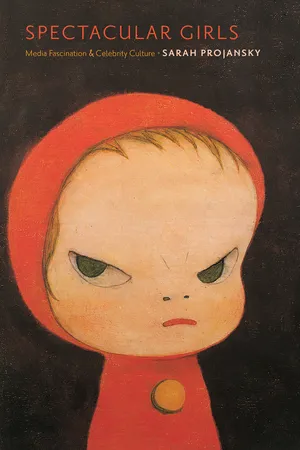
As an omnipresent figure of the media landscape, girls are spectacles. They are ubiquitous visual objects on display at which we are incessantly invited to look. Investigating our cultural obsession with both everyday and high-profile celebrity girls, Sarah Projanskyuses a queer, anti-racist feminist approach to explore the diversity of girlhoods in contemporary popular culture.The book addresses two key themes: simultaneous adoration and disdain for girls and the pervasiveness of whiteness and heteronormativity. While acknowledging this context, Projansky pushes past the dichotomy of the “can-do” girl who has the world at her feet and the troubled girl who needs protection and regulation to focus on the variety of alternative figures who appear in media culture, including queer girls, girls of color, feminist girls, active girls, and sexual girls, all of whom are present if we choose to look for them.
Drawing on examples across film, television, mass-market magazines and newspapers, live sports TV, and the Internet, Projansky combines empirical analysis with careful, creative, feminist analysis intent on centering alternative girls. She undermines the pervasive “moral panic” argument that blames media itself for putting girls at risk by engaging multiple methodologies, including, for example, an ethnographic study of young girls who themselves critique media. Arguing that feminist media studies needs to understand the spectacularization of girlhood more fully, she places active, alternative girlhoods right in the heart of popular media culture.
- 308 pages
- English
- ePUB (mobile friendly)
- Available on iOS & Android
eBook - ePub
About this book
Information
1
Pint-Sized and Precocious
The Girl Star in Film History
I was one of the last human beings to meet Tatum O’Neal as a little girl. She wasn’t a completely happy little girl. But she hadn’t yet known, as her father put it, “the recognition … the notoriety.” People still mistook her for a little boy.… Now she is a movie star.… I hope she’s a happy movie star, but I don’t know that movie stars are happier than little girls.
—Sam Blum, “The Real Love Story”
When my daughter was five years old, she frequently wore sunglasses. When she did, teachers, friends’ parents, and even strangers often commented, “You look like a movie star.” At the time, I was struck by how readily everyday girls such as my daughter could signify some of the meanings generated by and through the term “star”: glamour, to-be-looked-at-ness, performance, self-possession, independence, and (paradoxically) adultness. I was also struck by how commonplace the notion of a “girl star” is, so much so that the link between a five-year-old, sunglasses, and stardom appears perfectly transparent, yet also fascinating enough to remark on to perfect strangers.
This chapter seeks to unpack this presumed transparency and high visibility by theorizing the girl star in the context of both star studies and girls’ studies. I ask two interrelated questions: What role has the girl played in the history of the star system? And, can the lens of star theory help explain the role that representations of girls play in U.S. media culture? In order to explore the connection between girls and stars, it is instructive to consider a key girl star of the 1970s: Tatum O’Neal. In the context of the book’s emphasis on turn-of-the-twenty-first-century media representations of girls, this first chapter’s look back to the 1970s sets up a historical context for subsequent chapters, one that can illuminate both continuities and discontinuities in the history of U.S. conceptions of girlhood, as well as contextualize the current relationship between “girl” and “star/celebrity.”
A recurring theme in contemporary media is that “now, more than ever,” girls are in the public eye. Yet, as a large body of historical scholarship demonstrates, this claim is not exactly accurate.1 As I discuss in detail in the next chapter, it is true that an enormous amount of attention has been paid to girls since the early 1990s.2 In fact, the abundance of such discourse is, at least in part, why I wrote this book. Yet, the “more than ever” part of this claim masks important earlier eruptions of public discourse about girls, including—to name only a few examples—attention to age-of-consent laws in the early 1900s,3 anxiety about girl babysitters as laborers and nurturers,4 and the mid-twentieth-century trope of the girl on the phone as a symbol of ambivalence about post–World War II femininity and domesticity.5 As scholars researching these (and many other) issues have shown, throughout the twentieth century both media culture and public policy used the figure of the girl to work through various social anxieties, and in the process have shaped shifting meanings of girl itself.6 Tatum O’Neal in the 1970s, then, is simply one of any number of case studies I could have chosen to provide a historical context for the turn-of-the-twenty-first-century depictions of girls I emphasize in the remainder of this book.
Nevertheless, I choose (1) a film star, (2) the 1970s, and (3) Tatum O’Neal in particular for several reasons. First, by discussing film, an industry that emerged just as the nineteenth century ended, I can offer a focused overview of the history of girls in twentieth-century media culture. This overview is not meant to be comprehensive; film stars simply offer one way to address the span of the last century. Second, while I include a discussion of girl stars throughout the twentieth century, I develop a fuller analysis of a 1970s girl star in particular because she is recent enough to raise questions about feminism, sexuality, gender, and race in ways that resonate with similar issues in current media, while also being distant enough from the present to emphasize the specificity of historical context. Finally, I choose Tatum O’Neal—rather than the more often-discussed 1970s girl film stars, Jodie Foster and Brooke Shields—in order to initiate a key goal of this book (one that I enact in each chapter): to explore marginalized figures who nevertheless are still spectacularized.7 While Foster and Shields went on to more successful Hollywood careers than did O’Neal and have come to define 1970s girl stardom,8 in the 1970s O’Neal was just as much a spectacular girl star as were Foster and Shields. It is not that O’Neal raises more important issues than do Foster or Shields, but rather that as an under-researched figure in the history of girls in U.S. media culture she not only deserves our attention but also provides an opportunity to complicate that history.
In short, this chapter tells part of the history of girls in U.S. media culture, in this case in U.S. film, and helps explain how girls can be understood through codes of stardom, one aspect of celebrity culture. Celebrity studies scholars argue persuasively that there are important differences among, for example, film stars, accidental celebrities, and television personalities:9 “What constitutes celebrity in one cultural domain may be quite different in another.”10 Yet, as scholars also point out that the “pervasive circulation of contemporary media fame … does not respect media borders.”11 However we define various types of fame, then, they all are related to the ideas of “well-knownness,”12 “commodity,”13 and “emulation or … contempt”14 that define celebrity. Thus this chapter both pays attention to the specificity of the history of the girl film star and defines her as an aspect of celebrity culture. Further, the chapter forges connections between star studies and girls’ studies to argue for the importance of star and celebrity culture in understanding the mediation of girlhood and the importance of an attention to girls in the history and theory of the star system. And it insists that attention be paid not only to a marginalized spectacular girl, but also to the ways that anxiety and tensions surrounding gender, race, and sexuality are part of the complex and fraught (both adored and abhorred) version of girlhood she represents. In all these ways, the chapter provides a context for and initiates many of the overarching concerns of this book.
The chapter begins with an analysis of the place of the girl star in previous (primarily feminist) film studies scholarship on stars and the star system. Here, I tell a brief history of the girl star and argue that, although she has been under-examined in film studies, this scholarship inadvertently illustrates that the girl star is pervasive in and germane to the star system, a figure in need of careful attention. In the next section, I offer a case study of Tatum O’Neal, her first film (Paper Moon, 1973), and press response to the film. I argue that whiteness and ambivalent anxiety (primarily about the relationships among childhood, sexuality, and/or gender) precondition her visibility in both the film and contemporaneous press coverage. In other words, O’Neal is spectacular both because of her whiteness and because of her ability to elicit ambivalence and anxiety about her status as girl, particularly in relation to gender ambiguity and sexuality. Finally, in the conclusion, I return to a discussion of star theory, drawing on my analysis of O’Neal to argue that given that the girl star is pervasive in and germane to the star system and that she activates attention to and anxiety about the gender, sexuality, and race status of the social subject, she epitomizes that system. In short, the girl star embodies many of the contradictions and ambiguities of the star figure generally, particularly whiteness, the boundaries of the individual in relation to society, and the scandal—a sexual scandal—at the heart of the star as cultural object. Through analysis of both previous star studies scholarship and Tatum O’Neal as a case study, then, this chapter argues that the girl star elucidates the star system itself—that she is an ideal example of its operation.
Star Studies and a History of the Girl Star
Although I am sorely tempted, I am not quite willing to argue that the emergence of girl stars initiated the star system in the United States or that the U.S. star system requires girl stars in order to function. Nevertheless, I do argue that girl stars have occupied a profoundly important position within the U.S. star system and that studying them is instrumental to understanding that system. It is therefore curious that star studies—even feminist star studies—have not more closely examined the girl star and her role within the overall star system.15 That said, there are three ways in which star studies have at least indirectly addressed girl stars, and it is useful to draw on this material to illustrate the emergence and then the ubiquity of the girl star throughout the twentieth century.
First, some previous scholarship illustrates the role the concept of the girl played in the formation and early structure of Hollywood. For example, Richard deCordova makes clear that the concept of girl in the 1910s has become central to the story film studies tells itself about the emergence of the star system.16 While this is a narrative he challenged and complicated in the early 1990s, it is still common17 to read the story of the battle for market dominance between Biograph and the independents, particularly Independent Moving Pictures (IMP). As the story goes, IMP won the battle when it invented star marketing by staging a publicity stunt in which it claimed there were false reports of a famous “Biograph Girl’s” death. The death was a hoax, and IMP would later not only reveal that she was very much alive, but also publish her name for the first time: Florence Lawrence, now the new “IMP Girl.” While deCordova shows that this particular publicity stunt was not, in fact, the “beginning” of the star system, nor the first time a film actor’s name was revealed, he also establishes the fact that the publicity stunt did happen and thereby illustrates (but does not remark on) the fact that the concept of “girl” was a key marketing tool in the early star system.18 Through deCordova, then, I would suggest that “girl,” even at this very early point, could be understood to be synonymous with “star” (as in “Biograph star,” “IMP star”) and therefore to be central to the evolving star system and the eventual solidification of the entire Hollywood structure.
Like deCordova, Heidi Kenaga does not comment on the use of the term “girl” in her discussion of the “movie-struck fan” and the “extra girl” in the 1920s, but she does illustrate that these figures articulated social anxiety about single women/girls in the context of labor, public space, and the growing Hollywood film industry.19 Kenaga shows that in 1925 a narrative about the management of the girl helped connect the Central Casting Bureau (CCB) to the Motion Picture Producers and Distributors of America’s role in the representation of Hollywood as self-regulating. As early as 1914, religious and civic organizations, as well as newspapers and fan magazines, worried about “hoards” of girls coming to Hollywood in hopes of becoming movie stars. Hollywood’s response was to regulate these girls/women, establishing the CCB to screen, manage, and provide extras (primarily conceived of as women and children)20 to all the major studios at set wages and working-hour limits. Additionally, the CCB worked in concert with the YWCA to establish the Hollywood Studio Club, providing housing for the movie star hopefuls, as well as education designed to help them find employment. In short, through the CCB and the Hollywood Studio Club, the figure of the girl helped to produce an industry structure that both controlled the labor of the “extra”—regardless of gender or age—and publicly defined the industry as self-regulating and protective of the social good, particularly of young women and girls as laborers: both movie star hopefuls and working extras.
In both the cases examined by deCordova and Kenaga, the use of the word “girl” did not necessarily refer to children or even teens. Often, those labeled as girls were no longer teens or even in their early twenties, but were defined as girls because of their relative youth, their status as single, and/or the child or childlike roles they played.21 Nevertheless, regardless of the actual age of the early stars, movie-struck fans, and extras, both deCordova’s and Kenaga’s work illustrate that the concept of girlhood played a conspicuous role in the formation of the early U.S. film industry. That the age boundaries around “girl” in the 1910s and 1920s were different than they are today simply illustrates the historical specificity of this process. Further, very young girls did contribute to the formation and maintenance of the Hollywood star system. For example, in the 1920s, Baby Peggy (Diana Serra Cary) was a major star; born in 1918, she made more than one hundred films before the age of seven (including many high-profile “Universal Jewels”)22 and was available for purchase as a doll. More famously, scholarship on Shirley Temple’s role in the 1930s as “the biggest-drawing star in the world”23 suggests that as an individual girl star she helped shape the development of the film industry. In this case, a girl under the age of ten reportedly “single-handedly revived Fox and influenced its merger with 20th Century.”24 Like Baby Peggy, Temple was marketed as a doll, and in 1935 she received an honorary Oscar for her “outstanding contribution to the film industry.” In short, Temple helped the film industry as it fought to survive—and managed to thrive—during the Great Depression.25 Both Baby Peggy and Shirley Temple make clear that girl child stars were key economic pillars of the industry (even if the stories about them are likely overstated and in part retell Hollywood publicity material). Overall, then, all these examples from the first third of the twentieth century—from Florence Lawrence as the new IMP girl, to movie star hopefuls/extras, to mega child stars Baby Peggy and Shirley Temple—illustrate that the girl star played a central role in establishing, perpetuating, and protecting the structure of both the star system and Hollywood as a whole.
Not only does previous star studies work illustrate the girl’s role in establishing and maintaining industry structure, but it also alludes to her role in defining the meaning of “star” itself, even if these allusions are left frustratingly (for me) underdeveloped. For example, in Diane Negra’s excellent analysis of white ethnicity in Hollywood cinema, she complicates our understanding of cinematic whiteness by addressing a tension between the white ethnic childlike star (coded as virginal, demystified, assimilable) and the white ethnic womanlike star (coded as sexual, mystified, troublesome). She writes, “Throughout this book, I employ the dichotomy of girl/woman as a functional conceit, in part to draw attention to a broader pattern of differentiation in Hollywood between the safe sexuality of the girl and the often troublesome sexuality of the woman, but also to indicate how female ethnicity has been particularly subject to representation on these polarized terms.” More specifically, she suggests that a girlish white ethnic star can more easily be “celebrated as an exemplary American; even if her ethnicity is prominently displayed, the very fact of her girlishness promises...
Table of contents
- Cover Page
- Title Page
- Copyright Page
- Dedication
- Contents
- List of Illustrations
- Acknowledgments
- Introduction: Finding Alternative Girlhoods
- 1 Pint-Sized and Precocious: The Girl Star in Film History
- 2 “It’s Like Floating” or Battling the World: Mass Magazine Cover Girls
- 3 What Is There to Talk About? Twenty-First-Century Girl Films
- 4 “I’m Not Changing My Hair”: Venus Williams and Live TV’s Racialized Struggle over Athletic Girlhood
- 5 Sakia Gunn Is a Girl: Queer African American Girlhood in Local and Alternative Media
- 6 “Sometimes I Say Cuss Words in My Head”: The Complexity of Third-Grade Media Analysis
- Conclusion: Girlhood Rethought
- Notes
- Bibliography
- Index
- About the Author
Trusted by 375,005 students
Access to over 1.5 million titles for a fair monthly price.
Study more efficiently using our study tools.
Frequently asked questions
Yes, you can cancel anytime from the Subscription tab in your account settings on the Perlego website. Your subscription will stay active until the end of your current billing period. Learn how to cancel your subscription
No, books cannot be downloaded as external files, such as PDFs, for use outside of Perlego. However, you can download books within the Perlego app for offline reading on mobile or tablet. Learn how to download books offline
Perlego offers two plans: Essential and Complete
- Essential is ideal for learners and professionals who enjoy exploring a wide range of subjects. Access the Essential Library with 800,000+ trusted titles and best-sellers across business, personal growth, and the humanities. Includes unlimited reading time and Standard Read Aloud voice.
- Complete: Perfect for advanced learners and researchers needing full, unrestricted access. Unlock 1.5M+ books across hundreds of subjects, including academic and specialized titles. The Complete Plan also includes advanced features like Premium Read Aloud and Research Assistant.
We are an online textbook subscription service, where you can get access to an entire online library for less than the price of a single book per month. With over 1.5 million books across 990+ topics, we’ve got you covered! Learn about our mission
Look out for the read-aloud symbol on your next book to see if you can listen to it. The read-aloud tool reads text aloud for you, highlighting the text as it is being read. You can pause it, speed it up and slow it down. Learn more about Read Aloud
Yes! You can use the Perlego app on both iOS and Android devices to read anytime, anywhere — even offline. Perfect for commutes or when you’re on the go.
Please note we cannot support devices running on iOS 13 and Android 7 or earlier. Learn more about using the app
Please note we cannot support devices running on iOS 13 and Android 7 or earlier. Learn more about using the app
Yes, you can access Spectacular Girls by Sarah Projansky in PDF and/or ePUB format, as well as other popular books in Social Sciences & Cultural & Social Anthropology. We have over 1.5 million books available in our catalogue for you to explore.