For many Americans spirituality and business seem to be polar opposites: one is concerned with lofty questions of ultimate significance, the other with mundane matters of the daily grind. Yet over the last two decades the two have become increasingly linked, and as the barriers between them are broken down, many see this as a revolutionary shift in American business culture.
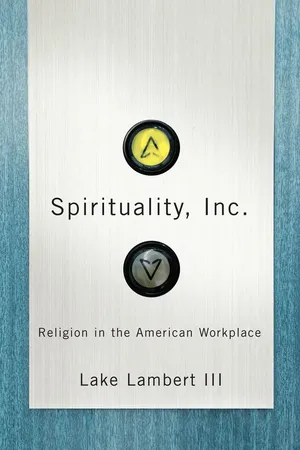
Lake Lambert III provides a comprehensive examination of the workplace spirituality movement, and explores how it is both shaping and being shaped by American business culture. Situating the phenomenon in an historical context, Lambert surveys the role of spirituality in business from medieval guilds to industrial "company towns" right up to current trends in the ever-changing contemporary business environment. Using case studies from specific businesses, such as Chick-fil-A and Hobby Lobby, he analyzes the enhanced benefits and support that workplace spirituality offers to employees, while exposing the conflicts it engenders, including diversity, religious freedom, and discrimination issues.
The American workplace today is experiencing dramatic upheaval and change. Spirituality, Inc. offers important insights into the role of religion in this transformation. With employees seeking new ways to strike a proper life-work balance and find meaning in their everyday lives, spirituality in the workplace is a trend that will become increasingly important in the American business landscape. Spirituality, Inc. provides a critical overview of this phenomenon that does not ignore the movement's many positive contributions to the workplace, yet does not overlook the potential for abuse.
- 228 pages
- English
- ePUB (mobile friendly)
- Available on iOS & Android
eBook - ePub
About this book
Information
Topic
Theology & ReligionSubtopic
Christianity1
Finding Meaning in Business
When Patricia Aburdene issued her latest book in the Megatrends franchise, she and her sometime partner, John Naisbitt, had been offering their prophecies on American business culture for almost twenty years. The newest edition was unique, however, because it blurred the line between religion and commerce in a way unexpected for a business best seller. Megatrends 2010 promised to reveal “the rise of conscious capitalism” as the new revolution in corporate operations, consumer behavior, investing, business leadership, and work itself. Filled with interviews, anecdotes, and predictions in bold face, Megatrends 2010 concluded that capitalism was being transformed from an egoistic survival of the fittest built around greed to a new vision of commerce grounded in compassion and enlightened self-interest that is, at its heart, a spiritual phenomenon. No longer would God and mammon be separate, and the path to enlightenment would no more require the renunciation of worldly possessions. Instead, they were coming together in new and creative ways. The “power of spirituality,” Aburdene asserted, was making an impact and demanded notice as the next big trend in American business.
What Aburdene predicted is today not hard to see. At the food giant Tyson Foods, workplace chaplains roam the corporate halls and processing floors. Corporations like Ford and Xerox sponsor spiritual retreats to spark creativity, and small businesses include Bible verses and Christian symbols on their advertising. In the fast-food industry, Chick-fil-A honors the Sabbath by closing on Sunday, and amid rapid growth they dedicate each new store to God’s glory. Prominent business theorists like The One-Minute Manager’s Kenneth Blanchard write books about Jesus as a leader, and even Wal-Mart sells the publications. At the same time, major American universities including Virginia Tech, Notre Dame, and Columbia University offer courses touting the value of spirituality to future business managers, and in Washington, DC, public policy makers wonder how to respond to a rising tide of religious discrimination complaints.
Not to be left out, churches and many new religious organizations support workplace spirituality. Domino’s Pizza founder Tom Monaghan established Legatus as an organization exclusively for Roman Catholic CEOs and other high-level business executives. Evangelical Christians have a similar organization in Fellowship of Companies for Christ, and now Muslim CEOs can connect through the Minaret Business Association. For major league and minor league baseball players, including Cy Young Award–winner Jake Peavy, Baseball Chapel connects sports and faith through team Bible studies and worship. For PBS correspondent Judith Valente, the Coalition for Ministry in Daily Life is a faith-at-work-resource.
For many Americans throughout our recent history, spirituality and business have seemed like exact opposites. The former is concerned with questions of meaning and ultimate significance while the latter is supposedly devoted to making money and to affairs of this world. Aburdene reported there had traditionally been a “firewall” between spirituality and business, but it was a barrier that was breaking down as both individuals and organizations undergo a spiritual awakening. Individuals are seeking to bring their whole selves to the workplace, including their spirituality, and businesses today are dependent upon the creativity that only “consciousness” and spirituality can provide. Thus, capitalism is being transformed from the inside and the outside, changing the way Americans do business.1
Six years earlier, a BusinessWeek cover and feature story had already heralded spirituality in business as a hot trend, and the magazine offered evidence to prove it. The article reported that Americans desired meaning and fulfillment in their work more than additional pay or time off.2 Although surprising on a certain level, this finding revealed not only how many people were beginning to realize that there was potentially more to work than getting a paycheck, but also that the inability to find workplace meaning had the potential to create personal anxiety and even crisis. The search for meaning in work, the connection between work and faith or the divine, and the relationship between work and other areas of life like family and health were being raised more frequently and acted on in new, creative ways individually and organizationally. These same developments were prompting profound moral, philosophical, and religious questions not normally asked or answered in American business.
Beginning in the 1990s, different forms of spirituality in work seemed to pop up all the time. An explosion of books on the subject could be found in both religious bookstores and mainstream retailers with titles such as The Business Bible, Your Soul at Work, The Soul of a Business, Angels in the Workplace, Soul at Work, Jesus, CEO, and Leading with Soul. Individuals sought out like-minded co-workers for lunchtime discussion groups and Bible studies, and a variety of organizations began to emerge that hosted meetings and conferences to connect work and spirituality. Employers, especially when faced with labor shortages for highly skilled workers, adopted programs and accommodations that created holistic and family-friendly work environments, all of which were more open and accommodating to the spiritual and emotional needs of employees.3 Corporations and the individuals who work in them recognized that child care concerns, depression, or even poor fitness could impede optimal work performance, and so programs and services to meet those needs were created and used. Why not spirituality too? Professional training also adopted this concern for holism and forms of spirituality, and employees appreciated the accommodation and vision of these workplaces while the companies themselves hoped that short-term costs would eventually result in greater economic success. In 1990 John Naisbitt and Patricia Aburdene had noted in Megatrends 2000 that companies were spending $4 billion for spiritual consultants and “consciousness raising,” and they were correct when they predicted that this trend would only continue to grow.4
Something was indeed happening. Many of the developments in workplace spirituality related easily to the traditional theological identities of Christians or the practices of diverse religious traditions, but others expressed forms of spirituality outside the boundaries of established faiths. Some of the changes could easily be understood as new forms of professional development or programs to increase morale and productivity; other activities, programs, and services appeared unrelated to the affairs of commerce. Still others seemed to tap into Americans’ incredible love for “self-help” methodologies and, perhaps most of all, their love of success. Whatever it was, the apparent novelty made spirituality big news and a worthy subject for trend-watchers like Aburdene. But while there are always new things, very few developments, if any, come into existence ex nihilo. This was the case for workplace spirituality as well. In fact, the efforts to find meaning in work extend at least as far back as the founding of America and were a recurring theme in much of the modern Western tradition, and within that tradition, the Christian notion of calling was central.
The Idea of Vocation
When the Puritan divine Richard Steele wrote his treatise The Religious Tradesman in 1684, he too was claiming a connection between business and spirituality. Steele praised business as worthy work for a Christian, and he hoped that parents would “be persuaded to educate their children for a life of business and usefulness.”5 Offering careful advice for discerning whether business was one’s appropriate vocation, Steele suggested self-examination as to vocational fit, consultation with experienced businessmen, and prayer to God for direction and assistance. For the remainder of his book Steele described in detail the virtues that were necessary for a Christian in business, including prudence, justice, truth, and contentment. Steele did not worry about business as a potential challenge to faith as much as he feared sloth—a sin that an industrious businessman was sure to avoid. The great English hymnist and fellow minister Isaac Watts found the volume so inspirational that he wrote an introduction to a new printing in 1747.6 For Steele and his admirers, the justification for Christians in commerce was biblically derived from fusing the economic division of labor with the gifted diversity of the Body of Christ, thus making some Christians literally called to business.7
It was from his study of Puritans specifically and Calvinists more generally that the great sociologist Max Weber developed his famous “Protestant ethic” thesis on the origins of capitalism and modern business practices. In looking at the development of business life and capitalist systems at the end of the nineteenth century, Weber was struck by how overwhelmingly Protestant everything was. Why, he asked, were business owners and capitalists more often Protestant, and why were Calvinists even more prevalent? In particular he was struck by the Puritans and their rigorous piety in all areas of life, coupled with the successful commerce they developed in New England. He concluded that these religious traditions and the forms of economic organization known as capitalism had an affinity for one another.
In The Protestant Ethic, Weber also offered a definition of capitalism that still deserves attention. He argued that capitalism is not about the maximization of wealth or even its pursuit. Long before the rise of capitalism, humans sought money and riches, but greed has “nothing to do with capitalism.” Rather, Weber argued, capitalism is an economic system with inherent values, including self-discipline and rationality, that result not in profit but “forever renewed profit.”8 Unfortunately, popular opinion has not changed a great deal from Weber’s time until now. From Gordon Gecko in the film Wall Street touting that “greed is good” to the perception that business is all about making a lot of money, business is associated with many values, but few are seen as good ones.
Despite his being misinterpreted frequently, Weber asserted that the relationship between economics and religion was directly connected to the values and behaviors that each fostered and demanded, and perhaps most important, the connection was never one way. Whereas Adam Smith saw economics as shaped by religion and morality, and Karl Marx asserted that economics determined religion, Weber argued for a more complex relationship with each influencing the development of the other. Religion, he said, has the power to shape economic life, and economic realties can make certain religious groups and certain religious ideas more or less available.9 For his “Protestant ethic” thesis, Weber asserted that on the economic side, capitalism demanded hard work and asceticism; on the faith side, Calvinism’s teaching on predestination produced anxiety and a need to prove eternal salvation in this world while, at the same time, proclaiming that everyone was assigned a vocation—places and roles to which one was called to serve God. This form of faith and this pattern of economics were then attracted by their “elective affinity.”
The idea of vocation had deep roots in the Hebraic and Christian traditions, from the biblical text to the Protestant reformers, roots of which both Steele and Weber were well aware. The Hebrew and Christian scriptures frequently speak of human work, its meaning, and its difficulty. In the Genesis stories of creation, humanity is called into being as workers. God gives to humans “dominion” over the newly created earth, and in Eden, the man is placed in the garden “to till it and to keep it.”10 Yet another part of Genesis speaks of the difficulty found in work. The sin of Adam and Eve in the Garden of Eden is mythically connected to the demeaning of work in that human labor is cursed as a consequence of disobedience. God’s words to Adam foretell the trouble ahead, “Cursed is the ground because of you; in toil you shall eat of it all the days of your life; thorns and thistles it shall bring forth for you; and you shall eat the plants of the field. By the sweat of your face you shall eat bread until you return to the ground.”11 Adam and Eve are expelled from the rich productivity of the garden and forced to work in alienation from God’s presence.
The New Testament has similar tensions in consideration of work. Jesus often calls individuals away from their daily work to a life of disciple-ship free from mammon and affairs of the world, but at the same time he repeatedly tells stories about daily work and what work will be like in the Kingdom of God. Jesus teaches about faithful managers, dishonest and lazy workers, and ungrateful laborers. He states that as his Father in heaven is working, so he as the Son of God must also be working, and certainly humans can be no different. The call of Jesus to discipleship is a call to be part of a community that will work to make disciples of all nations.12 This need not involve grand schemes or so-called important work. Even the most minor task is claimed by Jesus and made part of God’s work: Jesus teaches that even fetching a cup of cold water can have spiritual meaning.13
However, it was in the writings of St. Paul that the Protestant reformers found their greatest inspiration. It was Paul and his Epistle to the Galatians that in 1517 prompted the German Protestant reformer Martin Luther to question the monastic life to which he had sworn himself. He began to ask whether the spiritual works of monasticism were better than the good works of the common layman, and he wondered whether good works mattered at all in one’s relationship with God. His conclusion was that all Christians are “called” and not just a spiritual elite group of bishops, priests, monks, and nuns. In fact, Luther said that the supposed good works of monks and nuns were far surpassed by the simple work of a common maid. For Luther, you know you are serving God when you serve others, and any work that does not serve is demonic and to be avoided. A “calling” or a vocation was for all Christians, and so the Christian life should be seen as living out one’s calling in the everyday world of work, family, community, and church.
Working in Geneva several years later, John Calvin adopted Luther’s larger project on vocation with a few alterations. A vocation, for Calvin, was a “station” or “sentry post,” which God gives to Christians to prevent them from wandering. Monasticism is unsuitable as a Christian vocation because it is not a defined area of responsibility where spirituality daily engages materiality, nor does it provide service.14 The vow taken by monks is false, said Calvin, because it is likely in conflict with one’s true calling to marriage, family, occupation, and social participation.15 In his great work, The Institutes, Calvin considered a main problem of the Christian life to be human mobility and restlessness that would lead Christians to abandon God-given work because of the hardships associated with it. His fear was not that Christians would hold too fast to the status quo, but rather they would be too likely to roam, looking for a nonexistent occupation without hardship.16 In his commentary on 1 Corinthians 7:20, Calvin allowed for occupational change only if a sufficient reason is available, and he interprets Paul in this passage as condemning the eagerness by which many switch jobs for little or no reason. Change is possible but must be made with prayerful consideration of motive, merit, and the will of God.17 This reinforced the conviction that the meaning of work was not to be found in personal satisfaction but rather in service to others.
The Puritans in Britain and the American colonies received this rich tradition and added to it as well. Less than fifty years after Calvin’s death, William Perkins put forth a theology of vocation that distinguished the “general call” from the “particular call.” The general call referred to faithfulness in Jesus Christ and as such was the same for all Christians, but the particular call directed individual Christian to their specific roles, occupations, and stations in life. Because all Christians have a particular calling, Perkins wanted to ensure that all understood the divine rules that governed them. Faith and work were to be joined; a person was to be confident and steady in a calling; and since all are called to work, begging should be outlawed.18 Another Puritan pastor and theologian, Cotton Mather, later added that the two types of call were like the oars on a rowboat, and each must be pulled equally.19
The theological clarifications of Mather and the Puritans of the early 1700s defined subtle but important changes to the idea of vocation established by Luther and Calvin. Mather’s rowboat metaphor included in it that the boat was the Christian’s transportation to heaven, meaning that faith and holiness were to be combined with diligent work in one’s particular calling to merit salvation. Whereas Luther asserted that one could serve God only by serving one’s neighbor, the later Puritans claimed that a vocation served God, society, and oneself. The individual was aided because one’s vocation was a path to salvation. Richard Baxter, the Pur...
Table of contents
- Cover Page
- Title Page
- Copyright Page
- Contents
- Acknowledgments
- 1 Finding Meaning in Business
- 2 The Genealogy of Corporate Spirituality
- 3 The Making of a “Christian Company”
- 4 Jesus as a Management Guru
- 5 The Spiritual Education of a Manager
- 6 Team Chaplains, Life Coaches, and Whistling Referees
- 7 The Future of Workplace Spirituality
- Notes
- Select Bibliography
- Index
- About the Author
Trusted by 375,005 students
Access to over 1.5 million titles for a fair monthly price.
Study more efficiently using our study tools.
Frequently asked questions
Yes, you can cancel anytime from the Subscription tab in your account settings on the Perlego website. Your subscription will stay active until the end of your current billing period. Learn how to cancel your subscription
No, books cannot be downloaded as external files, such as PDFs, for use outside of Perlego. However, you can download books within the Perlego app for offline reading on mobile or tablet. Learn how to download books offline
Perlego offers two plans: Essential and Complete
- Essential is ideal for learners and professionals who enjoy exploring a wide range of subjects. Access the Essential Library with 800,000+ trusted titles and best-sellers across business, personal growth, and the humanities. Includes unlimited reading time and Standard Read Aloud voice.
- Complete: Perfect for advanced learners and researchers needing full, unrestricted access. Unlock 1.5M+ books across hundreds of subjects, including academic and specialized titles. The Complete Plan also includes advanced features like Premium Read Aloud and Research Assistant.
We are an online textbook subscription service, where you can get access to an entire online library for less than the price of a single book per month. With over 1.5 million books across 990+ topics, we’ve got you covered! Learn about our mission
Look out for the read-aloud symbol on your next book to see if you can listen to it. The read-aloud tool reads text aloud for you, highlighting the text as it is being read. You can pause it, speed it up and slow it down. Learn more about Read Aloud
Yes! You can use the Perlego app on both iOS and Android devices to read anytime, anywhere — even offline. Perfect for commutes or when you’re on the go.
Please note we cannot support devices running on iOS 13 and Android 7 or earlier. Learn more about using the app
Please note we cannot support devices running on iOS 13 and Android 7 or earlier. Learn more about using the app
Yes, you can access Spirituality, Inc. by Lake Lambert III in PDF and/or ePUB format, as well as other popular books in Theology & Religion & Christianity. We have over 1.5 million books available in our catalogue for you to explore.