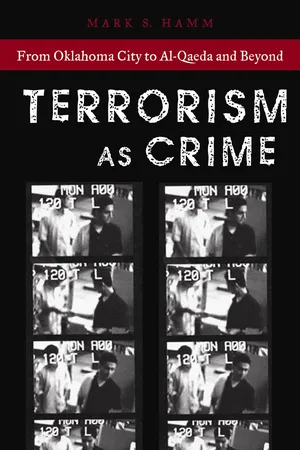
Car bombing, suicide bombing, abduction, smuggling, homicide, and hijacking are all profoundly criminal acts. In Terrorism as Crime Mark S. Hamm presents an understanding of terrorism from a criminological point of view, arguing that the most successful way to understand, detect, prosecute and deter these acts is to use conventional criminal investigation methods. Whether in Oklahoma City or London, Terrorism as Crime demonstrates that criminal activity is the lifeblood of terrorist groups and that there are simple common denominators at work that can remove the mystery surrounding many of these terrorist groups. Once understood the vulnerabilities of these organizations can be exposed.
This important volume focuses in on six case studies of crimes committed by jihad and domestic right wing groups, including biographies of more than two dozen terrorists along with descriptions of their organizations, strategies, and terrorist plots. Terrorism as Crime offers an original and significant framework for explaining international and domestic terrorism, as well as how future acts might be detected or exposed.
- 271 pages
- English
- ePUB (mobile friendly)
- Available on iOS & Android
eBook - ePub
About this book
Information
GLOBAL CRIME AND TERRORISM
1
Criminal Stupidity and the Age of Sacred Terrorism
The First World Trade Center Bombing
Scholars have traditionally explained terrorism by placing it within an historical context. Efforts have also been made to describe terrorism through the contexts of changing global politics, ethnic and nationalistic conflicts, and religious movements. Other writers have concentrated on the personal pathologies of terrorists as well as on the social pulls and pressures that influence the dynamics of terrorist groups. And still others have focused on the conceptualization of terrorism as a form of communication. Once we appreciate the enormous variety of social, political, cultural, and individual features of terrorism, we can understand why it is such an overwhelming subject of study.
This work takes an entirely different approach by assuming that terrorism is first and foremost a criminal matter. This strategy was well-known to terrorism investigators long before the attacks of 9/11. “Terrorists are criminals,” said a veteran FBI counter-terrorism official in 1998, “and we use criminal investigations to go after them.”1 These investigations focused on such highly sophisticated affairs as building bombs and coordinating terrorist cells to such mundane activities as breaching airport security and motor vehicle violations. Some terrorists will show signs of criminal brilliance in carrying out these activities. Richard Clarke, the former counter-terrorism czar for both Presidents Bill Clinton and George W. Bush, comments on this trait in his analysis of Islamic terrorists. “These people are smart,” Clarke writes, “many trained in our colleges, and they have a very long view.”2 But this is not true for all terrorists, Islamic or otherwise, no more than it is accurate to say that all car thieves are superlative criminals. Some terrorists will be only marginally competent in carrying out their activities. And some will be completely incompetent.
The terrorists who perpetrated the attacks of September 11 were no exception to this basic principle of criminology. In a speech delivered at the University of California, Los Angeles, in February of 2004, Presidential candidate John Kerry pointed out that the 9/11 attacks could have been prevented had U.S. law enforcement and intelligence communities coordinated information on the hijackers’ driving records. “In the months leading up to September 11,” said Kerry, “two of the hijackers were arrested for drunk driving—and another was stopped for speeding and then let go, although he was already the subject of an arrest warrant in a neighboring county and was on a federal terrorist watch list.”3 Although drunk driving and speeding may seem like extremely careless actions for terrorists to engage in, such infractions are not uncommon.
For example, less than ninety minutes after detonating a massive truck bomb in front of the Alfred P. Murrah Federal Building in Oklahoma City on April 19, 1995, Timothy McVeigh was arrested for driving without a license plate. What kind of criminal bombs a federal building, killing 169 and injuring hundreds more, and then drives off in a car that does not have a license plate, an act that led directly to his capture?
As incredible as they are, these cases pale in comparison to the criminal ineptitude displayed in the 1993 World Trade Center bombing, the focus of this chapter.4
BACKGROUND
Around noon on Friday, February 26, 1993, a group of Islamic extremists drove a bomb-laden van into the underground parking lot of New York’s World Trade Center complex and, using a timer, set the bomb to detonate. At 12:18 p.m., the bomb exploded, killing six and wounding over a thousand others, thus presaging the September 11, 2001 attacks on the same building. Six days later, the FBI made its first arrest in the case. This arrest was based on what prosecutors would later call a “ludicrous mistake” made by one of the conspirators. As we shall see, this mistake was not an isolated incident. Rather, throughout the conspiracy, criminal patterns were overlooked by law enforcement. Time and again authorities could have taken the terrorists off the streets if only police and immigration officials had enforced the letter of the law.
The Poor Immigrant
Mohammad Salameh was born in the town of Biddya, on what was then the Jordanian-controlled West Bank, on September 1, 1967—shortly after the “Six-Day War” between Israel and her Arab neighbors. Extremism was a family trait, due mainly to the influence of relatives on his mother’s side. Salameh’s maternal grandfather was a member of the PLO, as was his maternal uncle, who served eighteen years in an Israeli prison for terrorism.5 In 1968, the Salameh family relocated to Zarqa, Jordan, where Mohammad’s father, a Jordanian soldier and Palestinian, was stationed. Mohammad grew up there in a bleak lower-class neighborhood, along with his parents and ten brothers and sisters. From an early age, humiliation became part of his emotional landscape. There were a number of reasons for this.
First was the Black September massacre of 1970—an event initiated by Jordan’s King Hussein after he ordered a campaign to relocate Palestinians to refugee camps. During the relocation, three-year-old Mohammad Salameh was shot by a Jordanian soldier and hospitalized under inadequate medical conditions. Several years later, Mohammad’s father retired from the military and took on odd jobs; yet he was unable to make ends meet, and the family slipped into abject poverty. Then another problem arose. Mohammad was the oldest of the eleven Salameh children, and he would prove to be the least accomplished. He functioned at a below-average level of intelligence, had few interests, and little ambition. Even within his own family, Mohammad Salameh was an outcast.
After graduating from high school, Salameh took entry exams to become a student at the University of Jordan, where he planned to study law or medicine. Failing those exams, he ended up majoring in Islamic studies. There is no evidence of his participation in fundamentalist movements, though, and upon graduating, he entered Jordan’s austere job market. Unable to find work, Salameh was reduced to selling candy on the streets.6 Sensing that employment opportunities would be better in America, and seeking to avoid Jordan’s mandatory military service, he applied for, and was granted, a five-year visa to the United States. Borrowing money from his family, Salameh bought a one-way ticket to New York City.
He arrived in early 1988. Barely able to speak English and with no job skills, Salameh found that employment opportunities were no better than those he had left behind. Often destitute, he bounced from one menial job to the next until he ended up in a refugee center in Jersey City, New Jersey. There he began attending the Masjid al-Salaam mosque.
The Assassin
The Jersey City mosque was led by a radical Palestinian immigrant named Sultan el-Gawli, who by 1988 had attracted a following of struggling young Middle Eastern émigrés.7 Among them was a round-faced, thirty-two-year-old Egyptian refugee who was a walking testament to the theory that terrorism is caused by individual pathology.
El Sayyid Nosair was born in 1955 near Port Said, Egypt, to a family that was also displaced following the Six-Day War in 1967. Nosair was raised in Cairo and went on to study industrial design and engineering at Helwan University. He graduated in 1978 and apparently spent some time in the training camps of the Arab terrorist Abu Nidal. Nosair immigrated to America in the early 1980s and settled with family friends in Pittsburgh. Nosair found work as a diamond cutter in a jewelry store and married a despondent, overweight Irish-American woman who had recently converted to Islam.
Nosair’s life began to unravel shortly after that. He was fired from his diamond cutting job in 1983, in part because he had begun proselytizing co-workers in the name of Islam. In 1985, a woman from the Pittsburgh mosque filed battery charges against Nosair, and later another person accused him of assault. Eventually cleared of both charges, Nosair was nevertheless ostracized from the local Muslim community. Unemployed, with three children and a wife to support, Nosair relocated to Jersey City where he found work in a power plant. But in 1986, Nosair was electrocuted on the job. The accident left him impotent, disabled, depressed, and unemployed. He began taking the anti-depressant medication Prozac. In mid-1987, Nosair went to work as a heating and air conditioning repairman in the Criminal Courts Building in Manhattan.
By this time, Nosair had become a fixture at the Jersey City mosque where his rabid hatred of the United States for its pro-Israel policies went into overdrive. Nosair’s fanaticism eventually so alienated his brethren at the mosque that he began praying at home with a small circle of other disenfranchised worshipers, including Mohammad Salameh. And soon the impressionable Salameh became Nosair’s disciple.
In 1989, Nosair and Salameh became involved with the al-Kifah Refugee Service Center located in the al-Farooq mosque on Atlantic Avenue in Brooklyn. The Service Center was founded by a charismatic Islamic scholar named Abdullah Azzam, whose influence among volunteer mujahideen soldiers fighting the Soviet army in Afghanistan was legendary. Among his devotees was the young Saudi millionaire Osama bin Laden. Under Azzam’s leadership, the al-Kifah Service Center functioned as a recruiting and propaganda arm for the Afghan mujahideen. Clandestinely, the Service Center also engaged in counterfeiting and producing phony passports to enable Muslim volunteers to travel to America.
Through their involvement with the Service Center, Nosair and Salameh met three other refugees who would become part of an unfolding criminal conspiracy. But unlike Nosair and Salameh, all three would enter the conspiracy with considerable talent. The first was a giant thirty-year-old Egyptian-born New York City cab driver named Mahmud Abouhalima—known as “Mahmud the Red” because of his hair. The Red was a hardened combat veteran who had survived two tours of duty in Afghanistan; there he had developed a reputation for fearlessness, often volunteering for mine-sweeping missions. Emblematic of his jihadist background, Abouhalima continued to wear his military fatigues and combat books as he walked the streets of Brooklyn. The second was a twenty-seven-year-old Palestinian named Bilal Alkaisi, also a veteran of the Soviet-Afghan war. And the third was twenty-five-year-old Nidal Ayyad, a naturalized American citizen, born in Kuwait to Palestinian parents, who had recently graduated with a degree in chemical engineering from Rutgers University. These five men (Nosair, Salameh, Abouhalima, Alkaisi, and Ayyad) formed the nucleus of the first Islamic terrorist cell in the United States.
In the spring of 1989, Nosair’s cell began conducting paramilitary training exercises at the Calverton Gun Range on eastern Long Island. There, they participated in basic firearms training taught by a Black Muslim from Brooklyn named Richard Smith. Smith also sold Nosair’s crew an assortment of rifles, shotguns, assault weapons, and grenades.8 That summer, the training was expanded to include survival and surveillance courses taught by a U.S. Army Special Forces instructor, Ali Mohamed, at Nosair’s apartment in Jersey City. Alkaisi, who had been an explosives trainer in bin Laden’s camps, also added a course on rudimentary bomb building.
As the training progressed, Nosair sought the approval of Azzam and other spiritual leaders, including the blind Egyptian cleric Omar Abdel-Rahman, considered one of the most accomplished religious scholars in all of Islam. By the summer of 1989, Nosair was in regular contact with Abdel-Rahman, who was then being held under house arrest by the Egyptian government. At length, Nosair and Abouhalima launched a campaign to bring the blind sheik to New York. In one audio cassette to Abdel-Rahman, Nosair boasted, “We have organized an encampment. We are concentrating here.” Indeed they were, and this led to the cell’s first of many motor vehicle violations.
By now, Nosair had moved the firearms training to the High Rock Shooting Range in Naugatuck, Connecticut. On August 29, 1989, a state trooper stopped a suspicious-looking car carrying six Middle Eastern men near the range. Upon searching the vehicle, the officer found a small arsenal of semi-automatic weapons and several out-of-state license plates. The guns were legally purchased and licensed to the driver, a local gun dealer of Albanian descent. A computer search showed that the extra license plates were registered to one El Sayyid Nosair. This brought Nosair to the attention of the FBI, yet his name meant little to them at the time.9
Soon thereafter, Nosair planned his first terrorist strike in the United States. This involved a plot to set off bombs in the Atlantic City casinos, yet the scheme never came to fruition. Nosair took a step closer to implementing another plan later that year. On December 8, Soviet premier Mikhail Gorbachev was on a state visit to New York. As Gorbachev’s motorcade passed through Manhattan, Nosair threw a homemade grenade at the premier’s limousine, but the device failed to detonate, and Nosair’s assassination attempt went unnoticed by law enforcement.10 Yet Nosair was relentless. In April 1990, he set off a crude pipe bomb at a gay bar in Greenwich Village, causing three minor injuries. Again Nosair got away unnoticed.11
A month later, Nosair’s spiritual mentor, Sheik Abdel-Rahman, arrived in New York after absconding from house arrest in Egypt. Abdel-Rahman began preaching at the al-Farooq mosque in Brooklyn and then at the Jersey City mosque. Sometime that summer, the blind sheik issued a fatwah, calling on his Muslim brothers to rob American banks and kill Jews anywhere they were found. Ten years earlier, Abdel-Rahman’s fiery oratory had inspired the creation of the Egyptian Islamic Jihad—the organization responsible for the assassination of Egyptian president Anwar Sadat. Now Abdel-Rahman would inspire Nosair and his confederates to carry out another assassination, this time on American soil.
In the fall of 1990, Mahmud Abouhalima struck up a relationship with a Lebanese Muslim, then living in Texas, named Wadih el-Hage. From el-Hage (who would later become a personal emissary for bin Laden and a key figure in the 1998 bombing of the American embassies in East Africa), Abouhalima attempted to buy weapons to use against the Jewish Defense League—classified as a terrorist organization by both the U.S. State Department and the Israeli Knesset—and its outspoken fifty-eight-year-old founder, Rabbi Meir Kahane. Simultaneously, Nosair began stalking Kahane.
On the evening of November 5, Kahane gave a speech on the expulsion of Palestinians from Israel at the Marriott Hotel in Manhattan. In the crowd stood Nosair, wearing a yarmulke to disguise himself as a dark-skinned Sephardic Jew, along with Bilal Alkaisi. Mahmud the Red was in his cab outside the hotel, and Mohammad Salameh sat behind the wheel of a green sedan a block away. As Kahane left the crowded ballroom, Nosair approached him with a coat draped over his arm.
Suddenly, Nosair pulled a .357 revolver and fired two shots into Kahane’s jugular vein, killing him. As the crowd erupted in chaos, Nosair ran from the room, shouting, “It’s Allah’s will!” At the door, an elderly man grabbed Nosair around the neck; Nosair shot him in the leg and fled.
Once he and Alkaisi reached the street, Alkaisi ran toward the green sedan as Nosair jumped into a cab. Three blocks away, Nosair realized that he was in the wrong cab (security had shooed the Red away from the hotel) and told the driver to stop. As Nosair sprinted toward the sedan, he was confronted by a U.S. postal police officer who told him to halt. Nosair fired one shot at the officer, hitting him in his bullet-proof vest. The officer fired back, hitting Nosair in the chin and bringing him to his knees.
When Alkaisi reached the sedan, he shouldered Salameh over to the passenger’s seat and took the wheel. Alkaisi hit the accelerator and fled the scene, leaving Nosair bleeding on the sidewalk. A police report later stated that witnesses saw “two bug-eyed Middle Eastern men in the front seat of a green sedan careening the wrong way down Park Avenue.”12
THE PLOT
When police searched Nosair’s apartment they discovered forty-seven boxes of documents, including training manuals from the Army Special Warfare School at Fort Bragg, North Carolina, and copies of teletypes related to the war in Afghanistan that had been routed to the Secretary of the Army and the Joint Chiefs of Staff. There were bomb-making manuals in the boxes, as well as maps of landmark New York locations, including the Statue of Liberty, Times Square, the Holland Tunnel… and the World Trade Center. Detectives also found a notebook in which Nosair had written (in Arabic) about the destruction of the enemies of Allah “by means of exploding the structure of their civilized pillars.” It would be years, however, before investigators would understand the significance of these documents.
Abouhalima and Salameh were found staying at Nosair’s former residence after the assassination and were taken into custody by New York City police. A background check showed that in 1990 Salameh had lied on an immigration document, falsely claiming that he had been in the United States since 1982, and that he had left briefly in 1987. Both men denied their involvement in the Kahane murder, and, lacking evidence to the contrary and ignoring Salameh’s immigration violation, police released them without filing charges.
Nosair was locked up in the Manhattan house of detention and charged with first-degree murder. Yet he received numerous visitors, including the Red and representatives of the blind sheik. To cover his legal costs, supporters created the El Sayyid Nosair Defense Fund, to which Osama bin Laden made a $20,000 contribution.
Nosair’s trail began in late 1991. His defense—which was led by famed civil rights attorney William Kunstler—claimed that Nosair had not fired the gun that killed Meir Kahane, and that Kahane had actually been shot by one of his own followers. Each day, a small group of Muslim men paced the sidewalks in front of the courthouse, fulminating against Israel, the Uni...
Table of contents
- Cover Page
- Title Page
- Copyright Page
- Dedication
- Contents
- Acknowledgments
- Introduction
- PART I GLOBAL CRIME AND TERRORISM
- PART II DOMESTIC CRIME AND TERRORISM
- PART III THE CURRENT STATE AND FUTURE OF THE TERRORISM-CRIME CONNECTION
- Notes
- Index
- About the Author
Trusted by 375,005 students
Access to over 1.5 million titles for a fair monthly price.
Study more efficiently using our study tools.
Frequently asked questions
Yes, you can cancel anytime from the Subscription tab in your account settings on the Perlego website. Your subscription will stay active until the end of your current billing period. Learn how to cancel your subscription
No, books cannot be downloaded as external files, such as PDFs, for use outside of Perlego. However, you can download books within the Perlego app for offline reading on mobile or tablet. Learn how to download books offline
Perlego offers two plans: Essential and Complete
- Essential is ideal for learners and professionals who enjoy exploring a wide range of subjects. Access the Essential Library with 800,000+ trusted titles and best-sellers across business, personal growth, and the humanities. Includes unlimited reading time and Standard Read Aloud voice.
- Complete: Perfect for advanced learners and researchers needing full, unrestricted access. Unlock 1.5M+ books across hundreds of subjects, including academic and specialized titles. The Complete Plan also includes advanced features like Premium Read Aloud and Research Assistant.
We are an online textbook subscription service, where you can get access to an entire online library for less than the price of a single book per month. With over 1.5 million books across 990+ topics, we’ve got you covered! Learn about our mission
Look out for the read-aloud symbol on your next book to see if you can listen to it. The read-aloud tool reads text aloud for you, highlighting the text as it is being read. You can pause it, speed it up and slow it down. Learn more about Read Aloud
Yes! You can use the Perlego app on both iOS and Android devices to read anytime, anywhere — even offline. Perfect for commutes or when you’re on the go.
Please note we cannot support devices running on iOS 13 and Android 7 or earlier. Learn more about using the app
Please note we cannot support devices running on iOS 13 and Android 7 or earlier. Learn more about using the app
Yes, you can access Terrorism As Crime by Mark S. Hamm in PDF and/or ePUB format, as well as other popular books in Social Sciences & Criminology. We have over 1.5 million books available in our catalogue for you to explore.