Between the years 1850 and 1950, Americans became the leading energy consumers on the planet, expending tremendous physical resources on energy exploration, mental resources on energy exploitation, and monetary resources on energy acquisition. A unique combination of pseudoscientific theories of health and the public’s rudimentary understanding of energy created an age in which sources of industrial power seemed capable of curing the physical limitations and ill health that plagued Victorian bodies. Licensed and “quack” physicians alike promoted machines, electricity, and radium as invigorating cures, veritable “fountains of youth” that would infuse the body with energy and push out disease and death.
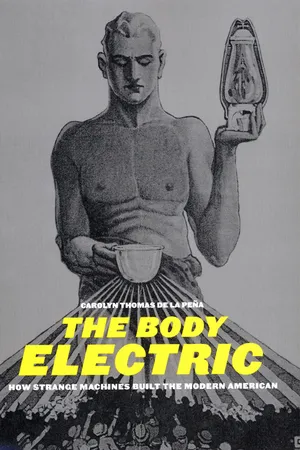
The Body Electric is the first book to place changing ideas about fitness and gender in dialogue with the popular culture of technology. Whether through wearing electric belts, drinking radium water, or lifting mechanized weights, many Americans came to believe that by embracing the nation's rapid march to industrialization, electrification, and “radiomania,” their bodies would emerge fully powered. Only by uncovering this belief’s passions and products, Thomas de la Peña argues, can we fully understand our culture’s twentieth-century energy enthusiasm.
eBook - ePub
The Body Electric
How Strange Machines Built the Modern American
- 329 pages
- English
- ePUB (mobile friendly)
- Available on iOS & Android
eBook - ePub
About this book
Information
Notes
NOTES TO THE PREFACE
1. See Donna Haraway, “A Manifesto for Cyborgs: Science, Technology, and Socialist Feminism in the 1980s,” in Coming to Terms: Feminism, Theory, Politics, ed. Elizabeth Weed (New York: Routledge, 1989).
2. See, for example, Judith Waltzer Leavitt, Brought to Bed: Childbearing in America 1750–1950 (New York: Oxford University Press, 1986), Margarete Sandelowski, Pain, Pleasure & American Childbirth: From the Twilight Sleep to the Read Method, 1914–1960 (Westport: Greenwood Press, 1984), and Dorthy and Richard Wertz, Lying-In: A History of Childbirth in America (New Haven: Yale University Press, 1989).
3. Mythologies about Native American women’s “painless” childbirth typically originated with American men who had observed Native American women following the cultural practice of birthing alone and returning to the group with newborn in tow. Rarely did these men themselves actually witness the births to observe birthing women experiencing pain. They concluded that it was the fit, healthy lifestyle of Native American women that rendered the experience painless. In reality, Native American women’s active lifestyles likely shortened labors and made them less painful; they did not, however, remove pain entirely. For accounts of Native American births, see George Wharton James, Indians’ Secrets of Health (Pasadena: Radiant Life Press, 1908), 178, 111; Henry Lyman, Artificial Anesthesia and Anesthetics (New York: William Wood & Company, 1881), 68; Samuel Bruckner, “On the Physical Character of the Pain of Parturition,” Galliard’s Medical Journal (January 1900): 799; George Engelmann, Labor Among Primitive Peoples (St. Louis: J. H. Chambers & Co., 1982), 5. By 1888, the myth was used to market American products designed to relieve labor pains. Dr. Wrightman’s Sovereign Balm of Life’s advertisement asserted that because “Indians experience little or no pangs of childbirth due to their simple life in the open . . . it is contrary to all natural laws” that women should suffer in childbirth. See Jackson Lears, Fables of Abundance: A Cultural History of Advertising in America (New York: Basic Books, 1994), 148.
4. John Kasson, Amusing the Million: Coney Island at the Turn of the Century (New York: Hill and Wang, 1978).
5. Carolyn Marvin finds similar properties in electric products in When Old Technologies Were New: Thinking About Electric Communication in the Late Nineteenth Century (New York: Oxford University Press, 1988).
6. Anne Kull sees the cyborg as offering “new metaphors for understanding how science and technologies affect our lives, subjectivities, and concepts.” See “The Cyborg as an Interpretation of Culture-Nature,” Zygon 36, no. 1 (March 2001): 49–56. Stacy Alaimo uses Haraway’s theories of the cyborg as a foil for eco feminism in “Cyborg and Ecofeminist Interventions: Challenges for an Environmental Feminism,” Feminist Studies 20, no. 1 (April 30, 1994): 133. For Haraway’s original theories see “A Manifest for Cyborgs.”
7. This is something mentioned by both Tom Lutz in American Nervousness, 1903: An Anecdotal History (Ithaca: Cornell University Press, 1991) and F. G. Gosling in Before Freud: Neurasthenia and the Medical Community (Urbana: University of Illinois Press, 1988). My research affirms that their findings, based on medical data, hold true in the popular realm of “pseudo-science” as well.
8. My own definition of an irregular practitioner is one working outside the accepted, and licensed, medical establishment. For different definitions and explorations of “quack” electric medicine, see Roy Porter, Health for Sale: Quackery in England, 1660–1850 (Manchester: Manchester University Press, 1989); Arthur J. Cramp, Miscellaneous Nostrums , 5th ed., (Chicago: Propaganda Department of the Journal of the American Medical Association Press, 1923); Arthur J. Cramp, Nostrums and Quackery , vol. 1–3 (Chicago: American Medical Association Press, 1912, 1921, 1936); Stewart H. Holbrook, The Golden Age of Quackery (New York: Macmillan, 1959); Jameson, The Natural History of Quackery , 61; David Armstrong, The Great American Medicine Show: Being an Illustrated History of Hucksters, Healers, Health Evangelists, and Heroes from Plymouth Rock to the Present (New York: Prentice Hall, 1991).
NOTES TO THE INTRODUCTION
1. According to David Nye, by the end of the twentieth century, the United States had the highest per capita use of energy in the world, roughly 40 percent more than Germany and almost three times as much as Italy or Japan. See Nye, Consuming Power: A Social History of American Energies (Cambridge: MIT Press, 1998), 6. Statistics comparing the energy consumption and energy efficiency ratings of forty-seven nations can be found in Benjamin Barber, Jihad vs. McWorld (New York: Times Books, 1995), 302–303.
2. See, for example, Paul Israel’s Edison: A Life of Invention (New York: John Wiley, 1998), and Wayne Lewchuk, “Men and Monotony: Fraternalism as a Managerial Strategy at the Ford Motor Company,” Journal of Economic History 5, no. 4 (December 1993): 824–856.
3. Cynthia Russett characterizes the period between 1860 and 1900 as one when “health depended upon moderation in the expenditure of energy” and one’s achievements in one area necessitated “lesser attainment elsewhere.” Tom Lutz explores Beard’s theories about a finite “nerve force” that, if overtaxed, could lead to nervous bankruptcy. Both scholars accurately represent Beard’s ideas on neurasthenia. If we combine this information with an understanding of Beard’s experiments with restorative electric currents, however, his diagnoses appear less dire. See Russett, Sexual Science: The Victorian Construction of Womanhood (Cambridge: Harvard University Press, 1989), 112–113, and Lutz, American Nervousness, 1903: An Anecdotal History (Ithaca: Cornell University Press, 1991), 3–4.
4. Tim Armstrong, Modernism, Technology, and the Body: A Cultural Study (Cambridge: Cambridge University Press, 1998), 6.
5. Cleveland Moffett, “The Sense and the Nonsense about Radium,” Success (April 1904): 246.
6. Several recent studies suggest that our ability to believe that a drug will work is often a major factor in its effectiveness. According to a recent study at the University of British Columbia, placebos can actually cause a chemical response in the body. Individuals with Parkinson’s disease were given either a placebo or apomorphone, a drug that stimulates the body’s release of dopamine. Patients were not told whether they were receiving apomorphone or a placebo. After taking the drugs, each of the patients who had received only the placebo had a substantial amount of dopamine in his or her system. Researchers concluded that patients’ expectations can cause their bodies to simulate the effects of a drug they have not received. Alison Motluk, “Some of the Best Medicines Are All in the Mind,” New Scientist 171, no. 2304 (August 18, 2001): 19. An additional study has also confirmed that when a condition has a strong psychological component, such as pain, anxiety, and depression, the placebo response rate among patients is frequently high, making it difficult to determine the effectiveness of prescribed drugs. Martin Enserink, “Can the Placebo Be the Cure?” Science 284, no. 5412 (April 9, 1999): 238.
7. Pilates, originally developed in the 1920s by Joseph Pilates, has recently enjoyed renewed popularity as a fitness system “without machines.” See Brooke Siler, The Pilates Body: The Ultimate At-Home Guide to Strengthening, Lengthening, and Toning Your Body without Machines (New York: Bantam Doubleday, 2000).
8. According to Jeffrey Hornstein, the tension between professional and entrepreneurial status marked the twentieth-century American middle class. See Hornstein, “The Rise of the Realtor®: Professionalism, Gender, and Middle-Class Identity, 1908–1950,” in Burton J. Bledstein and Robert D. Johnston, eds., The Middling Sorts: Explorations in the History of the American Middle Class (New York: Routledge, 2001), 217–233.
9. See John W. Leavitt, Exercise a Medicine; or Muscular Action as Related to Organic Life (New York: J. W. Leavitt, 1890), i–v.
10. Tom Lutz finds that gender conventions shaped treatments for neurasthenia patients in general. Whereas women were prescribed cures of inactivity, men’s cures revolved around activity. According to Lutz, “[B]oth cures were represented in terms of a return to traditional values of passive feminity and masculine activity.” See Lutz, American Nervousness, 34.
11. See, for example, Janice Todd, Physical Culture and the Body Beautiful: Purposive Exercise in the Lives of American Women, 1800–1870 (Macon: Mercer University Press, 1998), and Frances B. Cogan, All-American Girl: The Ideal of Real Womanhood in Mid-Nineteenth-Century America (Athens: University of Georgia Press, 1989).
12. Rachel Maines provides evidence that women were often willing to partake of forbidden technologies, even when the best “experts” told them that devices were unnecessary or dangerous. See Maines, Technology of Orgasm: Hysteria, the Vibrator and Women’s Sexual Satisfaction (Baltimore: Johns Hopkins University Press, 1994).
13. Gail Bederman makes a cogent argument for this connection in Manliness and Civilization: A Cultural History of Gender and Race in the United States, 1880–1917 (Chicago: University of Chicago Press, 1995).
14. For work on American masculinity during the modern era, see ibid.; Michael Kimmell, Manhood in America: A Cultural History (New York: Free Press, 1996); E. Anthony Rotundo, American...
Table of contents
- Cover Page
- Title Page
- Copyright Page
- Contents
- Acknowledgments
- Preface
- Introduction
- The Machine-Built Body
- Measuring Mechanical Strength
- Exploring Electric Limits
- Powering the Intimate Body
- “Radiomania” Limits the Energy Dream
- Conclusion
- Notes
- Bibliography
- Index
- About the Author
Trusted by 375,005 students
Access to over 1.5 million titles for a fair monthly price.
Study more efficiently using our study tools.
Frequently asked questions
Yes, you can cancel anytime from the Subscription tab in your account settings on the Perlego website. Your subscription will stay active until the end of your current billing period. Learn how to cancel your subscription
No, books cannot be downloaded as external files, such as PDFs, for use outside of Perlego. However, you can download books within the Perlego app for offline reading on mobile or tablet. Learn how to download books offline
Perlego offers two plans: Essential and Complete
- Essential is ideal for learners and professionals who enjoy exploring a wide range of subjects. Access the Essential Library with 800,000+ trusted titles and best-sellers across business, personal growth, and the humanities. Includes unlimited reading time and Standard Read Aloud voice.
- Complete: Perfect for advanced learners and researchers needing full, unrestricted access. Unlock 1.5M+ books across hundreds of subjects, including academic and specialized titles. The Complete Plan also includes advanced features like Premium Read Aloud and Research Assistant.
We are an online textbook subscription service, where you can get access to an entire online library for less than the price of a single book per month. With over 1.5 million books across 990+ topics, we’ve got you covered! Learn about our mission
Look out for the read-aloud symbol on your next book to see if you can listen to it. The read-aloud tool reads text aloud for you, highlighting the text as it is being read. You can pause it, speed it up and slow it down. Learn more about Read Aloud
Yes! You can use the Perlego app on both iOS and Android devices to read anytime, anywhere — even offline. Perfect for commutes or when you’re on the go.
Please note we cannot support devices running on iOS 13 and Android 7 or earlier. Learn more about using the app
Please note we cannot support devices running on iOS 13 and Android 7 or earlier. Learn more about using the app
Yes, you can access The Body Electric by Carolyn Thomas de la Pena in PDF and/or ePUB format, as well as other popular books in History & North American History. We have over 1.5 million books available in our catalogue for you to explore.