An 1797 publication of Enlightenment era thought, read by virtually every American schoolboy in the early 19th century
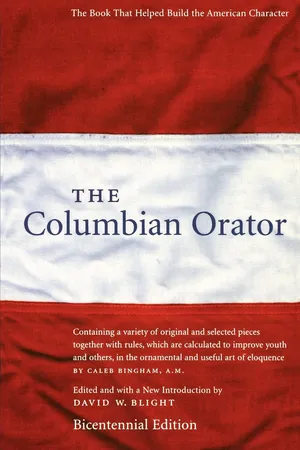
First published in 1797, The Columbian Orator helped shape the American mind for the next half century, going through some 23 editions and totaling 200,000 copies in sales. The book was read by virtually every American schoolboy in the first half of the 19th century. As a slave youth, Frederick Douglass owned just one book, and read it frequently, referring to it as a "gem" and his "rich treasure."
The Columbian Orator presents 84 selections, most of which are notable examples of oratory on such subjects as nationalism, religious faith, individual liberty, freedom, and slavery, including pieces by Washington, Franklin, Milton, Socrates, and Cicero, as well as heroic poetry and dramatic dialogues. Augmenting these is an essay on effective public speaking which influenced Abraham Lincoln as a young politician.
As America experiences a resurgence of interest in the art of debating and oratory, The Columbian Orator--whether as historical artifact or contemporary guidebook--is one of those rare books to be valued for what it meant in its own time, and for how its ideas have endured. Above all, this book is a remarkable compilation of Enlightenment era thought and language that has stood the test of time.
- 296 pages
- English
- ePUB (mobile friendly)
- Available on iOS & Android
eBook - ePub
The Columbian Orator
About this book
Information
SLAVES IN BARBARY (Everett) A Drama in Two Acts
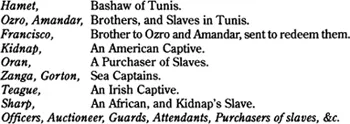
PERSONS OF THE DRAMA.
ACT I.
Scene I — A Garden.
AMANDAR SOLUS, CONFINED WITH A CHAIN.
In vain the flowers spread their gaudy colours, and fill the air with fragrance. The sun has not a cheering beam for me. All nature’s smiles are frowns to him, who wears the chain of bondage. Fifteen long months have witnessed my misfortune: what luckless winds delay Francisco’s passage?
ENTER ORAN WITH A CANE.
Oran. Moping fugitive! quick to your task. [BEATING HIM.] I have not placed you here to mutter to the herbs and flowers: they need the labour of your hands. Let them have it; or heavier blows shall punish your neglect.
Aman. Then do your worst! I ask the fatal blow, to put a period to my miseries.
Oran. Your life is in my hands; but it shall be prolonged; and with your life, I’ll lengthen out your miseries.
Aman. Unfeeling tyrant! from you I only ask the murderer’s office. Speech was designed for friendly intercourse; it ill becomes the tiger. In brutal silence you may tear my flesh: add not the sting of words.
Oran. Hah! Ozro. A slave enlarged is no grateful sight to his old master. [ASIDE.]
Ozro. I come, my brother, to end your sufferings.
Aman. Welcome! You know them to be more than man can bear.
Oran. Vile intruder! are you so soon intoxicated with your liberty? Quick, flee this place; or stronger chains, than bound you here before, shall sober you again.
Ozro. Talk not of chains! but rather learn to dread the hand on which they have been bound. I come to execute the orders of your lord and master; not to be frightened with your threats. Amandar’s injuries have reached the ears of the Bashaw; and I am sent—
Oran. Tale-bearing renegade! Well, I shall learn to husband my own property, and give up no more slaves for Hamet’s counsellors. Attend your duty! [TO AMANDAR, STRIKING HIM.]
Ozro. Repeat that blow, and it shall cost you dear.
Oran. Caitiff! begone from hence; or even the Bashaw shall not defend you from my indignation. Quick, leave my sight!
Ozro. Not while you have it in your power to exercise your tyranny over my brother. But yesterday, you promised to sell Amandar for this sum: here it is, ready counted to your hands. I demand him of you.
Oran. One half this sum would have bought him yesterday. It is my present choice to sacrifice my property for my revenge. I will double his task and shorten his allowance, till his pride is reduced, and he becomes more profitable, by additional severity. This is my promise to-day: take it for your solace.
Ozro. Monster! would you forever feast your soul on the miseries of the unfortunate? Your word is passed; recall it at the peril of your life. There is your money. [FLINGING IT AT HIS FEET.] Amandar is—
Oran. When foreign ruffians, who ought to wear the chains of bondage, are armed with swords, all right is lost: our property is given to the winds. Were it not for what weak heads, and sickly hearts call justice, I’d feast my dogs upon your flesh.
Ozro. Go vent your railings to the savage beasts, that prey on one another. If you love the law that sanctions cruelty, they are your fit associates. Amandar, you are once more restored to liberty and life. [CUTTING OFF HIS BANDS WITH HIS SWORD.]
EXEUNT AMANDAR AND OZRO.
Oran. [TAKING HIS MONEY.] These high-bred fellows make but poor slaves. Tis well to shift them off at any rate. I will take care how I lay out my money for the future. [Exit]
Scene II. — The Highway.
OZRO AND AMANDAR.
Aman. Am I deluded by a dream? or is this real? What angel eye of pity has glanced upon us?
Ozro. I would not interrupt thy bliss, nor stir the dregs, which the fair surface of the draught conceals. But fortune seems to make our happiness her sport.
Aman. Has not the Bashaw purchased our freedom? What are the conditions?
Ozro. That is for time or wild conjecture to determine. We must deliberate what course to take.
Aman. What does thou say? let me hear the worst.
Ozro. You know the circumstances of my liberation. All had the appearance of affability and pity in the Bashaw. He questioned particularly concerning our situation, and seemed moved with the account I gave. I informed him our brother was daily expected with the gleanings of an unfortunate father’s interest to redeem us from our chains, and restore us to a disconsolate family. He turned aside, as though some sudden emotion had seized his mind; then exclaimed, “They shall be mine!” The money was paid for your ransom, and committed to me. We are considered as his property.
Aman. What then creates suspicion? This favour has some claim upon our gratitude. If we must err, let it be on the side of honour.
Ozro. So thought I, Amandar. These were the impressions of the moment But avarice often assumes the appearance of generosity; and malice, to make its prey more sure, puts on the guise of pity. If the Bashaw’s motive were our happiness, all, but my freedom, I would pledge to pay the debt of gratitude. But I would sooner seek the lion’s den, or trust the mercy of a tiger, than commit myself to a mercenary Turk. A father’s fortune well may tempt the hypocrit-ic show of kindness to his sons.
Aman. This thought gives weight to your suspicion. Are our misfortunes then the object of base speculation? This well becomes the dignity of rulers; the honour of the prime magistrate of Tunis! to seek us out, like brutes, to buy and sell, and fill his coffers on the ruins of our family. But stay. Is there no room for charity? Tunis, of all the states of Barbary, is famed for its refinement. Every Turk is not an Oran. I think I have heard the Bashaw noted for his humanity.
Ozro. That ruler has but an ill title to humanity, who suffers his subjects to traffic in the dearest rights of man, and shares himself the execrated commerce.
Aman. True, my brother; but let us remember our native Venice. We have seen the Turk sold there in open market, and exposed to all the indignities which we have borne with Oran. Nay more; we may come nearer home, and spread the blush on our own faces. We both have heard the story of the grateful Turk, who by the intercession of Francisco was twice released from servitude. He has a noble soul, a feeling heart. Though his virtues were discovered; and finally rewarded by our father, we may blush that they were so long unheeded by our countrymen, and he suffered to languish in ignominious bondage.
Ozro. Your words have weight. For the sake of this noble captive, I will take part of my censure from the Turks, and spare it for my countrymen. Though this was done before my memory, the story paints his virtues to my mind; and had I no other claim, I would call Francisco brother for this deed.
Aman. [AFTER A PAUSE.] Can it be! no; ‘tis too much to think of.
Ozro. What, Amandar?
Aman. A thought has struck my mind. Help to confirm or to confute it.
ENTER GUARDS, ABRUPTLY.
Orzo. [DRAWING.] Who is here! Stand off. [GUARDS DRAW.]
1st Guard. But look, my lads! You see you are outmanned. We are more than two to one.
Orzo. Then keep your distance, and let us know your business: else, were you ten to one, I’d make your number less.
1st Guard. As to our business, we are obliged to let you know it; or I believe your swords would not frighten us to it. It is to carry you to the Bashaw.
Orzo. Under what conditions must we go?
1st Guard. As to that we shall not be nice. We have no cavalry, you see; so you must to be content to march on foot. You may take the front, or centre, as suits you best. But we shall not trust you in the rear, if you show a disposition to desert us; and if you are inclined to be hostile, we must secure that sword.
Orzo. I ask the terms on which we are to go; as slaves or freemen?
1st Guard. We dont wish to take the trouble to bind you. If you are not free to go, we must quicken your march with the point of our swords. Our orders are to return immediately.
Orzo. Keep us no longer in suspense. We now are free and—
1st Guard. As to that I believe you are a little mistaken. The Bashaw has bought you both, and paid for you; and we shall look better to his interest than to lose you for nothing, d’ye see? Come; march!
Orzo. What is the paltry price, compared with years of misery? Perhaps you know our destiny. If we are for sale again, tell him, we give the terms. This place shall be the fair, and life the price.
1st Guard. I tell you again, we are not easily frightened. But I see you are afraid of getting into Oran’s hands again.—If you choose to be obstinate, we could easily slice you in pieces, and carry you on the points of our swords. But we don’t wish to spoil you in such a manner. Besides, our master keeps no cut-throats. Our orders were to carry you safe to the Bashaw, and neither hurt you ourselves, nor let any body else. You may wonder at this extraordinary honour, and so do we. But he takes a liking to Christians, and is very often doing them a good turn. I fancy something uncommon is going forward today, by this manoeuvre. Perhaps he is inclined to sin a little in your own way, by drinking a few bottles of wine with you.
Orzo. [TO AMANDAR.] Their honest frankness quite unarms me. I hope my suspicions have been groundless.
Aman. Let us trust ourselves in their care. I am anxious to know the sequel.
Scene III. — Hamet’s House.
Hamet. [SOLUS.] The grateful day returns, that brings to mind my generous benefactors. The birth-day of my happiness, my fortune, and my honour. Let it be sacred to gratitude, and devoted to the sons of sorrow.
ENTER OFFICER.
Officer. Noble sir, the sale of prisoners begins in half an hour. Is it your pleasure to attend the auction?
Hamet. It is. Have them upon the spot, and see that they are treated with humanity. [EXIT OFFICER.] Ill-fated men! their lot is miserable indeed. Twere almost just to rise above the laws, and give them all their freedom.
[EXIT HAMET.]
Scene IV. — The Street in Tunis.
ENTER CRIER, RINGING HIS BELL.
At half an hour from this time! will be sold at public auction! to the highest bidder! prisoners of all colours! sorts and sizes! lately captured! on the Mediterranean! and bought fresh into port! warranted free from sickness, and wounds! also, a considerable number, a little damaged! by musket shot! and cannon balls! and careless handling, with long ...
Table of contents
- Cover Page
- Title Page
- Copyright Page
- Contents
- Editor’s Acknowledgments
- Editor’s Introduction
- Identification Of Authors
- Preface
- Introduction
- Extract from an Oration on Eloquence, Pronounced at Harvard University, on Commencement Day, 1794 (Perkins)
- Extract from President Washington’s First Speech in Congress, 1789
- Speech of Paulus Emilius to the Roman People as he was Takingthe Command of their Army
- Exhortation on Temperance in Pleasure (Blair)
- Judah’s Plea for his Brother Benjamin, before Josephin Egypt (Philo)
- Extract from the Plea of Thomas Muir, Esq. at his celebrated Trial in Scotland
- On the Starry Heavens (Hervey)
- Paper, a Poem (Franklin)
- Extract from Cato’s Speech Before the Roman Senate, after the Conspiracy of Catiline
- Dialogue between the Ghosts of an English Duellist, a North-Americansavage, and Mercury (Littleton)
- Speech of an Indian Chief, of the Stockbridge Tribe, to the Massachusetts Congress, in the Year 1775
- On the Creation of the World (Blair)
- Lines spoken at a School-Exhibition, by a little Boy Seven Years Old (Everett)
- Extract from Mr. Pitt’s Speech in the British Parliament, in the Year 1766, on the Subject of the Stamp-Act
- Scene from the Farce of Lethe (Garrick)
- Extract from the Eulogy on Dr. Franklin, Pronounced by the Abbe Fauchet, in the Name of the Commons of Paris, 1790
- Epilogue to Addison’s Cato
- Self-Conceit an Address, Spoken by a very Small Boy
- Howard and Lester— A Dialogue on Learning and Usefulness
- Christ’s Crucifixion (Cumberland)
- The Wonders of Nature (Hervey)
- Dialogue on Physiognomy
- Oration delivered at Paris, by Citizen Carnot, President of the Executive Directory, at the Festival of Gratitude, and Victory, celebrated at the Champ De-Mars, May 29, 1796
- Address of Mr. Adet. French Ambassador, on Presenting the Colours of France, to the United States, 1796
- President Washington’s Answer
- The Oppressive Landlord
- Lord Mansfield’s Speech, in support of a Billfor Preventing delays of Justice, by reason of Privilege of Parliament, 1770
- Extract from a Sermon on the Day of Judgment (Davies)
- Christ Triumphant over the apostate Angels (Milton)
- Slaves in Barbary (Everett)A Drama in Two Acts
- Conclusion of a celebrated Speech of Mr. Pitt, in 1770, in support of a Motion in Parliament, to request the King to Lay before that Body all the papers relative to certain depredations of the Spaniards, and likewise, to a Treaty which he was then Negociating with Spain
- Socrates’ Defence before his accusers and Judges
- Dialogue on Cowardice and Knavery
- Mr. Sheridan’s Speech against Mr. Taylor
- Part of Cicero’s Oration against Catiline
- Description of the First American Congress; from the vision of Columbus (Barlow)
- Speech of Buonaparte, Commander in Chief of the French Army in Italy, to his Brethren in Arms
- Reflections over the Grave of a Young Man (Hervey)
- Scene from the Drama of “Moses in the Bulrushes” (H. Moore)
- Speech of Gaius Cassius to his collected forces, after the death of Cesar
- Part of Mr. Erskine’s Speech against Mr. Pitt, 1784
- Extract from President Washington’s address to the People of the United States, Sept. 17, 1796
- Dialogue on the choice of Business for life
- Speech of Buonaparte, Commander in Chief of the French Army in Italy, before his attack on Milan, April 26, 1796
- Mr. Pitt’s Speech, Nov. 18, in opposition to Lord Suffolk, who proposed to Parliament to employ the Indians against the Americans; and who said, in the course of the Debate, that “they had a right to use all the means, that God and Nature had put into their hands, to conquer America”
- Dialogue between a School-Masterand School Committee
- Extract from Mr. Pitt’s Speech, in answer to Lord Mansfield, on the affair of Mr. Wilkes, 1770
- On the General Judgment Day; from Dwight’s Conquest of Canaan
- On the works of Creationand Providence (Hervey)
- Speech of Mr. Fox, in the British Parliament, on American affairs, 1778
- The Conjurer, a Dialogue (Everett)
- Extract from Mr. Pitt’s Speech in the British Parliament, Jan. 20, 1775
- Speech of Galgachus to the Caledonian Army
- Modern Education dialogue between a Preceptor of an Academy, and a parent of an offered Pupil
- The Existence of God, Demonstrated from the works of Creation; being a Sermon preached at Providence
- The Dignity of Human Nature extract of an Oration delivered at Rhode—Island College, 1796 (Surges)
- Infernal Conference (Cumberland)
- Extract from Mr. Pitt’s Speech in the British Parliament, May 13, 1777
- On the Day of Judgment (Young)
- The Dissipated Oxford Student, a dialogue between a Brother and his two Sisters (Burney)
- Extract from a Speech in Congress, April, 1799, on the subject of the Treaty with great Britain (Ames)
- Extract From an Oration, Pronounced at Worcester, (Mass.) July 4, 1796 by Francis Blake, ESQ.
- General description of America Extract from a Poem Spoken at Dartmouth College, on Commencement Day, 1795 (Everett)
- Dialogue between a Master and Slave
- Part of Mr. O’Connor’s Speech in the First Irish House of commons, in favour of the bill for Emancipating the Roman Catholics, 1795
- Scene from the Tragedy of Tamerlane (Rowe)
- Colonel Barre’s Speech in the British Parliament 1765, on the Stamp-Act bill
- The last Day Extract from a Manuscript Poem (Everett)
- A Dialogue on Loquacity
- American Sages (Barlow)
- Extract from Mr. Pitt’s Speech, Nov. 18, 1777, on American affairs
- Scene from the Tragedy of Cato (Addison)
- Extract from an Oration delivered at Boston, July 4, 1794, in Commemoration of American Independence (Phillips)
- Dialogue between a White Inhabitant of the United States and an Indian (Everett)
- Extract from an Oration, Pronounced at Boston, July 4, 1796 (Lathrop)
- Dialogue between Edward and Harry (Everett)
- David and Goliath (H. Moore)
- An Oration on the Powers of Eloquence, written for an Exhibition of a School in Boston, 1794
- A Dialogue between a City Gentleman of the town, and a Country Farmer
- Extract from a Discourse delivered before the New-York Society for PROMOTING THE Manumission of Slaves, April 12, 1797 by Rev. Samuel Miller
- A Forensic Dispute, on the Question, are the Anglo-Americans Endowed With Capacity and Genius Equal to Europeans? (Everett)
- Extract from an Oration, delivered at Boston, March 5TH, 1780 by Jonathan Mason, Jun. ESQ.
Trusted by 375,005 students
Access to over 1.5 million titles for a fair monthly price.
Study more efficiently using our study tools.
Frequently asked questions
Yes, you can cancel anytime from the Subscription tab in your account settings on the Perlego website. Your subscription will stay active until the end of your current billing period. Learn how to cancel your subscription
No, books cannot be downloaded as external files, such as PDFs, for use outside of Perlego. However, you can download books within the Perlego app for offline reading on mobile or tablet. Learn how to download books offline
Perlego offers two plans: Essential and Complete
- Essential is ideal for learners and professionals who enjoy exploring a wide range of subjects. Access the Essential Library with 800,000+ trusted titles and best-sellers across business, personal growth, and the humanities. Includes unlimited reading time and Standard Read Aloud voice.
- Complete: Perfect for advanced learners and researchers needing full, unrestricted access. Unlock 1.5M+ books across hundreds of subjects, including academic and specialized titles. The Complete Plan also includes advanced features like Premium Read Aloud and Research Assistant.
We are an online textbook subscription service, where you can get access to an entire online library for less than the price of a single book per month. With over 1.5 million books across 990+ topics, we’ve got you covered! Learn about our mission
Look out for the read-aloud symbol on your next book to see if you can listen to it. The read-aloud tool reads text aloud for you, highlighting the text as it is being read. You can pause it, speed it up and slow it down. Learn more about Read Aloud
Yes! You can use the Perlego app on both iOS and Android devices to read anytime, anywhere — even offline. Perfect for commutes or when you’re on the go.
Please note we cannot support devices running on iOS 13 and Android 7 or earlier. Learn more about using the app
Please note we cannot support devices running on iOS 13 and Android 7 or earlier. Learn more about using the app
Yes, you can access The Columbian Orator by David W. Blight in PDF and/or ePUB format, as well as other popular books in History & North American History. We have over 1.5 million books available in our catalogue for you to explore.