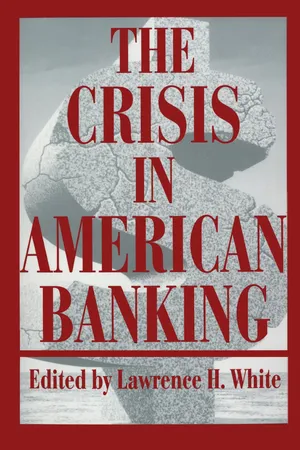
The U.S. banking system, its regulation and deregulation, and especially its deposit guarantees, continue to pose complex problems. The Crisis in American Banking offers six original perspectives on this continuing crisis, drawing from modern Austrian economics and from public choice theories that have seldom been applied to contemporary banking troubles. The contributors suggest that political regulation has seriously impaired the health of the banking industry. The authors consider long-term prospects for reform in the banking industry in light of the regulatory environment Much in the news lately, the U.S. banking system, its regulation and deregulation, and its troubles, pose a persistent and complex problem for Americans. This timely volume offers six original perspectives keyed to the continuing crisis in the U.S. banking industry. Several authors draw from modern Austrian economics or from public choice theory ideas that have seldom been applied to explaining contemporary banking problems. A pervasive theme of the ideas presented is that the U.S. banking crisis is fundamentally linked to the political regulation of banking. Taken as a whole, the book suggests that government regulatory, macroeconomic, and fiscal policies have seriously impaired the health of the banking industry. The Crisis in American Banking compellingly explains how rent-seeking, ideology, and the historical accretion of regulations have given banking policy its current unfortunate form. Also considered are the long term prospects for reform of banking regulation, and for the banking industry itself in light of the current and foreseeable regulatory environment. At present, the state of the U.S. commercial banking industry and the FDIC suggests disturbing parallels to the state of the savings and loan industry and the FSLIC a decade earlier. The policy regime that allowed their problems to develop does not seem to be on the verge of any dramatic change. The reluctance of Congress to enact real reforms means that the critical analyses and reform proposals in this volume will remain relevant for some time to come.Contributing to the volume are: Gerald P. Driscoll, Jr. (Vice President and Economic Advisor, Federal Reserve Bank of Dallas), Roger W. Garrison (Auburn University), Thomas Havrilesky (Duke University), George G. Kaufman (Loyola University of Chicago), Richard M. Salsman (Vice President, Financial Institutions Group of Citibank), and Walker Todd (Gulliver Foundation, San Francisco).
- 186 pages
- English
- PDF
- Available on iOS & Android
eBook - PDF
The Crisis in American Banking
About this book
Information
Table of contents
- Cover
- Title Page
- Copyright Page
- Contents
- Foreword
- Introduction
- 1 Why Is the U.S. Banking Industry in Trouble? Business Cycles, Loan Losses, and Deposit Insurance
- 2 Public-Sector Deficits and Private-Sector Performance
- 3 An Empirical Analysis of Public Choice Aspects of the Savings and Loan Disaster
- 4 Bankers as Scapegoats for Government-Created Banking Crises in U.S. History
- 5 Deposit Insurance Reform Is Not Enough
- 6 The Diminishing Role of Commercial Banking in the U.S. Economy
- Contributors
- Index
Trusted by 375,005 students
Access to over 1.5 million titles for a fair monthly price.
Study more efficiently using our study tools.
Frequently asked questions
Yes, you can cancel anytime from the Subscription tab in your account settings on the Perlego website. Your subscription will stay active until the end of your current billing period. Learn how to cancel your subscription
No, books cannot be downloaded as external files, such as PDFs, for use outside of Perlego. However, you can download books within the Perlego app for offline reading on mobile or tablet. Learn how to download books offline
Perlego offers two plans: Essential and Complete
- Essential is ideal for learners and professionals who enjoy exploring a wide range of subjects. Access the Essential Library with 800,000+ trusted titles and best-sellers across business, personal growth, and the humanities. Includes unlimited reading time and Standard Read Aloud voice.
- Complete: Perfect for advanced learners and researchers needing full, unrestricted access. Unlock 1.5M+ books across hundreds of subjects, including academic and specialized titles. The Complete Plan also includes advanced features like Premium Read Aloud and Research Assistant.
We are an online textbook subscription service, where you can get access to an entire online library for less than the price of a single book per month. With over 1.5 million books across 990+ topics, we’ve got you covered! Learn about our mission
Look out for the read-aloud symbol on your next book to see if you can listen to it. The read-aloud tool reads text aloud for you, highlighting the text as it is being read. You can pause it, speed it up and slow it down. Learn more about Read Aloud
Yes! You can use the Perlego app on both iOS and Android devices to read anytime, anywhere — even offline. Perfect for commutes or when you’re on the go.
Please note we cannot support devices running on iOS 13 and Android 7 or earlier. Learn more about using the app
Please note we cannot support devices running on iOS 13 and Android 7 or earlier. Learn more about using the app
Yes, you can access The Crisis in American Banking by Lawrence H. White in PDF and/or ePUB format, as well as other popular books in Economics & Banks & Banking. We have over 1.5 million books available in our catalogue for you to explore.