From youth violence, to the impact of high stakes educational testing, to editorial hand wringing over the moral failures of
hip-hop culture, young people of color are often portrayed as gang affiliated, "troubled," and ultimately, dangerous. The Hip-Hop Generation Fights Back examines how youth activism has emerged to address the persistent inequalities that affect urban youth of color. Andreana Clay provides a detailed account of the strategies that youth activists use to frame their social justice agendas and organize in their local communities.
Based on two years of fieldwork with youth affiliated with two non-profit organizations in Oakland, California, The Hip-Hop Generation Fights Back shows how youth integrate the history of social movement activism of the 1960s, popular culture strategies like hip-hop and spoken word, as well as their experiences in the contemporary urban landscape, to mobilize their peers. Ultimately, Clay's comparison of the two youth organizations and their participants expands our understandings of youth culture, social movements, popular culture, and race and ethnic relations.
eBook - ePub
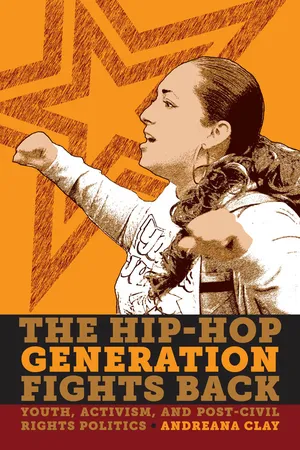
The Hip-Hop Generation Fights Back
Youth, Activism and Post-Civil Rights Politics
- 240 pages
- English
- ePUB (mobile friendly)
- Available on iOS & Android
eBook - ePub
About this book
Information
1
YOUTH
Crisis, Rebellion, and Identity
Whenever I think of an activist, I think of Tupac.
—Xochitl, 14
—Xochitl, 14
As a teenager, I read Nelson Mandela: the Man and the Movement, by Mary Bensen.1 I was mesmerized by the story of his life as an activist: how he joined the African National Congress (ANC), developed a military branch of the organization, was indicted and spent twenty-seven years in prison, separated from his wife, family, and friends—all in the name of freedom. I remember looking up to him as someone who gave up his life for “the cause” of ending apartheid in South Africa. His commitment was similar to that of the U.S. civil rights leaders I admired at the time, such as Martin Luther King Jr. and Malcolm X. Although Mandela was still in prison when I read his inspiring story of activism, I was convinced that the struggle and hardship he endured would guarantee a free South Africa.
A few years later, as an undergraduate, I read A Taste of Power by Elaine Brown. As I read Brown’s autobiography—which told the story of her childhood in Philadelphia, how she became a Black Panther Party member, and later the first chairwoman of the party—I felt the same sense of inspiration and awe as I had when I read Mandela’s story. Both of these leaders were activists involved in “the struggle,” fighting against inequality to improve their lives and those of the people in their communities. In both cases, I was also taken with the fact that these leaders are Black people, like me. As a young activist, I tried to live in their image.
Inspired by Brown’s work, I became interested in the debates about affirmative action in California. In 1995 Ward Connerly, an African American businessman and University of California Regent was just beginning his campaign, Proposition 209, to end preferences based on race, sex, and national origin in university admissions. As an undergraduate, I received scholarships targeted at “minorities,” and recognized the importance of education in providing access to social resources. I was concerned that Black youth and other youth of color’s opportunities to succeed would be further limited if such civil rights policies as affirmative action came under attack. Contemporary struggles such as Prop. 209 reminded me of the tenuous nature of the gains made by Brown, Martin Luther King Jr., Ella Baker, and other civil rights activists. I was interested in the ways teenagers and young adults throughout California organized against Prop. 209. I wondered who would lead their struggle. Would a charismatic leader like King emerge? Or had the social context shifted so that an “individual leader” was no longer necessary? These questions, along with my initial interest in social change as a teenager, propelled my research on youth activism in California.
Since the 1980s, state actions intensifying attacks on affirmative action, the war on drugs, and laws against gang activity have left an indelible imprint on the hip-hop generation. For instance, in California, adult voters chose to enact policies like Prop. 209, the California Civil Rights Initiative, which resulted in the end of affirmative action in universities and the workplace, and Prop. 21, the Gang Violence and Prevention Act, which made it possible to prosecute teenagers as adults in the criminal justice system. These policies have contributed to decreased enrollments on college campuses like the University of California and a rise in incarceration rates among Black and Latino youth. In response to these contemporary circumstances, youth of color have been organizing in their communities, particularly in their high schools. In the last decade, youth empowerment organizations, like the two I examine here, have also emerged throughout the country to mobilize, train, and empower youth.
Troubled Youth: Studies of Deviance and Resistance
Current academic and popular constructions of youth of color portray them as gang affiliated, “troubled,” and potentially dangerous. From early work undertaken by the Chicago School in the United States and the Centre for Contemporary Cultural Studies in Great Britain to more recent inquiries, sociological representations of youth culture have tended to focus on “deviant” behavior. By focusing on gangs or the consumption of fashion, music, and the media, scholars have pointed to a crisis among youth, particularly youth of color and working class youth.2 Recent attacks on affirmative action, increases in police brutality and racial profiling, and new anti-youth legislation have exacerbated this sense of crisis, urgency, and hopelessness among critics, community activists, scholars, and the youth themselves.3
Social movement representations of youth suggest that young people have always been at the center of political activism and social change. Youth have been characterized as the backbone of the civil rights, feminist, antiwar, and gay and lesbian liberation movements.4 However, little ethnographic research has been conducted on youth activism outside of these movements. Moreover, the “youth” in these movements are primarily college-aged. Little research has been conducted on adolescence as a significant identity from which to frame social justice organizing.5 New social movement scholars have long focused on the importance of identity to social movement activism. For instance, previous research indicates that preexisting identities are an important determinant of social movement participation.6 Others suggest that movement participation and identities are shaped by the sociohistorical contexts in which movements emerge.7 In the following chapters, I examine how the current backlash against civil rights has impacted the activism and identities of teenagers of color.
Recognizing that contemporary forms of activism may not fit neatly into previous social justice models, sociologists have begun to compare and contrast contemporary youth activism with sixties activism. For instance, the sociologist and former Students for a Democratic Society (SDS) president Todd Gitlin’s recent book Letters to a Young Activist tackles this issue directly. In particular, Gitlin questions how youth can organize in an era when popular (and academic) discourse identifies the 1960s as the pinnacle of social movement activism. In one letter, “On the Burden of History, or Several Warped Ways of Looking at the Sixties,” Gitlin asks:
How can you not feel preempted, diminished even by your parents and teachers sitting around the proverbial campfire retelling (not for the first time) their antiwar stories? The afterglow threatens to steal your sense of uniqueness—an especially bracing propensity in a land that relishes the feeling of getting born again at the drop of an advertising campaign. Nothing you can do about your date of birth, after all. So you’re trapped. The sixties (like parents) are useful but also oppressive. What would you do without them? What can you do with them?8
I attempt to answer Gitlin’s questions by looking at the ways in which youth of color organize in light of the “burden” of the sixties. This book focuses on youth, identity, and social change at the beginning of the twenty-first century. Specifically, I focus on activism and the development of collective and individual political identities and organizing strategies among teenagers in Oakland, California. Moving beyond Gitlin’s discussion of age, I ask: How do dominant representations of activism, which reflect previous social movements and struggles, inform how youth of color, members of the “hip-hop generation” participate in social change processes?9 Further, because power exists and operates in dispersed and diffused ways, how is youth activism affected by the activism of previous social movements as well as the current backlash against civil rights? Finally, how does this participation, combined with dominant representations of activism, inform their political and activist identities? In addition to analyzing the dominant representations of activism, or what I refer to as the “idealized cultural image” of activism, I examine how youth activists organize and participate in social change in an era when people may in fact be “getting born again at the drop of an advertising campaign,” as Gitlin suggests, but also when this country is experiencing a backlash against civil rights laws.
The Duality of Civil Rights
Other scholars have written about the post–civil rights movement creating a dual experience, which has shaped youth of color identity since that time. For instance, journalist and activist Bakari Kitwana highlights the duality of the persistence of racial segregation and discrimination in the wake of civil rights gains, which has contributed to a current crisis for hip-hop generationers (Kitwana 2002). The incongruity of the gains in civil liberties accompanied by continued racism, sexism, and heterosexism constitutes a cognitive and communal crisis for youth. In the face of this crisis, youth of color have employed several different strategies to create collective and individual identities. In Black Picket Fences, Mary Pattillo-McCoy suggests that middle-class Black youth experience a dual identity because of the negotiation of two worlds: racial marginality and high socioeconomic status. This negotiation makes Black middle-class youth distinct from their white middle-class counterparts as, despite their economic gains and benefits, racial segregation ensures they live in close proximity to poor and working-class youth, contributing to a bifurcated experience. As a result, Pattillo-McCoy observed while conducting an interview with a middle-class African American that “he … had a different manner of speaking with his friends from college and his friends from the neighborhood gang.”10 For instance, when he is with his friends he used “Black English,” while at school and at home he uses a more standard English. This practice, which Pattillo-McCoy describes as “code-switching,” is necessary for youth of color who may have to balance civil rights gains like upward class mobility and access with the values and practices of the street. This balancing act is indicative of a historical moment where diverse strategies are necessary to address oppression and opportunity.
The term “post–civil rights” has been broadly used to refer to significant shifts in structural and individual realities for people of color (particularly youth) since the civil rights movement.11 Scholars point out that teenagers of color grow up in an important historical moment. At the same time that youth of color have presumably benefited from desegregated schools and antidiscrimination laws, recent state policies have increasingly restricted youth agency. For example, the establishment of “super jails” for youth, police surveillance of suspected gang members, and the prosecution of juveniles as adults all impact members of the hip-hop, or post–civil rights, generation. For instance, people of color have been granted certain rights as citizens of the United States, but we are still informed and targeted by the changing power structures: the rise in the prison industrial complex, increased surveillance of youth, and de-industrialization. I use the term hip-hop generation similarly in this book: while there have been gains with regards to civil rights for white women and people of color, the post–civil rights moment is a time ripe with contradiction: Take, for instance, the globalization of hip-hop culture, which was started by Black and Puerto Rican youth in the Bronx and has now become a worldwide phenomenon. In the United States, mainstream representations of hip-hop are almost exclusively of Black men. From Jay-Z to Lil Wayne, the predominant images splayed across the screen are African American men. Yet, the rates of incarceration for African American men outside (and sometimes inside) of the realm of hip-hop remain among the highest of all groups. Similarly, while there have been increases in LGBTQ (lesbian, gay, bisexual, transgender, queer) visibility with more and more celebrities coming out as queer, same-sex marriage is legal in several states (though not at the federal level); at the same time LGBTQ youth are four times more likely than their straight counterparts to commit suicide. LGBTQ youth of color also seem to experience high rates of violence, attack, and murder.12 These contradictions define the post–civil rights generation.
I don’t mean to suggest that there weren’t contradictions during the civil rights era; certainly there were contradictions during the African American civil rights movement: students were mobilizing the vote among poor African Americans in the South, challenging and overturning state laws, at the same time that these same activists were being surveilled, attacked, imprisoned, and murdered. One key difference is that today’s youth activists, in addition to the contradictions that are currently present, are also expected to organize in the shadow of previous social movement activists. More importantly, this organizing happens in the midst of the mass commodification of activist images and documentary (and fictional) retellings of these movements. For instance, the documentary Eyes on the Prize is a staple in American high schools, as are other films that, together, contribute to a collective understanding of social movement organizing, 1960s style, in American memory. These images were present in both sites that I studied, either as posters in the public high schools where youth organized or in the offices where they worked. This legacy is also written into the politically conscious hip-hop that youth listen to. Songs like “Propaganda,” by Dead Prez, artists the youth reference, pay homage to the legacy of the Black Panther Party. As they state, “thirty-one years ago, I woulda been a Panther. They killed Huey ’cause they knew that he had the answer. The views that you see in the news is propaganda.” Overall, these words serve as reminders of the social movements that preceded them as well as motivation for the youth’s own organizing.
Artists like Dead Prez also make a direct link between previous social movement actors and youth organizers today, who, they suggest, have been told lies by the media, the government, and their schools. Given the pervasiveness of this dual experience for youth, particularly for youth of color, one might expect a unified, collective action against such oppression. However, U.S. public discourse has not yet recognized a large-scale social movement. The absence of a recognizable social movement may be linked to the largely diffused and dispersed ways that power and oppression operate today. Power is decentralized, often creating what Michel Foucault calls an “invisible enemy.”13 The implication is that true resistance and change have been rendered impossible because power is no longer centrally located or visible. Other scholars have written about how recent civil rights gains have created a contemporary context where the invisible enemy is still quite powerful.14 However, I suggest that rather than being invisible, the deployment of state and ideological power is masked by an apparent increase in social and political rights. At the same time, though, this power has become increasingly visible in the lives of youth of color. While “positive” strides may have been made in areas, like racial desegregation in schools and neighborhoods, gentrification, a decline in wages, attacks on affirmative action, continued “tracking” in public schools, and an increase in hate crimes continue to shape the experience of youth.15 Since 1996, five states, including California, have passed voter-bans on affirmative action. In cities like Oakland, where this study takes place, the decline and restructuring of the shipping industry and the rising costs of housing has significantly shaped the migration of communities of color out of the San Francisco Bay Area into regions farther East.16 This economic and political landscape informs the social location and experience of youth of color.
Some youth embrace hip-hop culture, music, and performance to articulate their ideologies and create political identities, as this genre most accurately reflects the lives, language, and rhythms of youth of color, particularly in urban areas.17 Both youth of color and white youth have turned to hip-hop culture and other forms of performance to understand and create community with one another.18 As George Lipsitz (1994) suggests, youth use hip-hop culture to “bring a community into being… map[ping] out real and imagined relations between people that speak to the realities of displacement, disillusion, and despair” (Lipsitz 1994, 36). In the late twentieth century, the hip-hop industry began addressing the important connection between youth, identity, and hip-hop culture. Conferences brought together hip-hop artists, producers, writers, and young people to discuss the political possibilities of hip-hop music. This forging of community was so successful that the hip-hop mogul and co-founder of Def Jam Recordings, Russell Simmons, founded the Hip-Hop Summit Action Network (HSAN) in 2001. Since that time, HSAN’s primary strategy has been focused on mobilizing the “hip-hop vote.”19 In 2003, the National Hip-Hop Political Convention was founded by hip-hop activists to create a political agenda for and encourage civic engagement among the hi...
Table of contents
- Cover Page
- Title Page
- Copyright Page
- Contents
- Acknowledgments
- 1. Youth Crisis, Rebellion, and Identity
- 2. Keep Your Eyes on the Prize The Contemporary Struggle
- 3. It’s Gonna Get Hard Negotiating Race and Gender in Urban Settings
- 4. Hip-Hop for the Soul Kickin’ Reality in the Local Scene
- 5. Queer Youth Act Up Tackling Homophobia Post-Stonewall
- 6. Big Shoes to Fill Activism Past and Present
- 7. Conclusion Sampling Activism
- Appendix
- Notes
- Bibliography
- Index
- About the Author
Trusted by 375,005 students
Access to over 1.5 million titles for a fair monthly price.
Study more efficiently using our study tools.
Frequently asked questions
Yes, you can cancel anytime from the Subscription tab in your account settings on the Perlego website. Your subscription will stay active until the end of your current billing period. Learn how to cancel your subscription
No, books cannot be downloaded as external files, such as PDFs, for use outside of Perlego. However, you can download books within the Perlego app for offline reading on mobile or tablet. Learn how to download books offline
Perlego offers two plans: Essential and Complete
- Essential is ideal for learners and professionals who enjoy exploring a wide range of subjects. Access the Essential Library with 800,000+ trusted titles and best-sellers across business, personal growth, and the humanities. Includes unlimited reading time and Standard Read Aloud voice.
- Complete: Perfect for advanced learners and researchers needing full, unrestricted access. Unlock 1.5M+ books across hundreds of subjects, including academic and specialized titles. The Complete Plan also includes advanced features like Premium Read Aloud and Research Assistant.
We are an online textbook subscription service, where you can get access to an entire online library for less than the price of a single book per month. With over 1.5 million books across 990+ topics, we’ve got you covered! Learn about our mission
Look out for the read-aloud symbol on your next book to see if you can listen to it. The read-aloud tool reads text aloud for you, highlighting the text as it is being read. You can pause it, speed it up and slow it down. Learn more about Read Aloud
Yes! You can use the Perlego app on both iOS and Android devices to read anytime, anywhere — even offline. Perfect for commutes or when you’re on the go.
Please note we cannot support devices running on iOS 13 and Android 7 or earlier. Learn more about using the app
Please note we cannot support devices running on iOS 13 and Android 7 or earlier. Learn more about using the app
Yes, you can access The Hip-Hop Generation Fights Back by Andreana Clay in PDF and/or ePUB format, as well as other popular books in Social Sciences & Cultural & Social Anthropology. We have over 1.5 million books available in our catalogue for you to explore.