DNA testing and advances in forensic science have shaken the foundations of the U.S. criminal justice system. One of the most visible results is the exoneration of inmates who were wrongly convicted and incarcerated, many of them sentenced to death for crimes they did not commit. This has caused a quandary for many states: how can claims of innocence be properly investigated and how can innocent inmates be reliably distinguished from the guilty? In answer, some states have created "innocence commissions" to establish policies and provide legal assistance to the improperly imprisoned.
The Innocence Commission describes the creation and first years of the Innocence Commission for Virginia (ICVA), the second innocence commission in the nation and the first to conduct a systematic inquiry into all cases of wrongful conviction. Written by Jon B. Gould, the Chair of the ICVA, who is a professor of justice studies and an attorney, the author focuses on twelve wrongful conviction cases to show how and why wrongful convictions occur, what steps legal and state advocates took to investigate the convictions, how these prisoners were ultimately freed, and what lessons can be learned from their experiences.
Gould recounts how a small band of attorneys and other advocates — in Virginia and around the country — have fought wrongful convictions in court, advanced the subject of wrongful convictions in the media, and sought to remedy the issue of wrongful convictions in the political arena. He makes a strong case for the need for Innocence Commissions in every state, showing that not only do Innocence Commissions help to identify weaknesses in the criminal justice system and offer workable improvements, but also protect society by helping to ensure that actual perpetrators are expeditiously identified, arrested, and brought to trial. Everyone has an interest in preventing wrongful convictions, from police officers and prosecutors, who seek the latest and best investigative techniques, to taxpayers, who want an efficient criminal justice system, to suspects who are erroneously pursued and sometimes convicted.
Free of legal jargon and written for a general audience, The Innocence Commission is instructive, informative, and highly compelling reading.
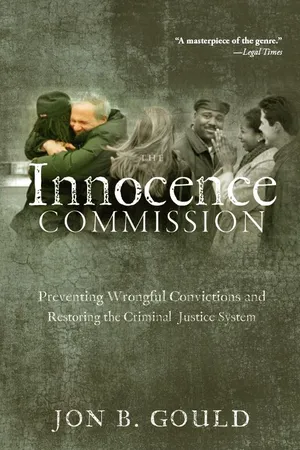
eBook - ePub
The Innocence Commission
Preventing Wrongful Convictions and Restoring the Criminal Justice System
- 364 pages
- English
- ePUB (mobile friendly)
- Available on iOS & Android
eBook - ePub
The Innocence Commission
Preventing Wrongful Convictions and Restoring the Criminal Justice System
About this book
Information
1
History and Background
Twenty years ago, the claim that innocent people had been wrongly convicted of serious crimes would have been “treated with general incredulity.” By 2001, however, a “Harris Poll found 94 percent of Americans believed that innocent defendants are sometimes executed.”1 How did we get to this point? Many observers point their fingers at DNA testing, saying the exonerations that came to light in the late 1990s made it impossible to deny that the criminal justice system makes mistakes. But this was hardly the first evidence of erroneous convictions; that line of research goes back more than eighty years now and possibly much longer, depending on whom you believe.
There sometimes is a tendency to see wrongful convictions as a legal issue. That is, the causes of wrongful convictions rest with officers and agents of a legal process; the existence of such errors represents the denial of important legal protections; and the response to mistaken convictions is legal reforms pressed by legal activists and adopted by lawmakers or jurists. Such a view, however, misses the broader, political context in which policy issues are identified, advanced, and resolved in America. Erroneous convictions have become a cause célèbre, not simply because there now is incontrovertible evidence of innocence, but also because changes in political and social life have raised the salience of the issue. In turn, a legal and political constituency arose to demand the resolution of this problem, and people from across the political spectrum—most notably, traditional conservatives—came to support reform.
Nor can we ignore the issue’s connection to the death penalty, where the stakes of error are much higher than for other felonies. Indeed, the fact that many of the first erroneous convictions were found in capital cases propelled the issue ahead at a sometimes breakneck pace in the late 1990s and early 2000s. But no one should be fooled into believing that wrongful convictions exist only in capital matters; in fact, the research by the Innocence Commission for Virginia suggests that the problems are just as great in other cases. Nonetheless, the heightened stakes of error in capital cases served to launch reform once DNA testing provided the kind of irrefutable evidence that mistakes had been made.
Virginia provides a remarkable laboratory in which to observe the changing political and legal cultures that have made wrongful convictions a subject worthy not only of serious political consideration but also reform. A state that had rightfully earned its reputation as the cradle of the confederacy and whose criminal justice system was lambasted as one of the most needlessly severe in the country, Virginia has remade itself in the first decade of the new millennium as a leader in criminal justice reform. To be sure, Virginia’s transformation may reflect just how far it had to come—and as will be detailed in later chapters, the Commonwealth still has much further to go—but if meaningful reform can take place in Virginia, the same is certainly true elsewhere. Virginia’s change also illustrates one of the central themes of this book: that the discovery and reform of problems in the criminal justice system do not happen by chance, nor do they occur by some rational, legalistic formula by which activists identify a problem, propose a reform, and advance their proposal to legal policymakers who adopt the measure. Wrongful convictions have been with us for decades, if not centuries. That the issue reached the national policy agenda and has engendered reform over the last decade is a reflection of political processes and social pressures at work on a legal issue. This is not to say that lawyers or legal processes are irrelevant to the resolution of problems in the criminal justice system. Rather, observers and activists for legal change must understand that the process is about much more than law.
In this chapter, I outline the history of wrongful convictions and explain how the issue began its rise to the national policy agenda, especially in Virginia. Both the legal and political worlds found it convenient to downplay the probability of wrongful convictions until scientific evidence made it impossible to ignore them. As the rest of the book argues, though, it would be a tragedy if policymakers came to believe that the modest reforms adopted in the last few years have “solved” the problem of wrongful convictions. There are many forces behind these errors, and they are likely to continue in the criminal justice system without serious reform. The challenge for policymakers and judicial officers, then, is to continue to watch for sources of error and to address them immediately rather than blindly hoping that everything will be all right.
Early Evidence of Wrongful Convictions
In his article “The History of Wrongful Execution,” law professor Bruce Smith traces wrongful convictions—specifically, wrongful executions—back to seventeenth-century England. As he notes, the execution “of innocent persons for crimes that had never even occurred generated widespread anxiety among Anglo-American legal commentators from the seventeenth through early nineteenth centuries,” with many “influential treatise writers and public officials … urg[ing] the courts [to] adopt stricter evidentiary safeguards in capital cases.”2
In America, by contrast, Smith observes, “Criminal justice administrators” largely “sought to preserve the legitimacy of the death penalty by denying the existence of a ‘wrongful conviction problem.’”3 Although Smith’s conclusion concerned nineteenth-century America, he could just as easily have been describing the nation’s experience a century later. “As a prosecutor in Worcester County, Massachusetts, put it [more recently], ‘Innocent men are never convicted. Don’t worry about it, it never happens in the world. It is a physical impossibility.’” 4
According to many observers, wrongful convictions were first probed in the United States by Yale law professor Edwin Borchard, who in 1932 published Convicting the Innocent: Sixty-Five Actual Errors of Criminal Justice. Closely examining cases in America and England, Borchard not only identified sixty-five in which an innocent defendant had been convicted, but he also classified the likely “sources of error, including erroneous eyewitness testimony, false confessions, faulty circumstantial evidence, and prosecutorial excesses.”5 Interestingly, Borchard did not limit his inquiry to capital cases but looked at a wide range of cases in the criminal justice system.
From the release of Borchard’s book until the early 1990s, “there was typically one big-picture book or major article published every decade or so on the subject of miscarriages of justice,” many of which “followed a familiar structure.”6 Writers would assert the premise of the American criminal justice system, that it was better to release more than one hundred guilty men than to convict one innocent person. They would then describe cases in which innocent suspects had been wrongly convicted, and they would finish by proposing reforms to address the scourge of wrongful convictions.7 For example, in the late 1940s Erle Gardner, the author of fictional defense lawyer Perry Mason, created the “Court of Last Resort,” an unofficial body to investigate suspected cases of wrongful conviction. “Gardner’s efforts caught the public’s imagination, but not even an author with Gardner’s reach succeeded in reforming the systemic problems that led to unfair trials.”8
Gardner was not the only writer of renown to find his work falling on the deaf ears of lawmakers and justice officials. The famous judge Jerome Frank collaborated with his daughter Barbara in their 1957 book Not Guilty. As in works to come, the Franks documented suspected cases of wrongful conviction and offered recommendations for reform.9 In the 1960s, the journalist Edward Radin “carried on [a] public education campaign, turning up unfair trials and cases of actual innocence by tirelessly reading newspapers and magazines.”10 Still, the American political and legal processes slumbered, content to permit the wheels of justice to continue to grind even in the face of evidence of errors.
Bedau and Radelet and the New Era of Research
The first indication that change might be afoot came in November 1985 when philosophy professor Hugo Bedau and sociologist Michael Radelet presented a paper at the annual meeting of the American Society of Criminology (ASC) reporting that many death row defendants, including some already executed, were, in fact, innocent. The American Civil Liberties Union (ACLU) helped arrange publicity for Bedau and Radelet’s conclusions, which found their way into major publications, including the New York Times.11
Following the ASC meeting, Bedau and Radelet completed their research and published their conclusions in a landmark article, “Miscarriages of Justice in Potentially Capital Cases,” in a 1987 issue of Stanford Law Review.12 Their article reported on
350 cases of defendants erroneously convicted of capital—or potentially capital—crimes in the United States in the interval 1900–1985. Of those convictions, 139 resulted in actual death sentences and ultimately 23 executions. An additional 8 died in prison and 22 were reprieved within 72 hours of execution. Of those cases in which the inmate was ultimately released, 40% of releases came more than 5 years after conviction; 20% of releases arrived after more than 10 years.13
Bedau and Radelet’s research found its way to President Ronald Reagan’s Justice Department, where Assistant Attorney General Stephen Markman responded to the findings in an internal memorandum to Attorney General Edwin Meese.14 Markman drew on this report when he and Associate Deputy Attorney General (now a federal judge) Paul Cassell challenged Bedau and Radelet in 1988 with a separate piece in the Stanford Law Review. Labeling Bedau and Radelet’s work “severely flawed in critical respects,” Markman and Cassell criticized their research methodology, their evaluations of the defendants’ innocence, and their conclusions about the efficacy and accuracy of the death penalty.15
Bedau and Radelet were given an opportunity to respond,16 but rather than continuing a largely intralegal debate, the two teamed up with Bedau’s wife, the professional journalist Constance Putnam, to publish their famous book In Spite of Innocence.17 Released in 1992, the book “extended their research to mid-1991 and added 66 new cases to their list.”18 Of particular note, the authors claimed that more than 90 percent of the cases they had identified involved “official judgments of error.”19
By itself, Bedau, Radelet, and Putnam’s work did not lead to a change in policy, but their research began to chip away at a legal and political culture that presumed wrongful convictions were rare and virtually nonexistent in capital cases. The fact that Markham and Cassell felt compelled to respond to Bedau and Radelet—not to mention that a publication as prestigious as Stanford’s law journal would publish the research and sponsor the dialogue—was a signal that the findings were significant and that the possibility of wrongful convictions was more than speculative. Indeed, Bedau and Radelet’s research seemed to usher in a new period in research on wrongful convictions in general and the death penalty in particular.
In 1996, the trio of Ronald Huff, Arye Rattner, and Edward Sagarin published their book Convicted but Innocent: Wrongful Conviction and Public Policy, which provided a historical analysis of cases of wrongful conviction.20 In 1998, Richard Leo and Richard Ofshe released their groundbreaking research, which analyzed sixty cases of police induced false confessions.21 Martin Yant22 and others also published works on wrongful conviction, the collection of which “signaled a new and deepening interest in the study of miscarriages of justice by journalists and scholars unlike any time since Borchard’s founding work in the 1930s.”23
DNA Changes Everything
The renewed interest in wrongful convictions was catapulted forward by the introduction of DNA testing in the late 1990s. DNA, short for deoxyribonucleic acid, is the genetic building blocks of living cells. With the exception of identical twins, each person’s DNA is unique, thereby making it a better marker for an individual’s identity than blood type or fingerprints. DNA is found in bodily secretions, including blood, saliva, sweat, and semen, and also in sloughed-off skin cells and hair. In criminal cases, then, DNA evidence represents a potential gold mine, permitting investigators to identify an individual’s presence at a crime scene. In particular crimes, primarily rape and murder, DNA evidence can identify the likely perpetrator when, for example, the suspect’s semen is found inside the victim or his skin cells are located under the victim’s fingernails.24
By the same token, DNA evidence can help clear innocent defendants who are erroneously linked to, or even convicted of, a crime. When semen is collected from a rape victim and properly retained in a physical evidence recovery kit (PERK), the evidence can later be tested for the DNA profile of the perpetrator who deposited the semen. If the genetic markers do not match those of the suspect being held, he can petition the courts for release. Now, as DNA evidence is more routinely collected from suspects at arrest, DNA testing holds the prospect of additional “cold hits,” in which genetic evidence left at a crime scene is tested and matched with DNA profiles already on file to identify the actual perpetrators.
DNA can be tested in several ways. “The current standard for forensic DNA testing is the Short Tandem Repeat (STR) test … which allows for very small and degraded samples to be tested successfully.”25 Mitochondrial DNA testing is available as well. Similar to that done in genealogical research, mitochondr...
Table of contents
- Cover Page
- Title Page
- Copyright Page
- Dedication
- Contents
- Acknowledgments
- Introduction
- 1 History and Background
- 2 The Innocence Commission for Virginia (ICVA)
- 3 The Cases
- 4 An Unmet Obligation
- 5 Putting It All Together
- Appendixes
- Notes
- Index
- About the Author
Trusted by 375,005 students
Access to over 1.5 million titles for a fair monthly price.
Study more efficiently using our study tools.
Frequently asked questions
Yes, you can cancel anytime from the Subscription tab in your account settings on the Perlego website. Your subscription will stay active until the end of your current billing period. Learn how to cancel your subscription
No, books cannot be downloaded as external files, such as PDFs, for use outside of Perlego. However, you can download books within the Perlego app for offline reading on mobile or tablet. Learn how to download books offline
Perlego offers two plans: Essential and Complete
- Essential is ideal for learners and professionals who enjoy exploring a wide range of subjects. Access the Essential Library with 800,000+ trusted titles and best-sellers across business, personal growth, and the humanities. Includes unlimited reading time and Standard Read Aloud voice.
- Complete: Perfect for advanced learners and researchers needing full, unrestricted access. Unlock 1.5M+ books across hundreds of subjects, including academic and specialized titles. The Complete Plan also includes advanced features like Premium Read Aloud and Research Assistant.
We are an online textbook subscription service, where you can get access to an entire online library for less than the price of a single book per month. With over 1.5 million books across 990+ topics, we’ve got you covered! Learn about our mission
Look out for the read-aloud symbol on your next book to see if you can listen to it. The read-aloud tool reads text aloud for you, highlighting the text as it is being read. You can pause it, speed it up and slow it down. Learn more about Read Aloud
Yes! You can use the Perlego app on both iOS and Android devices to read anytime, anywhere — even offline. Perfect for commutes or when you’re on the go.
Please note we cannot support devices running on iOS 13 and Android 7 or earlier. Learn more about using the app
Please note we cannot support devices running on iOS 13 and Android 7 or earlier. Learn more about using the app
Yes, you can access The Innocence Commission by Jon B. Gould in PDF and/or ePUB format, as well as other popular books in Social Sciences & Criminal Law. We have over 1.5 million books available in our catalogue for you to explore.