Traces the influences of lesbian, gay and bisexual voters in American elections
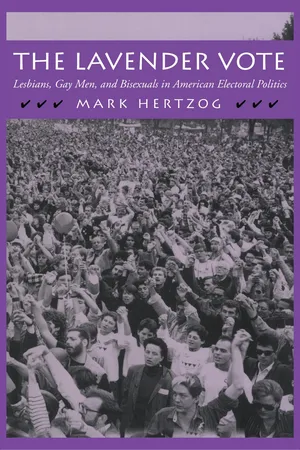
In the half century since the Stonewall riots in New York City's Greenwich Village launched the national gay-rights movement in earnest, LGB voters have steadily expanded their political influence. The Lavender Vote is the first full- length examination of lesbians, gay men, and bisexuals as a factor in American elections. Mark Hertzog here describes the differences in demographics, attitudes, and voting behavior between self-identified bisexuals and homosexuals and the rest of the voting population. He shows that lavender self-identifiers comprise a distinctive voting bloc equal in numbers to Latino voters, more liberal across the board on domestic social issues (though not necessarily on economic or national security issues) than non-gay voters, and extremely unified in high-salience elections. Further, lavender voters, contrary to popular belief, are up for grabs between the two major parties. Offering a clear and thorough explanation of LGB voting tendencies, this volume will be must-reading for elected officials, candidates for office, and all those interested in learning about LGB voters.
eBook - ePub
The Lavender Vote
Lesbians, Gay Men, and Bisexuals in American Electoral Politics
- 288 pages
- English
- ePUB (mobile friendly)
- Available on iOS & Android
eBook - ePub
About this book
Information
THREE
The Sexuality Gap: The 1990 National Exit Polls
This is the first of four chapters presenting the results of the study of LGB voting behavior. The first two of these chapters present data from the 1990 midterm general elections for members of Congress and for state governors. The present chapter discusses the results of two simultaneous versions of the national exit poll, which give us the first look ever at lesbian and gay (though not bisexual) voters across the land. Chapter 4 goes on to look at the aggregated results from twenty-one states in which the gay/lesbian self-identification question was asked, and at three states in particular for which the lesbian and gay sample size was large enough to conduct more in-depth analysis.
Chapter 5 looks at a Democratic primary race in New York City in September 1990 that is distinctive both for having a strong, openly lesbian candidate in the contest and for being the subject of an exit poll developed by local political scientists that measures not only the demographics and political attitudes of the voters, but the effect of newspaper and magazine endorsements, support of political clubs, and contact by specific campaign organizations, and how all of these together affected the voters’ decisions. Using these data we can assess the effect of LGB political activists on LGB voters.
Chapter 6 gives us our first look at LGB political behavior in a presidential race, the 1992 contest among Bill Clinton, George Bush, and Ross Perot. It also marks the first time that bisexuals are included in the LGB identification category in a general election survey.
Two things should be noted at the outset. First, chapters 3 to 5 do not include bisexuals, because the self-identifier questions did not include bisexuals; I shall be discussing in those chapters only the voting behavior of self-identified lesbians and gay men.1 In those chapters, therefore, I will usually not refer to “LGBs.” Second, all the surveys discussed here are exit polls, which differ in certain respects from pre- and postelection polling done either door-to-door or by telephone.
A thorough discussion of the study methods is found in the appendix, but a brief introduction to exit polling is in order here. All the polling places (usually called precincts) in the country are stratified by their geographic location. Then, within each geographic “sampling unit” a number of precincts are selected at random. Precincts with more voters assigned to them have a greater chance of being chosen, but small and middle-sized precincts get included as well.
On election day, a trained polltaker goes to each sample precinct and asks every Nth voter (the number varies according to her instructions) leaving the polling place to participate. Each selected respondent who agrees to participate is handed a single sheet of paper printed on one or both sides with questions. All questions are in a check-the-box format; there are no “open-ended” questions in which the respondent writes out an answer. The respondent completes the form either at an adjacent table or booth, or on a clipboard provided by the polltaker. She then folds up her survey and deposits it, unsigned, in a “ballot box.”
At the end of her shift, the polltaker either transports the completed forms to a data-entry location or telephones a data-entry operator at the central office and reads the answers off each form. The results are tabulated on a mainframe computer and are made available to the broadcast networks that commissioned the poll, which announce the results as the polls close in each state (unless the contest is, according to the poll, too close to call).
The disadvantages to exit polling are that researchers cannot compare the results among voters with those among nonvoters, and that the check-the-box format does not allow researchers to probe respondents’ answers or observe tone of voice, body language, and the like that may be important in interpreting responses, as they can do in a telephone or face-to-face poll. Exit polls, however, offer the great advantages of allowing for the polling of very large numbers of people in a very short time frame; assuring that only those people who actually voted are included in the sample (leaving out those who did not vote but later claim they did, a constant problem with postelection surveys); and getting the voter’s attitudes and impressions of the candidates and campaigns immediately after she leaves the polls.
With these things in mind, let us proceed to look at the national results from 1990. In this chapter, I present first comparative demographic data, then comparative attitudinal and voting behavior data. As this study is the first of its kind of this group of voters, I necessarily shall devote a substantial portion of the chapter to these “baseline” statistics. Following this, I shall attempt to develop an initial causal model to account for differences between the self-identified lesbian and gay voters and nonidentifiers, and any differences between lesbians and gay men.
The 1990 national exit polls allow us to assess the first six of the nine hypotheses set forth at the end of chapter 2; the remaining three will be addressed in chapters 4 and 5. This chapter is organized in the order in which the hypotheses appear in chapter 2. At each stage, I shall refer back to these hypotheses and note whether the data confirm or fail to confirm them.
Throughout this discussion I refer to the CBS, VRS, and U.S.A. data bases. As mentioned in chapter 1, CBS wrote a separate version of the national exit poll, whereas a joint version of the survey was written for all four participating networks: CBS, ABC, CNN, and NBC. Both were administered by Voter Research and Surveys, Inc. (VRS), and some questions on each poll were identical to those on the other poll. Data from the CBS version alone make up the CBS data base; data from the four-network joint version alone are called the VRS data base; and the combined responses to identical questions on both versions are called the U.S.A. data base.
Hypothesis 1: Rate of Identification
Lesbians and gay men will self-identify in political surveys at rates equivalent to those found in previous random-sample research, about 1.0 to 1.5 percent of the population. When bisexuals are included, the share of self-identifiers will increase by an additional 2 to 3 percent.
Of the 19,888 respondents to the U.S.A. poll, 221, or 1.1 percent, identified themselves as being gay or lesbian. Exactly the same percentage so identified themselves when the total unweighted responses from the twenty-one state exit polls were added together (see chapter 4). One percent of the respondents to the VRS form, and 1.2 percent of those to the CBS form, said they were lesbian or gay. If we compare this to rates of exclusively or predominantly homosexual behavior, using either the Kinsey figure of 10 percent or the Janus and Janus figure of 7 percent (3 percent being self-identifiers), we find that only a minority of lesbians and gay men in the United States are willing to identify themselves as such on a political survey that was anonymous and self-administered, although not completed in absolute privacy. These findings conform to Hypothesis 1; self-identification falls in the range between 1.0 and 1.5 percent found in other random-sample surveys not completed in absolute privacy.
Edelman (1991, 1993) notes that there is a substantial drop-off in responses to the “grab-bag” questions, among which the self-identification item was included, which means this figure is likely an underestimate. The discussion of Hypothesis 1 in chapter 6 sets forth Edelman’s findings on this issue in greater depth.
Hypothesis 2: Demographic Characteristics
LGBs who do self-identify will be possessed of the equivalent of “group consciousness.” Therefore, the demographic correlates of group consciousness found among women and African Americans—youth, high education levels, and strong partisanship—should be disproportionately great among self-identified LGBs. Also, given the results of prior sex surveys, men may significantly outnumber women among self-identifiers.
The Essential Differences and Similarities
The essential demographic differences and similarities between the homosexual and heterosexual samples are set forth in table 3.1 (at the end of the chapter). The reader’s attention may be directed to the following differences in particular.
Age. Self-identification appears to be largely a function of age. Random-sample data indicate that the rate of homosexual behavior reported by any given age group among men is statistically identical to that at any other, save for a slight dip in reporting among those aged sixty-five and older (Fay et al. 1989).2 We see, however, that among those aged eighteen to twenty-nine (born in 1961 or later), 2.6 percent checked the “gay or lesbian” box, whereas only 1.5 percent of those between ages thirty and forty-nine (born between 1941 and I960) did so, and a paltry 0.3 percent of those aged fifty or older (born before World War II).3
It is worth noting that there was no significant difference between the gay and nongay samples in the share of first-time voters, usually persons eighteen or nineteen years of age. Given the data above, it would be expected that a larger share of first-time voters would self-identify. This finding, along with the data on education discussed below, indicates that the predominant age for “coming out” is not eighteen or nineteen but sometime in the twenties.
Education. Another significant correlate with high levels of group consciousness is education, and the lesbian/gay sample certainly scores exceedingly high on this indicator. The VRS survey sample as a whole is, as expected, more educated than is the population (Wolfinger and Rosenstone 1980), according to concurrent census data. However, although the sex studies cited previously indicate that college-educated respondents were far more likely to report having had a homosexual experience than were those without college, there is no theoretical or anecdotal reason to suppose that homosexual and heterosexual voters would have significantly different levels of education. They do. Eighty-nine percent of the lesbian and gay sample reported having some college education, as against two-thirds of the rest of the voters and a bit over one-half of the total adult population in the 1990 census. An absolute majority of self-identified lesbians and gay men (53 percent) had received at least a bachelor’s degree. Most notably, two gay voters in seven reported having attended post baccalaureate graduate or professional schools.
As noted above, the sample is predominately young. However, even controlling for age, the gay sample was far more highly educated than were the rest of the voters (data not shown).
Sex. Gay men consistently were found to outnumber lesbians significantly. In the U.S.A. data, men constituted 59 percent of the gay and lesbian respondents, as against 49 percent of the nongay respondents.4 This imbalance is found in the state surveys as well: in only four of the twenty-one state-level studies did women outnumber men (see table 4.1, chapter 4).
Why this should be so is beyond the scope of this work to determine, but should be touched upon here. The early studies (Kinsey et al. 1948; Institute for Sex Research 1953) indicated that about twice as many men as women were homosexual. The Janus and Janus (1993) findings confirm this, as do the Chicago findings on sexual self-identification (Laumann et al. 1994).5 It has been postulated that differences in gender role training—the greater permissibility of emotional and physical closeness between women than between men, and the stronger social forces directing women toward marriage and motherhood—may lead women to comprehend their feelings as lesbian later in life than is the case with gay men. It is possible as well that a large number of lesbians have custody of children, which, they feel, would be endangered were they to identify themselves as lesbian, even in a self-administered exit poll, because of the lack of total privacy.6
An additional hypothesis that may be worthy of investigation was generated by the finding of considerable “lesbian bisexuality” in the Glick poll (see chapters 5 and 7 for further explication).
As predicted in Hypothesis 2, the gay and lesbian self-identifiers are disproportionately young and highly educated; these are two demographic correlates of group consciousness, and indicate a likelihood of especially strong identification with the group. Further, we find that gay men do significantly outnumber lesbians, by rates equivalent to those found in previous sex research on sexual behavior and identity.
Other Demographic Findings
Race. It is interesting that the one significant difference found among the races in self-identification was that a considerably larger proportion of Latinos than whites self-identified. It also is of interest that rates of self-identification among blacks, Asians, and persons of “other” races did not differ significantly. If group consciousness and group identification overlap, as I have hypothesized, one would expect based on overall education levels that Latinos and African Americans would self-identify at a much lower rate than would whites in the sample. The lack of difference among African Americans may be attributable to the higher levels of partisanship and politicization among blacks who do vote; these levels, as noted in chapter 2, are not necessarily dependent on education level. I am not sure, however, what to make of the significantly higher self-identification rate of Latino voters, who have the lowest education levels in the sample.
Residence. A major difference among the groups was found with respect to both region of residence and the size of the locality of residence. Twice as many lesbians and gay men as nongays, indeed almost half of the subsample (43 percent), lived in the Western states. There were no significant differences in residence patterns between the groups in the Northeast and, interestingly, in the South. It is in the Midwestern states that the lowest level of self-reporting is found, half the national rate. These findings were confirmed precisely in the twenty-one state surveys when the totals from the states in each region were added together (see table 4.1, chapter 4).
This apparent Western migration was not confined to California. Nor, apparently, was it dependent on state laws regulating sexual activities or the existence of state gay rights laws. No significant differences in self-reporting were found between states with and without “sodomy” laws (data not shown), and none of the states in the continental West had statewide civil rights laws protecting sexual minorities in 1990.7
Significant differences also were found in the size of localities in which lesbian and gay respondents resided, and in this particular instance significant differences between the lesbians and the gay men were found. The lesbian/gay sample as a whole was considerably more urban than the rest of the respondents, with about one-third living in a major city. The urban residents, however, were disproportionately male; although more lesbians lived in the cities than did similarly situated nongay women, they tended to reside in the suburbs.
Income. It is interesting that there are no statistically significant differences between the incomes of the gay sample and the rest of the sample. There are somewhat more gay/lesbian respondents in the lowest income category, but this appears to be caused by the substantial tilt toward youth in the sample; controlling again for age, ...
Table of contents
- Cover Page
- Title Page
- Copyright Page
- Dedication
- Contents
- Acknowledgments
- ONE Virgin Ground
- TWO From “Lavender” People to “Lavender” Voters
- THREE The Sexuality Gap: The 1990 National Exit Polls
- FOUR A View from the States
- FIVE Can the Activists Turn Out the Vote? The Case of Deborah Glick
- SIX Into the Mainstream: The Lavender Vote Helps Elect a President
- SEVEN What It All Means and Why It Matters
- Appendix: Methods
- Notes
- References
- Index
Trusted by 375,005 students
Access to over 1.5 million titles for a fair monthly price.
Study more efficiently using our study tools.
Frequently asked questions
Yes, you can cancel anytime from the Subscription tab in your account settings on the Perlego website. Your subscription will stay active until the end of your current billing period. Learn how to cancel your subscription
No, books cannot be downloaded as external files, such as PDFs, for use outside of Perlego. However, you can download books within the Perlego app for offline reading on mobile or tablet. Learn how to download books offline
Perlego offers two plans: Essential and Complete
- Essential is ideal for learners and professionals who enjoy exploring a wide range of subjects. Access the Essential Library with 800,000+ trusted titles and best-sellers across business, personal growth, and the humanities. Includes unlimited reading time and Standard Read Aloud voice.
- Complete: Perfect for advanced learners and researchers needing full, unrestricted access. Unlock 1.5M+ books across hundreds of subjects, including academic and specialized titles. The Complete Plan also includes advanced features like Premium Read Aloud and Research Assistant.
We are an online textbook subscription service, where you can get access to an entire online library for less than the price of a single book per month. With over 1.5 million books across 990+ topics, we’ve got you covered! Learn about our mission
Look out for the read-aloud symbol on your next book to see if you can listen to it. The read-aloud tool reads text aloud for you, highlighting the text as it is being read. You can pause it, speed it up and slow it down. Learn more about Read Aloud
Yes! You can use the Perlego app on both iOS and Android devices to read anytime, anywhere — even offline. Perfect for commutes or when you’re on the go.
Please note we cannot support devices running on iOS 13 and Android 7 or earlier. Learn more about using the app
Please note we cannot support devices running on iOS 13 and Android 7 or earlier. Learn more about using the app
Yes, you can access The Lavender Vote by Mark Hertzog in PDF and/or ePUB format, as well as other popular books in Social Sciences & LGBT Studies. We have over 1.5 million books available in our catalogue for you to explore.