In this authoritative volume, race and ethnicity are themselves considered as central organizing principles in why, how, where and by whom crimes are committed and enforced. The contributors argue that dimensions of race and ethnicity condition the very laws that make certain behaviors criminal, the perception of crime and those who are criminalized, the determination of who becomes a victim of crime under which circumstances, the responses to laws and crime that make some more likely to be defined as criminal, and the ways that individuals and communities are positioned and empowered to respond to crime.
Contributors: Eric Baumer, Lydia Bean, Robert D. Crutchfield, Stacy De Coster, Kevin Drakulich, Jeffrey Fagan, John Hagan, Karen Heimer, Jan Holland, Diana Karafin, Lauren J. Krivo, Charis E. Kubrin, Gary LaFree, Toya Z. Like, Ramiro Martinez, Jr., Ross L. Matsueda, Jody Miller, Amie L. Nielsen, Robert O'Brien, Ruth D. Peterson, Alex R. Piquero, Doris Marie Provine, Nancy Rodriguez, Wenona Rymond-Richmond, Robert J. Sampson, Carla Shedd, Elizabeth Trejos-Castillo, Avelardo Valdez, Alexander T. Vazsonyi, María B. Vélez, Geoff K. Ward, Valerie West, Vernetta Young, Marjorie S. Zatz.
eBook - ePub
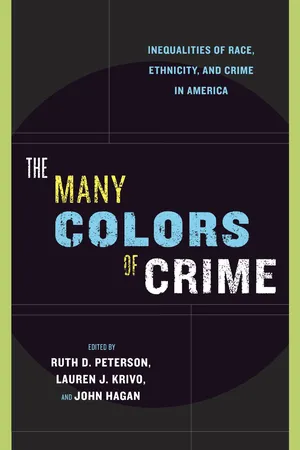
The Many Colors of Crime
Inequalities of Race, Ethnicity, and Crime in America
- 430 pages
- English
- ePUB (mobile friendly)
- Available on iOS & Android
eBook - ePub
The Many Colors of Crime
Inequalities of Race, Ethnicity, and Crime in America
About this book
Information
Chapter 1
Cultural Mechanisms and Killing Fields
A Revised Theory of Community-Level Racial Inequality
Ten years ago, Sampson and Wilson proposed a theory of race and urban inequality to explain the disproportionate representation of African Americans as victims and offenders in violent crime.1 The basic idea put forth was that community-level patterns of racial inequality give rise to the social isolation and ecological concentration of the truly disadvantaged, which in turn leads to structural barriers and cultural adaptations that undermine social organization and ultimately the control of crime. According to this perspective, “race” holds no distinct scientific credibility as a cause of violence—rather, it is a marker for the constellation of social contexts that are differentially allocated by racial status in American society. Sampson and Wilson pursued this logic to argue that the community-level causes of violence are the same for both Whites and Blacks but that racial segregation by community differentially exposes members of minority groups to key violence-inducing and violence-protecting social mechanisms, thereby explaining Black-White disparities in violence.2 Their thesis has come to be known as “racial invariance” in the fundamental causes of crime.
In this chapter, we revisit the central arguments of the racial invariance thesis. Our goal is to build on recent findings and articulate new theoretical directions for the study of race, ethnicity, and violence. The good news motivating this effort is that in a short ten-year span many research advances have been made and large-scale secular changes have dramatically reduced the crime problem in American society. Indeed, a veritable explosion of research on race and crime has taken place in recent years, including numerous direct tests of the thesis of relative invariance in the causes of crime by race. At the same time, society has changed in ways that are decidedly for the better, so much so that the United States is now witnessing one of the lowest rates of violence it has seen since the mid-1960s, which benefits Blacks and Whites alike.
Less noticed in some circles but equally relevant, American society has grown to be more diverse in interesting ways. We have witnessed an increasing representation of ethnic groups and increasing immigration from around the world, especially among Latinos. These changes have led to what some consider surprising paradoxes, such as the finding that Mexican immigrants, despite their economic disadvantage, experience disproportionately lower rates of violence compared to second- and third-generation Americans. Concentrated immigrant enclaves also appear to be comparatively safe. Increasing diversity and immigration have thus not meant increasing crime, as many imagine—if anything, the opposite is true.
The bad news is that the bleak picture of Black disadvantage relative to Whites (and Latinos) remains as durable as ever when it comes to violence and the criminal justice system. Sampson and Wilson wrote that “the evidence is clear that African Americans face dismal and worsening odds when it comes to crime in the streets and the risk of incarceration.”3 These dismal odds are still with us. African Americans are six times more likely to be murdered than Whites,4 and homicide remains the leading cause of death among young African Americans.5 Both police records and self-reported surveys continue to show disproportionate involvement in serious violence among Blacks,6 and nearly one in three Black males will enter prison during his lifetime compared to less than 5 percent of White males.7 Moreover, even as crime continues to decline, African Americans are at increasing risk of incarceration and subsequent weak attachment to the labor force, which in turn reinforces Black disadvantage and involvement in crime.8
The question of race and crime thus remains as salient as ever, but its parameters have changed. There is now more empirical evidence on which to assess theoretical claims, and the increasing diversification of society demands that we incorporate ethnicity and immigration more centrally into the theoretical picture along with an apparently robust decline in rates of violence. This chapter takes aim at these challenges by revisiting and expanding the theoretical grounds that were plowed by Sampson and Wilson.9 One chapter cannot do justice to the complexity of the challenge, of course, so we must necessarily be selective in our points of emphasis. For example, it is beyond the scope of this chapter to engage in a detailed review of the literature, cover crimes other than violent ones, or review debates about the correct definition of “neighborhood.”10 Our strategy, then, is to summarize the literature produced after 1995 by highlighting key findings in a broad-brush format. We are fortunate in this effort to be able to rely on independent assessments of recent research that allow conclusions to be drawn about the racial invariance thesis.11
Once the basic patterns in recent research are laid out, we turn to promising new directions in conceptualizations of communities, race, and violence. Our argument highlights the implications of (1) “ecological dissimilarity” and spatial inequality by race, (2) ethnicity and immigration, and (3) a revised cultural perspective on violence. Our contention is that research on race and crime has been hampered by its persistent attempts to control for community-level conditions that are not comparable across racial groups. Moreover, prior research neglects extralocal processes of spatial inequality, gives little attention to the implications of increasing ethnic diversity, and takes an impoverished view of culture. On the latter, we present a critique of cultural modes of theorizing in criminology, followed by a theoretical formulation that draws on recent advances in the sociology of culture.
Communities, Race, and Crime
The dominant tradition in criminology seeks to distinguish offenders from nonoffenders, so it comes as no surprise that it is from this tradition that the race question has typically been addressed. Sampson and Wilson promoted instead a community-level explanation that examined the way community structures and cultures produced differential rates of crime.12 Their unit of analysis was thus the community and not the individual. Using this strategy as a starting point, they posed two questions.13 To what extent do rates of Black crime vary by type of ecological area? Is it possible to reproduce in White communities the structural circumstances under which many Blacks live? To the first question they responded that Blacks are not a homogeneous group any more than are Whites. It is racial stereotyping that assigns to Blacks a distinct or homogeneous character, allowing simplistic comparisons of Black-White group differences in crime. In fact, there is tremendous heterogeneity among Black neighborhoods that corresponds to variations in crime rates. Sampson and Wilson hypothesized that if the structural sources of variation in crime are not unique by race, then rates of crime by Blacks should vary with social-ecological conditions in a manner similar to the way they co-vary among Whites.14
The data are now in and confirm the wide variability in crime rates across White and Black communities along with robust similarity in their basic predictors at the community level—especially the concentration of socioeconomic disadvantage. This conclusion is confirmed in two rigorous assessments of the available literature from 1995 to the present by Peterson and Krivo and Pratt and Cullen.15 It is unambiguously the case in meta-analysis, for example, that concentrated neighborhood disadvantage is the largest and most consistent predictor of violence across studies.16
More to the point in assessing the racial invariance thesis is the conclusion by Peterson and Krivo: “One consistent pattern emerges from race-specific studies irrespective of the outcomes, predictors and units under consideration: structural disadvantage contributes significantly to violence for both Blacks and Whites.”17 We would point out that what is important in the racial invariance thesis, in addition to the comparability of causal distributions (described below), is the invariance in the effect of an underlying concept or dimension (such as concentrated disadvantage), rather than a specific indicator or variable. This point has often been misunderstood in recent empirical research.18 Even so, Peterson and Krivo further report that the invariance finding is “resilient to the exact configuration of factors representing disadvantage, e.g., differing combinations of poverty, income, family disruption, and joblessness/unemployment.”19 Hannon, Knapp, and DeFina also demonstrate that, when properly estimated, concentrated poverty’s association with homicide is invariant across racial groups.20
Ecological Dissimilarity
We now address the second question raised by Sampson and Wilson.21 Is it possible to reproduce in White communities the structural circumstances under which many Blacks live? Here again the data have been clear for a long time. Consider Shaw and McKay’s observation in Chicago from over half a century ago:22
The important fact about rates of delinquents for Negro boys is that they too, vary by type of area. They are higher than the rates for white boys, but it cannot be said that they are higher than rates for white boys in comparable areas, since it is impossible to reproduce in white communities the circumstances under which Negro children live. Even if it were possible to parallel the low economic status and the inadequacy of institutions in the white community, it would not be possible to reproduce the effects of segregation and the barriers to upward mobility.23
We still cannot say that Blacks and Whites share a similar environment—especially with regard to concentrated urban poverty. Consistently over recent decades, the vast majority of poor non-Hispanic Whites have lived in nonpoverty areas compared to approximately less than a fifth of p...
Table of contents
- Cover Page
- Title Page
- Copyright Page
- Dedication
- Contents
- Acknowledgments
- Introduction
- Chapter 1 Cultural Mechanisms and Killing Fields
- Part I Constructs and Conceptual Approaches
- Part II Populations and Intersectionalities
- Part III Contexts and Settings
- Part IV Mechanisms and Processes
- Conclusion
- Bibliography
- Contributors
Trusted by 375,005 students
Access to over 1.5 million titles for a fair monthly price.
Study more efficiently using our study tools.
Frequently asked questions
Yes, you can cancel anytime from the Subscription tab in your account settings on the Perlego website. Your subscription will stay active until the end of your current billing period. Learn how to cancel your subscription
No, books cannot be downloaded as external files, such as PDFs, for use outside of Perlego. However, you can download books within the Perlego app for offline reading on mobile or tablet. Learn how to download books offline
Perlego offers two plans: Essential and Complete
- Essential is ideal for learners and professionals who enjoy exploring a wide range of subjects. Access the Essential Library with 800,000+ trusted titles and best-sellers across business, personal growth, and the humanities. Includes unlimited reading time and Standard Read Aloud voice.
- Complete: Perfect for advanced learners and researchers needing full, unrestricted access. Unlock 1.5M+ books across hundreds of subjects, including academic and specialized titles. The Complete Plan also includes advanced features like Premium Read Aloud and Research Assistant.
We are an online textbook subscription service, where you can get access to an entire online library for less than the price of a single book per month. With over 1.5 million books across 990+ topics, we’ve got you covered! Learn about our mission
Look out for the read-aloud symbol on your next book to see if you can listen to it. The read-aloud tool reads text aloud for you, highlighting the text as it is being read. You can pause it, speed it up and slow it down. Learn more about Read Aloud
Yes! You can use the Perlego app on both iOS and Android devices to read anytime, anywhere — even offline. Perfect for commutes or when you’re on the go.
Please note we cannot support devices running on iOS 13 and Android 7 or earlier. Learn more about using the app
Please note we cannot support devices running on iOS 13 and Android 7 or earlier. Learn more about using the app
Yes, you can access The Many Colors of Crime by Ruth D. Peterson,Lauren J. Krivo,John Hagan, Ruth D. Peterson, Lauren J. Krivo, John Hagan in PDF and/or ePUB format, as well as other popular books in Social Sciences & Criminology. We have over 1.5 million books available in our catalogue for you to explore.