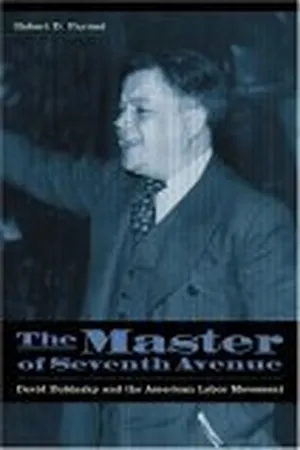
The Master of Seventh Avenue is the definitive biography of David Dubinsky (1892—1982), one of the most controversial and influential labor leaders in 20th-century America. A “character” in the truest sense of the word, Dubinsky was both revered and reviled, but never dull, conformist, or bound by convention. A Jewish labor radical, Dubinsky fled czarist Poland in 1910 and began his career as a garment worker and union agitator in New York City. He quickly rose through the ranks of the International Ladies’ Garment Workers’Union (ILGWU) and became its president in 1932. Dubinsky led the ILGWU for thirty-four years, where he championed “social unionism,” which offered workers benefits ranging from health care to housing. Moving beyond the realm of the ILGWU, Dubinsky also played a leading role in the American Federation of Labor (AFL), particularly during World War II. A staunch anti-communist, Dubinsky worked tirelessly to rid the American labor movement of communists and fellow-travelers.
Robert D. Parmet also chronicles Dubinsky’s influential role in local, national, and international politics. An extraordinary personality whose life and times present a fascinating lens into the American labor movement, Dubinsky leaps off the pages of this meticulously researched and vividly detailed biography.
eBook - ePub
The Master of Seventh Avenue
David Dubinsky and the American Labor Movement
- 436 pages
- English
- ePUB (mobile friendly)
- Available on iOS & Android
eBook - ePub
About this book
Information
1
Escape from Czarism
On the 160th anniversary of George Washington’s birthday, February 2, 1892, David Isaac Dobnievski, the youngest of five boys and three girls of Bezalel and Shaine Wishingrad Dobnievski, was born in the city of Brest-Litovsk near the Russian border in eastern Poland, then part of the Russian Empire.1
The Dobnievski family resided in Brest-Litovsk until 1895, when Bezalel moved it to Lodz, the leading textile center in the western part of the Russian Empire.2 In 1815 the Russians had succeeded the Prussians as rulers of the city. Under Russian direction the textile industry developed, attracting Jewish weavers, and the Jewish population grew considerably. The city’s more than 98,000 Jews in 1897 comprised almost 32 percent of the general population.3 By the turn of the twentieth century, most of the Jewish industrial workers in Lodz were in textiles,4 and by 1910 Jews owned 159 of the city’s 305 “larger factories.”5
The concentration of industry made the city ugly, and worse than Lodz’s filth was its contrast between rich and poor. It was a city of mansions alongside slums and streets discolored by the textile waste dyes because there was no sewage system.6 As late as 1903 its factory workers labored from “sixteen to eighteen hours a day.”7
As might be expected, Lodz was a place of much industrial unrest. On May 1, 1892, 70,000 workers participated in a general strike, but an anti-Jewish riot, or pogrom, followed. In 1897, a Jewish socialist party, the General Jewish Labor Bund, was founded at Vilna, but Lodz was one of its leading centers of activity, resulting in repression of the city’s workers’ movement. In March 1901, 2,000 workers gathered for the funeral of a popular Bundist but were dispersed by Cossacks.8
The Dobnievski family arrived in Lodz shortly before David’s third birthday. Initially they lived in the basement of an old house at 1 Kamienna Street,9 where David recalled feeling little parental affection. As the youngest of eight children, he evidently felt it necessary to use his wits to gain attention or simply hold his own among his older brothers and sisters. Bezalel Dobnievski was a religious man. He prayed in the synagogue three times each day but had little interest in the bakery he owned or in anything other than religion. As David would later recall, “All he did was keep the books and order the flour. He knew very little else about the bakery or even about baking.” “The real boss” of the business and the family was Shaina, David’s mother.10 David was eight when she died, and a year and a half later Bezalel returned to his native Brest-Litovsk and brought back to Lodz a stepmother named Rayzel for his eight children.
Rayzel Dobnievski gave her husband two sons and a daughter,11 but her stepchildren, including David, despised her. She was “a stranger” in the house who allegedly dominated Bezalel even more than Shaina had. The stepchildren believed that she feigned fainting spells in order to be revived with a favorite cordial. During one such spell, one of David’s brothers checked to see if it was real by sticking her with a pin, only to be in turn smacked by his father who had entered the room.”12 With David’s older siblings playing an important part in running the bakery after Shaina’s death, business had improved and the family moved to better surroundings, from the basement on Kamienna Street to ground-floor rooms at 27 Srednia Street, behind the bakery. In warm weather, David’s usual “bed” was a delivery wagon in the backyard, but when the temperature dropped he moved into the kitchen. Near the head of his bed, in the kitchen, was a board on which the bakers who worked in the evening left bread and rolls to cool. David could not have had a more direct introduction to baking.13
However, education came before a career in baking. David first attended a Hebrew school, where he studied Polish, Russian, and Yiddish, and then the semi-private Poznansky School. Named for the leading textile manufacturer in Lodz, it was on the level of an American high school and was, along with the Kunstadt School, the best of only four such schools in the city. Because of Bezalel’s preoccupation with prayer and Rayzel’s dislike of him, David had to rely on his own devices to gain admission. Therefore, he took the trolley, registered at four schools, and luckily was chosen by Poznansky.
Even while attending the primary school, however, David began each day by delivering freshly baked bread and rolls to stores supplied by his father. At 6 a.m. he was a delivery boy and at 8 a.m. a student. One day as he neared his fourteenth birthday, and after he had already spent two years at the Poznansky School, Bezalel insisted that he leave school and replace his older brother in the bakery. Lazer, a master baker, had gone to play cards and not returned.14
David entered an industry that was singularly unattractive. Among Jewish workers in Poland, bakers endured some of the worst working conditions, with employer-employee relations regarded as extremely paternalistic. In 1901 the bakers of Bialystock had called a strike and won several demands, including a twelve-hour day and the regular payment of wages. In Lodz there was less sense of class consciousness. As of 1903, bakers there had not yet participated in the labor movement and were working as many as fifteen hours a day, six days a week.15
By 1905 the possibility that bakers and other workers within the Russian Empire might have a better life suddenly appeared realistic. Russia was in revolution. Agitation for reform and unrest had been on the rise since 1904, when a disastrous war began with Japan over control of Manchuria and Korea and a terrorist bomb took the life of Minister of the Interior Vyacheslav Plehve. On January 9, 1905, Father Georgy Gapon, a Russian Orthodox priest, led a group of workers to the Winter Palace of Czar Nicholas II in St. Petersburg for a peaceful protest. The military fired on them, killing about two hundred and staining the white snow on the ground red. “Bloody Sunday,” as the day was called, led to additional agitation for reform, which was expressed via strikes, terrorist bombings, and a naval mutiny by the crew of the battleship Potemkin at Odessa.
For Russia’s Jews, the revolution meant new waves of government-supported oppression. Feared and despised by Russian Christians, Jews had been residentially segregated within the empire since the 1790s, in southern and western provinces known as the Pale of Settlement. Blamed for the assassination of Czar Alexander II in 1881, Jews became the targets of violent pogroms and of laws designed to isolate them. Widespread anti-Semitic violence continued through 1905. Government officials blamed the revolution on the Jews and incited new pogroms in the Pale of Settlement.16 Primarily under the leadership of revolutionary socialist organizations, the Jewish workers fought back, especially the Jewish Labor Bund.17 Immediately after Bloody Sunday, the Bund, as it was known, issued a leaflet, To Arms! which proclaimed that “The Revolution” had arrived and urged workers to seize weapons from arsenals. A wave of demonstrations and general strikes followed, and casualties mounted.
Lodz experienced “open rebellion.”18 In June, Cossacks attacked Jewish and Polish demonstrators, leading to a huge protest rally. A few days later there was a second rally, twice the size of the first, and another attack on the demonstrators. The result of these assaults was a full-scale uprising, “the battle of Lodz,” on June 22 and 23. Lodz’s proletariat rose up and the streets were filled with barricades and human casualties.19
In October 1905, revolutionary events reached a climax. Less than two months after a negotiated settlement ended the war with Japan, Russia was paralyzed by a general strike. In response to the latter, Nicholas II signed the October Manifesto, granting a constitution that guaranteed civil liberties, broadened suffrage, and granted legislative powers to the Duma, a national congress that had been established in August. It seemed that Russia was on the road to democracy, but for her Jews there was renewed despair. As the manifesto was made public, Russia plunged into the most severe pogroms in her history.20
The persecution continued into the middle of 1906. By this time fourteen-year-old David was a unionist as well as a baker. At a mass meeting he had attended in 1905, he had been greatly impressed by several Bund speakers, notably Ephraim Loozer Zelmanowicz, the leader of the hosiery union. This gathering evidently began his gradual involvement with the Bund. He joined the bakers’ union, which was controlled by the Bund, and, owing to his superior education, soon became assistant secretary of the union. As he later recalled with regard to the Bund, “I was not a member of the party but I considered myself already a Bundist without being a member of the party.” Furthermore, he said he “began reading” Bund literature only after he joined the union.21
The Bund had been founded in September 1897 at a conference in Vilna during the Jewish High Holy Days so that outsiders, the police in particular, would view the movement of the delegates as the ordinary travel of friends. Their goal was to organize the Jewish working class throughout the western part of the Russian Empire, represent Jewish interests, and become part of the larger revolutionary movement.22 As the creation of Jewish Socialists, the Bund was more Socialist than Jewish, but Jews would be recognized as a nationality within a workers’ state and the Yiddish language and cultural expressions fostered and respected. As Bernard Johnpoll has written, the Bund was not “interested specifically in the welfare of the Jewish workers as Jews, but rather as a working-class party interested in the Jewish workers as part of the working class.”23 Approaching adulthood in an era of repression and revolution, David Dobnievski embraced democratic socialism as the path to a better world and accepted the Bundist vision of a utopia where Jews could thrive as a nation by being granted cultural freedom, and where one could be proudly Jewish without being religious.
As early as age fifteen, David moved in the direction of the Bund and away from his father. As assistant secretary of the bakers’ union, it was David’s first task to draw up a call for a strike demanding a pay increase. Bezalel Dobnievski’s bakery was among those to be struck. Moreover, David enlisted his young stepsister, Gita, to the cause. To avoid being caught by the police with strike flyers in his possession, he had Gita carry them in her basket from the printers to a union meeting. The bakers won an increase, but immediately afterward the police arrested the strike organizers, including David. They came for him in the middle of the night, at 3 a.m., but before he left the house Bezalel gave him something to take to the police station: coins to buy favors from the jailers. David was placed “in a big cell with more than sixty other strikers” but freed after three days, before he could be docketed, on the condition that he leave town and not return. Bezalel had bought his release from the chief of police for twenty-five rubles.24
He left for his birthplace, Brest-Litovsk, and then traveled to Kobrin, thirty miles east. There he worked as a baker, earning very little—and yearned for Lodz. Knowing he could not be seen in Lodz as David Dobnievski, he first returned to Brest-Litovsk, where he obtained a passport under a pseudonym. By claiming he had lost his original passport and then advertising the loss for three days in a newspaper, he was able to secure a replacement from authorities who knew nothing of his political activities. Even with the new document, David was fearful. A policeman in Lodz could recognize him by sight. So he went back but also hid, living in turn with various friends and relatives.25
David had no scruples about rejoining the union and was pleased to carry out various assignments, including one concerning his father, to whom he had also returned. David was responsible for learning from Bezalel and then reporting to the union the plans of the bakery owners. Simply stated, he informed on his father, the man whose money had recently secured his release from jail. But it was also David’s task to put an end to the bakery workers’ practice of stealing from their employers.26
This activity was short-lived. On January 8, 1908, six weeks before his sixteenth birthday, David was arrested again at a union election meeting, which was held with a police permit. Permits were required to hold all meetings, but this particular one was issued for a special purpose, as afterward became obvious. In attendance was a government official. Also present was Shmul Domshevski, known as “Noach,” a Bund representative and union leader. During the open voting by shows of hands, the nominees awaited the results in the nearby hosiery workers’ union office. The first nominee was Noach, who was waiting in that office when a Bund member warned him that the police had surrounded the meeting and urged him to escape through a rear door. Instead of leaving, Noach returned to the meeting room and informed David of the police presence. Noach would not leave but offered to nominate David for secretary, which would give him a chance to get out. The fact that Noach, a well-known Socialist with a police record, stood his ground, impressed David, who likewise refused to run. The meeting ended with the arrest of everyone.
His son’s second arrest was too much for Bezalel Dobnievski to tolerate. This time, as David later said, “my father disowned me and would not help me. As a result of it, I spent 18 months in jail and was sent to Siberia.”27 In any case, Bezalel probably could not have done much to help. David had returned to Lodz without permission and was now regarded as a political prisoner, a revolutionary, just like Noach; still only sixteen years old, David was sentenced to exile in Siberia.28
Thus proceeded his prison odyssey, which began in Lodz. It was followed by Warsaw’s Paviak and Moscow’s Butyrki. The year and a half he spent in prison put him in physical contact with bedbugs and intellectual contact with both hardened criminals and political offenders. The criminals thought kindly of the “politicals,” whom they saw as idealists sacrificing themselves for the downtrodden. David, perhaps for the first time, began to think seriously about the contrasting fates of rich and poor in society.
From Moscow, David journeyed to Samara, where he spent time in yet another jail en route to Chelyabinsk in Siberia. He made the trip to Samara in handcuffs that kept slipping off because his hands were so small. Stymied, his guards told him that in the presence of their superior he should act as though he were chained to the prisoner alongside him.29
Chelyabinsk was the last stop on the train, but it was not where David was being sent. He had hoped to remain there with some exiled friends, Yussel and Esther Rosenberg, but his request to the local governor received no reply. Hence, he was compelled to march with other exiles to some remote Siberian village. It was summer and hot, and the marchers covered between twenty and thirty miles per day beginning at 8 a.m. and ending at 6 p.m. As David had left Lodz with only heavy clothes, he found the heat hard to bear. Some of the clothes he carried in a sack, and some he sold to a guard. His food was “black bread and hot water.”
After the tenth day he made up his mind to escape. His plan was to place himself at the end of the prisoner convoy and then just disappear. Before it could be tested, however...
Table of contents
- Cover Page
- Title Page
- Copyright Page
- Dedication
- Contents
- Preface
- Introduction
- 1 Escape from Czarism
- 2 East Side Socialist
- 3 At War within the ILGWU
- 4 Second in Command
- 5 Acting President
- 6 Dubinsky’s Union
- 7 A World of Conflict
- 8 Fast Company
- 9 Beyond the Blue Eagle
- 10 Industrial Unionism and Labor Politics
- 11 An Independent Spirit
- 12 Allies and Adversaries
- 13 Home at Last
- 14 War on Two Fronts
- 15 Cold War Liberal
- 16 Labor Statesman
- 17 Riding High at Home and Abroad
- 18 Trouble on Seventh Avenue
- 19 End of an Era
- 20 Honorary President
- Notes
- Index
- About the Author
Trusted by 375,005 students
Access to over 1.5 million titles for a fair monthly price.
Study more efficiently using our study tools.
Frequently asked questions
Yes, you can cancel anytime from the Subscription tab in your account settings on the Perlego website. Your subscription will stay active until the end of your current billing period. Learn how to cancel your subscription
No, books cannot be downloaded as external files, such as PDFs, for use outside of Perlego. However, you can download books within the Perlego app for offline reading on mobile or tablet. Learn how to download books offline
Perlego offers two plans: Essential and Complete
- Essential is ideal for learners and professionals who enjoy exploring a wide range of subjects. Access the Essential Library with 800,000+ trusted titles and best-sellers across business, personal growth, and the humanities. Includes unlimited reading time and Standard Read Aloud voice.
- Complete: Perfect for advanced learners and researchers needing full, unrestricted access. Unlock 1.5M+ books across hundreds of subjects, including academic and specialized titles. The Complete Plan also includes advanced features like Premium Read Aloud and Research Assistant.
We are an online textbook subscription service, where you can get access to an entire online library for less than the price of a single book per month. With over 1.5 million books across 990+ topics, we’ve got you covered! Learn about our mission
Look out for the read-aloud symbol on your next book to see if you can listen to it. The read-aloud tool reads text aloud for you, highlighting the text as it is being read. You can pause it, speed it up and slow it down. Learn more about Read Aloud
Yes! You can use the Perlego app on both iOS and Android devices to read anytime, anywhere — even offline. Perfect for commutes or when you’re on the go.
Please note we cannot support devices running on iOS 13 and Android 7 or earlier. Learn more about using the app
Please note we cannot support devices running on iOS 13 and Android 7 or earlier. Learn more about using the app
Yes, you can access The Master of Seventh Avenue by Robert D. Parmet in PDF and/or ePUB format, as well as other popular books in Politik & Internationale Beziehungen & Politische Biographien. We have over 1.5 million books available in our catalogue for you to explore.