In the early part of the twentieth century, Methodists were seen by many Americans as the most powerful Christian group in the country. Ulysses S. Grant is rumored to have said that during his presidency there were three major political parties in the U.S., if you counted the Methodists.
The Methodist Unification focuses on the efforts among the Southern and Northern Methodist churches to create a unified national Methodist church, and how their plan for unification came to institutionalize racism and segregation in unprecedented ways. How did these Methodists conceive of what they had just formed as “united” when members in the church body were racially divided?
Moving the history of racial segregation among Christians beyond a simplistic narrative of racism, Morris L. Davis shows that Methodists in the early twentieth century—including high-profile African American clergy—were very much against racial equality, believing that mixing the races would lead to interracial marriages and threaten the social order of American society.
The Methodist Unification illuminates the religious culture of Methodism, Methodists' self-identification as the primary carriers of "American Christian Civilization," and their influence on the crystallization of whiteness during the Jim Crow Era as a legal category and cultural symbol.
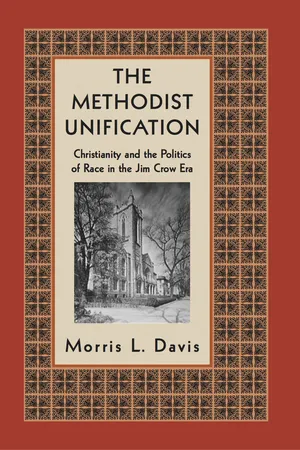
eBook - ePub
The Methodist Unification
Christianity and the Politics of Race in the Jim Crow Era
- 197 pages
- English
- ePUB (mobile friendly)
- Available on iOS & Android
eBook - ePub
The Methodist Unification
Christianity and the Politics of Race in the Jim Crow Era
About this book
Information
Topic
Theology & ReligionSubtopic
Christian Denominations1
Birth of a Nation, Birth of a Church
In 1915, D. W. Griffith’s monumental film Birth of a Nation “wrote history with lightning,” as President Woodrow Wilson supposedly said. The film cast the civil war in the United States as a horrible but eventually purifying event in the life of the nation. The America that was born of the conflict was stronger and wiser. It was a natural reunion. It repaired an unnatural cleavage in the family of the white race in America, a mongrel race melded from the best genetic stock of Europe—though primarily by the greatest strain, the Anglo-Saxon.
The film begins with a few scenes that establish the blame for all of America’s troubles: the arrival of African slaves. First it shows the arrival of the slaves, the central problem in American life, and then those good-hearted but sadly misguided figures in the narrative, the northern liberals. They are shown in the early scenes of the film in their abolitionist phase, not helping the black man at all, we find out, but instead altering natural relationships in ways that nearly destroy the entire nation.
The central racial theme of the film is the evil of miscegenation. Of all the characters in the film, the mulatto seductress and the puppet mulatto governor are the most evil and misguided. In fact, they are the only characters with misguided intentions. Neither the Union nor the Confederacy is portrayed as the malevolent aggressor. The Union, and northerners in general, to be sure, are not gallant heroes in the same way the Confederates are. They are rather, like the Confederates, tragic figures, caught in an inevitable confluence of opposing political needs bred by unnatural alliances with blacks and greed. They are a part of a community torn apart by past sins. Lincoln, especially, is portrayed as a heroic leader, trapped between equally abhorrent choices. What takes the northern leadership astray is the self-interested meddling of mixed-blood troublemakers. Well-intentioned northern liberals are duped into thinking they are helping blacks and making up for the wrong of slavery by integrating them fully into white American society on a socially equal basis. But the film firmly contends that race mixing only leads to disaster, no matter what the intentions of the participants.
The South, before the war, is portrayed as an idyllic land of right relationships. Everyone is in his or her place: masters are kind but firm, slaves are obedient but happy. Trouble arises from the improper relationship between the white northern abolitionist senator and his mulatto mistress; he also keeps many blacks in his company. This senator and others like him move the North to war. After the war, it is the mulatto leadership, which is clever but finally unable properly to handle the mantle of authority, that nearly destroys the South entirely by encouraging ignorant blacks in the Union Army to seek revenge on southerners. The turning points for this world turned upside down are two sexual encounters: one in which the mulatto governor makes sexual advances on a white woman, and another in which a confused black Union soldier lusts for a white girl and chases her until she jumps to her death. These incidents rouse the southern men to don the white uniforms of the Klan and ride to the rescue. They defeat the mulatto-led reconstruction government and return southern society to its proper order. Blacks and whites, both South and North (though not mulattos), are all happy in the end as the natural racial order is preserved, and the nation is reborn from the cleansing fire of war.
These scenes do not suggest that blacks are inherently evil or sexually uncontrollable. They do imply that improper racial ordering will lead blacks out of their place and cause them to do evil. Mulattoes in particular are singled out as the evil spawn of race mixing. And the black Union soldiers are only rapists when in a soldier’s uniform and given authority they are unable to handle. There are many blacks in the film who do no evil. Several even participate in the fight against black Union soldiers. These blacks never step out of their “natural” roles into improper intimacy or illegitimate authority. They know their place, and they are perfectly capable of a good and happy life in their place. They are loved by their white owners/bosses, and they love them back.
The themes and concerns of this film closely mirror those that drove the discussion of unification among Methodists: race and social order, regional identity and national unity, and a racialized program of national progress toward civilization. Perhaps most importantly, it is the fears of whites that become so horribly realized in the film’s scenes of sexual predation and its Frankensteinian mulatto characters twisted by experimentation with unnatural social intimacy. Initially glossed over or only vaguely referred to, the question of “social relations” between whites and blacks was a primary concern of white Methodists. What became known as the “bogey of social equality” among the Methodist conversants was also one of the few things they all agreed on: that black and white Methodists should never be “socially” equal, and that to eliminate segregation even in a church would be to suggest that they were. Both black and white Methodists went to great lengths to say that they had absolutely no interest in even discussing the prospect of “social equality.” The most selfconsciously “progressive” white Methodists expended their strongest rhetorical dismissiveness on this matter. Advocating “social equality” was considered an extremely radical position of “agitation.” In the same way, black Methodists made abundant gestures of disgust in answering the accusation that they were interested in “social equality.”
Like the makers of Birth of a Nation, who were looking for a more perfect reunion of North and South, Methodists were looking for a reunion of the regionally defined branches that would not only return them to their original structure but also move them beyond, to something new and better. Like the unified American nation, Methodists needed to leave behind old divisions and return to proper relationships with each other. Unification was necessary if they were to hold their place as the carriers of American Christian civilization. That unified church had to conform to the standards of American civilization, and had to reflect the social relationships there as well. What precisely “American Christian civilization” meant for the church, or what proper social relationships looked like, were of course disputed.
“The Long Road”
Methodist Episcopals of all persuasions had been pondering a reunion of the northern and southern churches from the moment they split. The General Conference of the Methodist Episcopal Church of 1844 brought about a formal division that reflected sectional differences within the Methodist Episcopal Church that had been brewing for several decades, and provided enough fuel to stoke vociferous and consistent debates over property, blame for the split, and the rights to the claim of “true” Methodist Episcopal heritage. Methodists in the MEC generally contended that the split was the result of differences over the slavery question, while many in the MECS argued that the slavery question merely revealed deeper ecclesiastical issues. In his book about the unification of the MEC and MECS, Bishop John Moore, an MECS bishop who was a member of the Joint Commission, wrote that an earlier division in the MEC, one that produced the Methodist Protestant Church, reflected the very same issues that caused the split of 1844. The creation of the Methodist Protestant Church has been generally accepted as a matter of divergences concerning ecclesiastical power.1
The phrase that came to represent this MECS position was that “slavery was not the cause, but the occasion” of separation. It took twenty-five years and the end of the Civil War before the two churches engaged in formal discussions. One of the first things to be discussed was reunification, as many MEC members and leaders assumed that the end of slavery meant the end of division. In 1869 the MEC sent a delegation of two bishops to the MECS General Conference in St. Louis. They presented a formal plea for unification. In response, the MECS sent a letter to the MEC College of Bishops putting forth the case that reunification was not a simple matter, and that the occasion, not the cause, of the separation had disappeared with the emancipation of the slaves. More important, perhaps, was the lack of agreement about the status of the action of the 1844 General Conference. At its 1848 General Conference, the MEC declared that the Plan of Separation of the 1844 General Conference was null and void. This meant that the MEC did not formally recognize the MECS as a legal church, and thus that (in the view of the MEC) the MECS was illegally holding property and carrying on work under the name Methodist Episcopal Church.2
No formal meetings on the question occurred until the American centennial, 1876, when two commissions, each appointed by their respective General Conferences, met in Cape May, New Jersey. The meetings were friendly and conciliatory, and included a crucial exchange of official mutual recognition. The dispute over the Plan of Separation was resolved when the parties accepted a statement that both churches represented legitimate branches of the original Methodist Episcopal Church of 1784. This was the beginning of real attempts at union.3
Other important changes occurred after the Cape May meeting. The MEC dropped objections to MECS expansion into “northern” territory, as MECS congregations appeared in the Pacific Northwest and Illinois. The MEC was already sending missionaries to the South, especially among ex-slaves. This extensive missionary enterprise, which often resulted in separate MEC and MECS congregations serving the same communities, led to one of the main rallying cries in support of unification, as the state of “altar against altar” embarrassed some Methodists, infuriated others, and reeked of inefficiency to the younger church leaders who had been following the early-twentieth-century trends in “scientific” church management.4 This condition also offended the patriotic sensibilities of many Methodists in both churches, something we will revisit later in this chapter.
By the late nineteenth century, the MEC leadership was moving quickly in the direction of ecumenical cooperation. This movement culminated in the first Ecumenical Methodist Conference in London, England, in 1881. In 1888 the General Conference appointed a commission on Interecclesiastical Relations, with the purpose of promoting general Christian (read Protestant) unity. At the MECS General Conference of 1894 a Committee of Federation of Methodism was formed, and a request was sent to the MEC General Conference asking that they do likewise. The MEC General Conference approved, and the two committees met in January 1898.5 From this meeting several broad recommendations for cooperation emerged, especially in regard to liturgical and congregational level issues. A common catechism, hymnbook, and order of worship were called for, as well as cooperation in foreign mission work. The Commission also recommended, without many specifics, that domestic cooperation increase in order to allay overlap and redundancy at the local level. These recommendations were approved by the MECS General Conference that same year, but were not recommended by the MEC until 1904.
In the realm of foreign missions, the two churches divided up work by geographic regions, with the MEC responsible for Puerto Rico and the Philippines, the MECS for Brazil and Cuba. A common publishing house was established in China, and they combined their separate Japanese mission churches into the independent Methodist Church of Japan in 1907. The establishment of an autonomous church in Japan was to be a significant event for the black congregations in the United States, as those who wanted the black congregations to set up their own independent church used the Japanese church as a successful precedent.
One move made by the MEC General Conference gives some indication as to how far apart, despite the cooperation that had been achieved, the MEC and the MECS were, and also how much the problem of race factored into that distance. The 1908 MEC General Conference passed a proposal to the Methodist Protestant Church for unification. The Methodist Protestant leadership accepted the proposal with enthusiasm and in response proposed that along with the MECS, the three churches organize another committee to study the possibility of a union among the three Methodist bodies. As a result, the Joint Commission on Federation was formed, and held its first meeting in Cincinnati in January 1910.6 From this meeting emerged a subcommittee, composed of three members from each church, to work out the details of possible union.
This Committee of Nine produced a proposal that would set the stage for the creation of the Joint Commission on Unification, which would not include the Methodist Protestants and which began meeting in late 1916. The committee of nine met in Chattanooga in May 1910. The report from this meeting proposed a merger without many specific guidelines, but also included an addendum that suggested the black membership be separated into its own jurisdiction. The only other major topic of discussion was the nature of the General Conference, which was largely a problem between the MEC and MECS and did not affect the Methodist Protestant Church. Recognizing that the major obstacles to a viable plan of union lay between the other two denominations, the MP delegation recommended to their General Conference of 1912 that they continue the appointment of delegates to the Commission, but that they not participate until the MEC and MECS settled their differences.7 This proposal was accepted and the MEC and MECS continued meeting alone.
The recommendation that was eventually passed on to their respective General Conferences was essentially the same proposal from the 1911 meeting in Chattanooga, Tennessee.8 Official approval by the 1916 MEC General Conference in Saratoga Springs, New York, finalized MEC support for the Chattanooga proposal, but made no mention of the change made by the MECS General Conference of 1914.9 The resulting reaction in the MECS was mixed. Some took the silence as a sign that the MEC was willing to negotiate and might compromise on the issue of black membership. Others understood it to be a firm stance, and used it to express the worry shared by many MECS members, that any unification would only result in the “absorption” of the MECS by the MEC. Black MEC members and whites who supported their presence in the new church, for their part, worried that over-eager leadership from their church would compromise too far in their desire for a larger, more powerful reunited church and accept a racially segregated compromise. Despite these fears and heated exchanges between the various church serials, the movement toward unification continued. The Joint Commission on Unification scheduled its first meeting for late December 1916.10
The Working Conference on the Union of American Methodism
An event outside of denominational planning gave one more push toward the meetings of the Joint Commission, and is indicative of both the level of national attention to this issue between the two churches and the concern from outside the MEC and MECS that Methodism’s regional division reflected badly on the state of national unity. In February 1916, delegates from seven Methodist denominations—the MEC, MECS, AME, AMEZ, MP, CME, and Methodist Church of Canada—gathered at Northwestern University at the behest and expense of the John Richard Lindgren Foundation for the Promotion of Peace and International Unity for a conference titled “A Working Conference on the Union of American Methodism.” For the most part the Foundation awarded prize money to papers prepared by students on the topic of ecumenism, but the board of the fund felt that the Methodist cause was important enough to assist directly. Representatives were bishops, editors of denominational publications, seminary professors, and prominent laymen. Invited presenters were asked to address specific issues, which included sectional problems, polity, doctrine and ritual, church discipline, “the Negro,” foreign missions, domestic missions, property, “connectional enterprises,” and “federation vs. organic union.” Perhaps in recognition that it was the most contentious issue, the session on “the Negro” was scheduled for more speakers than any other. The topic also took up much of the time in the roundtable discussions afterward.
It was the first gathering of Methodist representatives at which there was reasonable hope whatsoever that any of the Methodist denominations would soon be uniting. Indeed, the Foundation had high hopes. They were spurred forward on the one hand by the fear and apprehension that broad war in Europe could threaten “Christian civilization,” and on the other by the optimism of modern progress and all that it held out for the spread of “Christian civilization” from America.
In that spirit, the meeting opened with the adoption of a “Call to Prayer for Methodist Unity.” This opening statement was animated by a sense of urgency because of what those gathered perceived as the potential for global disaster if Methodists remained divided. No one had dreamed, it said, that
the twentieth century would witness almost world-wide war, involving nearly all the great Christian nations, and that in hatred and savage cruelty, enormous loss of life and immense loss of property, it should stand without a parallel in all the centuries of man’s existence on this planet. Men’s hearts have begun to fail them because of fear.… The hopes of international peace seem bankrupt … men’s hopes of international peace are blasted. The world is in despair. Civilization is halted and Christianity dishonored and disparaged. Men ask, is god no longer a god of peace? Is the god of war to overthrow the kingdom of the Prince of Peace? If the Church of Christ fails to restore the spirit of brotherhood in the world, then may we despair of the race.…
The world they saw before them could not appear more bleak. Under this sense of impending worldwide doom, these Methodists from all over North America saw themselves and their proposed task as a crucial piece of saving the world from self-destruction:
We are called to consider the question of Christian Unity in the interest of international peace itself. The brother...
Table of contents
- Cover Page
- Title Page
- Copyright Page
- Contents
- Acknowledgments
- Introduction
- 1 Birth of a Nation, Birth of a Church
- 2 The Baltimore Meeting: Saints, Cemeteries, and Savages
- 3 Race Consciousness
- 4 The Savannah Meeting: “The Bogey of Social Equality”
- Epilogue
- Appendix: List of Delegates to the Joint Commission with Biographical Notes
- Notes
- Selected Bibliography
- Index
- About the Author
Trusted by 375,005 students
Access to over 1.5 million titles for a fair monthly price.
Study more efficiently using our study tools.
Frequently asked questions
Yes, you can cancel anytime from the Subscription tab in your account settings on the Perlego website. Your subscription will stay active until the end of your current billing period. Learn how to cancel your subscription
No, books cannot be downloaded as external files, such as PDFs, for use outside of Perlego. However, you can download books within the Perlego app for offline reading on mobile or tablet. Learn how to download books offline
Perlego offers two plans: Essential and Complete
- Essential is ideal for learners and professionals who enjoy exploring a wide range of subjects. Access the Essential Library with 800,000+ trusted titles and best-sellers across business, personal growth, and the humanities. Includes unlimited reading time and Standard Read Aloud voice.
- Complete: Perfect for advanced learners and researchers needing full, unrestricted access. Unlock 1.5M+ books across hundreds of subjects, including academic and specialized titles. The Complete Plan also includes advanced features like Premium Read Aloud and Research Assistant.
We are an online textbook subscription service, where you can get access to an entire online library for less than the price of a single book per month. With over 1.5 million books across 990+ topics, we’ve got you covered! Learn about our mission
Look out for the read-aloud symbol on your next book to see if you can listen to it. The read-aloud tool reads text aloud for you, highlighting the text as it is being read. You can pause it, speed it up and slow it down. Learn more about Read Aloud
Yes! You can use the Perlego app on both iOS and Android devices to read anytime, anywhere — even offline. Perfect for commutes or when you’re on the go.
Please note we cannot support devices running on iOS 13 and Android 7 or earlier. Learn more about using the app
Please note we cannot support devices running on iOS 13 and Android 7 or earlier. Learn more about using the app
Yes, you can access The Methodist Unification by Morris L Davis,Morris L. Davis in PDF and/or ePUB format, as well as other popular books in Theology & Religion & Christian Denominations. We have over 1.5 million books available in our catalogue for you to explore.