Uncovers the surprising cause behind the recent rise of fake news
In an ideal world, journalists act selflessly and in the public interest regardless of the financial consequences. However, in reality, news outlets no longer provide the most important and consequential stories to audiences; instead, news producers adjust news content in response to ratings, audience demographics, and opinion polls. While such criticisms of the news media are widely shared, few can agree on the causes of poor news quality. The People's News argues that the incentives in the American free market drive news outlets to report news that meets audience demands, rather than democratic ideals. In short, audiences' opinions drive the content that so often passes off as "the news."
The People's News looks at news not as a type of media but instead as a commodity bought and sold on the market, comparing unique measures of news content to survey data from a wide variety of sources. Joseph Uscinski's rigorous analysis shows news firms report certain issues over others—not because audiences need to know them, but rather, because of market demands. Uscinski also demonstrates that the influence of market demands also affects the business of news, prohibiting journalists from exercising independent judgment and determining the structure of entire news markets as well as firm branding.
Ultimately, the results of this book indicate profit-motives often trump journalistic and democratic values. The findings also suggest that the media actively responds to audiences, thus giving the public control over their own information environment. Uniting the study of media effects and media content, The People's News presents a powerful challenge to our ideas of how free market media outlets meet our standards for impartiality and public service.
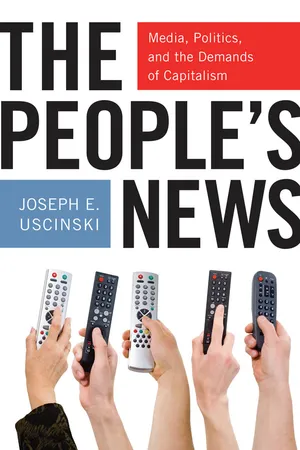
- 195 pages
- English
- ePUB (mobile friendly)
- Available on iOS & Android
eBook - ePub
About this book
Information
1
Introduction
Whose News?
Most television news programs are designed to satisfy the perceived appetites of our audiences. That may be not only acceptable but unavoidable in entertainment; in news, however, it is the journalists who should be telling their viewers what is important, not the other way around.
—Ted Koppel, January 29, 2006
—Ted Koppel, January 29, 2006
After leaving the daily grind of the ABC News Division, veteran anchor Ted Koppel tried his hand as a columnist for the New York Times. Prior to his retirement in late 2005, Koppel had spent decades in the news business; he covered numerous heads of state, natural disasters, major wars, and momentous elections. Rather than focus on the substance of any of these major stories in his first column, Koppel chose instead to discuss a problem he felt could negatively affect election outcomes, public policy, and democratic procedures. In short, Koppel discussed a problem he felt could damage the very fabric of American democracy. This problem is the amount of audience influence over American news programming.
Koppel contended that news firms no longer provide the most important and consequential stories to audiences, an approach sometimes called “traditional journalism.” Instead, outlets fill precious space with news designed to appease the audience’s demands. This leaves audiences without the information necessary to properly function in a democracy. Instead, Koppel argued, news producers have been too willing to abdicate their independent judgment and, as a substitute, adjust news content in response to ratings, audience demographics, and public opinion polls. He claimed that news firms chase audiences and profits at the expense of the public good. In other words, news outlets provide the news people want to know, at the expense of the news people need to know.
Koppel is not alone in these concerns; in fact, many in the news industry agree with his chilling assessment. For example, veteran CBS anchor Dan Rather commented, in typical Dan Rather fashion, “If we [try] to figure out what it is the audience wants and then try to deliver it to them, we’re lost souls on the ghost ship forever.” These concerns should not be dismissed as mere complaints by jilted practitioners who desire more power to exercise their own judgment. Unbiased experts outside of the newsroom have gathered mountainous evidence lending support to Koppel’s assessments.
For decades, scholars have lamented the effect of money on the news. In explaining citizens’ unsophisticated political views and scant knowledge of politics, preeminent media scholar Robert Entman (1989a:17) points to economic markets as the source: “The problem begins in the economic market, where news organizations compete for the audiences and advertising revenues necessary to maintain profitability and stay in business. The nature of both demand and supply … diminishes the press’s autonomy.” Noted media economics scholar James Hamilton (2005:351) points to the structure of incentives and the way they influence newsroom decision making:
Although journalists may not explicitly consider economics as they consider the day’s events, the stories, reporters, firms, and media that ultimately survive in the marketplace depend on economic factors. The decisions of producers and editors are driven by supply and demand: Who cares about a particular piece of information? What is an audience willing to pay for the news, or what are advertisers willing to pay for the attention of readers, listeners, or viewers? How many consumers share particular interests in a topic?
This is not to say that journalists, editors, and producers make every news decision with money, profitability, and audience share in mind. But, many news decisions are made for purely economic reasons. And, in order for news content to be influenced by economic concerns, those economic considerations need never be consciously on the minds of newspeople. As media economist John McManus (1995:309) puts it, decisions to report certain stories are “rarely made by consciously thinking through the components of business and journalism standards. … Reporters and editors may feel free to report the news as they see fit. But their freedom may seem larger than it is.” News routines and organizational norms are shaped by powerful economic incentives, but newspeople may never know it.
Whether the influence of economic incentives over news content is conscious or unconscious, McManus (1992:789–90) argues that it leads to poorer-quality news:
Adding viewers who possess the characteristics that advertisers value increases the station’s revenues. The result is an economic pressure to attract as many viewers as possible. … National advertisers are paying, not for news quality, but for audience “quality” and quantity. All else held equal, advertisers can be expected to support the program generating the largest audience likely to purchase the products offered. … If the premium newscast drew no more of the “right kind” of viewers than a run-of-the-mill newscast, the station would not earn as great a profit as it might have with a less expensive production. Further, if the premium newscast were like the journalistically acclaimed MacNeil/Lehrer NewsHour, it might attract a smaller audience than competitors. The loyalty of that small viewership and the esteem with which journalists held the station might be admirable, but not bankable. … In television, and only to a slightly lesser degree in newspapers, advertising’s “subsidy” makes a definition of quality based on popularity more profitable than one based on less widely shared professional or craft standards.
While there is broad agreement that the structure of economic incentives frustrates good journalism, many questions still remain. How much do economic incentives affect news content? Where can we see evidence of economics impacting substantive news content? What impact does a profit-driven news media have on society, and how can we correct the problems it creates? Journalists, such as Koppel and Rather, express great disdain for market-driven news decisions, but it is not clear that their reporting has been any more resistant to the influence of economics than that of any other journalist. Economic influence may be so strong that most people probably cannot even imagine a news environment not designed around the appeasement of audience demands.
It is this problem, the influence news markets have on news content, that The People’s News: Media, Politics, and the Demands of Capitalism is about. There is no doubt that systemic economic forces, such as the need to sell advertising space and manage expenditures, determine the actions of news firms. But, the idea that economics determines the actual content of news reporting is more controversial. Unfortunately, despite the fact that journalists and scholars have recited concerns about the influence of economics over news reporting for decades, scholars have only recently taken a widespread interest in empirically testing the impact of supply and demand on news content. This has led to three problems in our understandings of news media. First, the actual effect of economic markets on news content remains elusive due to a lack of testing and specification. Second, the forces that drive news reporting continue to be debated by scholars. Third, the impact news outlets exert over audiences may be overestimated in relation to the impact that audiences have over news reporting.
The People’s News seeks to fill these gaps in our understanding by detailing just how much of an impact market demands have on the news Americans consume. The People’s News not only identifies the specific market demands that affect substantive news content but also provides a detailed account of the extent to which some of these demands affect news coverage. Along the way, The People’s News explores the political ramifications of a market-driven news environment and provides insight into a series of long-standing debates that have puzzled researchers. For example, what makes a story “newsworthy”? What are the sources of news? How much do the media affect the audience’s political opinions and behaviors? The People’s News attempts to enlighten these debates with empirical evidence that will not only illuminate the way media scholars think about the construction of day-to-day news content but also refocus the public debate about the United States’ vastly segmented contemporary news environment.
The remainder of this chapter introduces the major debates and concepts that subsequent chapters address in more detail. I begin with a discussion of how economic markets affect news outlets. A robust understanding of the way economic forces shape news content is vitally important given the crucial role news is expected to play in democratic society. Why do economics influence news content? How do economic concerns manifest in day-to-day reporting? What is the extent of this influence?
I then introduce the impact news has on democratic society. How does the news contribute to citizen knowledge, encourage good citizenship, and drive public opinion and public policy? How can the news media positively affect society, and can we see evidence of these positive effects? Unfortunately, the compiled evidence will suggest that while the news can exhibit strong and positive impacts on democratic society, it falls drastically short in the United States.
This chapter then introduces the three major theoretical paradigms that scholars have proffered to explain news content. The first, traditional journalism, argues that journalists should encourage and nurture good citizenship, most prominently by providing the information citizens need to effectively participate in democratic governance. I argue that American news outlets should follow traditional journalistic standards; however, the evidence presented will suggest that they do not. The second major theoretical paradigm to explain news content, supply-side, argues that those supplying the news, in or above the newsroom, choose what news to report and how to report it with little deference given to the demands of audiences. The third paradigm explaining news content focuses on the influence of economics over news. Demand-side points of view argue the opposite of supply-side models—that audiences, or those who consume the news product, drive news content. Much like producers of other products, news firms must produce a product that meets consumer demands. If news firms do not, their product will lose audience size, revenue, and viability. In discussing demand-side models, I discuss three different types of demands that news outlets may seek to meet: those for entertainment, those for information, and those for gratification. In introducing these demands, I provide examples of how news outlets may alter substantive news content to meet those different demands. This discussion is followed by the plan of the book, which delineates how each remaining chapter will demonstrate the influence of market demands on news content. To begin, I now examine the economic system that news firms operate within and explain how understanding the incentives of that system is vastly important to understanding the American news media.
Markets and the Media
In the United States, firms operate within a capitalist economic system and therefore must provide products appealing to a sizable number of consumers in order to incur a profit. Firms that fail to incur profits go out of business. Given that they operate in the same incentive structure, news firms are no different from the farmer’s market on the side of the road or the international conglomerate selling software products worldwide. Just like those other companies, news firms must produce a product that people will consume at a price maximizing profits. Media scholars do concede that the economics of news is slightly different than that of many other products: news firms often earn revenue not by charging the end news consumer but instead by selling other companies access to those consumers through advertising space (Picard 2002). As McManus (1992:788) asserts, “Most commodities are simpler. … [Y]ou fork over the money directly. For news production it is more complicated. Most of the cost of creating both newspapers and newscasts is paid by a third party, advertisers.”
In order to attract revenue from the sale of advertising space, news firms must maintain sizable audiences. If news firms do not attract a sizable audience with their product, their employees will lose their jobs, the company will be reorganized, and it will eventually go “belly-up.” Simply put, news firms must provide a product people want to consume. So, despite the differences in who provides the actual income, news firms are little different from the farmer’s market selling cucumbers to passersby or the conglomerate selling computer operating systems to other large conglomerates—all must provide products that people will willingly choose to consume in the face of alternatives.
To name but a few examples, the New York Times saw revenues of $2.4 billion and the news division at CBS brought in $424 million in revenue in 2010.1 Given the financial stakes involved for news producers, it is little surprise that economic forces have often been indicted as the cause of what many consider to be low-quality news content. Thus, economic theories of news have been prominent in scholarly discussions (McChesney 1997; McManus 1994; Lacy 1992; Entman and Wild-man 1992; Hamilton 2005). Perhaps the most important empirical study examining the role of markets in news is Hamilton’s All the News That’s Fit to Sell: How the Market Transforms Information into News (2004). This work provides perhaps the most exhaustive account of the way market demands drive news production. But while some scholars have invested effort in looking at markets to explain the news, economic theories have not gained universal acceptance. Some continue to believe that economic concerns are kept out of the newsroom and beyond the concern of those choosing and crafting stories for dissemination (see discussion in Fengler and Russ-Mohl 2008).
To bolster economic arguments, scholars in recent years have employed vast amounts of empirical data as well as sophisticated methods of analysis to estimate the effects of audience demands on news content (Powers 2001; Althaus et al. 2009; Dunaway 2008; Arnold 2004; Hamilton 2004; Zaller 1998; McDonald and Lin 2004; Dunaway 2012). These studies have provided direct evidence showing that the content and quality of news are greatly affected by audience demands. To name but one example, in a cross-sectional examination of U.S. newspapers, Gentzkow and Shapiro (2010) found that consumers’ partisan preferences drive newspaper demand, and that that demand accounts for 20 percent of the observed variation in newspaper reporting. In other terms, political preferences translate into news preferences, and news preferences translate into actual news content.
Despite the emergence of new systematic evidence, most popular discussion of news economics skips over the impact of economics on news content. Instead, much of the discussion about media economics, especially in the last three decades, has focused on attempts by firm management to adapt to newer modes of delivering content and collecting advertising revenue. For example, much has recently been made of news outlets downsizing payrolls and closing foreign bureaus (e.g. Enda 2011). The corporatization (and near-monopolization) of the media has been a topic of frequent discussion as well (e.g. Pérez-Peña 2008). These changes have been met with much dismay, particularly by journalists who have faced dwindling job opportunities in recent years. But, the downsizing and adaptation present only a symptom of the much larger economic forces affecting news content long prior to recent decades.
As the earlier quotations from media scholars Hamilton and McManus suggest, economic models of news content are very much structural arguments. Much like actors in Charles Darwin’s theory of evolution, or Adam Smith’s “invisible hand,” actors in the media need not be consciously aware of their incentive structure. They are simply punished if they fail to follow it. News firms that fail to attract audiences get restructured or go out of business, and journalists who displease editors, owners, and advertisers get fired (McManus 1995:309). Consider the recent restructuring at Newsweek. After seventy-nine years, the once-lauded news magazine is ceasing its print operations following years of dwindling sales.
Furthermore, actors need not ever admit to following their incentive structures even if they are consciously aware of it. This is why journalists, editors, producers, and owners rarely suggest that their product is intended to draw in audiences. Such an admission would be akin to a member of Congress claiming to have taken a vote on legislation in order to get reelected, rather than to make good public policy. Just as individual members of Congress always claim to act in the best interest of the people (even though many studies suggest that legislators are insincere and self-interested), news firms claim to abide by traditional journalistic standards that preclude the influence of money on reporting. Because newspeople rarely admit in public that economic concerns affect their reporting, smoking-gun confessions directly linking economic motives and subsequent news content will be rare.
A great deal of research shows that journalists respond to audience demands when constructing substantive news content. Polls of network television news correspondents indicate that almost a third feel directly pressured to report certain stories over others due to owners’ or advertisers’ financial concerns (Price 2003). And beyond direct pressure, competition for scarce jobs naturally leads journalists to favor profitability over “journalistic value.” For example, journalists at online news outlets are judged by the number of clicks their articles receive. This sets up very clear incentive structures for journalists.
Given the incentives, there is little surprise that surveys have long shown that, as opposed to stories addressing pressing policy concerns, journalists define “news” as stories that “attract and hold the audience’s interest” (Atkin and Gaudino 1984; Burgoon et al. 1982). Surveys also show that journalists value market demand in constructing news content: for example, half of journalists believe that public opinion polls are important to judging newsworthiness (Weaver 2005). It is safe to conclude that economic concerns bleed into journalists’ news judgments.
In addition to journalists’ incentives and inclinations to follow audience demands in reporting the news, it is important to note that news outlets are well suited to follow those demands as well. Not only do journalists believe it is important to meet audience demands, but they also have the necessary information to do so. Firms employ vast amounts of market research to determine what content best appeals to what audiences (McChesney 1997:23). Firms obtain sophisticated data detailing the demographics, opinions, and behaviors of their audiences, and they closely follow their market share (Ferguson 2004). Firms know who is watching, listening, reading, and clicking—they can make informed plans for catering to audiences based on hard data.
In addition to the availability of hard data, journalists, producers, and editors have first-hand knowledge of their audiences’ likes, wants, and desires. Journalists are public figures—they are out and about, and they interact regularly with the audiences that they seek to satisfy. Journalists tend to have large Rolodexes, and talk to people at all levels of their communities. In short, newspeople are imbedded in audiences they seek to satisfy. Even before sophisticated methods of measurement became available, news firms had the ability to estimate audiences’ demands.
Compiled studies indicate that, much like other businesses operating in capitalist systems, news outlets have the motive and means to temper their product to appeal to as wide an audience as possible. For most businesses, this would be great, and many may be tempted to view this as such. For example, a portion of Adam Smith’s (1904) argument in favor of free markets states that when actors are allowed to act in their self-interest and freely follow the forces of supply and demand, they will achieve not only the...
Table of contents
- Cover Page
- Title Page
- Copyright Page
- Contents
- Acknowledgments
- 1. Introduction: Whose News?
- 2. Informational Demands for News: Agenda Setting and Audience Influence
- 3. Demands for Gratification: Competing in the National News Economy
- 4. Perpetual Feedback: Monitoring the New Media Environment
- 5. Where Can We Go? Consuming Responsibly
- Notes
- References
- Index
- About the Author
Trusted by 375,005 students
Access to over 1.5 million titles for a fair monthly price.
Study more efficiently using our study tools.
Frequently asked questions
Yes, you can cancel anytime from the Subscription tab in your account settings on the Perlego website. Your subscription will stay active until the end of your current billing period. Learn how to cancel your subscription
No, books cannot be downloaded as external files, such as PDFs, for use outside of Perlego. However, you can download books within the Perlego app for offline reading on mobile or tablet. Learn how to download books offline
Perlego offers two plans: Essential and Complete
- Essential is ideal for learners and professionals who enjoy exploring a wide range of subjects. Access the Essential Library with 800,000+ trusted titles and best-sellers across business, personal growth, and the humanities. Includes unlimited reading time and Standard Read Aloud voice.
- Complete: Perfect for advanced learners and researchers needing full, unrestricted access. Unlock 1.5M+ books across hundreds of subjects, including academic and specialized titles. The Complete Plan also includes advanced features like Premium Read Aloud and Research Assistant.
We are an online textbook subscription service, where you can get access to an entire online library for less than the price of a single book per month. With over 1.5 million books across 990+ topics, we’ve got you covered! Learn about our mission
Look out for the read-aloud symbol on your next book to see if you can listen to it. The read-aloud tool reads text aloud for you, highlighting the text as it is being read. You can pause it, speed it up and slow it down. Learn more about Read Aloud
Yes! You can use the Perlego app on both iOS and Android devices to read anytime, anywhere — even offline. Perfect for commutes or when you’re on the go.
Please note we cannot support devices running on iOS 13 and Android 7 or earlier. Learn more about using the app
Please note we cannot support devices running on iOS 13 and Android 7 or earlier. Learn more about using the app
Yes, you can access The People's News by Joseph E. Uscinski in PDF and/or ePUB format, as well as other popular books in Politics & International Relations & Politics. We have over 1.5 million books available in our catalogue for you to explore.