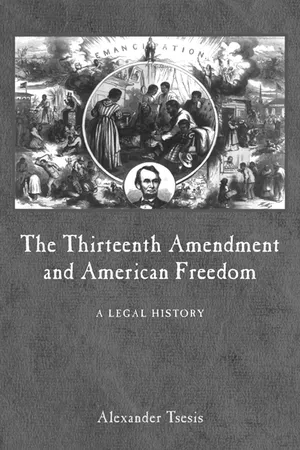
In this narrative history and contextual analysis of the Thirteenth Amendment, slavery and freedom take center stage. Alexander Tsesis demonstrates how entrenched slavery was in pre-Civil War America, how central it was to the political events that resulted in the Civil War, and how it was the driving force that led to the adoption of an amendment that ultimately provided a substantive assurance of freedom for all American citizens.
The story of how Supreme Court justices have interpreted the Thirteenth Amendment, first through racist lenses after Reconstruction and later influenced by the modern civil rights movement, provides insight into the tremendous impact the Thirteenth Amendment has had on the Constitution and American culture. Importantly, Tsesis also explains why the Thirteenth Amendment is essential to contemporary America, offering fresh analysis on the role the Amendment has played regarding civil rights legislation and personal liberty case decisions, and an original explanation of the substantive guarantees of freedom for today's society that the Reconstruction Congress envisioned over a century ago.
- 229 pages
- English
- ePUB (mobile friendly)
- Available on iOS & Android
eBook - ePub
About this book
Information
Topic
JuraSubtopic
Rechtstheorie & -praxisPART I
1 Slavery and Its Social Penetration
Study of constitutional law is most rewarding when it concerns civil rights. The chief aim of Thirteenth Amendment analysis should be understanding how to enforce the humanistic principles that lie at its core. Constitutional abolition profoundly transformed the United States from a land that tolerated racial slavery to a country whose core law protects fundamental liberties. The Thirteenth Amendment is not merely a positive prescription against slavery; it is a normative statement about the intrinsic value of freedom. It is both an excoriation of slavocracy, by which I mean all the institutional practices of hereditary servitude, and the guarantee of personal liberty.
The amendment’s full effect on the Constitution can best be understood by first examining the oppressive institution it ended. This chapter traces the centrality of slavery in the sectional conflicts that played out in the decades preceding the Civil War. Understanding this history is key to constructing a present that is committed to interpreting the liberal principles of the Reconstruction generation. The discussion here is selective, using a thematic approach, trying to give sufficient context to an infinite set of causes. The aim is to provide adequate historical background, using a synthesis of facts needed for understanding the legal and political events that led to a war born from the South’s desire to protect its peculiar institution and that culminated in an amendment designed to destroy it. To this end, some interpretive discussion of the practices of slavery will be helpful. For a more comprehensive overview, there are a number of excellent studies on slavery, including Leon F. Litwack’s Been in the Storm So Long and Kenneth M. Stampp’s The Peculiar Institution. Put simply, this institution was one of unrequited exploitation and broken family life that provided its victims with only the bare amenities and forced them into lifelong, hereditary servility. Slaveholding was the aspiration of many whites living in the South who longed for a sense of economic independence and social standing through the ownership of human capital.
A. Slavery and the Founding Generation
The revolutionary generation was engrossed in creating a free republic. The Sons of Liberty rallied colonists against taxation without representation, Liberty Polls were assembly places, Patrick Henry embodied the revolutionary project in his pithy statement “Give me liberty or give me death,” and Thomas Paine believed America to be “the place where the principle of universal freedom could take root.”1 Revolutionary colonists typically proclaimed that they were under the British yoke of slavery. The 1774 Rhode Island law prohibiting slave importation proclaimed that among rights and liberties, “personal freedom must be considered as the greatest.” Black leaders and some of their white counterparts, such as James Otis, recognized the opportunity that the Revolution offered for putting an end to slavery. A group of black New Hampshire petitioners used natural rights terminology to make the point, “[t]hat freedom is an inherent right of the human species…[and] [t]hat private or public tyranny and slavery are alike detestable.” Similarly, on April 20, 1773, black petitioners from Massachusetts expressed their expectation of “great things from men who have made such a noble stand against the designs of their fellow-men to enslave them.” The same year, blacks from Boston and other Massachusetts provinces demanded relief from the manifold burdens New England slavery placed on them: “We have no Property! We have no Wives! No Children! We have no City! No Country.”2
The ideal of universal freedom, particularly as John Locke presented it, made its way into the Declaration of Independence, but it did not end slavery.3 The Declaration adopted Locke’s statement of inalienable human rights, unbeholden to positive laws and not subject to arbitrary governmental infringements.4 The Declaration’s promise of equal freedom would later serve as the starting point for Radical Republicans, who advanced the Thirteenth Amendment through Congress and, later, through state ratification. But the founding generation of American revolutionaries lived with the contradictory promises of civil freedom and property rights in human chattel. In Thomas Jefferson’s original draft of the Declaration, his accusations against King George included a clause condemning the British monarch of acting “against human nature itself” by keeping open an international slave trade that violated the “rights of life and liberty in the persons of a distant people.” South Carolina, which repeatedly appeared as a leader in the antebellum proslavery camp, opposed the clause, and the Continental Congress did not retain it in the final version of the Declaration.
In the decades between the passage of the country’s founding documents and the Thirteenth Amendment, the Declaration’s universal guarantee of freedom posed a moral dilemma to politicians and citizens who tolerated and participated in an institution that was contrary to core national commitments. Even though it excluded the antislavery passages, the Declaration of Independence nevertheless established liberty as a chief national aspiration. The Declaration’s terms created a rhetorical dilemma for the nascent republic because the nation relied on eugenic theories about supposed black inferiority to justify slavery even though the Declaration proclaimed its support for the principle of universal equality.5
The Declaration’s wording was so general, without any accompanying philosophical or policy explanation, that politicians only began to identify the Declaration with antislavery sentiments shortly before states ratified the Thirteenth Amendment. In 1844, the Liberty Party’s platform asserted that the Fifth Amendment’s protections for life, liberty, and property were based on the Declaration’s recognition that “all men are endowed” with inalienable rights. Their 1844 platform further declared that slavery was “against natural rights” because it deprived persons of life, liberty, and property without due process of law. The Republican Party likewise understood the Fifth Amendment’s commitment to natural rights as a guarantee against the spread of slavery. Accordingly, the 1860 Republican platform stated that “the normal condition of all the territory of the United States is that of freedom. That, as our Republican fathers, when they had abolished slavery in all our national territory, ordained that ‘no persons should be deprived of life, liberty or property without due process of law’ it becomes our duty, by legislation, whenever such legislation is necessary, to maintain this provision of the Constitution against all attempts to violate it.” Even though the Republican Party had adhered to the view that “all men are endowed with inalienable rights” in its 1856 platform, it had then only committed itself to preventing the spread of slavery into the Western territories but not to its total abolition. This stance fell short of the full implications of the Republicans’ perspective on the Fifth Amendment. Only in the midst of the Civil War did the Republican Party adopt the position that slavery had to be eradicated throughout the nation and shifted from relying on the Fifth Amendment to calling for constitutional change.6
The Fifth Amendment had proven itself to be a two-edged sword, as proslavery forces also relied upon it. Nineteenth century apologists for the expansion of slavery developed a political philosophy that placed property at the pinnacle of personal interests and regarded its protection to be government’s chief purpose. The Fifth Amendment’s Just Compensation Clause provided the proslavery camp with a bastion for fortifying the peculiar institution against congressional restrictions to its spread westward. Based on this property rights-centered argument, Chief Justice Roger B. Taney, in his infamous Dred Scott v. Sanford (1857) decision, found the Missouri Compromise unconstitutionally violated substantive due process: “[A]n act of Congress which deprives a citizen of the United States of his liberty or property, merely because he came himself or brought his property into a particular Territory of the United States, and who had committed no offence against the laws, could hardly be dignified with the name of due process of law.” Taney further equated slaves with chattel, holding that nothing in the Constitution enabled Congress to give less protection to slave property than to any other possessions.
Taney’s decision was intended to undermine the Declaration of Independence’s embrace of universal equality. He did not stand alone in his wish to limit Congress’s power to prevent the spread of slavery, siding with the prejudices of other prominent government officials. For instance, during debates on the Kansas-Nebraska Bill, Senator Albert G. Brown declared that “negroes are not men, within the meaning of the Declaration. If they were, Madison, and Jefferson, and Washington, all of whom lived and died slaveholders, never could have made it, for they never regarded negroes as their equals.”7
Jacobus tenBroek, a historian of the Reconstruction period, pointed out that the ability of both camps to harness the Fifth Amendment for opposite ends indicated the centrality that constitutional interpretation played in the historic struggle over slavery: “Once the constitutional starting point on either side was accepted, almost all else followed automatically.” If slaves were merely property, then the Fifth Amendment protected owners’ property rights, but if they were humans, and the proslavery argument was a self-interested excuse for tyrannical exploitation, then the Just Compensation Clause was inapplicable and the Due Process Clause protected African American liberty rights. The antislavery position relied on the Fifth Amendment to expound a natural rights theory against exploitation of persons and the misappropriation of their fundamental interest in life and liberty. Meanwhile, proslavery rhetoric, which the Taney Court accepted, relied on the natural or vested property rights claim that the federal government could not trump state control over private economic interests.8 Therein lay the need for a clear constitutional pronouncement against slavery and all its manifestations; unfortunately, in the face of Supreme Court conservatism, even the language of the Thirteenth Amendment for a time turned out to be inadequate.
Ironically, the compromise on slavery that the framers of the Constitution made to secure the Union was almost its undoing. Among the framers were a number of outspoken supporters of abolition. Benjamin Franklin was well known for his antislavery sentiments, and in 1787 the Pennsylvania Society for Promoting the Abolition of Slavery, the Relief of Negroes Unlawfully Held in Bondage elected him to be its president. At the constitutional convention the same year, George Mason and Gouverneur Morris argued against continuing the slave trade. Some powerful Southerners sided with Thomas Jefferson, who was an ambassador to France during the Philadelphia Constitutional Convention, in calling for compensated, gradual manumission.9
Economic interests, however, proved more powerful than ethical ones. By the mid-eighteenth century, slavery was entrenched in both the North and South. Northern shippers and merchants participated in slave importation in the years preceding the Constitutional Convention until 1808, when Congress legally ended the slave trade. Northern industrialists shipped Africans into the colonies and assured Southern return on human capital by purchasing Southern goods. The North’s willingness to ship Africans provided the South with enough laborers to turn a profit on what otherwise would have been fallow farm land.
The proslavery camp used its leverage at the 1787 Constitutional Convention by demanding protections for slavery in exchange for ratifying the Constitution. The willingness to sacrifice human lives for the sake of gaining the consent of South Carolinian and Georgian representatives led the country away from the universal values of the Declaration of Independence and toward an enduring factional division on the question of slavery. Those Northern and Upper Southern delegates who had sought an immediate cessation of the trade gave in to the Deep South’s demands.
To their credit, the founders provided avenues for formal political change, including a method in Article V for proposing and amending the Constitution, which Radical Republicans later used to nullify the proslavery sections. However, the founders did little to alter oligarchical social relations that existed in their own time, granting disproportionate power to slave owners, rather than immediately producing the representative democracy that the Declaration heralded.10
The framers’ lack of concern for the human rights of slaves was reflected in numerous constitutional clauses. The constitutional concessions to slavocracy were so extensive that the Thirteenth Amendment profoundly altered U.S. laws and society. The antebellum Constitution was marked by a glaring contradiction with its protection of both liberty and slavery. In an article first published in 1850, Frederick Douglass, who had escaped from slavery in his youth and became a renowned civil rights leader, brought out this contradiction: “If we adopt the preamble, with Liberty and Justice, we must repudiate the enacting clauses, with Kidnapping and Slaveholding… Every slaveholder in the land stands perjured in the sight of Heaven, when he swears his purpose to be, the establishment of justice—the providing for the general welfare, and the preservation of liberty to the people of this country; for every such slaveholder knows that his whole life gives an emphatic lie to his solemn vow.” Similarly, two years earlier Douglass explained slavery’s success to be grounded in “moral, constitutional, political and religious support which it receives from the people of this country.” Douglass’s clearest explication of his meaning came in a March 16, 1849 article in his newspaper North Star, which he published under the slogan, “Right is of no Sex— Truth is of no Color—God is the Father of us all, and we are all Brethren.” In the article, Douglass provided a list of constitutional provisions that furthered slaveholding in spite of the Constitution’s avoidance of the terms “slaves” and “slavery.”11
The Importation Clause prohibited Congress from abolishing the international slave trade for twenty years after ratification. During that period of time, the Importation Clause limited Congress’s authority to levying a ten dollar head tax for each imported slave. Even though Congress passed laws in 1818 and 1820 that severely punished participants of the slave trade, calls for reopening it continued to be heard until the Civil War. Supporters of the slave trade, particularly those from South Carolina and Louisiana, sought to depress the prices of slaves by flooding the market with them, thereby decreasing labor costs. The Three-Fifths Clause in Article I, section 2, enabled the South, Douglass’s article explained, to obtain a “domineering representation” in the House of Representatives. This provided the Southern congressmen with the power to proffer proslavery laws and the numbers to pass them. Another author has recently pointed out that the Three-Fifths Clause also had a direct effect on presidential elections. Article II, section 1, clause 2 granted each state presidential electors whose number was equal to the states’ combined number of senators and representatives. The electors, who comprise the body that votes for the president, played a consequential role in both placing slaveholders, instead of principled antislavery advocates, into the executive office, as occurred in 1800 when Thomas Jefferson defeated John Adams for the presidency, and in seating Northerners willing to placate the slave South, as was the case with James Buchanan’s victory in 1856. The Insurrection Clause gave Congress power to call up the militia to suppress revolts, including slave rebellions such as the Nat Turner Rebellion. The Fugitive Slave Clause, which passed without any dissenting votes at the Constitutional Convention, required fugitives to be returned “on demand” and prohibited free states from liberating them. Douglass denounced the provision for making “the whole land one vast hunting ground for men,” making felons out of persons who broke the fetters of slavery. The amendment provision in Article V required two-thirds of both congressional houses to propose an amendment and three-fourths of the legislatures or conventions of states to ratify it. This made the passage of an antislavery amendment wholly impossible in the United States before the Civil War, since, in 1860, slavery was legal in fifteen of the thirty-three states in the Union.12
This superabundance of slaveholding compromises rendered the Thirteenth Amendment not only critical to ending the physical bondage of slaves; the Abolition Amendment liberated the entire Constitution. It rendered all clauses directly dealing with slavery null and altered the meaning of other clauses that had originally been designed to protect the institution of slavery. The Thirteenth Amendment further reinterpreted the Declaration of Independence to apply the universal declaration of human rights to blacks, whites, and any other citizens. Until the Thirteenth Amendment’s ratification, abolitionists who, like Charles Sumner, argued that Fifth Amendment guarantees applied to blacks and whites held this view in the face of explicit constitutional provisions to the contrary. Antebellum constitutional efforts to restrict slavery were ingenious but limited in scope. In 1850, Congress used its Article I, section 8, clause 17 authority over the nation’s capital to prohibit slave trading, but not slavery, there; however, the Constitution did not empower legislators to do the same in the slave states.
Antislavery advocates faced the dogma that states had the exclusive right to ...
Table of contents
- Cover Page
- Title Page
- Copyright Page
- Dedication
- Contents
- Acknowledgments
- Preface
- PART I
- PART II
- Conclusion
- Notes
- Select Bibliography
- Index
- About the Author
Trusted by 375,005 students
Access to over 1.5 million titles for a fair monthly price.
Study more efficiently using our study tools.
Frequently asked questions
Yes, you can cancel anytime from the Subscription tab in your account settings on the Perlego website. Your subscription will stay active until the end of your current billing period. Learn how to cancel your subscription
No, books cannot be downloaded as external files, such as PDFs, for use outside of Perlego. However, you can download books within the Perlego app for offline reading on mobile or tablet. Learn how to download books offline
Perlego offers two plans: Essential and Complete
- Essential is ideal for learners and professionals who enjoy exploring a wide range of subjects. Access the Essential Library with 800,000+ trusted titles and best-sellers across business, personal growth, and the humanities. Includes unlimited reading time and Standard Read Aloud voice.
- Complete: Perfect for advanced learners and researchers needing full, unrestricted access. Unlock 1.5M+ books across hundreds of subjects, including academic and specialized titles. The Complete Plan also includes advanced features like Premium Read Aloud and Research Assistant.
We are an online textbook subscription service, where you can get access to an entire online library for less than the price of a single book per month. With over 1.5 million books across 990+ topics, we’ve got you covered! Learn about our mission
Look out for the read-aloud symbol on your next book to see if you can listen to it. The read-aloud tool reads text aloud for you, highlighting the text as it is being read. You can pause it, speed it up and slow it down. Learn more about Read Aloud
Yes! You can use the Perlego app on both iOS and Android devices to read anytime, anywhere — even offline. Perfect for commutes or when you’re on the go.
Please note we cannot support devices running on iOS 13 and Android 7 or earlier. Learn more about using the app
Please note we cannot support devices running on iOS 13 and Android 7 or earlier. Learn more about using the app
Yes, you can access The Thirteenth Amendment and American Freedom by Alexander Tsesis in PDF and/or ePUB format, as well as other popular books in Jura & Rechtstheorie & -praxis. We have over 1.5 million books available in our catalogue for you to explore.