What does it mean to be black in a nation increasingly infatuated with colorblindness? In The Tie That Binds, Andrea Y. Simpson seeks to answer this crucial question through the prism of ethnic and political identification.
Historically, African Americans have voted overwhelmingly Democratic in governmental elections. In recent years, however, politically conservative blacks--from Clarence Thomas to Louis Farrakhan to Ward Connerly–have attracted much of the media's gaze. What is the nature of black conservatives' constituency, and is it as strong and numerous as conservatives would have us believe? To what extent, if at all, does black conservatism stem from a weakened sense of collective racial identity?
Simpson tackles the peculiar institution of black conservatism by interviewing college students to determine their political attitudes and the ways in which these are shaped. The result is a penetrating interrogation of the relations between political affiliation, racial identity, and class situation.
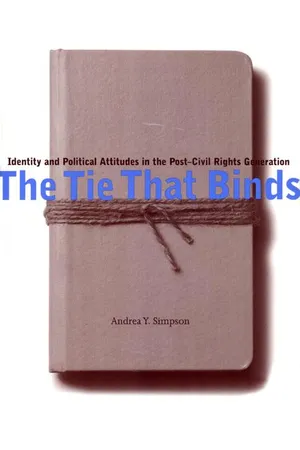
eBook - ePub
The Tie That Binds
Identity and Political Attitudes in the Post-Civil Rights Generation
- 202 pages
- English
- ePUB (mobile friendly)
- Available on iOS & Android
eBook - ePub
The Tie That Binds
Identity and Political Attitudes in the Post-Civil Rights Generation
About this book
Trusted by 375,005 students
Access to over 1.5 million titles for a fair monthly price.
Study more efficiently using our study tools.
Information
1
Introduction
This is a book about what it means to be black, specifically, what it means to be black to members of a generation who many hoped would never have to ponder such a question. It is also a book about how answers to this question influence this generations political attitudes. The perspectives of the young men and women in this book are critically important as the debate about the political effectiveness of racial solidarity versus coalition—building rages on. Will race continue to be a powerful and effective determinate of political outcomes? Has integration allowed the post-civil rights generation to build a bridge across the racial chasm in this country? According to the members of the post-civil rights generation featured here, the power of race to divide communities, destroy friendships, and determine opportunity has not been diminished. Racial segregation continues in the midst of integrated institutions—parallel universes of black and white.
Occupants of the black universe are the subjects of this book, and their perspectives are the foundation of this portrait of post-civil rights experiences. Earlier works on race, class, and gender explored similar issues. E. Franklin Frazier (1939) described and analyzed the evolution of the black family in America, including the development of class divisions. Frazier explained how social conditions throughout history—slavery, rural life, and the great migration to northern cities—resulted in cultural adaptations that allowed African-Americans to construct stable societies. The present work, too, indicates that black people are still finding ways to adapt to social conditions that meet the human need for acceptance and validation.
The conditions, limitations, and opportunities of city blacks in the post-World War II era were studied by Drake and Cayton ([1945] 1962). Relationships with whites, discrimination, political attitudes, school integration, and the sharing of public spaces were the phenomena they analyzed. Much of what they found—mistrust of whites and discomfort around whites—will be found here.
Recent work by Feagin and Sikes (1994) on the black middle class describes the nature of discrimination faced by blacks who are in majority—white settings. Parents of small children speak about the lack of books by and about blacks in school libraries, and the reluctance of teachers and librarians to advocate inclusion of these books. Black college students talk about subtle and not-so-subtle humiliations suffered at the hands of white professors. Black professionals talk about being shut out of the informal social circles that can help pave the way to success. Feagin and Sikes focus on the experience of racism in a variety of arenas. This work extends that focus to include the relationship between the experience of racism, the development of black identity, and the formation of political attitudes.
Race remains highly effective as a political wedge. Yet at the same time, political liaisons based on shared racial group membership are being criticized from many different quarters. For example, the need for gerrymandered electoral districts to increase opportunities for black residents to elect black representatives has been judged unconstitutional in many states, which implies that representation of blacks need not mean black representatives.1 What is really being contested here is the significance of racial group identity and the viability of a unique black experience. In other words, if serving an African-American constituency does not require any special knowledge or understanding about African-Americans as a group, it follows that African-Americans do not have any needs particular to their group. Anyone is capable of representing their interests.
A question around which much racial tension has accumulated of late is whether affirmative action is still necessary or justified. Are African-Americans so subjugated and disadvantaged as a group that extraordinary measures should be taken to ensure equal opportunity? If the decisions and behavior of the individual determine life chances and experiences, then racial policies should be abandoned. But if racial group membership, despite the decisions and behavior of the individual, does affect life chances and experiences, then racial policies remain necessary. Additionally, members of this group may indeed have a deeper comprehension of the social and political dynamics of the group, and may use this knowledge to better serve them. This is not to suggest that members of other groups are constitutionally incapable of serving a black constituency, only that the reality of black group identity makes black representation meaningful.
Despite strident commentary from whites and blacks on the destructiveness of race-based politics, major studies demonstrate that race remains salient for African-Americans and that most African-Americans retain solid racial identities.2 One of the fundamental reasons cited for this phenomenon is the continuing economic inequality between whites and blacks, feeding the perception that widespread discrimination persists. Racially charged events such as the beating of Rodney King and revelations of continuing police brutality—as in the case of the Los Angeles and Philadelphia police departments—only reinforce this perception.
It is clear that individual blacks feel connected to other blacks, profoundly influencing political attitudes and behavior. The subjects of this book tell us that this feeling is not always one of collective fate. For example, some believe that their socioeconomic status and education insulates them from the problems of poorer and uneducated blacks, but obligates them to help solve those problems. Helping sometimes means voting for the party or policy that will benefit the poorest among the group. It can also mean tutoring or mentoring young people, or organizing community groups. In other words, some members of the “integration generation” would like to expand the definition of blackness beyond shared experiences of discrimination or a sense of collective fate. Glenn Loury has written that he is “more than the one wronged, misunderstood, underestimated, derided, or ignored by whites.”3 Desmond Apprey, one of the students you will meet here, sarcastically says, “What does it take to be black? Oh, is there a list we have? Black, OK, at one time you had to have kente cloth. See—I’m out.”
What is the root cause of racial identity, in this case black identity? One of the young men interviewed here believes that the racist attitudes of whites force blacks to construct a black identity. This is what Du Bois (1903) meant by his lament that blacks are forced to see themselves through the eyes of others—as if through a veil. For Du Bois, and for some of the students here, the image is a negative one. Others believe that black identity is an inherent, fixed attribute. If black identity is constructed, what factors influence its manifestation? This book reveals how environment, class, and experiences with racism contribute to individual beliefs about what it means to be black.
The question of racial group identity leads to another, more politically significant, question about political attitudes regarding racial issues. If black identity has been weakened by integration, can the tradition of Democratic liberalism continue in the black community? Are blacks going to continue to be united on issues of affirmative action and civil rights? In recent years a number of black conservatives, espousing anti-affirmative action views and calling for a color-blind society, have emerged. Scholars have been unable to identify a significant constituency for these views in the black community. Yet there are two organizations of Young Republicans at historically black colleges. Could there be a conservative wave forming among members of the “integration generation”?
Developments on the Right
In the past several years, two kinds of African-American conservatives have achieved national prominence. One is a product of the Reagan-Bush era, a true believer in the free market, small government, and personal responsibility as the formula for the good life. The other kind is also a believer in the free market, less reliance on government (though not necessarily small government), personal responsibility, and is influenced by black nationalism. The latter kind of conservative also believes ardently in the conservation of African-American culture, which involves some separation, mainly social and economic, from the majority culture.
These two groups of conservatives have shared the spotlight in several compelling events and developments. First, the confirmation hearings on the nomination of Clarence Thomas to the Supreme Court in October 1991 paraded before the mass public many of those rarely seen, but much talked, about black conservative politicos of the Reagan-Bush era. These conservative blacks testified on behalf of Justice Thomas during the hearings that followed Anita Hill’s accusations that Thomas had sexually harassed her during her tenure at the Department of Education’s Commission on Civil Rights. They included men and women, many of whom held positions in the Bush administration, and others who had attended law school with Thomas. Their conservatism was apparent from their partisan affiliation (most were Republicans), as well as obvious indications that they shared many of Thomas’s political views. What has often been overlooked in the valorization of Anita Hill is that she was essentially the same kind of conservative as Clarence Thomas.
In the wake of the hearings, publications critical of affirmative action by writers such as Shelby Steele and Stephen Carter have staked out important and controversial positions. Steele (1990) and Carter (1991) both wrote books arguing that affirmative action does more harm than good by saddling blacks with the stigma of inferiority. According to Kinder and Sanders (1996), white opposition to affirmative action in college admissions triggers opposition to other kinds of racial policies. This opposition comes from the perception of personal racial threat-that the blacks who are admitted may take the place of family members and friends who are more deserving. The animosity generated by affirmative action in college admissions may be part of what is driving the students here to conservatism-both black nationalist and Republican Party conservatism. Both brands of conservatism advocate self-help and individual responsibility. Sensitivity to anti-affirmative action sentiments can lead to different forks on the same road.
In October 1995, Louis Farrakhan, leader of the Nation of Islam, organized the “Million Man March” in Washington, D.C. The march, according to Farrakhan, was to atone for the failure of black men to care properly for their families and their communities. Adolph Reed has said that “as a friend of mine aptly noted, it was the first protest in history where people gathered ostensibly to protest themselves” (Reed 1995). This event attracted somewhere between 800,000 and 1.5 million men, and was televised on the Cable News Network (CNN) in its entirety. Marchers came from all walks of life; the march cut across socioeconomic strata, age, and region. It raised Farrakhan to a new level of national prominence, and was a tangible demonstration of the palliative power of Farrakhans rhetoric.
These developments beg questions about how race is being transformed within the post-civil rights black community. What has contributed to the popularity of both kinds of conservatism? What role has integration played in either of these movements? What are the possible political outcomes of these phenomena?
The Black Solidarity Imperative
A conservative trend among African-Americans, at least on issues of government spending and policies concerning racial equality, has yet to be confirmed by systematic research (Tate 1994; Dawson 1994; Gilliam 1986). African-Americans tend to be highly homogeneous ideologically, with blacks voting overwhelmingly Democratic in presidential elections (Smith and Seltzer 1985:105; Asher 1988:82). This trend has persisted through all modern presidential elections.
African-American political solidarity has persisted in part because of the strength of racial group identity, or group consciousness. Research shows that black group consciousness is an important factor in determining levels of participation (Verba and Nie 1972). African-American group consciousness was a catalyst for the political activism of the 1960S and 1970S. Distinctions are sometimes made between group identification and group consciousness (Miller et al. 1981). The former can be characterized as the objective classification of the individual-the group to which a person can be assigned, or assigns him-or herself, without subjective considerations. The latter is the politicization of that identity-the awareness that the objective group to which the individual belongs is denied certain benefits and privileges by society, thereby denying the individual benefits. Consciousness can also be defined as “feelings of closeness” to other blacks (Demo and Hughes 1990; Allen, Dawson, and Brown 1989; Gurin, Miller, and Gurin 1980). Extending these definitions to blacks in particular, it would be possible to feel kinship with blacks without feeling that systemic inequities are to blame for the status of blacks. Scholars in this field use both terms, “identity” and “consciousness,” interchangeably. In this work, the term “identity” connotes feelings of closeness to other blacks and the degree to which respondents believe that society oppresses blacks as a group.
Assimilation and the Psychology of Nigrescence
We cannot discuss the salience of group identification without addressing assimilation. The goal of integration was not to eliminate the cultural identity of blacks, but to facilitate an understanding and acceptance of that identity. It has failed, and members of the post-civil rights generation are as race-conscious as previous generations. What is assimilation, and why has it been impossible for blacks to achieve? What keeps black identity so dynamic?
Assimilation is a concept that holds some negative connotations in contemporary thinking about race relations. Some think of assimilation as the obliteration of the culture of the minority in a fashion that denigrates the minority culture. One of the reasons that assimilation has been disparaged is that it is associated with the idea that ethnic groups, particularly African-Americans, have nothing of value to preserve in their own cultures. Assimilation is thus perceived as the abandonment of the core identity of the individual, and perhaps even more important, as a concession in the cold war for cultural dominance.
Others subscribe to the view that assimilation is the incorporation of the minority culture, which helps to form a hybrid culture. The hybrid culture, and ultimately the dominant culture, would be “American” culture. However, not only is “American” culture dominated by Anglo-American ideals, but African-Americans, Latinos, Native Americans, and Asian-Americans often find that the battle for acceptance continues in spite of efforts to fit in. The experience of individuals who have come to identify as completely American, only to realize that they are not in fact accepted as such, can result in the development of the “marginal man,” caught between his ethnic group and the group with which he identifies.4 It may also result, as we will see, in the development of an acute awareness of the importance of ethnic group membership.
Part of the current racial debate is about whether it is possible for minorities to maintain a separate and distinct subculture and achieve economic, political, and social equality. For many the ideal solution is to eliminate ignorance of, and prejudice against, minority groups through education. This way minority groups could preserve their history and folkways, yet enjoy a primary benefit of assimilation-the elimination of discrimination and full integration into the social fabric of the majority.
Integration into the social fabric of the majority requires that members of the minority develop primary relationships with members of the majority (Gordon 1964). Primary relationships are ones in which people interact on a personal basis. They share all aspects of their lives and spend leisure time together. Secondary relationships, on the other hand, are those in which people share only segments of their lives-work, or perhaps a hobby. These relationships are formal. Most relationships between blacks and whites are secondary ones. One of the reasons for this is that whether rich or poor, blacks remain residentially segregated. In fact, if more than a few African-American families move into an all-white neighborhood, the neighborhood rapidly “turns over,” with black families replacing the white families that move out ...
Table of contents
- Cover Page
- Title Page
- Copyrighht Page
- Dedication
- Contents
- List of Figures and Tables
- Acknowledgments
- 1 Introduction
- 2 The Conservatives, Part 1
- 3 The Conservatives, Part 2:
- 4 Issues of Empowerment and Liability:
- 5 Identity and Integration:
- 6 The Tie That Binds and Redeems:
- Appendix A
- Appendix B
- Notes
- Works Cited
- Index
- About the Author
- Footnotes
Frequently asked questions
Yes, you can cancel anytime from the Subscription tab in your account settings on the Perlego website. Your subscription will stay active until the end of your current billing period. Learn how to cancel your subscription
No, books cannot be downloaded as external files, such as PDFs, for use outside of Perlego. However, you can download books within the Perlego app for offline reading on mobile or tablet. Learn how to download books offline
Perlego offers two plans: Essential and Complete
- Essential is ideal for learners and professionals who enjoy exploring a wide range of subjects. Access the Essential Library with 800,000+ trusted titles and best-sellers across business, personal growth, and the humanities. Includes unlimited reading time and Standard Read Aloud voice.
- Complete: Perfect for advanced learners and researchers needing full, unrestricted access. Unlock 1.5M+ books across hundreds of subjects, including academic and specialized titles. The Complete Plan also includes advanced features like Premium Read Aloud and Research Assistant.
We are an online textbook subscription service, where you can get access to an entire online library for less than the price of a single book per month. With over 1.5 million books across 990+ topics, we’ve got you covered! Learn about our mission
Look out for the read-aloud symbol on your next book to see if you can listen to it. The read-aloud tool reads text aloud for you, highlighting the text as it is being read. You can pause it, speed it up and slow it down. Learn more about Read Aloud
Yes! You can use the Perlego app on both iOS and Android devices to read anytime, anywhere — even offline. Perfect for commutes or when you’re on the go.
Please note we cannot support devices running on iOS 13 and Android 7 or earlier. Learn more about using the app
Please note we cannot support devices running on iOS 13 and Android 7 or earlier. Learn more about using the app
Yes, you can access The Tie That Binds by Andrea Y Simpson,Andrea Y. Simpson in PDF and/or ePUB format, as well as other popular books in Politics & International Relations & Civil Rights in Politics. We have over 1.5 million books available in our catalogue for you to explore.