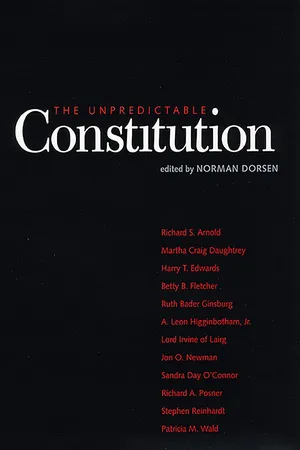
The Unpredictable Constitution brings together a distinguished group of U.S. Supreme Court Justices and U.S. Court of Appeals Judges, who are some of our most prominent legal scholars, to discuss an array of topics on civil liberties.
In thoughtful and incisive essays, the authors draw on decades of experience to examine such wide-ranging issues as how legal error should be handled, the death penalty, reasonable doubt, racism in American and South African courts, women and the constitution, and government benefits.
Contributors: Richard S. Arnold, Martha Craig Daughtry, Harry T. Edwards, Ruth Bader Ginsburg, Betty B. Fletcher, A. Leon Higginbotham, Jr., Lord Irvine of Lairg, Jon O. Newman, Sandra Day O'Connor, Richard A. Posner, Stephen Reinhardt, and Patricia M. Wald.
- 347 pages
- English
- ePUB (mobile friendly)
- Available on iOS & Android
eBook - ePub
The Unpredictable Constitution
About this book
Information
Chapter 1
Government Benefits
Tonight I am going to talk about an old problem in constitutional law: the volatile relationship between constitutional rights and government benefits. In my view, the jury-rigged doctrine of rights and benefits we are now living with deserves serious reconsideration. One aspect of that doctrine—unconstitutional conditions—may still be in flux but is moving swiftly backwards; another—fourteenth amendment procedural due process rights—seems static for the moment, mired in unattractive premises. In the current climate, many civil libertarians dread the idea of unsettling precedent. They would, in Hamlet’s words, “rather bear the ills we have, than fly to others that we know not of.”1 Yet that attitude may be too timorous. As we pass through the bicentennial and enter the twenty-first century, we should not be afraid to propose changes in law or doctrine we believe are necessary—we must not accept as irreversible the battles we have lost in the past.
I begin with two recent Supreme Court decisions. The first, decided in the 1989 term, is DeShaney v. Winnebago County Department of Social Services,2 a suit for damages under section 1983.3 The facts were these:4 infant Joshua DeShaney, placed in his father’s custody after his parents’ divorce, was physically beaten so regularly and so badly that he suffered permanent brain damage. Officials of the county Department of Social Services regularly received distress calls from neighbors and emergency room attendants that Joshua was being abused by his father. At one point the Department temporarily placed the boy in custodial care, but shortly returned him to his father. His social worker kept orderly records of the calls and of suspicious conditions in the home but did not again try to remove the boy. “I just knew,” she said later, “the phone would ring someday and Joshua would be dead.”5 After his final beating, Joshua’s mother sued the county, its Department of Social Services, and various department employees, contending that Joshua had been deprived of his liberty in violation of the due process guarantee of the fourteenth amendment.
This lecture was delivered on October 26, 1989, and appeared in 65 N.Y.U.L. Rev. 247 (1990).
The Supreme Court affirmed the trial court’s dismissal, holding that Joshua’s loss of liberty could not be attributed to any unconstitutional action by the state.6 The due process clause, the Court announced, “is phrased as a limitation on the State’s power to act, not as a guarantee of certain minimal levels of safety and security.”7 The Court reasoned that, since the county had no obligation to provide child welfare services in the first place, it could not be held liable when the Department of Social Services failed to provide protection to the child, no matter how vulnerable he was known to be or how inevitable the tragedy. The county’s sin was inaction, not action. It simply failed to do something helpful for Joshua; it did not do anything injurious to him, and that difference, the Court said, made all the difference for constitutional purposes.8
The second case, Ross v. Oklahoma,9 decided the Term before DeShaney, involved a death row defendant’s challenge to the composition of the jury which had sentenced him to death. The trial court had declined to excuse for cause a prospective juror who stated during voir dire that he would vote for a death sentence if the defendant were convicted; the defense instead had to use one of its nine peremptory challenges. The defendant contended on appeal that the trial court’s error deprived him of one of his scarce peremptory challenges in violation of the fourteenth amendment.10
The Supreme Court unanimously agreed that the trial court had erred in failing to strike the juror for cause, but a majority of the Court held that the error had no constitutional significance.11 Since the challenged juror did not sit on the panel which convicted and sentenced the defendant, the majority reasoned, the only injury to the defendant lay in the loss of a peremptory challenge; and “[b]ecause peremptory challenges are a creature of statute and are not required by the Constitution, it is for the state to determine the number of peremptory challenges allowed and to define their purpose and the manner of their exercise.”12 The defendant, in the Court’s words, had “received all that Oklahoma law allowed him,”13 and that in turn was all that the Constitution guaranteed. He had, in short, only been denied a benefit the state could have withheld in the first place.
Though the link between these two cases may not be immediately apparent, DeShaney and Ross were decided on common premises for due process purposes: both presumed that the denial or dilution of a mere privilege (as opposed to a right) properly can be characterized as government inaction, not action, and that there is a fundamental distinction between government inaction and government action that affirmatively harms an individual—that puts her in a worse position than she would have been in had government not acted. In DeShaney, that distinction was explicit: the Court said that the state’s failure to protect a child—even one it knew was in danger—did not constitute a deprivation of liberty. “While the State may have been aware of the dangers that Joshua faced in the free world, it played no part in their creation, nor did it do anything to render him any more vulnerable to them.”14 The Ross Court’s reliance on this distinction was less obvious, but no less real. Since the state was not constitutionally required to allow peremptory challenges, the defendant simply had been denied a gratuitous state benefit when he was forced to use a peremptory challenge to remedy an erroneous ruling on a challenge for cause.
In both Ross and DeShaney, the Court, critically, characterized the benefit the state failed to provide as a “gratuity” rather than a right. Thus, whether it is a “gratuitous” benefit or service that the state denied, or failed to provide, appears today to be the litmus test for whether constitutional harm has occurred. This mode of analysis has profound implications for our jurisprudence.
Over the years, the courts have developed several different verbal formulations for framing the issue. Sometimes it has been posed in terms of “rights” and “privileges”: a constitutional difference exists between the state’s power to infringe upon a right and its power to deny a mere privilege.15 The same distinction appears at other times under the rubric of “burden” and “benefit”: is the challenged government action a burden on the exercise of a citizen’s right or just a restriction on a benefit the government was not compelled to bestow?16 For certain kinds of benefits, the touchstone is “unconstitutional conditions”: was the individual’s access to government benefits conditioned upon his renunciation of constitutional rights?17
Whatever the verbal formulation, the premise remains the same: the Constitution enters at the point where the state constricts the individual’s freedom to pursue protected private activity. But when the state simply declines to confer a benefit upon an individual, it is far less clear when or if constitutional principles apply. An example: it is obvious that my first amendment rights are not violated if the government refuses to provide me with a copy of Ulysses. Even if I am indigent, no one else will give me the book, and the government’s refusal has the practical effect of denying me the opportunity to read it. The result will be no different even if the state institutes, then discontinues, a program of “Ulysses for the poor”; the mere fact that the government decides to provide a particular benefit does not create any vested right to its continued availability.
Yet, it is frightening to think that because something is a discretionary benefit in the first place, its denial on any grounds or in any circumstance has no constitutional significance. The Constitution, after all, imposes virtually no affirmative obligations upon the states.18 A state is probably required to establish a judicial system, and perhaps to provide police protection, but that is about it. Virtually every other service that government offers could be characterized as a privilege, in the sense that the government could withdraw it entirely. If the characterization of a government program as a privilege or gratuity removes it entirely from constitutional scrutiny, then government possesses almost infinite power to control and manipulate every aspect of our daily lives.
In fact, as government expands its role in the lives of citizens—supplying food, jobs, travel, communication, information, housing, student loans—it can no longer plausibly be contended that their loss is simply the loss of a “windfall.” Questions concerning the dispersal of government largesse that once were at the periphery of constitutional adjudication today lie at its core.
My worry is that the Supreme Court, especially in recent years, has dealt with these issues in mechanical, even casual, ways, that cumulatively could significantly diminish our constitutional protections from arbitrary or even malevolent government action or inaction. In two groups of cases—those in which the Court considers alleged “unconstitutional conditions” that have been imposed on the delivery of government services or benefits, and those in which the Court tries to define government actions giving rise to procedural protections under the due process clause of the fourteenth amendment—the Court has developed a highly formalistic jurisprudence. It applies constitutional protections on the basis of whether the government withholds a service or benefit awarded to others or effectively takes away something from a citizen that belonged to him to begin with. This distinction means little in the real world; it now means everything in constitutional terms. How did we arrive at this paradox?
I. Unconstitutional Conditions
A. Historical Evolution of the Problem
At the turn of the century, prevailing doctrine held that access to government benefit programs was a privilege which the state could grant or withhold on virtually any terms it chose. In McAuliffe v. Mayor of New Bedford in 1892,19 Justice Holmes, while still on the Massachusetts Supreme Judicial Court, rejected a policeman’s challenge to his dismissal for violation of a regulation limiting his political activities.20 Said Holmes, “The petitioner may have a constitutional right to talk politics, but he has no constitutional right to be a policeman.”21 In one sense, Holmes’s analysis was stunningly unresponsive. McAuliffe had not contended that he had a constitutional right to be a policeman. His claim was that his constitutional right to freedom of speech was infringed by his dismissal. Holmes’s rationale makes sense only if we accept a second, unspoken, premise: that an unconstitutional infringement of speech occurs only if the sanction for exercising free speech is the deprivation of some other right, such as the right to liberty or property, rather than just the denial of a government benefit.
In Hamilton v. Regents of the University of California,22 forty-two years later, the Supreme Court echoed the same view. In that case, male students challenged on religious grounds the university’s requirement that they complete a course in military science and tactics. “California,” the Court held, “has not drafted or called them to attend the university. They are seeking education offered by the State and at the same time insisting that they be excluded from the prescribed course solely upon grounds of their religious beliefs and conscientious objections to war.”23 In the Court’s view, California had satisfied the Constitution’s requirements by affording its citizens a choice betwee...
Table of contents
- Cover Page
- Title Page
- Copyright Page
- Contents
- Acknowledgments
- Introduction
- 1 Government Benefits: A New Look at an Old Gift Horse
- 2 Racism in American and South African Courts: Similarities and Differences
- 3 Portia’s Progress
- 4 Speaking in a Judicial Voice
- 5 Beyond “Reasonable Doubt”
- 6 The Death Penalty in America: Can Justice Be Done?
- 7 To Err Is Human, but Not Always Harmless: When Should Legal Error Be Tolerated?
- 8 How James Madison Interpreted the Constitution
- 9 Against Constitutional Theory
- 10 The Anatomy of an Execution: Fairness versus “Process”
- 11 Women and the Constitution: Where We Are at the End of the Century
- 12 Sovereignty in Comparative Perspective: Constitutionalism in Britain and America
- Contributors
- Index
Trusted by 375,005 students
Access to over 1.5 million titles for a fair monthly price.
Study more efficiently using our study tools.
Frequently asked questions
Yes, you can cancel anytime from the Subscription tab in your account settings on the Perlego website. Your subscription will stay active until the end of your current billing period. Learn how to cancel your subscription
No, books cannot be downloaded as external files, such as PDFs, for use outside of Perlego. However, you can download books within the Perlego app for offline reading on mobile or tablet. Learn how to download books offline
Perlego offers two plans: Essential and Complete
- Essential is ideal for learners and professionals who enjoy exploring a wide range of subjects. Access the Essential Library with 800,000+ trusted titles and best-sellers across business, personal growth, and the humanities. Includes unlimited reading time and Standard Read Aloud voice.
- Complete: Perfect for advanced learners and researchers needing full, unrestricted access. Unlock 1.5M+ books across hundreds of subjects, including academic and specialized titles. The Complete Plan also includes advanced features like Premium Read Aloud and Research Assistant.
We are an online textbook subscription service, where you can get access to an entire online library for less than the price of a single book per month. With over 1.5 million books across 990+ topics, we’ve got you covered! Learn about our mission
Look out for the read-aloud symbol on your next book to see if you can listen to it. The read-aloud tool reads text aloud for you, highlighting the text as it is being read. You can pause it, speed it up and slow it down. Learn more about Read Aloud
Yes! You can use the Perlego app on both iOS and Android devices to read anytime, anywhere — even offline. Perfect for commutes or when you’re on the go.
Please note we cannot support devices running on iOS 13 and Android 7 or earlier. Learn more about using the app
Please note we cannot support devices running on iOS 13 and Android 7 or earlier. Learn more about using the app
Yes, you can access The Unpredictable Constitution by Norman Dorsen in PDF and/or ePUB format, as well as other popular books in Law & Public Law. We have over 1.5 million books available in our catalogue for you to explore.