A spirited collection of essays that get to the heart of what gives popular culture its emotional impact
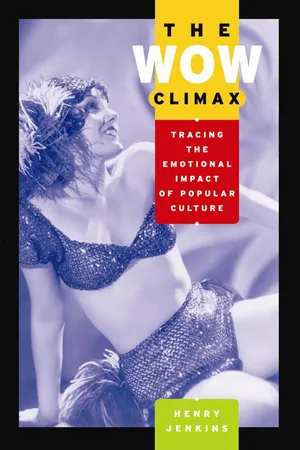
Vaudevillians used the term "the wow climax" to refer to the emotional highpoint of their acts—a final moment of peak spectacle following a gradual building of audience's emotions. Viewed by most critics as vulgar and sensationalistic, the vaudeville aesthetic was celebrated by other writers for its vitality, its liveliness, and its playfulness.
The Wow Climax follows in the path of this more laudatory tradition, drawing out the range of emotions in popular culture and mapping what we might call an aesthetic of immediacy. It pulls together a spirited range of work from Henry Jenkins, one of our most astute media scholars, that spans different media (film, television, literature, comics, games), genres (slapstick, melodrama, horror, exploitation cinema), and emotional reactions (shock, laughter, sentimentality). Whether highlighting the sentimentality at the heart of the Lassie franchise, examining the emotional experiences created by horror filmmakers like Wes Craven and David Cronenberg and avant garde artist Matthew Barney, or discussing the emerging aesthetics of video games, these essays get to the heart of what gives popular culture its emotional impact.
- 285 pages
- English
- ePUB (mobile friendly)
- Available on iOS & Android
eBook - ePub
About this book
Information
PART I
The Lively Arts
In 1924, the cultural critic Gilbert Seldes wrote an essential book on the popular aesthetic, The Seven Lively Arts, making what was then a bold argument—that America’s greatest cultural contributions in the twentieth century would come not from imitating the great art traditions of Europe, but rather from exploring emerging idioms such as jazz, Broadway musicals, cinema, and comic strips.1 Seldes sought an aesthetic language for discussing these “lively arts,” one that emphasized energy, virtuosity, and kinetics rather than nuance, narrative, or thematic ambitions, and he was not afraid to apply this vocabulary to talk about what excited him about Picasso and the emergence of modern art. His book is seldom read today because it is so preoccupied with describing the emotional dynamics of specific performances rather than making grand statements, but it contains core insights that continue to shape the study of popular culture.
In “Games, the New Lively Art” I attempt to tease out some of Seldes’s core claims about popular culture and apply them to the study of computer and video games. This essay emerged from a series of workshops that I and other faculty in the MIT Comparative Media Studies Program conducted with key “creative leaders” at Electronic Arts, one of the preeminent games publishers. As we sat around a seminar table with leading game designers, it was clear that they already had a well-developed framework for thinking about their craft, but they felt that discourse on games as “art” strengthened their hands in dealing with the management and marketing divisions of their own company, who were often hostile to experimentation and innovation. When I presented the earliest formulation of these ideas in Technology Review and in the arts section of the New York Times, I was struck by the public resistance to the idea that games might be considered art. I pondered yet again how radical Seldes’s assertions about the value of slapstick comedy or comic strips must have seemed the better part of a century ago. Today we take such arguments for granted, but we still have difficulty extending them to newer forms of popular art. I used to joke that by the end of the twenty-first century, some guy in an arm chair would be urging Public Television viewers to think back nostalgically over a century of artistic accomplishment in game design. It turns out that I didn’t need to wait so long: a recent PBS documentary, The Video Game Revolution, opened with a guy in an arm chair and included me as one of the talking heads helping viewers develop an aesthetic appreciation of games. Games have gone a long way toward cultural respectability and artistic accomplishment over the past few decades, but what will come in the future will boggle people’s brains.
The French cultural theorist Pierre Bourdieu rather famously sets forth the differences between popular and bourgeois aesthetics in his book Distinction. On the one hand, he argues, the popular aesthetic reflects “a deep-rooted demand for participation … the desire to enter into the game, identifying with the character’s joys and sufferings, worrying about their fate, espousing their hopes and ideals, living their life.”2 By contrast, Bourdieu argues that the bourgeois aesthetic values “disinvestment, detachment, indifference.”3 Bourdieu associates the bourgeois aesthetic with “the icy solemnity of the great museums, the grandiose luxury of the opera-houses and major theatres, the décor and decorum of concert halls.”4 The popular spectacles of circus and melodrama, on the other hand, are “less formalized … and less euphemized, they offer more immediate satisfactions. … They satisfy the taste for and sense of revelry, the plain speaking and hearty laughter which liberate by setting the social world head over heals, overturning conventions and proprieties.”5
Working in a different intellectual tradition, Lawrence Levine arrives at a very similar set of conclusions when he seeks to understand how Shakespeare became a central and “sacred” part of American culture. In the nineteenth century, Shakespeare’s plays were quoted in vaudeville routines on the decks of showboats and performed in blackface as part of minstrel shows. The emphasis was on the broad humor and the raw emotional power of Shakespeare’s stories, not necessarily on the lyricism of his language. Americans of all classes shared a fascination with the vibrant, larger-than-life personalities of the great Shakespearean performers, whose images were marketed on cheap postcards that people collected much as we collect baseball cards today. And the theatrical practices of the time encouraged the kinds of participation Bourdieu saw as so central to the popular aesthetic: “To envision nineteenth-century theater audiences correctly, one might do well to visit a contemporary sporting event in which the spectators not only are similarly heterogeneous but also … more than an audience; they are participants who can enter into the action on the field, who feel a sense of immediacy and at times even of control, who articulate their opinions and feelings vocally and unmistakably.”6 In the late nineteenth century, however, Shakespeare gradually became separated from popular culture by the belief that true understanding and appreciation of the “immortal bard” required specialized training and cultivated tastes. Educators argued that one needed to be taught to comprehend works that only a few decades earlier had been assumed to be immediately available to the bulk of the population. Levine writes about the “sacralization” of Shakespeare as the imposition of a kind of emotional distance and intellectual rigor on the part of the spectator and an emotional constraint on the part of the performer. Shakespeare, in other words, became an acquired taste, and over time fewer people made the effort to master these plays, until Shakespeare came to be regarded by many as something stuffy and boring.
John Kasson has similarly explored how emotional constraint and outburst came to demarcate different sets of class norms in nineteenth-century America. As the century progressed, the culture of popular participation gave way to more and more regulations on audience behavior, a process he describes as “the disciplining of spectatorship.”7 Read through Kasson’s account, we might see the “wow climax” in vaudeville as holding onto the play with passions that was under siege elsewhere in the culture. Yet, how then do we explain the persistence of the “wow climax” across a range of different forms of contemporary popular culture? As I will suggest in the next section, these powerful emotions were not so much repressed as managed.
Even though popular culture is widely consumed across all levels of our society, there is still a tendency to associate it with the lower orders. As I discover almost every time I go to a cocktail party, there are people out there who are excessively proud of the fact that they do not own a television set, go to movies, play games, or read comics. Somehow, the assertion that “I don’t even own a book” doesn’t carry the same weight! Yet, they are equally bone-headed statements in the modern era.
Arguably, Bourdieu is at his best as a critic of the bourgeois aesthetic, stripping aside its claims to neutrality in order to demonstrate how it is bound up with class privilege. Despite his core insights into the emotional intensity of popular culture, Bourdieu falls back on the old idea that less learning and skill are needed to consume it. More accurately, popular culture depends on skills we acquire outside formal education. We can probably describe in great detail the first time we set foot in an art museum, but few of us will remember our first experience watching television. The skills needed to make sense of popular texts emerge through informal education practices as we spend time consuming media with friends and family. Yet, those who lack such skills—and this would include any number of so-called intellectuals who tend to look down their noses at popular culture—misread television every bit as badly as a country bumpkin might who finds himself trying to make sense of modern dance.
Building on this insight, cultural studies theorists have increasingly investigated the process of popular discrimination and evaluation, perhaps most vividly in the essays gathered by Alan McKee in the anthology Beautiful Objects in Popular Culture. As McKee writes in the introduction, “When audiences don’t rely on intellectuals to guide them in their cultural consumption, they engage in detailed debates about what’s good, what’s bad, and how you would make these judgments. The consumers of popular culture already have aesthetic systems in place, which play a part in the intellectual work involved in making decisions about which trashy magazines to buy, which vulgar television programs to view, which dirty websites to visit.”8 McKee asked his contributors to write about what they saw as the “best” example of a particular form of popular culture and then to ground that assessment with a consideration of how evaluations get made within that popular tradition. I chose to write about Brian Michael Bendis as one of the best contemporary mainstream superhero comic-book writers, unpacking each of those modifiers to show how they represent specific criteria and contexts for evaluating comic books. I cited two competing publications that evaluate comics—Wizard, which praises artists and writers who work within the mainstream superhero genre, and Comics Journal, which celebrates aesthetic experimentation within the alternative comic books sphere. For me, personally, the most interesting work gets neglected by both publications—work that is innovative and yet accessible, that builds on genre traditions but spins them out in surprising new directions.
As the example above suggests, popular critics, no less than intellectuals, can assert too sharp a distinction between popular and high art, not recognizing the many contact zones between the two. Consider, for example, Village Voice film critic J. Hoberman’s essay “Vulgar Modernism.” Hoberman proposes a canon of American popular artists, mostly from the 1950s, whom he describes as “the vulgar equivalent of modernism itself,” in some cases drawing direct parallels, as when he speaks of Tex Avery as “the Manet of Vulgar Modernism” or talks about the “distanciation devices” found in Chuck Jones’s Duck Amuck.9 Hoberman’s essay directed overdue critical attention on folks like Frank Tashlin, Harvey Kurtzman, Will Elder, and Ernie Kovacs. Yet, he may overstate his case when he refers to such work as “vulgar modernism.” Many comic-strip artists, from the turn of the century forward, came from art school backgrounds and often took classes from or alongside leading American modernist artists; they often directly quoted from and responded to specific artists and their work. In what sense can their work be called “vulgar”? They certainly are not vulgar in the sense that their work is uninformed by the practices of modern art. Perhaps they might be called “vernacular” in the sense that they choose to operate outside of that art world, adopting different aesthetic principles more appropriate to alternative contexts of production and consumption. Would we not be better off saying that these artists carried out modernist goals and impulses through other means, rather than imagining them as naïve or primitive artists who don’t quite understand what they are doing?
My essay on Matthew Barney examines the increasingly blurry lines between popular culture and modern art. Barney has freely acknowledged being a fan of many forms of contemporary popular culture, particularly horror films. When I was approached by the Guggenheim Museum to write an essay on this significant contemporary artist, I was initially reluctant, arguing that I was a specialist on American popular culture and had never written about experimental art. Yet, as I began to read the critical writing about Barney’s Cremaster cycle, it was clear that his work was often discussed in relation to popular culture by art critics who had little or no real appreciation of the genre traditions that inspired him. I was angered by the ease with which these writers dismissed David Cronenberg, Clive Barker, or Wes Craven, seeing their work not as accomplished popular art interesting on its own terms, but rather reading horror cinema as a junkyard from which Barney could raid spare parts. As someone who has written extensively about fan creativity, I had no trouble valuing Barney’s appropriations as expanding the range of meanings associated with the horror genre, but I would be damned if I would see his deployment of these borrowed materials as elevating their status. The resulting essay respects both Barker and Barney, showing the commonality of their interests, while acknowledging the very different kinds of emotional responses they court—the intensification of affect in popular horror films and the dissociation in Barney’s installation pieces. I was asked to rewrite it again and again; in the end, the Guggenheim bowed to Barney’s own wish to avoid comparisons with other artists, high or low. I was frankly shocked that any artist could exert such great control over how his work was discussed. This essay appears in print for the first time in this collection.
1
Games, the New Lively Art
Another important element is a belief that creators are artists. At the same time, however, it’s necessary for us creators to be engineers, because of the skill required for the creations.1
—Shigeru Miyamoto, Nintendo
Why can’t these game wizards be satisfied with their ingenuity, their $7 billion (and rising) in sales, their capture of a huge chunk of youth around the world? Why must they claim that what they are doing is “art”? … Games can be fun and rewarding in many ways, but they can’t transmit the emotional complexity that is the root of art.2
—Jack Kroll, Newsweek
Let’s imagine games as an art form. I know, I know—for many of us in contact with the so-called real arts, the notion sounds pretentious. It also makes developers who are former computer science majors edgy because it challenges assumptions that games are founded upon technology. Still, it’s a useful concept. It’s especially useful when we start to think about the mediocre state of our profession and about ways to elevate our aims, aspirations, and attitudes.3
—Hal Barwood, LucasArts
Over the past three decades, computer and video games have progressed from the primitive two-paddles-and-a-ball Pong to the sophistication of Final Fantasy, a participatory story with cinema-quality graphics that unfolds over nearly 100 hours of game play, or Black & White, an ambitious moral tale where the player’s god-like choices between good and evil leave tangible marks on the landscape.4 The computer game has been a killer app for the home PC, increasing consumer demand for vivid graphics, rapid processing, greater memory, and better sound. One could make the case that games have been to the PC what NASA was to the mainframe—the thing that pushes forward innovation and experimentation. The release of the Sony PlayStation 2, the Microsoft Xbox, and the Nintendo GameCube signals a dramatic increase in the resources available to game designers.
In anticipation of these new technological breakthroughs, people within and beyond the games industry began to focus on the creative potentials of this emerging medium. Mapping the aesthetics of game design, they argued, would not only enable them to consolidate decades of experimentation and innovation but would also propel them toward greater artistic accomplishment. Game designers were being urged to think of themselves not simply as technicians producing corporate commodities but rather as artists mapping the dimensions and potentials of an emerging medium; this reorientation, it was hoped, would force them to ask harder questions in their design meetings and to aspire toward more depth and substance in the product they shipped. At the same time, the games industry confronted increased public and government scrutiny. If you parsed the rhetoric of the moral reformers, it was clear that their analogies to pollution or carcinogens revealed their base-level assumption that games were utterly without redeeming value, lacking any claim to meaningful content or artistic form. Seeing games as art, however, shifted the terms of the debate. Most of these discussions started from the premise that games were an emerging art form that had not yet realized its full potential. Game designer Warren Spector, for example, told a Joystick 101 interviewer, “We’re just emerging from infancy. We’re still making (and remaking!) The Great Train Robbery or Birth of a Nation or, to be really generous, maybe we’re at the beginning of what might be called our talkies period. But as Al Jolson said in The Jazz Singer, “You ain’t heard nothing yet!”5 In this context, critical discussions sought to promote experimentation and diversification of game form, content, and audience, not to develop prescriptive norms.
These debates were staged at trade shows and academic conferences, in the pages of national magazines (such as Newsweek and Technology Review) and newspapers (such as the New York Times), and in online zines aimed at the gaming community (such as Joystick 101 and Gamasutra). Game designers, policy makers, art critics, fans, and academics all took positions on the questions of whether computer games could be considered an art for...
Table of contents
- Cover Page
- Title Page
- Copyright Page
- Contents
- Introduction Wow!
- PART I The Lively Arts
- PART II The Immediate Experience
- PART III
- Index
- Notes
- About the Author
Trusted by 375,005 students
Access to over 1.5 million titles for a fair monthly price.
Study more efficiently using our study tools.
Frequently asked questions
Yes, you can cancel anytime from the Subscription tab in your account settings on the Perlego website. Your subscription will stay active until the end of your current billing period. Learn how to cancel your subscription
No, books cannot be downloaded as external files, such as PDFs, for use outside of Perlego. However, you can download books within the Perlego app for offline reading on mobile or tablet. Learn how to download books offline
Perlego offers two plans: Essential and Complete
- Essential is ideal for learners and professionals who enjoy exploring a wide range of subjects. Access the Essential Library with 800,000+ trusted titles and best-sellers across business, personal growth, and the humanities. Includes unlimited reading time and Standard Read Aloud voice.
- Complete: Perfect for advanced learners and researchers needing full, unrestricted access. Unlock 1.5M+ books across hundreds of subjects, including academic and specialized titles. The Complete Plan also includes advanced features like Premium Read Aloud and Research Assistant.
We are an online textbook subscription service, where you can get access to an entire online library for less than the price of a single book per month. With over 1.5 million books across 990+ topics, we’ve got you covered! Learn about our mission
Look out for the read-aloud symbol on your next book to see if you can listen to it. The read-aloud tool reads text aloud for you, highlighting the text as it is being read. You can pause it, speed it up and slow it down. Learn more about Read Aloud
Yes! You can use the Perlego app on both iOS and Android devices to read anytime, anywhere — even offline. Perfect for commutes or when you’re on the go.
Please note we cannot support devices running on iOS 13 and Android 7 or earlier. Learn more about using the app
Please note we cannot support devices running on iOS 13 and Android 7 or earlier. Learn more about using the app
Yes, you can access The Wow Climax by Henry Jenkins in PDF and/or ePUB format, as well as other popular books in Social Sciences & Media Studies. We have over 1.5 million books available in our catalogue for you to explore.