A crafted collection detailing western responses to the Balkan War
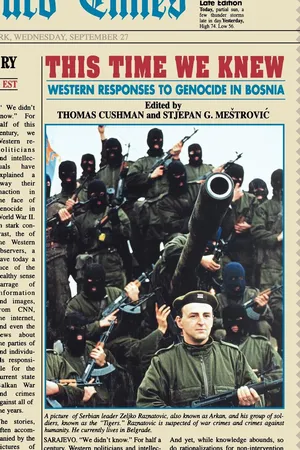
We didn't know. For half a century, Western politicians and intellectuals have so explained away their inaction in the face of genocide in World War II. In stark contrast, Western observers today face a daily barrage of information and images, from CNN, the Internet, and newspapers about the parties and individuals responsible for the current Balkan War and crimes against humanity. The stories, often accompanied by video or pictures of rape, torture, mass graves, and ethnic cleansing, available almost instantaneously, do not allow even the most uninterested viewer to ignore the grim reality of genocide.
And yet, while information abounds, so do rationalizations for non-intervention in Balkan affairs—the threshold of real genocide has yet to be reached in Bosnia; all sides are equally guilty; Islamic fundamentalism in Bosnia is a threat to the West; it will only end when they all tire of killing each other—to name but a few.
In This Time We Knew, Thomas Cushman and Stjepan G. Mestrovic have put together a collection of critical, reflective, essays that offer detailed sociological, political, and historical analyses of western responses to the war. This volume punctures once and for all common excuses for Western inaction. This Time We Knew further reveals the reasons why these rationalizations have persisted and led to the West's failure to intercede, in the face of incontrovertible evidence, in the most egregious crimes against humanity to occur in Europe since World War II.
Contributors to the volume include Kai Erickson, Jean Baudrillard, Mark Almond, David Riesman, Daniel Kofman, Brendan Simms, Daniele Conversi, Brad Kagan Blitz, James J. Sadkovich, and Sheri Fink.
eBook - ePub
This Time We Knew
Western Responses to Genocide in Bosnia
- 422 pages
- English
- ePUB (mobile friendly)
- Available on iOS & Android
eBook - ePub
About this book
Information
APPENDIX 1
A Definition of Genocide
Following is a definition of genocide by Raphael Lemkin, from Axis Rule in Occupied Europe: Laws of Occupation, Analysis of Government, Proposals for Redress (Washington, DC: Carnegie Endowment for International Peace, 1944), 79. The term “genocide” was coined by Lemkin specifically to describe the systematic murders carried out by Axis powers. Lemkin’s definition was the basis for the inclusion of the term “genocide” in the UN Geneva Conventions.
By “genocide” we mean the destruction of a nation or of an ethnic group. This new word, coined by the author to denote an old practice in its modern development, is made from the ancient Greek word genos (race, tribe) and the Latin cide (killing), thus corresponding in its formation to such words as tyrannicide, homicide, infanticide, etc. Generally speaking, genocide does not necessarily mean the immediate destruction of a nation, except when accomplished by mass killings of all members of a nation. It is intended rather to signify a coordinated plan of different actions aiming at the destruction of essential foundations of the life of national groups, with the aim of annihilating the groups themselves. The objectives of such a plan would be the disintegration of the political and social institutions, of culture, language, national feelings, religion, and the economic existence of national groups, and the destruction of the personal security, liberty, health, dignity, and even the lives of the individuals belonging to such groups. Genocide is directed against the national group as an entity, and the actions involved are directed against individuals, not in their individual capacity, but as members of a national group.
APPENDIX 2
Text of the United Nations Convention on the Prevention and Punishment of the Crime of Genocide
(U.N.G.C.) Resolution 260A (III), December 9, 1948
THE CONTRACTING PARTIES,
Having considered the declaration made by the General Assembly of the United Nations in its resolution 96 (I) dated 11 December 1946 that genocide is a crime under international law, contrary to the spirit and aims of the United Nations and condemned by the civilized world;
Recognizing that at all periods of history genocide has inflicted great losses on humanity; and
Being convinced that, in order to liberate mankind from such an odious scourge, international co-operation is required:
HEREBY AGREE AS HEREINAFTER PROVIDED:
Article I
The Contracting Parties confirm that genocide, whether committed in time of peace or in time of war, is a crime under international law which they undertake to prevent and to punish.
Article II
In the present Convention, genocide means any of the following acts committed with intent to destroy, in whole or in part, a national, ethnic, racial, or religious group, as such:
(a) Killing members of the group;
(b) Causing serious bodily or mental harm to members of the group;
(c) Deliberately inflicting on the group conditions of life calculated to bring about its physical destruction in whole or in part;
(d) Imposing measures intended to prevent births within the group;
(e) Forcibly transferring children of the group to another group.
Article III
THE FOLLOWING ACTS SHALL BE PUNISHABLE:
(a) Genocide;
(b) Conspiracy to commit genocide;
(c) Direct and public incitement to commit genocide;
(d) Attempt to commit genocide;
(e) Complicity in genocide.
Article IV
Persons committing genocide or any other acts enumerated in Article III shall be punished, whether they are constitutionally responsible rulers, public officials, or private individuals.
Article V
The Contracting Parties undertake to enact, in accordance with their respective Constitutions, the necessary legislation to give effect to the provisions of the present Convention and, in particular, to provide effective penalties for persons guilty of genocide or of any of the other acts enumerated in Article III.
Article VI
Persons charged with genocide or any of the other acts enumerated in Article III shall be tried by a competent tribunal of the State in the territory of which the act was committed, or by such international penal tribunal as may have jurisdiction with respect to those Contracting Parties which shall have accepted its jurisdiction.
Article VII
Genocide and the other acts enumerated in Article III shall not be considered as political crimes for the purpose of extradition.
• • •
The Contracting Parties pledge themselves in such cases to grant extradition in accordance with their laws and treaties in force.
APPENDIX 3
Indictments by the International Criminal Tribunal for the Former Yugoslavia
Following is a series of indictments issued by the International Criminal Tribunal for the Former Yugoslavia against Bosnian Serbs for war crimes, crimes against humanity, and genocide. We include the indictments against Radovan Karadžić and Ratko Mladić as well as the indictments against supervisors, guards, and civilians from the Omarska concentration camp in northern Bosnia. We offer here examples of indictments that name specific crimes: there are many more defendants and many more crimes named in other indictments. These are provided to give the reader a sense of the extent to which Bosnian Serb leaders were involved in war crimes, crimes against humanity, and genocide. In addition, the specific charges laid against the individuals named in the indictments provide illustrations of the heinous and barbaric nature of the alleged crimes. It is doubtful whether such indictments will lead to actual prosecution and punishment of war criminals, since, in most cases, the defendants named in the indictments remain sheltered in Serb-controlled Bosnia-Herzegovina or in Serbia proper. Such crimes continued even as “peace talks” were being held in the United States in November 1995.
THE INTERNATIONAL CRIMINAL TRIBUNAL FOR THE FORMER
YUGOSLAVIA
THE PROSECUTOR OF THE TRIBUNAL
AGAINST
RADOVAN KARADŽIĆ
RATKO MLADIĆ
Indictment
Richard J. Goldstone, Prosecutor of the International Criminal Tribunal for the Former Yugoslavia, pursuant to his authority under Article 18 of the Statute of the International Criminal Tribunal for the Former Yugoslavia (“The Statute of the Tribunal”), charges:
The Accused
1. RADOVAN KARADŽIĆ was born on 19 June 1945 in the municipality of Savnik of the Republic of Montenegro. From on or about 13 May 1992 to the present, he has been president of the Bosnian Serb administration in Pale.
2. RATKO MLADIĆ was born on 12 March 1943 in the municipality of Kalinovik of the Republic of Bosnia and Herzegovina. He is a career military officer and holds the rank of general in the Bosnian Serb armed forces. From on or about 14 May 1992 to the present, he has been the commander of the army of the Bosnian Serb administration.
Superior Authority
Radovan Karadžić
3. RADOVAN KARADŽIĆ was a founding member and president of the Serbian Democratic Party (SDS) of what was then the Socialist Republic of Bosnia and Herzegovina. The SDS was the main political party among the Serbs in Bosnia and Herzegovina. As president of the SDS, he was and is the most powerful official in the party. His duties as president include representing the party, co-ordinating the work of party organs and ensuring the realisation of the programmatic tasks and goals of the party. He continues to hold this post.
4. RADOVAN KARADŽIĆ became the first president of the Bosnian Serb administration in Pale on or about 13 May 1992. At the time he assumed this position, his dejure powers, as described in the constitution of the Bosnian Serb administration, included, but were not limited to commanding the army on the Bosnian Serb administration in times of war and peace and having the authority to appoint, promote and discharge officers of the army.
5. In addition to his powers described in the constitution, RADOVAN KARADŽIĆ’S powers as president of the Bosnian Serb administration are augmented by Article 6 of the Bosnian Serb Act on People’s Defence which vested in him, among other powers, the authority to supervise the Territorial Defence both in peace and war and the authority to issue orders for the utilisation of the police in case of war, immediate threat and other emergencies. Article 39 of the same Act empowered him, in cases of imminent threat of war and other emergencies, to deploy Territorial Defence units for the maintenance of law and order.
6. RADOVAN KARADŽIĆ’S powers are further augmented by Article 33 of the Bosnian Serb Act on Internal Affairs, which authorised him to activate reserve police in emergency situations.
7. RADOVAN KARADŽIĆ has exercised the powers described above and has acted and been dealt with internationally as the president of the Bosnian Serb administration in Pale. In that capacity, he has, inter alia, participated in international negotiations and has personally made agreements on such matters as cease-fires and humanitarian relief that have been implemented.
Ratko Mladić
8. RATKO MLADIĆ was, in 1991, appointed commander of the 9th Corps of the Yugoslav People’s Army (JNA) in Knin in the Republic of Croatia. Subsequently, in May 1992, he assumed command of the forces of the Second Military District of the JNA which then effectively became the Bosnian Serb army. He holds the rank of general and from about 14 May 1992 to the present, has been the commander of the army of the Bosnian Serb administration.
9. RATKO MLADIĆ has demonstrated his control in military matters by negotiating, inter alia, cease-fire and prisoner exchange agreements; agreements relating to the opening of Sarajevo airport; agreements relating to access for humanitarian aid convoys; and anti-sniping agreements, all of which have been implemented.
General Allegations
10. At all times relevant to this indictment, a state of armed conflict and partial occupation existed in the Republic of Bosnia and Herzegovina in the territory of the former Yugoslavia.
11. All acts or omissions herein set forth as grave breaches of the Geneva Conventions of 1949 (hereafter “grave breaches”) recognised by Article 2 of the Statute of the Tribunal occurred during that armed conflict and partial occupation.
12. In each paragraph charging crimes against humanity, crimes recognised by Article 5 of the Statute of the Tribunal, the alleged acts or omissions were part of a widespread, systematic or large-scale attack directed against a civilian population.
13. The term “UN peacekeepers” used throughout this indictment includes UN military observers of the United Nations.
14. The UN peacekeepers and civilians referred to in this indictment were, at all relevant times, persons protected by the Geneva Conventions of 1949.
15. The accused in this indictment were required to abide by the laws and customs governing the conduct of war, including the Geneva Conventions of 1949.
Charges
16. The charges set forth in this indictment are in three parts:
Part I of the indictment, Counts 1 to 9, charges a crime of genocide, crimes against humanity and crimes that were perpetrated against the civilian population and against places of worship throughout the territory of the Republic of Bosnia and Herzegovina.
Part II of the indictment, Counts 10 to 12, charges crimes relating to the sniping campaign against civilians in Sarajevo.
Part III of the indictment, Counts 13 to 16, charges crimes relating to the taking of UN peacekeepers as hostages.
Part I
Counts 1-2 (Genocide) (Crime against Humanity)
17. RADOVAN KARADŽIĆ and RATKO MLADIĆ, from April 1992, in the territory of the Republic of Bosnia and Herzegovina, by their acts and omissions, committed genocide.
18. Bosnian Muslim and Bosnian Croat civilians were persecuted on national, political and religious grounds throughout the Republic of Bosnia and Herzegovina. Thousands of them were interned in detention facilities where they were subjected to widespread acts of physical and psychological abuse and to inhumane conditions. Detention facility personnel who ran and operated the Omarska, Keraterm and Luka detention facilities, among others, including, but not limited to Željko Meakić (Omarska), Duško Sikirica (Keraterm) and Goran Jelisić (Luka), intended to destroy Bosnian Muslim and Bosnian Croat people as national, ethnic, or religious groups and killed, seriously injured and deliberately inflicted upon them conditions intended to bring about their physical destruction. The conditions in the detention facilities, which are described in paragraphs 20-22 hereunder, are incorporated in full here...
Table of contents
- Cover Page
- Title Page
- Copyright Page
- Dedication
- Contents
- Acknowledgments
- One: Introduction
- Two: The Complicity of Serbian Intellectuals in Genocide in the 1990s
- Three: Bosnia: The Lessons of History?
- Four: No Pity for Sarajevo; The West’s Serbianization; When the West Stands In for the Dead
- Five: Israel and the War in Bosnia
- Six: The Politics of Indifference at the United Nations and Genocide in Rwanda and Bosnia
- Seven: The West Side Story of the Collapse of Yugoslavia and the Wars in Slovenia, Croatia, and Bosnia-Herzegovina
- Eight: Serbia’s War Lobby: Diaspora Groups and Western Elites
- Nine: Moral Relativism and Equidistance in British Attitudes to the War in the Former Yugoslavia
- Ten: The Former Yugoslavia, the End of the Nuremberg Era, and the New Barbarism
- Eleven: War and Ethnic Identity in Eastern Europe: Does the Post-Yugoslav Crisis Portend Wider Chaos?
- Twelve: The Anti-Genocide Movement on American College Campuses: A Growing Response to the Balkan War
- Thirteen: Western Responses to the Current Balkan War
- Appendix 1: A Definition of Genocide
- Appendix 2: Text of the United Nations Convention on the Prevention and Punishment of the Crime of Genocide
- Appendix 3: Indictments by the International Criminal Tribunal for the Former Yugoslavia
- Contributors
- Index
Trusted by 375,005 students
Access to over 1.5 million titles for a fair monthly price.
Study more efficiently using our study tools.
Frequently asked questions
Yes, you can cancel anytime from the Subscription tab in your account settings on the Perlego website. Your subscription will stay active until the end of your current billing period. Learn how to cancel your subscription
No, books cannot be downloaded as external files, such as PDFs, for use outside of Perlego. However, you can download books within the Perlego app for offline reading on mobile or tablet. Learn how to download books offline
Perlego offers two plans: Essential and Complete
- Essential is ideal for learners and professionals who enjoy exploring a wide range of subjects. Access the Essential Library with 800,000+ trusted titles and best-sellers across business, personal growth, and the humanities. Includes unlimited reading time and Standard Read Aloud voice.
- Complete: Perfect for advanced learners and researchers needing full, unrestricted access. Unlock 1.5M+ books across hundreds of subjects, including academic and specialized titles. The Complete Plan also includes advanced features like Premium Read Aloud and Research Assistant.
We are an online textbook subscription service, where you can get access to an entire online library for less than the price of a single book per month. With over 1.5 million books across 990+ topics, we’ve got you covered! Learn about our mission
Look out for the read-aloud symbol on your next book to see if you can listen to it. The read-aloud tool reads text aloud for you, highlighting the text as it is being read. You can pause it, speed it up and slow it down. Learn more about Read Aloud
Yes! You can use the Perlego app on both iOS and Android devices to read anytime, anywhere — even offline. Perfect for commutes or when you’re on the go.
Please note we cannot support devices running on iOS 13 and Android 7 or earlier. Learn more about using the app
Please note we cannot support devices running on iOS 13 and Android 7 or earlier. Learn more about using the app
Yes, you can access This Time We Knew by Thomas Cushman,Stjepan Mestrovic in PDF and/or ePUB format, as well as other popular books in Social Sciences & Violence in Society. We have over 1.5 million books available in our catalogue for you to explore.