The first book to address the interaction between the Walt Disney Company and the gay community
From its Magic Kingdom theme parks to its udderless cows, the Walt Disney Company has successfully maintained itself as the brand name of conservative American family values. But the Walt Disney Company has also had a long and complex relationship to the gay and lesbian community that is only now becoming visible.
In Tinker Belles and Evil Queens, Sean Griffin traces the evolution of this interaction between the company and gay communities, from the 1930s use of Mickey Mouse as a code phrase for gay to the 1990s "Gay Nights" at the Magic Kingdom. Armed with first-person accounts from Disney audiences, Griffin demonstrates how Disney animation, live-action films, television series, theme parks, and merchandise provide varied motifs and characteristics that readily lend themselves to use by gay culture. But Griffin delves further to explore the role of gays and lesbians within the company, through an examination of the background of early studio personnel, an account of sexual activism within the firm, and the story of the company's own concrete efforts to give recognition to gay voices and desires.
The first book to address the history of the gay community and Disney, Tinker Belles and Evil Queens broadly examines the ambiguous legacy of how modern consumerism and advertising have affected the ways lesbians and gay men have expressed their sexuality. Disney itself is shown as sensitive to gay and lesbian audiences, while exploiting those same audiences as a niche market with strong buying power. Finally, Griffin demonstrates how queer audiences have co-opted Disney products for themselves-and in turn how Disney's corporate strategies have influenced our very definitions of sexuality.
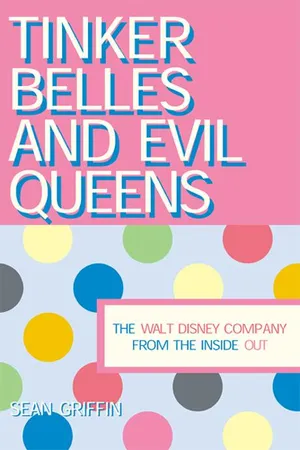
eBook - ePub
Tinker Belles and Evil Queens
The Walt Disney Company from the Inside Out
- 292 pages
- English
- ePUB (mobile friendly)
- Available on iOS & Android
eBook - ePub
About this book
Information
WITH WALT
1
Mickey’s Monastery
Sexuality and the “Disney Mystique”
TO ASSERT THAT there is a construction of sexuality in Disneyana might seem to be stating the obvious since sexuality pervades all areas of culture. But to many, the Walt Disney Company has long stood as a safe haven from the “rampant” sexuality that can be found in most popular culture. In 1995, a letter to the studio from a coalition of Florida lawmakers described how
For more than 50 years Walt Disney Company has represented all that is good and pure and wholesome in our nation. Families flocked to Walt Disney World and Disneyland because they knew that Walt Disney respected and nurtured the traditional American family and its strong moral values. Disney could always be counted on to provide parents and children alike with family-friendly, good-natured entertainment.1
Like these politicians, many consumers both in the past and present continue to value the studio precisely because they feel that Disney films, TV shows, theme parks and merchandise do not display sexuality (or, by implication, other forms of decadence or corruption).
Consumers did not create this vision of the Walt Disney Company of their own volition. The company has historically fostered this image, representing itself as an upstanding moral organization, committed to providing children with characters and narratives that would not unduly expose them to sex or violence. This carefully crafted “mystique” of asexuality so pervades the popular conception of the Walt Disney Company that as early as the 1930s, some in Hollywood had nicknamed the studio “Mickey’s Monastery,” in honor of the studio’s biggest “star.” The few kisses that get shown on screen between consenting adults in Disney cartoons are always chaste and short, with closed dry mouths (and often with plenty of comic support around to divert attention). There is never any indication that romance could lead to anything else but riding off into the clouds with Prince Charming or waltzing endlessly in a palace ballroom. Since no one is ever seen actually having sex, many viewers would argue that reading sexual messages into Disney’s films is itself nothing but a perverse act.2
Although many historians and biographers have consciously rein-scribed the asexual mythology of the company, Disney has consistently posited and reinforced an image of sexuality in films, television series, comic books, theme parks and countless other Disney texts: specifically, an image of American middle-class heterosexual courtship. Furthermore, through careful and untiring public relations, Disney has made this vision of sexuality seem such a given fact of life that most consumers are incapable of consciously acknowledging its construction. Disney consequently posits heterosexual courtship as the only “true” (if not the “only”) method by which individuals may conceive of sexuality. Foucault states plainly that “power is only tolerable on condition that it mask a substantial part of itself. Its success is proportional to its ability to hide its own mechanisms.”3 With this in mind, the refusal to read the discourse of sexuality contained within the oeuvre of the Walt Disney Company displays the enormous power that the “Disney mystique” has on individuals.
Tied into the discourse of sexuality is a larger discourse of “the body.” Foucault points out that “[sexuality] has been linked from the outset with an intensification of the body—with its exploitation as an object of knowledge and an element in relations of power.”4 Hence, power over the discourse of sexuality depends upon “proliferating, innovating, annexing, creating, and penetrating bodies in an increasingly detailed way.”5 Judith Butler’s work (on how gender and sexuality are culturally inscribed) points out that in using “the body” to control and regulate sexual discourse, “the body” itself is culturally constructed: “Any discourse that establishes the boundaries of the body serves the purpose of instating and naturalizing certain taboos regarding the appropriate limits, postures, and modes of exchange that define what it is that constitutes bodies.”6 By making certain conceptions of “the body” seem “only natural” (its boundaries, its optimal use, its gender), the construction of the discourse of sexuality grows more powerful. For example, discourse on “the body” regulates definitions of “male” and “female,” of “masculine” and “feminine,” which are essential to a concept of heterosexuality (and homosexuality). If representations of women’s bodies consistently display how they are “designed” for motherhood, a discourse that promotes heterosexuality becomes “normalized.” The Walt Disney Company’s emphasis in animation constantly forces the studio to consciously fashion and control bodies—drawing characters that somehow represent images of “men” and “women.” From Snow White and her Prince to Tarzan and his Jane, careful work has been done to make sure that the heroes and heroines of these animated features “measure up” to certain gender expectations. Without such stringent scrutiny, the studio’s promotion of heterosexual courtship would be compromised.
This chapter explores and analyzes how Walt Disney and his studio promoted a heterosexual paradigm through specific strategies of representing sexuality and the body. The chapter does not specifically engage with issues of homosexuality, but it is vital to deconstruct the naturalization of Disney’s produced image of “normal” heterosexuality in order to understand more fully how queer individuals at this time could read Disney “against the grain.”7 Disney’s motion picture and television production function as a form of social discourse used to control and regulate sexuality and the body and, in the early years, the studio concentrated on the “naturalness” of heterosexuality. Yet, the company’s discourse on heterosexuality during Walt’s lifetime also impacted the parameters of discourse on homosexuality that lesbian and gay audiences could find in these texts.
Of course, Disney is not in some manner unique or solely responsible for championing a heterosexual imperative. Rather, the messages historically constructed in Disney texts mirror the concepts of sexuality espoused by the Western hegemony in which it operates. Disney is only one voice in a multitude of discourses that attempt to fix, regulate and naturalize a certain version of sexuality. In fact, research into the history of Walt Disney and his studio reveals how other voices worked to help fashion Disney’s representation of sexuality and the body. (To distinguish between Disney the man and Disney the company, I shall henceforth designate the man as “Walt” and the company as “Disney.”) The influence of other, larger forces in molding the “Disney mystique” is easy to discern because Walt and his animators presented very different conceptions of sexuality and the body during different periods. Disney’s wholesome image began to coalesce as a specific method to maintain economic power and control.
The history of the Walt Disney Company’s representations of sexuality and the body during the tenure of Walt Disney himself can be roughly separated into four periods: 1924–30, from Disney’s first animated films to the success of the early Mickey Mouse cartoons; 1931–41, often described as Disney’s “Golden Period,” when his studio dominated the animation market worldwide; 1942–50, as World War II and the immediate postwar years changed and expanded what types of films the studio produced; and 1950–66, when the studio consolidated its financial successes and its corporate image. The “Disney mystique” had so solidified by the end of this era that when Walt died in 1966, the company seemed to continue apace with its image unfaltering for the next decade. The changes that occur at the borders of these periods point out how Walt and his studio consciously refashioned their representations of sexuality and the body, due to the influence (and sometimes specific economic support) of consumers, the Hollywood film industry, corporate America and even the federal government.
EARLY DISNEY:THE CARNIVALESQUE (1924–1930)
Contrary to the “Disney mystique” described in the letter from the Florida representatives, the very early Disney product seems to revel in the possibilities of sexuality and the potentiality of the body in every frame of film. Sexuality is not isolated in these texts; rather, it is always ready to assert its presence. The body is not a sacred temple with a sturdy foundation; it is a polymorphous sight of pleasure and excess. Consequently, unlike the cartoons aired on television or released on video, the cartoon characters from Walt’s earliest series display bawdy humor and sexual aggressiveness—even that paragon of virtue, Mickey Mouse.
In his examination of Walt Disney’s silent films, Russell Merritt finds Walt’s traditional image as a moral conscience sorely tested. Rather than teaching the importance of hard work and respect, “Disney’s sympathies are generally with those who goof off or tear the community apart. Authority figures are invariably absurd. . . . He shows kids cutting school, shoplifting and playing hooky, hoboes flee[ing] from having to work, prisoners escaping prison or Alice simply running away to have adventures.”8 Alice, the live-action heroine of Disney’s first nationally distributed cartoon series, often led her cartoon friends on adventures that included escaping the police or other authority figures. In Alice Gets in Dutch (1924), for example, Alice (Virginia Davis) is forced to wear the dunce cap after misbehaving in class. She then daydreams of doing battle against an old-maid schoolteacher and three anthropomorphized schoolbooks. In Alice the Jail Bird (1925), Alice (now played by Margie Gay) and her animated feline pal Julius steal a pie, are arrested and successfully start a prison riot during which they escape.
This rebellion against authority was often manifested in the shorts through behavior that emphasized the bawdy or sexually licentious. This can be seen in the recurrent trope of the “party,” which Merritt describes as “the most common expression of irresponsibility . . . an unauthorized free-for-all or jamboree where underlings . . . overturn the conventional order.”9 Merritt’s description of the running motif of the “party” invokes the spirit of the “carnivalesque” that media scholars have adapted from Mikhail Bakhtin’s work on Rabelais. The medieval carnival stressed bodily pleasure and excessiveness (particularly in regard to bodily functions) in order to overturn the received notions of morality, discipline and social order that ruled society outside of carnival time.10 Disney’s early work celebrates the spirit of the carnivalesque, including the constant reveling in the function and physical assault of the body. Alice Rattled by Rats (1925), for example, perfectly displays the orgiastic nature of carnival. Alice leaves Julius in charge while she’s away, but while chasing some mice, Julius inadvertently falls into a basement tub of moonshine (another recurrent joke in Disney’s films during this period of Prohibition). With Julius stumbling about drunk downstairs, the mice have a field day destroying the house with their makeshift celebration. Mice begin shimmying madly to the wild music being played. One mouse shimmies with such abandon that s/he drops her/his pants.
In Disney’s use of the carnivalesque during this early period, much of the “low” humor common to broad farce, vaudeville and burlesque found their way into the shorts. The aforementioned “losing one’s drawers” was a popular gag amongst Disney and his animators, showing up not only in Alice Rattled by Rats, but in Alice in the Jungle (1925) and Alice’s Tin Pony (1925) as well. Later, in Disney’s second cartoon series about Oswald the Lucky Rabbit, panties humor appears again. The climax of one cartoon, Tall Timber, shows Oswald being chased into a cave by a bear and a terrific fight ensuing off screen. Oswald emerges with a bearskin coat and the bear in nothing but a bra and panties. “Outhouse humor” often rules the day in the Alice Comedies and the Oswald cartoons. In Alice’s Orphan (1926), Julius finds a discarded waif who comes complete with what appears to be a soiled diaper. The animation in Alice’s Egg Plant (1925) takes particular delight in the physical exertion required by hens to lay eggs. Another recurrent image, if not necessarily a specifically recurring character, was the cow, who usually provided a good udder joke. The similarity of cow udders to human erogenous zones (female breasts in function, male genitalia in body location) was capitalized upon often in these cartoons. As the cows often found themselves stuck in confined spaces or needing to be hoisted, some other character would get a good squirt of milk in the face as a result. Cows would appear so regularly in the Oswald series that Merritt tries to argue that “the cow” is a character and sidekick to Oswald.11
The prevalence for violence upon the posterior of characters is another common motif, one that would recur throughout Walt’s tenure at the studio. Characters are constantly landing butt-first into cacti or getting a round of buckshot in the behind. (Even live-action five-year-old Margie Gay as Alice gets a bullet in the rear in Alice the Jail Bird.) Walt must have found such “butt humor” amusing, because it becomes obvious throughout the years that animators at the studio were always ready to throw in some child with the back flap of their Dr. Denton’s down or a quick whack to someone’s bottom, presumably knowing that it would gain Walt’s approval. The most blatant image of this humor appeared in the final credit of each Oswald cartoon: “The End” plastered across Oswald’s round distended backside.
Along with such an emphasis on the body, Disney’s cartoons also had strongly libidinous characters. Oswald quickly evinced a strong inkling for the ladies, flirting with female characters every chance he could get—which was often. Merritt refers to Oswald as “an incorrigible ladies’ rabbit, unable to resist an opportunity for romance—even when he knew in advance that such dalliances would put him in danger.”12 Although Oswald had a semi-permanent companion (named Fanny, in another bow to posterior humor), there were numerous others whom he sidled up to hoping to win their favors.
To some present-day viewers, these early shorts might be scandalous. Yet, by and large, none at the time thought these cartoons to be shocking. The carnivalesque atmosphere was not unique to Disney animation in the silent era. Rather, it was more the norm in American animation. Most audiences enjoyed this type of humor in silent animated cartoons and would have been disappointed to find it missing. Two of the most popular series, Max Fleischer’s Out of the Inkwell and Otto Messmer’s Felix the Cat cartoons, reveled in the type of randy but good-natured hijinks found in Disney’s first efforts. Fleischer animator Shamus Culhane readily admits that the Fleischer style was “kind of earthy, certainly crude, but honest.”13 Felix chased the girls around just as much as Oswald ever did. Rudolf Ising, who worked for Disney during this period, attempts to separate the silent Disney product from other producers when he says, “We never did like the . . . film ideas [of others] . . . some of it was kind of distasteful.”14 Yet, in his landmark survey of silent animation, Before Mickey, Donald Crafton finds that “the aspect that most set Disney’s series apart from his competitors’ was the overtly libidinous (but presumably naive) content of the humor.”15 The answer lies probably somewhere in-between: Disney’s low humor was not necessarily any better or worse than what was being done elsewhere. What might impart a slight difference is the atmosphere for such humor. While Messmer and Fleischer worked out of New York, Disney was one of the first to set up shop in Los Angeles. Although, as Culhane puts it, most of the Fleischer animators were “East Side Jewish kids or people like me” living and working in a sprawling urban metropolis, Walt and most of his crew had moved from the Midwest to a Los Angeles that was itself still a relatively small town. Consequently, the bawdy nature of Disney’s humor often centers around rural whimsy—falling into the outhouse, a squirt from a cow’s teet, getting poked in the behind by a goat—unlike the more urban burlesque of the New York animators.
In Disney’s attempt to break into the animation industry, it was inevitable that he would adapt to the humor already found popular in other cartoon series. This can be seen simply in the subjects and characters Disney worked on during this period. The Alice Comedies are a blatant reversal of the technological tricks used in Out of the Inkwell cartoons—putting a live-action girl into animation rather than a cartoon clown into live-action footage. The increasing reliance on the feline character Julius in the Alice Comedies also betrays the influence of Felix the Cat. Walt did not originate the idea for the Oswald series; rather Universal (his distributor at t...
Table of contents
- Cover Page
- Title Page
- Copyright Page
- Contents
- Acknowledgments
- Introduction
- Part I With Walt
- Part II Since Walt
- Epilogue
- Notes
- Bibliography
- Index
- About the Author
Trusted by 375,005 students
Access to over 1.5 million titles for a fair monthly price.
Study more efficiently using our study tools.
Frequently asked questions
Yes, you can cancel anytime from the Subscription tab in your account settings on the Perlego website. Your subscription will stay active until the end of your current billing period. Learn how to cancel your subscription
No, books cannot be downloaded as external files, such as PDFs, for use outside of Perlego. However, you can download books within the Perlego app for offline reading on mobile or tablet. Learn how to download books offline
Perlego offers two plans: Essential and Complete
- Essential is ideal for learners and professionals who enjoy exploring a wide range of subjects. Access the Essential Library with 800,000+ trusted titles and best-sellers across business, personal growth, and the humanities. Includes unlimited reading time and Standard Read Aloud voice.
- Complete: Perfect for advanced learners and researchers needing full, unrestricted access. Unlock 1.5M+ books across hundreds of subjects, including academic and specialized titles. The Complete Plan also includes advanced features like Premium Read Aloud and Research Assistant.
We are an online textbook subscription service, where you can get access to an entire online library for less than the price of a single book per month. With over 1.5 million books across 990+ topics, we’ve got you covered! Learn about our mission
Look out for the read-aloud symbol on your next book to see if you can listen to it. The read-aloud tool reads text aloud for you, highlighting the text as it is being read. You can pause it, speed it up and slow it down. Learn more about Read Aloud
Yes! You can use the Perlego app on both iOS and Android devices to read anytime, anywhere — even offline. Perfect for commutes or when you’re on the go.
Please note we cannot support devices running on iOS 13 and Android 7 or earlier. Learn more about using the app
Please note we cannot support devices running on iOS 13 and Android 7 or earlier. Learn more about using the app
Yes, you can access Tinker Belles and Evil Queens by Sean P. Griffin in PDF and/or ePUB format, as well as other popular books in Social Sciences & LGBT Studies. We have over 1.5 million books available in our catalogue for you to explore.