Winner, 2010 Association for Jewish Studies Jordan Schnitzer Book Award
2011 Honorable Mention for the American Sociological Association Culture Section's Mary Douglas Prize for Best Book
Since 1999 hundreds of thousands of young American Jews have visited Israel on an all-expense-paid 10-day pilgrimage-tour known as Birthright Israel. The most elaborate of the state-supported homeland tours that are cropping up all over the world, this tour seeks to foster in the American Jewish diaspora a lifelong sense of attachment to Israel based on ethnic and political solidarity. Over a half-billion dollars (and counting) has been spent cultivating this attachment, and despite 9/11 and the ongoing Israeli-Palestinian conflict the tours are still going strong.
Based on over seven years of first-hand observation in modern day Israel, Shaul Kelner provides an on-the-ground look at this hotly debated and widely emulated use of tourism to forge transnational ties. We ride the bus, attend speeches with the Prime Minister, hang out in the hotel bar, and get a fresh feel for young American Jewish identity and contemporary Israel. We see how tourism's dynamism coupled with the vibrant human agency of the individual tourists inevitably complicate tour leaders' efforts to rein tourism in and bring it under control. By looking at the broader meaning of tourism, Kelner brings to light the contradictions inherent in the tours and the ways that people understandtheir relationship to place both materially and symbolically. Rich in detail, engagingly written, and sensitive to the complexities of modern travel and modern diaspora Jewishness, Tours that Bind offers a new way of thinking about tourism as a way through which people develop understandings of place, society, and self.
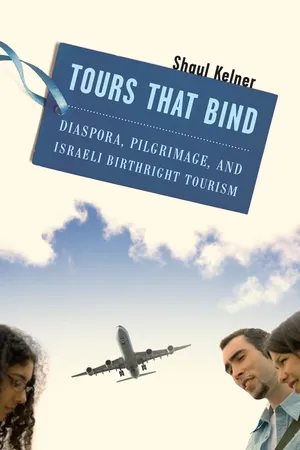
- 292 pages
- English
- ePUB (mobile friendly)
- Available on iOS & Android
eBook - ePub
About this book
Trusted by 375,005 students
Access to over 1.5 million titles for a fair monthly price.
Study more efficiently using our study tools.
Information
1
Deploying Tourism
On the evening of June 6, 2004, the Israeli cabinet announced its intention to dismantle all Jewish settlements in the Gaza Strip, captured from Egypt on that same date 37 years earlier. Soon afterward, Prime Minister Ariel Sharon made the short drive from the Knesset building to Jerusalem’s convention center, whose name, Binyanei Ha’umah—Buildings of the Jewish People—anticipated the crowd that had gathered to hear him. Packing the 3,100-seat Ussishkin Hall were college-age Jews from four continents whom Sharon’s government, in conjunction with diaspora Jewish philanthropists and nonprofit agencies, had brought to Israel on an all-expense-paid tour. They were neither the first nor the last of their kind. During the first decade of the millennium, over 200,000 young diaspora Jews would travel to Israel on free tours that were billed as “a gift from the Jewish people” and their “birthright.”
Flanked by four bodyguards, Sharon approached the podium: “Good evening to you all. I wish to welcome you to Jerusalem, the eternal capital of the Jewish people, and the united capital of the State of Israel forever.” Whatever the cabinet’s decision on Gaza, Jerusalem was not up for discussion, at least not then. Sharon went on to announce, first in Hebrew then in English, that by approving the “disengagement plan,” Israel’s government had declared its intention to exit the Gaza Strip by the end of 2005. Far more cheers than jeers arose from the audience. Still, Sharon’s detractors were unabashed in expressing their opposition. Opponents of territorial withdrawal responded to his announcement with audible disapproval. At the other end of the political spectrum, some who might have been expected to look favorably on the dismantling of Jewish settlements found it difficult to resolve the dissonance engendered by the fact that the author of Israel’s Gaza withdrawal was also the architect of its 1982 Lebanon invasion. A number of these people were not present for Sharon’s pronouncement, having walked out when he took the stage.
Although these were foreign tourists spending only 10 days on a whirlwind visit to the country, the travelers had few qualms about expressing their support or opposition to government policy, even to the extent of booing Israel’s prime minister in the heart of Jerusalem. Some Israelis might have taken umbrage at the tourists’ willingness to take sides in a divisive national policy debate. But perhaps these diaspora Jews were simply taking Sharon at his word. “Bruchim ha-ba’im ha-baytah!” he had greeted them. “Welcome home!”
Discovering and Deploying a Diasporic Practice
Home. In diasporic experience, no category is more unstable. Where is home, when, for members of a dispersed people, the term floats without a necessary connection to one’s actual country of residence? Where is home, when the places that are assigned and that are denied that label, when both “homeland” and “host country,” each share quotients of familiarity and strangeness? Surely it can come as no surprise that diasporic imaginings have been preoccupied with questions of spatial identity. From the Amoraim of the Talmud to scholars of the Birmingham School, intellectuals have attempted to think systematically about what almost everyone who has ever counted himself or herself a diasporan has been forced to do pragmatically: untangle the complexities that bind self, community, culture, and place—if not to resolve the tensions, then at least to find some modus vivendi. The ways in which this untangling has taken place have evolved over the centuries, being continually reshaped by each new technology of communication, travel, and symbolic mediation. Among modernity’s contributions to this enterprise has been the insertion of tourism into the repertoire of diasporic practice.
Over the past half-century, many factors have enabled international tourism to become a point of contact between nation-states and their diasporas. These include the commercialization of jet travel, the expansion of a global tourism industry, and growing affluence in the Western world, to name but a few. All this has democratized international travel, opening to ever-greater numbers an experience once reserved for soldiers, pilgrims, some merchants, and the children of the elite. It has also affected the nature of state-diaspora interactions. With the rise of mass tourism, places sometimes conceived of as points of origin—“homelands”1 from which people departed as emigrants, refugees, or slaves—are increasingly serving as destinations to which they and their descendents arrive as tourists, pilgrims, or some combination of the two.
Undoubtedly, much travel to ethnic homelands is embedded in familial, business, and social relations.2 Emigrants return to visit friends, meet with suppliers, celebrate with relatives, and care for parents. Any of these activities might qualify the travelers as tourists under the expansive definition used by the hospitality industry for administrative purposes, whereby a tourist is simply “any person who stays away from home overnight.”3 In casting such a wide net, this definition has the advantage of highlighting just how diverse diasporic travel to ethnic homelands actually is. Still, it glosses over a crucial distinction. Tourism is not simply travel in the generic sense; it is a distinctive set of social and cultural practices, a way of traveling. Incorporating sightseeing, photography, souvenir shopping, and the like, and supported by a well-developed industry of airlines, hotels, museums, and more, tourism is a particular way of engaging a place, of coming to “know” it, and of forging a relationship with it. What is significant about tourism’s entry into the repertoire of diasporic practice is precisely that it provides a means for diasporans to encounter their ethnic homelands, regardless of whether or not they have direct social and material ties there. Through the work of cultural entrepreneurs in the private, public, and not-for-profit sectors, nation-states commodified as diasporic “homelands” have been made available for mass consumption by diaspora tourists who use them as sites of memory and imagination, spaces to reflect on the perennial questions of diasporic existence and the individual’s relationship to place. Tourism, accordingly, has become a crucial way to reestablish, maintain, or initiate a diaspora-state relationship, even when links between the two are attenuated.
It is not a foregone conclusion that states and diasporas would desire such a relationship. The idea could easily meet with challenges from elements on each side. Classical nationalist formulations have tended to unite countries of origin and destination in shared suspicion of migrants, equating emigration with abandonment, in the first instance, and homeland ties with disloyalty, in the second. Globalization has tended to mute (though not eliminate) objections to ongoing homeland-diaspora ties, however, drawing attention, instead, to the potential advantages that the ties might confer.
One reason for this stems from the way that globalization and mass migration have intersected. At the beginning of the millennium, the United Nations estimated that about one out of every 33 people on the face of the planet was living somewhere other than the country of his or her birth—a proportion that had doubled in a mere 25 years.4 This upsurge in worldwide migration has taken place as globe-shrinking technologies of travel, commerce, and communication have been reshaping the migration experience. For today’s emigrants, striking roots in a new place hardly means severing ties with the old. On the contrary, émigré communities are emerging as significant forces in new political configurations that link nation-states with their diasporas and “break down the long-held assumption about the isomorphism of places, nation, and culture.”5 In today’s transnational moment, there is a growing realization that political and cultural identification and territorial location are only loosely coupled.6
At the same time, states’ assessments of their interests are evolving to account for the fact that the economics and politics of globalization have conferred power on transnational actors such as corporations, nongovernmental organizations (NGOs), and decentralized networks.7 How much this shift in power relations operates to the benefit or detriment of nation-states depends, in part, on how they adapt, resist, co-opt, or otherwise engage the situation. For states, the territoriality that is a central element in their strength is increasingly revealing its limiting character as well. It is this territoriality that confines them in their borders and tethers them in one and only one place. In an era of globalization, diaspora communities become a valuable (though not unproblematic) national resource. By claiming and co-opting their diasporas, nation-states achieve a certain liberation from the bonds of territoriality.8 This brings to the political realm something not unlike the invention of mechanical flight, which extended the range of human action into a heretofore-inaccessible dimension. State-diaspora alliances command the prerogatives of both territorialization and deterritorialization, which in combination provide a wider array of options—for polities and for people—than either alone.
Against this backdrop, states and diaspora institutions have increasingly recognized the significance of mass tourism as a means of forging transnational community. They have found willing partners among individual diasporans, who more and more exemplify Zygmunt Bauman’s contention that “if the modern ‘problem of identity’ was how to … keep it solid and stable, the postmodern ‘problem of identity’ is primarily how to avoid fixation and keep the options open.”9 For diasporans exploring questions of identity in a globalizing world and for nation-states seeking advantage in it, tourism has presented itself as a valuable resource. Both have sought to co-opt, develop, and systematize it, but their efforts are complicated by the fact that tourism entails multiple ways of knowing that are rife with contradiction.
What enables mass tourism to serve as a medium for constructing diasporic identities, and what contradictions in the medium undermine or limit attempts to put it to use? How do its social practices mediate the relationship between collective identities and the personal identities of those who travel? What is the nature of the knowledge that emerges? How does this shape peoples’ understandings of themselves in relation to their ethnic and civic communities and to the places they imagine as homelands? To address the questions raised by the deployment of mass tourism as a medium of diasporic political socialization, I focus in this book on the setting in which the practice, as an institutionalized instrument of policy, was pioneered in the 1950s and where it has reached a thoroughly elaborated expression, the State of Israel.
“Israel Experience Programs”
In 2004, the president of the Arab American Institute, James Zogby, addressed a conference in Beirut on the relationship between Lebanon and its diaspora. As reported in the Lebanese Daily Star, Zogby expressed concern that an “entire generation or two of Lebanese Americans have grown to maturity having never ventured forth to Lebanon”:
Zogby offered two proposals for improving relations between Lebanese-Americans and the homeland … [one of which] was to develop a program to reconnect Lebanese-American youth to their motherland. Using an example rarely heard in this part of the world, Zogby described the Operation Birthright [sic] program operated by Jews in the U.S. to help young people develop an attachment to Israel. “We must do the same,” he said.10
The program to which Zogby was referring is the one whose participants Ariel Sharon addressed in June 2004, and the one I examine in this book. “Taglit-Birthright Israel” is a half-billion-dollar joint initiative of individual philanthropists, the State of Israel, and diaspora Jewish organizations. Launched in December 1999, the program provides free 10-day pilgrimage tours of Israel to college-age diaspora Jews, primarily from North America but with significant representation from Western Europe, the former Soviet Union, South America, and Oceania. Since its inception, it has sent over 200,000 people to Israel, the majority coming from the United States and Canada. Taglit-Birthright Israel does not itself operate tours but functions as an umbrella organization financing, supporting, and licensing the operation of trips by approximately 30 different provider groups, one of the largest of which is Hillel, the organization serving Jewish students on college campuses. Tours are run semiannually in winter and summer sessions. Travelers are preassigned to groups of about 30 to 40 people each, frequently with fellow students from their university or with other people from their city. Each group has its own bus and driver, and each is staffed by an Israeli guide working alongside two or three counselors from the tourists’ country of origin. Between 2000 and 2006, participation in Birthright Israel fluctuated between 9,000 and 23,000 annually and then in 2007 and 2008 rose to around 40,000, after a $70 million gift from the Jewish American casino magnate Sheldon Adelson enabled the program to expand its capacity. In the wake of the 2008 global economic collapse, the number of funded trips available in years to come is expected to drop from this peak.
Birthright Israel has been considered a model for using tourism to foster state-diaspora relations. Zogby’s reference in Beirut was not an exceptional instance. A year earlier, officials from a nonprofit organization funded by the Hovnanian family, Armenian American real estate developers, met with Birthright Israel to exchange ideas in advance of launching a program that would coordinate the efforts of approximately one dozen organizations running youth trips to Armenia. One week before Zogby’s address in Beirut, “Birthright Armenia / Depi Hayk” held its inaugural event in Yerevan—a gathering similar to the Jerusalem Convention Center gala, complete with an address by the foreign minister exhorting the visitors to “Believe in Armenia. Be committed to it.… stay involved … influence your governments, and become more engaged.”11
Israel and the Jewish diaspora’s mobilization of tourism as a medium of political socialization has gained recognition in recent years, partly because of Birthright Israel’s unprecedented scale but also because the collapse of the Israeli-Palestinian diplomatic efforts of the 1990s raised awareness that the tours could be used to win the hearts and minds of a young generation of diaspora Jews just as the conflict was entering a period of renewed violence.12 (The second intifada broke out in September 2000, some 10 months after Birthright Israel began.) Yet although public awareness of Jewish political tourism is recent, the practice is not. The ability and desire of Jewish communities around the world to invest so heavily in Birthright Israel stemmed in part from the fact that tourism’s use as a medium of political socialization is deeply entrenched in the repertoire of modern Jewish practice. For immigrants to Palestine in the early years of the Zionist movement, tourism was a means of striking roots in an old-new homeland (chapter 2 in this volume). In the years after the establishment of the state, it served to introduce diaspora Jews to a country that was more a source of pride and wonder than of ethnic memory, few tracing any immediate ancestry to the place. Since the late 1980s, both the State of Israel and diaspora Jewish organizations have expanded their use of the medium beyond the borders of Israel, bringing Israeli and diaspora Jewish youth alike on “March of the Living” tours to Poland, where Holocaust sites are used to teach the moral imperative of Jewish empowerment.13 In all instances, educators have taken the lead in crafting the on-the-ground practices that have developed tourism for political and cultural use. The result has been a substantial continuity between classical Zionist practices of nation-building and globalized practices of “diaspora-building,”14 which are intended to strengthen Jewish cultural life outside of Israel.
Social scientists have taken an interest in diaspora Jewish tours of Israel since the early 1960s, when the first studies of these so-called Israel experience programs were conducted.15 The bulk of this work (and it is voluminous) consists of market research and evaluations commissioned to document program impact on participants.16 Only since the 2000s have researchers begun to show interest in deeper questions about the ideological work encoded in the enterprise17 and about the nature of identity construction effected by the tours.18 Like the evaluation studies, however, this newer research also tends to conceive of the trips as sui generis rather than as particular cases that partake in and shed light on more general phenomena. If there is any unifying characteristic of the research on Israel experience programs it is that it has largely been conducted without more than passing reference to scholarship on tourism generally19 and without drawing insights from the studies of homeland tours of other ethnic groups.
Tourism: A Particular Use of Space
Diaspora homeland tours have been referred to as “ethnic pilgrimages.”20 The term has evident appeal. Pilgrimage can be thought of as a “journey undertak...
Table of contents
- Cover Page
- Title Page
- Copyright Page
- Dedication
- Contents
- Acknowledgments
- Preface
- 1 Deploying Tourism
- 2 Striking Roots
- 3 Contesting Claims
- 4 Consuming Place
- 5 Collapsing Distance
- 6 Encountering Community
- 7 Locating Self
- 8 Building Diaspora
- Methodological Appendix
- Glossary
- Notes
- Bibliography
- Index
- About the Author
Frequently asked questions
Yes, you can cancel anytime from the Subscription tab in your account settings on the Perlego website. Your subscription will stay active until the end of your current billing period. Learn how to cancel your subscription
No, books cannot be downloaded as external files, such as PDFs, for use outside of Perlego. However, you can download books within the Perlego app for offline reading on mobile or tablet. Learn how to download books offline
Perlego offers two plans: Essential and Complete
- Essential is ideal for learners and professionals who enjoy exploring a wide range of subjects. Access the Essential Library with 800,000+ trusted titles and best-sellers across business, personal growth, and the humanities. Includes unlimited reading time and Standard Read Aloud voice.
- Complete: Perfect for advanced learners and researchers needing full, unrestricted access. Unlock 1.5M+ books across hundreds of subjects, including academic and specialized titles. The Complete Plan also includes advanced features like Premium Read Aloud and Research Assistant.
We are an online textbook subscription service, where you can get access to an entire online library for less than the price of a single book per month. With over 1.5 million books across 990+ topics, we’ve got you covered! Learn about our mission
Look out for the read-aloud symbol on your next book to see if you can listen to it. The read-aloud tool reads text aloud for you, highlighting the text as it is being read. You can pause it, speed it up and slow it down. Learn more about Read Aloud
Yes! You can use the Perlego app on both iOS and Android devices to read anytime, anywhere — even offline. Perfect for commutes or when you’re on the go.
Please note we cannot support devices running on iOS 13 and Android 7 or earlier. Learn more about using the app
Please note we cannot support devices running on iOS 13 and Android 7 or earlier. Learn more about using the app
Yes, you can access Tours That Bind by Shaul Kelner in PDF and/or ePUB format, as well as other popular books in Social Sciences & Sociology. We have over 1.5 million books available in our catalogue for you to explore.