Uncovers the systemic problems that expose poor communities to environmental hazards
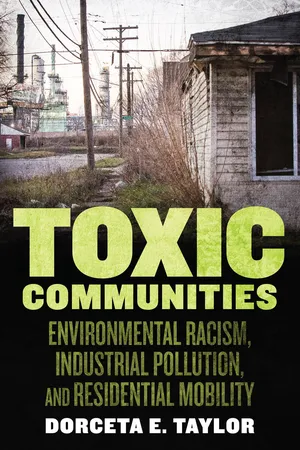
From St. Louis to New Orleans, from Baltimore to Oklahoma City, there are poor and minority neighborhoods so beset by pollution that just living in them can be hazardous to your health. Due to entrenched segregation, zoning ordinances that privilege wealthier communities, or because businesses have found the 'paths of least resistance,' there are many hazardous waste and toxic facilities in these communities, leading residents to experience health and wellness problems on top of the race and class discrimination most already experience. Taking stock of the recent environmental justice scholarship, Toxic Communities examines the connections among residential segregation, zoning, and exposure to environmental hazards. Renowned environmental sociologist Dorceta Taylor focuses on the locations of hazardous facilities in low-income and minority communities and shows how they have been dumped on, contaminated and exposed.
Drawing on an array of historical and contemporary case studies from across the country, Taylor explores controversies over racially-motivated decisions in zoning laws, eminent domain, government regulation (or lack thereof), and urban renewal. She provides a comprehensive overview of the debate over whether or not there is a
link between environmental transgressions and discrimination, drawing a clear picture of the state of the environmental justice field today and where it is going. In doing so, she introduces new concepts and theories for understanding environmental racism that will be essential for environmental justice scholars. A fascinating landmark study, Toxic Communities greatly contributes to the study of race, the environment, and space in the contemporary United States.
eBook - ePub
Toxic Communities
Environmental Racism, Industrial Pollution, and Residential Mobility
- 352 pages
- English
- ePUB (mobile friendly)
- Available on iOS & Android
eBook - ePub
Toxic Communities
Environmental Racism, Industrial Pollution, and Residential Mobility
About this book
Information
Table of contents
- Cover Page
- Title Page
- Copyright Page
- Dedication
- Contents
- Acknowledgments
- List of Acronyms and Abbreviations
- Introduction: Environmental Justice Claims
- 1 Toxic Exposure: Landmark Cases in the South and the Rise of Environmental Justice Activism
- 2 Disproportionate Siting: Claims of Racism and Discrimination
- 3 Internal Colonialism: Native American Communities in the West
- 4 Market Dynamics: Residential Mobility, or Who Moves and Who Stays
- 5 Enforcing Environmental Protections: The Legal, Regulatory, and Administrative Contexts
- 6 The Siting Process: Manipulation, Environmental Blackmail, and Enticement
- 7 The Rise of Racial Zoning: Residential Segregation
- 8 The Rise of Racially Restrictive Covenants: Guarding against Infiltration
- 9 Racializing Blight: Urban Renewal, Eminent Domain, and Expulsive Zoning
- 10 Contemporary Housing Discrimination: Does It Still Happen?
- Conclusion: Future Directions of Environmental Justice Research
- References
- Index
- About the Author
Trusted by 375,005 students
Access to over 1.5 million titles for a fair monthly price.
Study more efficiently using our study tools.
Frequently asked questions
Yes, you can cancel anytime from the Subscription tab in your account settings on the Perlego website. Your subscription will stay active until the end of your current billing period. Learn how to cancel your subscription
No, books cannot be downloaded as external files, such as PDFs, for use outside of Perlego. However, you can download books within the Perlego app for offline reading on mobile or tablet. Learn how to download books offline
Perlego offers two plans: Essential and Complete
- Essential is ideal for learners and professionals who enjoy exploring a wide range of subjects. Access the Essential Library with 800,000+ trusted titles and best-sellers across business, personal growth, and the humanities. Includes unlimited reading time and Standard Read Aloud voice.
- Complete: Perfect for advanced learners and researchers needing full, unrestricted access. Unlock 1.5M+ books across hundreds of subjects, including academic and specialized titles. The Complete Plan also includes advanced features like Premium Read Aloud and Research Assistant.
We are an online textbook subscription service, where you can get access to an entire online library for less than the price of a single book per month. With over 1.5 million books across 990+ topics, we’ve got you covered! Learn about our mission
Look out for the read-aloud symbol on your next book to see if you can listen to it. The read-aloud tool reads text aloud for you, highlighting the text as it is being read. You can pause it, speed it up and slow it down. Learn more about Read Aloud
Yes! You can use the Perlego app on both iOS and Android devices to read anytime, anywhere — even offline. Perfect for commutes or when you’re on the go.
Please note we cannot support devices running on iOS 13 and Android 7 or earlier. Learn more about using the app
Please note we cannot support devices running on iOS 13 and Android 7 or earlier. Learn more about using the app
Yes, you can access Toxic Communities by Dorceta Taylor in PDF and/or ePUB format, as well as other popular books in Social Sciences & Discrimination & Race Relations. We have over 1.5 million books available in our catalogue for you to explore.