"Transnational Torture by Jinee Lokaneeta reviewed with Prachi Patankar" on the blog Kafila.
Evidence of torture at Abu Ghraib prison in Iraq and harsh interrogation techniques at Guantánamo Bay beg the question: has the “war on terror” forced liberal democracies to rethink their policies and laws against torture? Transnational Torture focuses on the legal and political discourses on torture in India and the United States—two common-law based constitutional democracies—to theorize the relationship between law, violence, and state power in liberal democracies.
Analyzing about one hundred landmark Supreme Court cases on torture in India and the United States, memos and popular imagery of torture, Jinee Lokaneeta compellingly demonstrates that even before recent debates on the use of torture in the war on terror, the laws of interrogation were much more ambivalent about the infliction of excess pain and suffering than most political and legal theorists have acknowledged. Rather than viewing the recent policies on interrogation as anomalous or exceptional, Lokaneeta effectively argues that efforts to accommodate excess violence—a constantly negotiated process—are long standing features of routine interrogations in both the United States and India, concluding that the infliction of excess violence is more central to democratic governance than is acknowledged in western jurisprudence.
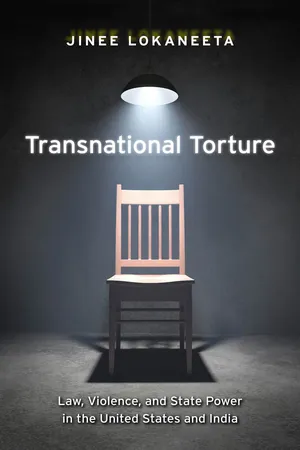
eBook - ePub
Transnational Torture
Law, Violence, and State Power in the United States and India
- 301 pages
- English
- ePUB (mobile friendly)
- Available on iOS & Android
eBook - ePub
About this book
Information
Topic
DerechoSubtopic
Derecho comparado1
Law’s Struggle with Violence
Ambivalence in the “Routine” Jurisprudence of Interrogations in the United States
It is sufficient to say that in pertinent respects the transcript reads more like pages torn from some medieval account, than a record made within the confines of a modern civilization which aspires to an enlightened constitutional government.
—Brown v. Mississippi (1936)1
In the post-9/11 context, when a debate ensued in the media about whether torture could be used against suspected terrorists in the United States, even the debate itself was characterized as a radical break from previous eras. When Jonathan Alter wrote immediately after the 9/11 attacks that “in this autumn of anger, even a liberal can find his thoughts turning to torture,” the responses to his article reflected the prevailing sentiment against torture.2 Readers wrote passionately that contemplating torture is similar to “going back into the middle ages,” is “traitorous to the ideals that keep America on the high moral ground,” and “negates the values on which our civilization was founded.”3
The debate itself seemed a radical break from previous eras because torture was considered impermissible in the United States. As noted earlier, in the reigning discourse, prohibition of torture represents a defining feature of a “civilized” liberal democracy. Most of all, the existence of torture becomes the point of distinction between democratic and nondemocratic systems. Since torture continues in a more blatant manner in many nondemocracies, its persistence also strengthens the claims that democracies do not allow this form of violence.4 In addition to the rhetoric against torture, there are actual formal provisions applicable to torture that back this claim in democracies. However, a close reading of the legal and political discourse regarding torture in one such democracy, namely, the United States, indicates a more complex story.
In this chapter, I analyze the U.S. legal discourse on torture by historically tracing the mechanisms in the Constitution that serve as protections from torture: the due process clause (Fourteenth and Fifth Amendments), the prohibition against cruel and unusual punishment (Eighth Amendment), and the guarantee of the right against self-incrimination (Fifth Amendment). Given the focus on interrogations in this study, I focus on the jurisprudence concerning the Fifth and the Fourteenth Amendments of the U.S. Constitution.5
A study of the jurisprudence of interrogations suggests that while the political rhetoric and formal law unequivocally claim that torture is impermissible in the United States, this protection from torture is fraught with challenges. Specifically, what the formal discourse conceals in its claim of freedom from torture is the gradual nature of this negotiation and the continuing struggle of the jurisprudence with excess violence. The chapter concludes by asserting that while extreme forms of torture, primarily physical torture (Brown model), are unequivocally prohibited by the legal discourse, there is ambiguity regarding several other forms of excess violence that exist at the borders of legality and illegality. While there may not be unanimity about the characterization of some of these forms of violence as torture, I argue that it is in fact the lack of clarity on the nature of violence prohibited by the legal discourse that makes it significant for debates on torture. The chapter illustrates a continuing accommodation of excess violence by the U.S. jurisprudence that is particularly visible in situations of necessity. Thus, the chapter points to a central problem in liberal democracies, namely, the law’s continuing struggle with excess violence, not just in extraordinary times but also in routine contexts.
A Chronology of “Progress” against Torture
In this section, I briefly present what I term the chronology of “progress” against torture by discussing how the Supreme Court has addressed the issue of torture and excess violence in interrogations. In the United States, there have been predominantly three regimes of constitutional protections that are relevant to our study of torture in interrogations—the voluntariness doctrine related to the Fifth Amendment right against self-incrimination (Bram model), voluntariness related to the due process clause of the Fourteenth Amendment (Brown model), and the Miranda regime related to the Fifth Amendment (Miranda model).
The first major case that connected the Fifth Amendment prohibition of compulsion to incriminate oneself in trials with the concern for voluntariness in confessions during interrogations was Bram v. United States (1897). The Fifth Amendment of the United States Constitution states that “[n]o person… shall be compelled in any criminal case to be a witness against himself,” and Bram extended this right in trials to interrogations.6 Bram, a U.S. sailor, was taken into custody for questioning related to a crime committed on an overseas American vessel and made some self-incriminating statements. The Supreme Court, however, noted that the circumstances under which the admission was made by Bram rendered it involuntary. The Court pointed out that the accused considered himself a prisoner of the police at Halifax, had no access to a U.S. counsel, and was ignorant of his status vis-à-vis U.S. or local law. Bram was asked to come in for an interview and subsequently ordered to strip by a foreign detective and, thereafter, interrogated. The Court stated that these conditions constituted “compulsion or inducement.” The admission could not be considered free and voluntary under the circumstances because Bram may have spoken due to fear of hurting himself by keeping quiet or due to a hope of benefiting by speaking. Using the Fifth Amendment in the case, the Supreme Court wrote,
The human mind under the pressure of calamity, is easily seduced; and is liable, in the alarm of danger, to acknowledge indiscriminately a falsehood or a truth, as different agitations may prevail. A confession, therefore, whether made upon an official examination or in discourse with private persons, which is obtained from a defendant, either by flattery of hope, or by the impressions of fear, however slightly the emotions may be implanted, is not admissible evidence; for the law will not suffer a prisoner to be made the deluded instrument of his own conviction.7
Thus, in Bram, the Court emphasized that complete voluntariness in confessions excludes even the slightest pressure of hope or fear. The previous concern in involuntary confessions had been unreliability of information, but now, focus on the circumstances of interrogation was an important principle to be upheld and served as a protection against compulsion, coercion, and violence of any kind.8
After Bram, the Fifth Amendment did not really become the standard for determining the admissibility of confessions for all cases. This is primarily the case because the Fifth Amendment was not applicable to the states until 1964, and it was the Fourteenth Amendment due process clause that was initially applied to state confessions.9 The issue of torture has, thus, been considered primarily in the context of the voluntariness doctrine related to the due process clause of the Fourteenth Amendment.
It is the Brown v. Mississippi case in 1936 that epitomizes the U.S. protections against torture. Indeed, it is the single most frequently cited case on torture and confessions in the pre-9/11 constitutional law case books, exemplifying the significance of the case for U.S. jurisprudence on interrogations.10 This case arose in the context of southern treatment of African Americans in the era of Jim Crow. The case involved the indictments of three black men accused of murdering a white man, and the question for the Court was whether convictions of the defendants primarily based on confessions “extorted by brutality and violence” were consistent with the due process of law mandated by the Fourteenth Amendment. This was only one in a series of cases against African Americans charged with interracial crimes, particularly rape and murder, who were subjected to the worst kind of police abuse to gain confessions.11 In the case, the defendants claimed that the confessions were false and had been obtained by physical torture unaddressed by the trial court and admitted despite objections from the counsel.
In the case, one of the defendants was hanged on a tree and whipped again and again on two different days by a deputy accompanied by a mob until he agreed to make the confession. The two other defendants were whipped with leather straps after being stripped by the deputy sheriff and forced to confess in great detail as prompted by the deputy sheriff, jailors, and a mob. The Supreme Court was shocked at the facts of the case and stated that due process required the state to ensure that the action did not “offend some principle of justice so rooted in the traditions and conscience of [our] people as to be ranked as fundamental.”12 One of the important principles suggested by the Court as a result was that “the rack and torture chamber may not be substituted for the witness stand” and that all state actions had to follow the “fundamental principles of liberty and justice.”13 The Supreme Court, thus, found the state action in the case not only unacceptable but revolting and completely rejected the confessions derived from physical torture.
Despite the landmark nature of this decision jurisprudentially, according to Michael Klarman, the impact of Brown is difficult to assess due to lack of information on the exact amount of physical coercion used in the South. However, he suggests that given the blatantly racist attitude of the sheriff during the trial and the infrequency of cases of torture reaching the courts, the practice of beating blacks to extort confessions may have actually continued long after the Brown case.14
Subsequent cases, such as Ashcraft v. Tennessee (1944), extended the protections against involuntary confessions as a result of physical torture to persistent and prolonged questioning, though the latter cases were mostly divided decisions. For instance, in Ashcraft, the case involved the conviction of a husband in his wife’s murder as an accessory before the fact. He was questioned for thirty-six hours incommunicado without sleep or rest, and the Supreme Court decided that this interrogation was “so inherently coercive that its very existence is irreconcilable with the possession of mental freedom by a lone suspect against whom its full coercive force [was] brought to bear.”15 However, even in this case, the dissent did state that questioning for thirty-six hours did not necessarily lead to inadmissibility of evidence despite the coerciveness.16 According to most scholars, in this phase, while there seemed to be a consensus about the Brown case, there was rarely unanimity about the due process violations in cases in which the interrogation fell short of physical torture and brutality.17 The Court, however, did develop the voluntariness doctrine, in which the emphasis was not only on the unworthiness of the admissions but also on an attempt to ensure that the confessions were a result of “rational intellect and free will” and not an “overborne will.”18 The inconsistent results of the voluntariness doctrine, however, could not stand the scrutiny of the Court’s own endeavor to deal with coerced confessions, and there was a gradual move by the Court towards the Miranda model.19
One of the major protections under the Fifth Amendment, as a result, has been the translation of the privilege against self-incrimination into safeguards known as the Miranda rights. In Miranda v. Arizona (1966), the Court stated that a person has to be rendered explicit warnings before being subjected to custodial questioning.20 The main question in Miranda was whether statements acquired from the suspects during custodial interrogation could be introduced as evidence in a trial in the absence of procedural safeguards protecting the Fifth Amendment. The case involved four individual defendants in four different cases who had been subjected to interrogation without adequate safeguards, including a right to counsel.21 The Court decided that neither exculpatory nor inculpatory statements made during custodial interrogation were admissible if certain procedural safeguards regarding the privilege against self-incrimination were not ensured. The Court followed the logic of Bram that the Fifth Amendment privilege essentially represents the right not to incriminate oneself, emerging historically from the reactions against the star chamber oath in seventeenth-century England and transported to the United States as a person’s right to “remain silent unless he chooses to speak in the unfettered exercise of his own will.”22 The Court notes that just as a ‘“noble principle often transcends its origins,” so the privilege has come rightfully to be recognized in part as an individual’s substantive right, a “right to a private enclave where he may lead a private life. That right is the hallmark of our democracy.”23 In order to convict a person, the Court noted, law enforcement had to get evidence against a suspect through “its own independent labors, rather than by the cruel, simple expedient of compelling it from his own mouth.”24 The emphasis on the right to a private enclave where individual integrity was protected emerged clearly in the Miranda discussions despite the divided nature of the decision. As a result, after Miranda, the Court considered the Fifth Amendment applicable to the protection of individuals from compelled confessions not only during trials but also during custodial interrogations by law enforcement officials.
Thus, the story of legal protections against torture and, indeed, excess violence of any kind appears to have moved smoothly and chronologically from Bram to Brown to the Miranda warnings, the latter suggesting that violence could no longer even be an issue in interrogations. In the process, there appeared to be little focus on how law actually interacted with violence jurisprudentially. Each of the significant cases on interrogations in its own way stood in as final answers on law’s relationship to violence despite never specifying the exact nature of violence. Questions such as the following were often left unanswered. What do these protections against torture actually represent? What is the violence that the jurisprudence allows and disallows? What are the parameters of pain and suffering permitted in interrogations?
In this sense, other arenas of law’s struggle with violence have developed very distinctly from the jurisprudence of interrogations. The jurisprudence emerging from the Eighth Amendment protection against cruel and unusual punishment and, in particular, the death penalty debates has a completely different history. There has been an extremely public jurisprudential debate on the amount of pain that can be inflicted in state killing. The methods of execution have changed accordingly from hanging to electric chair to lethal inj...
Table of contents
- Cover Page
- Title Page
- Copyright Page
- Contents
- Acknowledgments
- Introduction: Do the Ghosts of Leviathan Linger On? Law, Violence, and Torture in Liberal Democracies
- 1 Law’s Struggle with Violence: Ambivalence in the “Routine” Jurisprudence of Interrogations in the United States
- 2 “Being Helplessly Civilized Leaves Us at the Mercy of the Beast”: Post–9/11 Discourses on Torture in the United States
- 3 Torture in the TV Show 24: Circulation of Meanings
- 4 Jurisprudence on Torture and Interrogations in India
- 5 Contemporary States of Exception: Extraordinary Laws and Interrogation in India
- 6 Conclusion: Unraveling the Exception: Torture in Liberal Democracies.
- Notes
- Selected Bibliography
- Index
- About the Author
Trusted by 375,005 students
Access to over 1.5 million titles for a fair monthly price.
Study more efficiently using our study tools.
Frequently asked questions
Yes, you can cancel anytime from the Subscription tab in your account settings on the Perlego website. Your subscription will stay active until the end of your current billing period. Learn how to cancel your subscription
No, books cannot be downloaded as external files, such as PDFs, for use outside of Perlego. However, you can download books within the Perlego app for offline reading on mobile or tablet. Learn how to download books offline
Perlego offers two plans: Essential and Complete
- Essential is ideal for learners and professionals who enjoy exploring a wide range of subjects. Access the Essential Library with 800,000+ trusted titles and best-sellers across business, personal growth, and the humanities. Includes unlimited reading time and Standard Read Aloud voice.
- Complete: Perfect for advanced learners and researchers needing full, unrestricted access. Unlock 1.5M+ books across hundreds of subjects, including academic and specialized titles. The Complete Plan also includes advanced features like Premium Read Aloud and Research Assistant.
We are an online textbook subscription service, where you can get access to an entire online library for less than the price of a single book per month. With over 1.5 million books across 990+ topics, we’ve got you covered! Learn about our mission
Look out for the read-aloud symbol on your next book to see if you can listen to it. The read-aloud tool reads text aloud for you, highlighting the text as it is being read. You can pause it, speed it up and slow it down. Learn more about Read Aloud
Yes! You can use the Perlego app on both iOS and Android devices to read anytime, anywhere — even offline. Perfect for commutes or when you’re on the go.
Please note we cannot support devices running on iOS 13 and Android 7 or earlier. Learn more about using the app
Please note we cannot support devices running on iOS 13 and Android 7 or earlier. Learn more about using the app
Yes, you can access Transnational Torture by Jinee Lokaneeta in PDF and/or ePUB format, as well as other popular books in Derecho & Derecho comparado. We have over 1.5 million books available in our catalogue for you to explore.