Transpacific Antiracism introduces the dynamic process out of which social movements in Black America, Japan, and Okinawa formed Afro-Asian solidarities against the practice of white supremacy in the twentieth century. Yuichiro Onishi argues that in the context of forging Afro-Asian solidarities, race emerged as a political category of struggle with a distinct moral quality and vitality.
This book explores the work of Black intellectual-activists of the first half of the twentieth century, including Hubert Harrison and W. E. B. Du Bois, that took a pro-Japan stance to articulate the connection between local and global dimensions of antiracism. Turning to two places rarely seen as a part of the Black experience, Japan and Okinawa, the book also presents the accounts of a group of Japanese scholars shaping the Black studies movement in post-surrender Japan and multiracial coalition-building in U.S.-occupied Okinawa during the height of the Vietnam War which brought together local activists, peace activists, and antiracist and antiwar GIs. Together these cases of Afro-Asian solidarity make known political discourses and projects that reworked the concept of race to become a wellspring of aspiration for a new society.
eBook - ePub
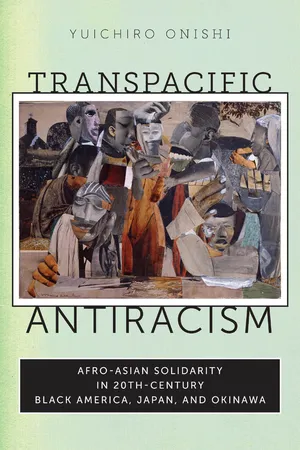
Transpacific Antiracism
Afro-Asian Solidarity in 20th-Century Black America, Japan, and Okinawa
- 240 pages
- English
- ePUB (mobile friendly)
- Available on iOS & Android
eBook - ePub
Transpacific Antiracism
Afro-Asian Solidarity in 20th-Century Black America, Japan, and Okinawa
About this book
Information
PART I
Discourses
The trouble with all Peace Conferences has been that they have always talked “pieces” instead of Peace.
—Andrea Razaf[in]keriefo, “Just Thinking,” Crusader, January–February 1922
1
New Negro Radicalism and Pro-Japan Provocation
During the First World War, Harry Haywood, who later emerged as one of the leading theoreticians for the Communist Party of the United States of America (CPUSA), served in the 370th Infantry of the U.S. Army and fought in France. While in the trenches, Haywood and his fellow Black soldiers in the segregated unit often talked about their life back home. Writing in his autobiography Black Bolshevik, he recounted one of the conversations:
The guys started reminiscing about what they were going to do when they got home. The news from home was bad. Discrimination and Jim Crow were rampant, worse than before. Blacks were being lynched everywhere. “Now, they want us to go to war with Japan,” observed one of the fellows. …
“Well,” someone said, “they won’t get me to fight their yellow peril. If it comes to that, I’ll join the Japs [sic]. They are colored.” There was unanimous agreement on that point.1
Haywood described fellow Black soldiers’ disenchantment with the persistence of racism, a disenchantment that appeared in the form of an imagined political alliance with Japan. He was in agreement and ready to declare that he was through with white supremacy. Ultimately, the 1919 Chicago race riot was what made him feel “totally disillusioned about being able to find any solution to the racial problem through the help of the government,” for as he explained, “official agencies of the country were among the most racist and most dangerous to me and my people.”2
The snapshots of Haywood’s family’s and his own encounters with white terror must have flit by as he came to this self-realization. Perhaps he recalled the story of his grandfather’s act of armed self-defense, shooting a Klansman “point blank” in Tennessee during the Reconstruction era, a story that he heard regularly growing up, or his father’s “frightened, hunted look” after being brutally beaten by a mob of white workers in Omaha, Nebraska, or how he walked into an all-white eighth-grade classroom on his first day upon moving to Minneapolis, Minnesota, where students were “singing old darkie plantation songs … [in a] mocking, derisive tone … emphasizing the Negro dialect … and really having a ball.” All of this came to the fore in the midst of the Chicago race riot as he and his fellow veterans took arms to defend their neighborhood and people from the wrath of white mob violence. Soon after, Haywood was on his way to discovering Black nationalism and revolutionary Marxism via Nevis-born intellectual Cyril V. Briggs’s militant organization, established in late 1919, called the African Blood Brotherhood (an outgrowth of the Hamitic League of the World), which eventually became one of the pipelines that brought Black activists to the CPUSA. Fashioning himself as a Black Bolshevik, he began his long career in the “struggle against whatever it was that made racism possible.” As historian Chad L. Williams writes, “the Chicago race riot indelibly transformed Haywood’s racial and political consciousness.”3
Far from being marginal to First World War political mobilization around the concept of the New Negro, during which young Black intellectual-activists categorically repudiated “the political accommodationism of the ‘Old Negro,’ ” Haywood’s articulation of solidarity with Japan had resonance in the Black public sphere. Like Haywood, Hubert Harrison, Andrea Razafinkeriefo (commonly known as Andy Razaf), Cyril V. Briggs, A. Philip Randolph, Chandler Owen, and Marcus Garvey also expressed solidarity with Japan. Particularly striking was how their discovery of the political efficacy of the symbolic significance of Japan’s fight for racial equality on the international stage actually made the culture of liberation productive for coalition work at the local level among these intellectual-activists of diverse and conflicting ideological orientations. Converging at a critical juncture, Randolph and Garvey, for instance, moved to the same beat. Although the Garveyites, looking at the world in purely racial terms, generally failed to acknowledge Japan’s imperialist aims and ambitions, they occupied the same lot with left-leaning New Negro activist-intellectuals, including the leading Black socialist, Randolph. Tapping into the capacity of the symbolic significance of Japan as a nonwhite world power to bring the vision and aim of New Negro radicalism into sharper focus, together they articulated in their political activity and thought the iconography of Japan’s race-conscious defiance against the global white polity. Such a work of political imagination, which I call pro-Japan provocation, proved effective in nurturing the distinct ethos of Black self-determination.4
The outstanding feature of the practice of pro-Japan provocation among New Negro intellectual-activists with competing ideological and political orientations was that forging solidarity with Japan was all about politics; it had nothing to do with Japan as “a biologically determined racial group.” Buoyed by militancy and urgency within the New Negro movement, they projected the image of Japan as “a racialized political group.” This distinction was crucial, as historian Minkah Makalani emphasizes in his brilliant study of the pan-Africanist politics of race among the members of the African Blood Brotherhood. Approaching race as simultaneously grounds for resistance and a forum to make known the “political voice of the militant ‘New Negro’ ” through the local and internationalist frames of insurgency, the participants of the New Negro movement marked the transpacific culture of liberation to push forward their agenda.5 Even as New Negro radical-intellectuals disagreed with each other on whether to place the primacy of race over class or class over race, to shape this new agenda, the political category of struggle called the “New Negro” found flexibility in an unlikely alliance with Japan.
The Articulation of a “Fifteenth Point”
In late 1918, William Monroe Trotter, finding President Woodrow Wilson’s outline of war aims and blueprint for a postwar world order, called “Fourteen Points,” to be Jim Crow writ large, called for the inclusion of a “Fifteenth Point”—the abolition of race-based policies in all nations. He was determined to make white supremacy a global issue at the upcoming Paris Peace Conference. Throughout Wilson’s presidency, as the founder of the all-Black Niagara Movement and the National Equal Rights League, Trotter denounced the administration’s refusal and resistance to resolve racial injustices against Black Americans and fought hard for Black equality. In his mind, as long as Jim Crow remained at the core of the American polity, there was no hope for postwar democracy and internationalism, especially since both were used as principles with which to create the new structure of world governance called the League of Nations. At the time, while the unspeakable scale of violence and savagery carried out by whites in the East St. Louis race riots in July 1917 still horrified and enraged many Black Americans, Trotter insisted that peace and justice would never materialize for Blacks and colonized people all over the world if the white-supremacist conceptions of Wilsonian liberal democracy and internationalism were legitimated.6
Trotter’s political acquaintance and collaborator, St. Croix–born Hubert Harrison, had been making such a connection between the ascent of liberal democracy and internationalism and the persistence of white supremacy “as far back as 1915,” as Harrison’s biographer Jeffrey B. Perry writes, to highlight “the racial aspect of the war in Europe” and to impart this knowledge to participants in the Black public sphere.7 In fact, Trotter and Harrison were central figures behind the organizing drive of the Liberty Congress that brought together 115 delegates from across the United States in June 1918 to present militant Black political demands in the midst of the First World War. The Liberty Congress confronted the underlying white supremacy of the First World War by sharply denouncing the absence of democracy at home for Black Americans while Wilson issued a call “to make the world safe for democracy.” The delegates were resolved to mount opposition to white supremacy in America and the world dominated by European nations that were eyeing consolidation of their colonial powers over darker nations and peoples in Africa, Asia, and Latin America. They called for the enforcement of the Thirteen, Fourteenth, and Fifteenth Amendments, the passage of federal antilynching legislation, and democracy for the “colored millions” worldwide who were the world’s majority. Their final act was the submission of their petition to the House of Representatives to make known these Black political demands.8
Such an internationalist race-conscious stance of anti-imperialism had been the key tenet of Harrison’s political thought. Throughout the first half of the 1910s, he had been the opinion setter in the world of Harlem radicalism in his capacity as a tireless organizer and consummate theoretician operating first within the orbit of socialists and later as a leading independent Black intellectual-activist. It is not at all an overstatement to say that the future leaders of New Negro radicalism, such as A. Philip Randolph, Chandler Owen, Marcus Garvey, Richard B. Moore, and Cyril Briggs, could not have acquired the necessary political vision and idioms to achieve political and intellectual maturity and in turn shape their own radical politics without first being transformed by Harrison’s captivating oratory, courage to speak truth to power, and breadth of knowledge. He was an intellectual mainspring or, as Randolph put it, “the father of Harlem radicalism.” During the years surrounding the First World War, he not only gave a form to an emergent race consciousness within the Black public sphere but also increased the tempo of the radicalization of the masses and leaders by pushing them to move in a racial groove to help transform existing Black political culture and leadership.9
Particularly important to the development of racial militancy was the launching of Harrison’s organization called the Liberty League and its newspaper, the Voice, in the summer of 1917. It marked the ascent of “the first organization and the first newspaper of the New Negro Movement,” as Perry emphasizes. Carving out a space of resistance to make known the new political voice, Harrison gave categorical unity to the political consciousness and identity of a determined, assertive, and militant Black American called the “New Negro.” At the time, as Harrison worked his way into Harlem to stake out the field of political action independent of the dominant currents of American radicalism, the emergent Black metropolis was rapidly being transformed by the influx of migrants from the Jim Crow South and the Caribbean and the exodus of the white middle class. Coinciding with this changing demographic urban landscape was the beginning of President Woodrow Wilson’s second term and America’s entry into the First World War. While Wilson’s vision of a new world order, couched in the language of international cooperation and democracy, appealed to a wide audience, Harrison’s Liberty League and the Voice categorically repudiated the Wilsonian liberal internationalist project. Intervening in this political culture with a strong clear vision, Harrison guided his peers on how to navigate the grounds of struggles that shifted with world-historic developments occurring at local, transnational, and global levels: rampant racial violence and state repression, labor radicalism, Caribbean and southern Black migration, the First World War, the Russian Revolution, the Irish rebellion and its revolutionary nationalism, and prospects for African liberation. All of this deepened New Negroes’ resolve to fashion the collective right to self-determination and to quicken the pace of racial militancy.10
Although both Trotter and Harrison issued a counterpolitical statement against Wilsonian internationalism in the form of a “Fifteenth Point,” ultimately they were not the catalysts that set the racial struggle in motion on the international stage in Paris. Acknowledging that diplomacy at the 1919 Paris Peace Conference, especially its deliberations, negotiations, and decisions, would be dictated by Anglo-American powers, Japan sought to attain equality with the imperial powers of the West and did so by invoking the language of racial equality. The Japanese delegation was certainly cognizant of this imperialist power politics. But Japan’s diplomatic strategy at the Paris Peace Conference was shaped as much by external factors as by domestic pressure groups that saw the international politics of racial discrimination as leverage to expand Japan’s political and economic spheres of influence in East Asia. Although major newspapers in Japan often pronounced that “the object of the League’s formation will not be fully realized, it would seem, so long as Japanese and other colored races are differentially treated in white communities,” the Japanese government was only remotely interested in attacking the stronghold of white supremacy.11 In Paris, Japan pursued its own imperial ambitions and colonial interests by demanding the control of the islands in the South Pacific, especially the Marshall, Mariana, and Caroline Islands, as well as of the German concessions in Shantung, China. Nonetheless, Japan’s race-conscious diplomatic maneuver did shake up the nature of the debate. The racial-equality clause proved effective in strengthening imperialist Japan’s position within the global racial polity. Such was the irony of race.12
Arriving in Paris, the leaders of the Japanese delegation, Baron Makino Nobuaki and Viscount Chinda Sutemi, took this issue to Colonel Edward M. House, President Wilson’s most trusted adviser, to figure out a way to accommodate Japan’s concern. In talks with Makino and Chinda in early February 1919, House remained attentive to Japan’s demand and expressed that the problem of the color line was “one of the serious causes of international trouble, and should in some way be met.”13 In the end, both parties decided to introduce the racial-equality clause by way of seeking an amendment to the religious-freedom article (Article 21) in the covenant of the League of Nations. On February 13, 1919, Japan presented the following draft: “The equality of nations being a basic principle of the League of Nations, the High Contracting Parties agree to accord as soon as possible to all alien nationals of states, members of the League, equal and just treatment in every respect making no distinction, either in law or in fact, on account of their race or nationality.”14 The delegates representing the British empire and the United States opposed the amendment. They interpreted Japan’s demand for racial equality as directed at achieving unrestricted Japanese immigration to countries such as England, Australia, Canada, and the United States. Thus, Lord Robert Cecil of the British empire and Australian Prime Minister William Morris Hughes organized strong opposition. Cecil declared on the floor that the proposal was divisive and would lead to “interference in the domestic affairs of State members of the League.” For the same reason, he added that the International Council of Women’s demand for gender equality would not be considered in drafting the Covenant of the League of Nations.15
After repeated negotiations and revisions, the Japanese delegation dropped all the referential connections between “race” and “equality” and presented a revised version that endorsed “the principle of equality of nations and just treatment of their nationals.” Italy and France as well as other countries, such as China, Greece, Serbia, Brazil, and Czechoslovakia, all voted for this revised amendment on April 11, 1919. By 11–6, it was passed. However, Wilson, presiding as the chair of this session, did not honor the result. He justified that “in the present instance there was, certainly, a majority, but strong opposition had manifested itself against the amendment and under these circumstances the resolution could not be considered as adopted.” Japan did not pursue the fight for racial equality at the last session of the League of Nations Commissions.16
When the racial-equality clause was introduced in Paris, it took on a life of its own within the context of imperialist diplomacy. It generated Anglo-Americans’ apprehension and their determination to protect the system of white supremacy. While Cecil cast Japan as a troublemaker of the international community for introducing the contentious race question, Wilson insisted t...
Table of contents
- Cover Page
- Title Page
- Copyright Page
- Contents
- Acknowledgments
- Notes on Japanese Sources and Names
- Introduction: Du Bois’s Challenge
- Part I: Discourses
- Part II: Collectives
- Conclusion: We Who Become Together
- Notes
- Bibliography
- Index
- About the Author
Trusted by 375,005 students
Access to over 1.5 million titles for a fair monthly price.
Study more efficiently using our study tools.
Frequently asked questions
Yes, you can cancel anytime from the Subscription tab in your account settings on the Perlego website. Your subscription will stay active until the end of your current billing period. Learn how to cancel your subscription
No, books cannot be downloaded as external files, such as PDFs, for use outside of Perlego. However, you can download books within the Perlego app for offline reading on mobile or tablet. Learn how to download books offline
Perlego offers two plans: Essential and Complete
- Essential is ideal for learners and professionals who enjoy exploring a wide range of subjects. Access the Essential Library with 800,000+ trusted titles and best-sellers across business, personal growth, and the humanities. Includes unlimited reading time and Standard Read Aloud voice.
- Complete: Perfect for advanced learners and researchers needing full, unrestricted access. Unlock 1.5M+ books across hundreds of subjects, including academic and specialized titles. The Complete Plan also includes advanced features like Premium Read Aloud and Research Assistant.
We are an online textbook subscription service, where you can get access to an entire online library for less than the price of a single book per month. With over 1.5 million books across 990+ topics, we’ve got you covered! Learn about our mission
Look out for the read-aloud symbol on your next book to see if you can listen to it. The read-aloud tool reads text aloud for you, highlighting the text as it is being read. You can pause it, speed it up and slow it down. Learn more about Read Aloud
Yes! You can use the Perlego app on both iOS and Android devices to read anytime, anywhere — even offline. Perfect for commutes or when you’re on the go.
Please note we cannot support devices running on iOS 13 and Android 7 or earlier. Learn more about using the app
Please note we cannot support devices running on iOS 13 and Android 7 or earlier. Learn more about using the app
Yes, you can access Transpacific Antiracism by Yuichiro Onishi in PDF and/or ePUB format, as well as other popular books in History & North American History. We have over 1.5 million books available in our catalogue for you to explore.