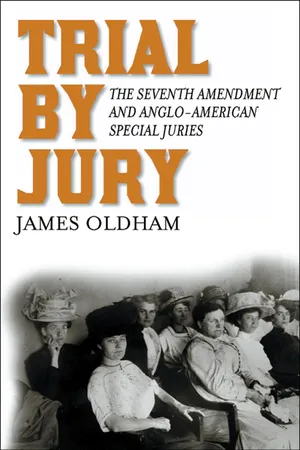
While the right to be judged by one's peers in a court of law appears to be a hallmark of American law, protected in civil cases by the Seventh Amendment to the Constitution, the civil jury is actually an import from England. Legal historian James Oldham assembles a mix of his signature essays and new work on the history of jury trial, tracing how trial by jury was transplanted to America and preserved in the Constitution.
Trial by Jury begins with a rigorous examination of English civil jury practices in the late eighteenth century, including how judges determined one's right to trial by jury and who composed the jury. Oldham then considers the extensive historical use of a variety of “special juries,” such as juries of merchants for commercial cases and juries of women for claims of pregnancy. Special juries were used for centuries in both English and American law, although they are now considered antithetical to the idea that American juries should be drawn from jury pools that reflect reasonable cross-sections of their communities. An introductory overview addresses the relevance of Anglo-American legal tradition and history in understanding America's modern jury system.
- 355 pages
- English
- ePUB (mobile friendly)
- Available on iOS & Android
eBook - ePub
About this book
Information
1
The Scope of the Seventh Amendment Guarantee
Trial by jury in the United States, however controversial in application, remains a treasured part of most citizens’ concept of liberty. Everyone is familiar with the safeguards that trial by jury supplies to criminal defendants. Nearly everyone knows that the right to a jury trial also applies to civil cases, although it can be waived. The source of the right in civil cases in federal courts is the Seventh Amendment, and in state courts the right is preserved by comparable provisions of state constitutions.
The Seventh Amendment provides that “in suits at common law” involving more than twenty dollars, “the right to jury trial shall be preserved.” This seems simple and straightforward, but what does it mean? What right to jury trial? What did the framers have in mind by their simple formulation? One possibility is that they intended to preserve the jury trial practices that existed in suits at common law in the United States when the Seventh Amendment became effective. But, as Edith Henderson observed in her study of the background of the Seventh Amendment, there were enormous and unsystematic variations among the original thirteen states, and, although “a general guarantee of the civil jury as an institution was widely desired, … there was no consensus on the precise extent of its power.”1 Indeed, the Seventh Amendment can be viewed as a formulation that was deliberately imprecise in order to cover divergent practices.
Unavoidably, it fell to the Supreme Court to fashion a test that could be used to measure the scope of the protection embodied in the Seventh Amendment, or in state imitations. The Court did so in 1812 in the case of United States v. Wonson, in which Justice Joseph Story wrote: “Beyond all question, the common law here alluded to [in the Seventh Amendment] is not the common law of any individual state, (for it probably differs in all), but it is the common law of England, the grand reservoir of all our jurisprudence.”2 Story added that his proposition must be so obvious “to every person acquainted with the history of the law” that it needed no explanation.3 He did not peg the test to 1791, the year when the Seventh Amendment took effect; this feature was clarified in a later opinion by the Court.4
The rule thus fashioned by the Supreme Court came to be called “the historical test.” A commonly quoted, succinct version of the test is the following 1935 formulation in the case of Dimick v. Schiedt: “In order to ascertain the scope and meaning of the Seventh Amendment, resort must be had to the appropriate rules of the common law established at the time of the adoption of that constitutional provision in 1791.”5
This test survives to the present day, despite unrelenting criticism from those who favor flexibility in constitutional interpretation. Illustrative is the following summary by Martin Redish:
Blind adherence to history would seem to place modern judicial administration in an historical straight jacket, controlled by the policies of a society of 200 years ago. Traditional constitutional analysis has never been so limited. Ever since Chief Justice Marshall admonished that it “is a constitution we are expounding,” courts generally have been willing to read the broad language of the Constitution to account for changing social conditions.6
In the past decade, the Supreme Court had several opportunities to revisit the historical test for the scope of the Seventh Amendment right to jury trial.7 In 1996, in Markman v. Westview Instruments, Inc., the Court emphatically declined the opportunity, unanimously reaffirming the historical test but finding no jury trial necessity on applying the test to the facts of the case. On the basis of my understanding of English trial practice in the late eighteenth century, the Court’s application of the historical test to the facts of Markman seems to me to be wrong. In reaching this conclusion I rely mainly on manuscript sources, both judges’ notes and original court documents.8
The discussion to follow is in two parts. The first summarizes the Court’s application of the historical test in Markman v. Westview Instruments, Inc. The second invokes the eighteenth-century English manuscript sources to assess whether the historical test was soundly applied in Justice David Souter’s unanimous opinion for the Court in Markman.
The Markman Decision
In Markman, the plaintiff owned a patent on a method for tracking inventory in dry-cleaning establishments. He sued Westview Instruments for patent infringement and won a jury verdict. Central to the dispute was the meaning of the term “inventory” in the patent claim, as to which plaintiff presented his own testimony and that of an independent expert witness. The trial judge, however, granted a deferred motion for judgment on a matter of law, concluding that the term “inventory” could not support the meaning contended for by plaintiff. Markman appealed, claiming that the trial judge had improperly supplanted the jury. The U.S. Court of Appeals for the Federal Circuit affirmed the trial judge, as did the U.S. Supreme Court after a grant of certiorari. Among the issues before the Supreme Court was the application of the historical test for Seventh Amendment rights to the specific facts.
While the Supreme Court’s Markman decision was pending, Court-watchers commented on the case. One writer expressed hope that the justices would reach beyond narrow patent law “and make some major corrections”; specifically, “the Supreme Court should reject the 1812 holding in Wonson requiring federal courts to look to 18th century English law as a constitutional touchstone.”9 The Court, however, did not take that path. After quoting the text of the Seventh Amendment, Justice Souter began his constitutional analysis by declaring that, “Since Justice Story’s day, [and] United States v. Wonson …, we have understood that ‘The right of trial by jury thus preserved is the right which existed under the English common law when the Amendment was adopted.’”10 He noted the Court’s “long-standing adherence to this ‘historical test’” and explained that if a case is properly regarded as an action at law, “we then ask whether the particular trial decision must fall to the jury in order to preserve the substance of the common-law right as it existed in 1791.”11
Justice Souter had no trouble with the first step; patent infringement actions were brought at common law in the late eighteenth century.12 He then posed the fundamental question in a way that foretold the outcome: “Whether a particular issue occurring within a jury trial (here the construction of a patent claim) is itself necessarily a jury issue, the guarantee being essential to preserve the right to a jury’s resolution of the ultimate dispute.”13 His answer was no, largely for three reasons. First, late-eighteenth-century English patent law was primitive and did not include the requirement that there be a stated patent “claim.” Second, even accepting the point that the patent specification in late-eighteenth-century England could be viewed as closely analogous to the claim in twentieth-century American patent law, there is not much to go on, since the specification itself was relatively new, and “the mere smattering of patent cases that we have from this period shows no established jury practice sufficient to support an argument by analogy that today’s construction of a claim should be a guaranteed jury issue.”14 Third, no demonstration was offered the Court that the role of juries in interpreting patents was different from their role with regard to other written instruments, “and we do know that in other kinds of cases during this period judges, not juries, ordinarily construed written documents.”15
According to eighteenth-century English trial practice, Justice Souter’s second reason appears incorrect. There were many more patent cases in England in the second half of the eighteenth century than a “smattering”; indeed, Justice Francis Buller of the Court of King’s Bench remarked in Turner v. Winter in 1787 that “many patent cases have arisen within our memory,”16 and Chief Justice James Eyre of the Court of Common Pleas observed in 1795 that “we have had many cases upon patents.”17 It is true that there was not an abundance of reported patent cases from the late eighteenth century at the “appellate” level, but this was in no way indicative of the depth of experience at the trial level.18 Published reports of eighteenth-century trial court proceedings did not exist in England until the late 1790s.19 But a mere fraction of the cases at the trial level went forward to full court proceedings on motions or on reserved questions of law. There were dozens of patent trials in the English common-law courts during the second half of the eighteenth century. In Lord Chief Justice Mansfield’s surviving trial notes (and less than half of the notes that he kept survive), there are nine unreported patent trials, and this was in only one of the three common-law courts, albeit the busiest.20
As authority for his third reason, Justice Souter referred to the 1786 decision of the Court of King’s Bench in Macbeath v. Haldimand21 because there the construction of written documents and letters was said by Justices Mansfield and Buller to be for the court, not for the jury. Nevertheless, on close inspection, Justice Souter’s reliance on Macbeath seems misplaced. What was at issue was the legal import of the letters and documents on an agency question—letters and documents about which there was no factual disagreement. Even so, there was a difference of views among the judges. Justice Edward Willes said that since the case came forward after a jury verdict, and since the letters had been before the jury, construction of them was “proper for the consideration of the jury,” though he agreed that “construction of deeds is a matter of law.” Justice Buller disagreed, saying it depended on whether “they be written in so dubious a manner, as to be capable of different constructions, and can be explained by other transactions,” in which case “the whole evidence must be left to the jury to decide upon; for they are to judge of the truth or falsehood of such collateral facts which may vary the sense of the letters themselves.” He added that, “if they be not explained by any other circumstances, then, like deeds or other written agreements, the construction of them is a mere matter of law.”22 In Markman, plaintiff argued that the term “inventory” was capable of different constructions, so that the whole evidence should have been left to the jury to decide, as was done by the trial judge.
After disposing of the constitutional issue in Markman, Justice Souter moved on to other arguments in the case, pointing out that complicated patent issues can be handled better by judges than by lay juries.23 This
“functional” consideration is taken up in the next chapter, but in order to understand more fully the historical test, it is first necessary to consider what cases customarily went to juries in eighteenth-century English trial practice.
Eighteenth-Century English Trial Practice
In the overwhelming majority of civil cases in the common-law courts in eighteenth-century England, the plaintiffs sought damages in jury trials. The forms of action were varied. Although actions were still brought on ancient writs such as Debt, Assault and False Imprisonment, or Trespass vi et armis, the most popular form of action by the 1770s was Trespass on the Case.24 This catch-all category encompassed all contract and quasi-contract actions, as well as a host of other private civil actions. This can readily be seen in Lord Mansfield’s trial notes25 and in a sampling of the plea rolls for the Court of Common Pleas in the 1770s.26 The latter contain two types of entries of particular relevance to jury practice: (1) default judgments with unascertained damages to be determined by a writ of inquiry;27 and (2) actions in which the defendant “puts himself upon the country,” that is, denies the plaintiff’s claim and requests a jury trial. There are examples of pleadings that show a demurrer and joinder on a question of law, in which case there would be no jury trial, but these are quite rare. For example, in the plea rolls for Trinity Term 1770, there is only one case on demurrer, compared with 181 cases sent to jury trial.28 Yet, in the late eighteenth century, the demurrer was virtually the only pretrial method in the common-law courts for taking a case forward for decision without calling a jury.29
In other words, almost all cases in the common-law courts were tried before juries. There was no pretrial discovery,30 nor was there any pretrial conference or procedure (other than...
Table of contents
- Cover Page
- Title Page
- Copyright Page
- Contents
- Preface
- Introduction
- 1 The Scope of the Seventh Amendment Guarantee
- 2 The “Complexity Exception”
- 3 Law versus Fact
- 4 Determining Damages: The Seventh Amendment, the Writ of Inquiry, and Punitive Awards
- 5 The Jury of Matrons
- 6 The Self-Informing Jury
- 7 The English Origins of the Special Jury
- 8 Special Juries in England: Nineteenth-Century Usage and Reform
- 9 Special Juries in the United States and Modern Jury Formation Procedures
- Appendix 1
- Appendix 2
- Appendix 3
- Appendix 4
- Notes
- Table of Statutes
- Table of Cases
- Index
- About the Author
Trusted by 375,005 students
Access to over 1.5 million titles for a fair monthly price.
Study more efficiently using our study tools.
Frequently asked questions
Yes, you can cancel anytime from the Subscription tab in your account settings on the Perlego website. Your subscription will stay active until the end of your current billing period. Learn how to cancel your subscription
No, books cannot be downloaded as external files, such as PDFs, for use outside of Perlego. However, you can download books within the Perlego app for offline reading on mobile or tablet. Learn how to download books offline
Perlego offers two plans: Essential and Complete
- Essential is ideal for learners and professionals who enjoy exploring a wide range of subjects. Access the Essential Library with 800,000+ trusted titles and best-sellers across business, personal growth, and the humanities. Includes unlimited reading time and Standard Read Aloud voice.
- Complete: Perfect for advanced learners and researchers needing full, unrestricted access. Unlock 1.5M+ books across hundreds of subjects, including academic and specialized titles. The Complete Plan also includes advanced features like Premium Read Aloud and Research Assistant.
We are an online textbook subscription service, where you can get access to an entire online library for less than the price of a single book per month. With over 1.5 million books across 990+ topics, we’ve got you covered! Learn about our mission
Look out for the read-aloud symbol on your next book to see if you can listen to it. The read-aloud tool reads text aloud for you, highlighting the text as it is being read. You can pause it, speed it up and slow it down. Learn more about Read Aloud
Yes! You can use the Perlego app on both iOS and Android devices to read anytime, anywhere — even offline. Perfect for commutes or when you’re on the go.
Please note we cannot support devices running on iOS 13 and Android 7 or earlier. Learn more about using the app
Please note we cannot support devices running on iOS 13 and Android 7 or earlier. Learn more about using the app
Yes, you can access Trial by Jury by James Oldham in PDF and/or ePUB format, as well as other popular books in Law & Law Theory & Practice. We have over 1.5 million books available in our catalogue for you to explore.